
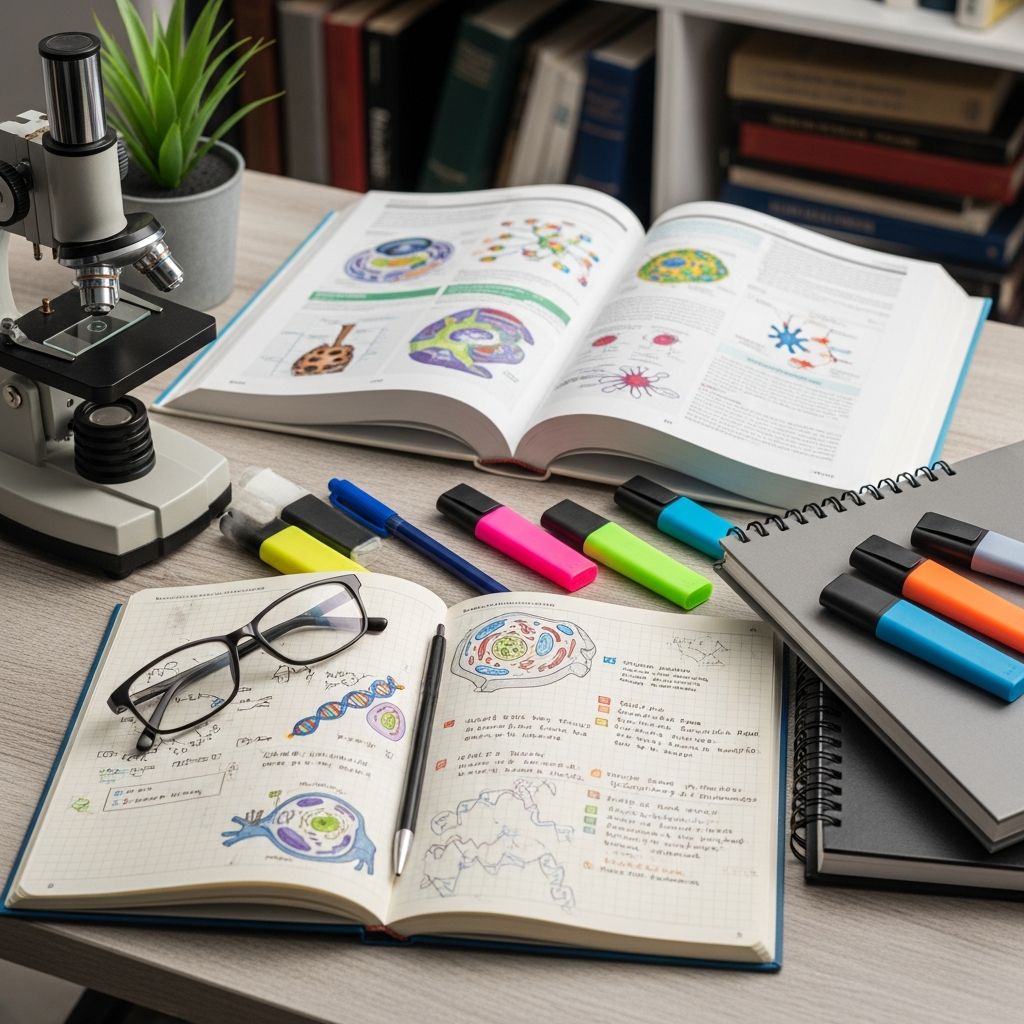
Biology demands precise capture of complex processes, terminology, and interconnections between concepts. Effective note-taking transforms overwhelming information into manageable, revisable material that enhances understanding and retention. This guide explores tailored approaches to excel in biology coursework.
Why Note-Taking Matters in Biology Studies
Biology courses involve dense content like cellular mechanisms, genetic pathways, and ecological systems. Poor notes lead to forgotten details during exams, while structured notes facilitate quick reviews and deep comprehension. Research supports active note-taking for superior grade outcomes compared to passive copying.
Students using organized systems process information actively, forging stronger neural connections. This method not only aids immediate recall but also builds long-term knowledge for advanced topics.
Selecting the Right Note-Taking Framework
Choose frameworks that accommodate biology’s visual and sequential nature. Traditional linear notes suit timelines, while visual tools handle processes like mitosis.
- Cornell System: Divides pages into cues, details, and summaries for efficient review.
- Outline Method: Uses hierarchies to link main ideas with supporting facts.
- Mind Mapping: Visual branches connect related concepts, ideal for systems biology.
Experiment during low-stakes sessions to find your fit. Adapt based on lecture style—fast-paced talks favor Cornell, while readings suit outlines.
Adapting Cornell Notes for Science Content
The Cornell method, developed for college efficiency, shines in biology. Divide paper into a narrow left column for questions or terms, a wide right for details, and a bottom summary space.
During lectures, jot phrases in the details section—avoid full sentences to capture pace. Post-session, craft questions in the left: “What triggers glycolysis?” or “Define allele.” Summarize key takeaways below to consolidate.
For biology, label diagrams in details and quiz via cues. Cover details to self-test, revealing gaps early.
Capturing Lectures with Precision
Lectures fly by with diagrams and jargon. Preview provided slides to anticipate focus areas. Use abbreviations like “DNA” or “H2O” consistently.
Prioritize: core definitions, process steps, exceptions. Sketch cycles (e.g., Krebs) quickly—neatness secondary to completeness. Signal transitions with arrows or boxes.
| Element | In-Lecture Action | Post-Lecture Polish |
|---|---|---|
| Terms | Bold or underline | Define fully |
| Processes | Number steps | Add arrows, labels |
| Examples | Note briefly | Expand with textbook |
| Questions | Flag unclear | Resolve immediately |
Review within 24 hours: rewrite messy parts, add connections. This “note massage” cements memory.
Extracting Value from Textbooks
Biology texts pack details. Skim first: headings, bold terms, figures. Read actively, questioning “How does this link to prior chapters?”
Annotate margins: summarize paragraphs, draw links. Condense chapters into one-page overviews. For processes like photosynthesis, create flowcharts instead of copying text.
Highlight sparingly—focus on mechanisms, not facts. Generate questions: “Why does pH affect enzymes?” This mirrors exam formats.
Incorporating Visuals and Diagrams
Biology thrives on visuals. Don’t just describe—draw. For replication, sketch DNA strands with enzymes labeled.
Mind maps centralize topics: branch from “Immune Response” to phagocytosis, antibodies. Color-code: green for inputs, red for outputs. These reveal patterns invisible in lists.
Digital tools like tablets allow layers: base sketch, then annotations. Practice redraws from memory to test grasp.
Active Processing Techniques
Passive copying fails; engage actively. Rephrase in your words: turn “Enzymes lower activation energy” into “Enzymes speed reactions by reducing needed energy.”
Create quizzes from notes. Input summaries into AI for questions, then self-test without peeking. Teach concepts aloud or to peers—explain osmosis simply.
Spaced repetition: review daily initially, then weekly. Link new info to known: compare mitosis/meiosis tables.
Organizing for Long-Term Retention
Maintain a dedicated biology binder with dividers by unit. Index pages for quick access. Digitize scans for searchability.
Weekly synthesis: merge lecture/textbook notes into master sheets. Identify themes across topics, like energy flow in respiration and photosynthesis.
Pre-exam, condense to flashcards: front question, back diagram/answer. Group study: exchange notes, quiz mutually.
Overcoming Common Pitfalls
Avoid verbatim transcription—summarize 1:3 ratio. Don’t neglect diagrams; words alone miss spatial relations.
Combat overload: focus top 20% concepts yielding 80% exam value. If lost, note question and research later.
Tiredness kills accuracy—short bursts with breaks. Tools like highlighters or colors aid scanning.
Leveraging Technology Wisely
Apps like Notion template Cornell layouts; GoodNotes enables diagram edits. Record lectures for rewind, but transcribe key parts.
Anki for flashcards automates spacing. Balance: handwriting boosts retention over typing for visuals.
Building Effective Study Routines
Daily 20-minute reviews prevent cramming. Weekly deep dives integrate units. Pre-test with past papers using notes only.
Track progress: rate understanding per topic. Adjust methods— if mind maps falter, switch to outlines.
Frequently Asked Questions
How soon after class should I review biology notes?
Within 24-48 hours to exploit the memory curve; expand, clarify, and question for best retention.
Are digital notes better than paper for biology diagrams?
Paper suits initial sketching for kinesthetic learning; digital excels for editing and portability—hybrid works best.
What’s the best way to handle dense textbook chapters?
Skim, annotate key sections, summarize in your words with diagrams, then quiz yourself on processes.
Can Cornell notes work for group study?
Yes—share cue columns for quizzing; discuss summaries to uncover gaps collaboratively.
How do I prioritize what to note in fast lectures?
Focus on definitions, steps, exceptions; use phrases and flags for later expansion.
Advanced Tips for Exam Mastery
Tailor notes to syllabus: emphasize high-mark areas like applications. Practice essay outlines linking topics.
Simulate exams: time yourself recalling from cues. Revise iteratively—version 2 notes are streamlined winners.
Success stems from consistency: treat note-taking as skill-building, not chore. Refined systems yield confident mastery.
References
- Using Science Cornell Notes in Your Classroom — Suburban Science. Accessed 2026. https://suburbanscience.com/science-cornell-notes/
- How to Take Effective Notes for A-Level Biology — Miss Estruch (YouTube). Accessed 2026. https://www.youtube.com/watch?v=O6l-51w7IYo
- Study Strategies for Biology — Rhodes College Academic Resources (.edu). Accessed 2026. https://sites.rhodes.edu/academic-and-learning-resources/learning-tips/study-strategies-biology
- Bio 235 & 236 Anatomy & Physiology Study Tips — Kirtland Community College LibGuides (.edu). Accessed 2026. https://libguides.kirtland.edu/c.php?g=1155275&p=8432628
- How to Take Notes — Plant Science Futures (.org.uk). Accessed 2026. https://www.plantsciencefutures.org.uk/skills/how-to-take-notes

- Integrated M.A. in Applied Linguistics, University of Hyderabad
- 5+ years in editorial, instructional, SEO, and research-based writing
Sneha is a relationships and lifestyle writer with a strong foundation in applied linguistics and certified training in relationship coaching. She brings over five years of writing experience to theskillvault, crafting thoughtful, research-driven content that empowers readers to build healthier relationships, boost emotional well-being, and embrace holistic living. Her writing and insights reflect the belief that beauty, happiness, and wellness…