
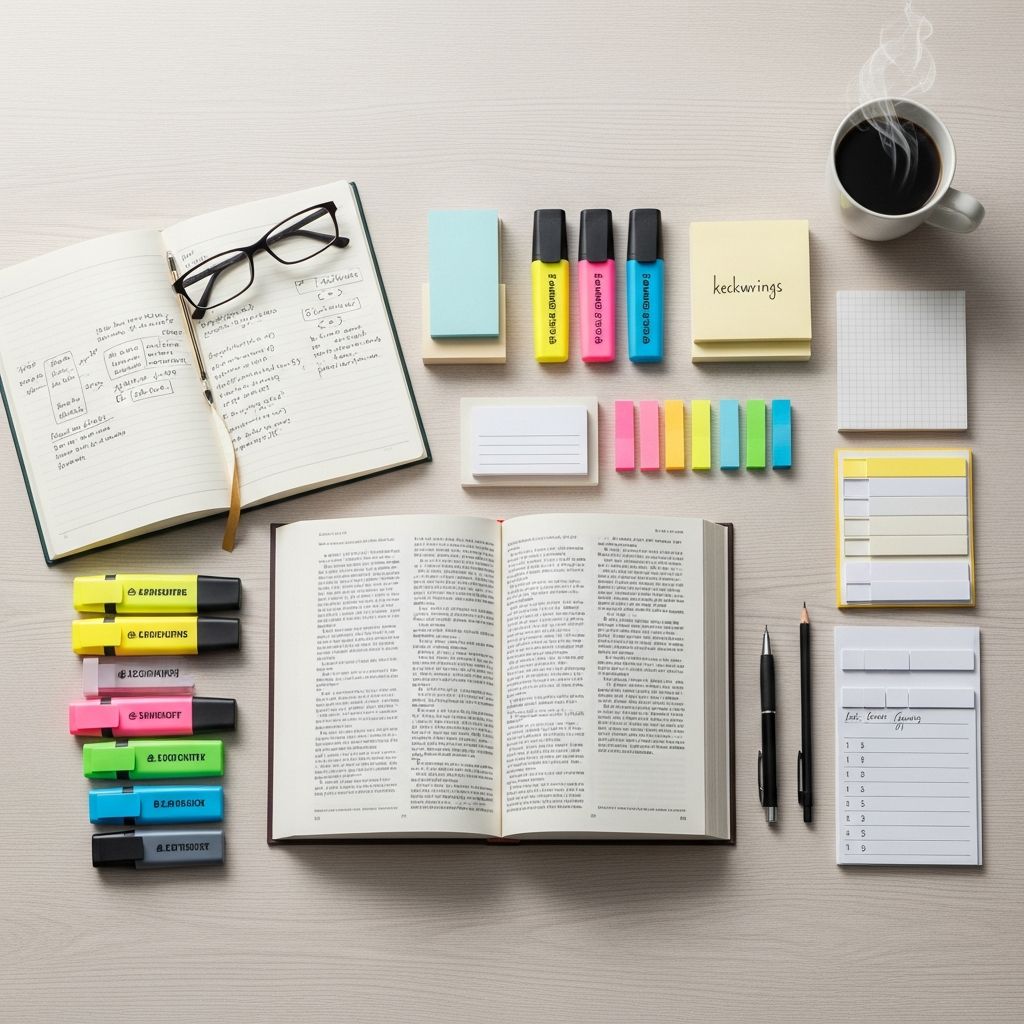
Effective note-taking from textbooks transforms dense reading material into manageable, memorable knowledge. By adopting structured approaches, students can grasp core concepts, identify critical details, and prepare efficiently for exams without overwhelming themselves.
Preparing Your Mind and Materials Before Diving In
Success in note-taking begins with preparation. Start by examining the textbook’s front and back matter, including the table of contents, index, and preface. This ‘priming’ phase builds a mental framework of the book’s scope and key themes, making subsequent reading more purposeful.
Gather your tools: opt for loose-leaf index cards or a digital app that allows easy reorganization, rather than bound notebooks which limit flexibility. Highlighters in varied colors, sticky notes, and a dedicated notebook or app like Notion for synthesis are essential. Set a timer for focused sessions to maintain momentum.
- Scan visuals first: Flip through pages noting charts, diagrams, and images. Sketch these elements roughly to engage visual memory.
- Assess prerequisites: Review any listed prior knowledge or glossary terms to fill gaps upfront.
- Define goals: Ask what you need from this chapter—exam prep, essay ideas, or concept mastery?
This groundwork prevents passive reading and sets the stage for active engagement.
Adopting a Multi-Pass Reading Strategy
Avoid the common pitfall of highlighting or noting during your first read-through, as it disrupts flow and leads to irrelevant marks. Instead, employ a layered approach: skim, mark, read deeply, then synthesize.
First Pass: Skim for Structure
Rapidly survey the chapter: read headings, subheadings, bolded terms, summaries, and captions. This reveals the skeleton of ideas, helping you predict content and allocate time wisely. Spend 5-10 minutes per chapter, noting overarching questions like ‘What problem does this solve?’ or ‘How does it connect to prior chapters?’.
Second Pass: Mark Key Signals
Read in chunks of 2-5 paragraphs. Identify big ideas—testable concepts or themes—by starring margins or using colored flags. Highlight sparingly: one key sentence per paragraph that captures the essence. Use a code: yellow for main ideas, green for examples, pink for questions.
Resist writing full notes yet; this preserves reading speed and focus. If a diagram appears pivotal, jot a quick reference number on a card.
| Pass | Focus | Actions | Time per Chapter |
|---|---|---|---|
| 1: Skim | Structure | Headings, visuals | 5-10 min |
| 2: Mark | Big Ideas | Stars, highlights, flags | 15-20 min |
| 3: Deep Read | Details | Annotate questions | 20-30 min |
| 4: Synthesize | Summaries | Own words on cards | 15-25 min |
This table outlines a balanced timeline for a 20-30 page chapter, adjustable by complexity.
Active Reading: Engaging Deeply Without Distraction
Transition to intensive reading on marked sections. Read actively by questioning: ‘Why is this emphasized?’ or ‘What evidence supports this claim?’ Write marginal queries but defer answers to avoid rabbit holes.
For technical texts, define unfamiliar terms immediately using built-in glossaries or reliable references. Connect new info to lectures or real-world applications to build relevance. If studying science or history, redraw processes or timelines from memory to test understanding.
Digital tools shine here: apps like GoodNotes allow layered annotations on PDFs, mimicking paper while enabling searchability. Handwriting outperforms typing for retention, as it forces processing.
Crafting Personalized, Manipulable Notes
After reading, close the book and synthesize in your own words—this cements comprehension and prevents plagiarism. Use the Cornell method: divide pages into cues, notes, and summary sections for structured recall.
Index Card Power
Create one card per key idea: front with a question or term, back with paraphrase, example, and page reference. This ‘manipulable’ format allows shuffling for custom reviews or mind maps.
Digital Templates
In Notion or similar, build toggles for chapters: embed questions, evidence, and weak spots. Tag by difficulty for targeted practice.
- Paraphrase definitions and processes.
- List pros/cons or cause/effect chains.
- Include visuals: simple sketches or links to diagrams.
Aim for brevity: 3-5 cards per section, focusing on what you’d teach a peer.
Integrating Proven Frameworks Like SQ3R and OK5R
Enhance your process with SQ3R (Survey, Question, Read, Recite, Review): survey structure, question headings, read actively, recite aloud, then review notes.
OK5R extends this (Overview, Key ideas, Read, Record, Recite, Review, Reflect), adding reflection on applications. These COPI-compliant methods from university resources ensure systematic learning.
Combine with Feynman Technique: explain concepts simply, identifying gaps.
Review and Reinforcement for Long-Term Retention
Notes are useless without review. Use Leitner system: sort cards into boxes by mastery—daily for new, weekly for strong. Digital apps like Anki automate spaced repetition.
Schedule: review markings same day, synthesize next, quiz weekly. Before tests, simulate exams with your cards shuffled randomly.
Track progress: note weak areas in a ‘mastery log’ and revisit. Group study? Share cards for collaborative quizzing.
Overcoming Common Pitfalls in Textbook Study
Over-Highlighting: Limit to 10% of text; excess dilutes focus.
Passivity: Force engagement with timers and self-quizzing.
Cramming: Space sessions over days for better encoding.
For heavy readers, batch similar chapters to spot patterns across texts.
Frequently Asked Questions (FAQs)
What if I don’t own the textbook?
Use library copies with post-its or digital PDFs for annotations. Focus on photocopied key sections for cards.
Handwriting vs. typing—which is better?
Handwriting aids retention per research; use tablets for hybrid benefits.
How long for a full chapter?
1-2 hours total, depending on length; break into 25-min Pomodoros.
Best for visual learners?
Prioritize sketching diagrams and mind maps from visuals.
Integrate with lectures?
Cross-reference: add lecture page refs to cards for unified notes.
Advanced Tips for Specialized Disciplines
In STEM, emphasize formulas and derivations on cards with step-by-step breakdowns. For humanities, capture arguments, counterpoints, and quotes (paraphrased). Law students: flowchart cases and precedents.
Experiment: track grades pre/post-method to refine your system.
By consistently applying these techniques, you’ll not only retain more but study with greater efficiency and confidence.
References
- Reading Textbooks for True Understanding — Cornell College. 2023-01-15. https://www.cornellcollege.edu/registrar/academics-registration/study-tips/reading-textbooks.shtml
- The Cornell Note Taking System — Cornell University Learning Strategies Center. 2024-09-10. https://lsc.cornell.edu/how-to-study/taking-notes/cornell-note-taking-system/
- Textbook Reading & Notetaking — University of Central Florida Student Academic Resource Center. 2023-05-20. https://sarc.sswb.ucf.edu/textbook-reading-notetaking/
- How I make notes: From a textbook — University of Bristol Study Skills. 2022-01-24. https://studyskills.blogs.bristol.ac.uk/2022/01/24/how-i-make-notes-from-a-textbook/
- How To Take Notes From A Textbook: My Proven Process — Magnetic Memory Method (.edu referenced techniques). 2023-11-05. https://www.magneticmemorymethod.com/how-to-take-notes-from-a-textbook/

Medha Deb is an editor with a master's degree in Applied Linguistics from the University of Hyderabad. She believes that her qualification has helped her develop a deep understanding of language and its application in various contexts. Medha specializes in the areas of beauty, health, sports, and wellness and is committed to ensuring that the content on the website is…