
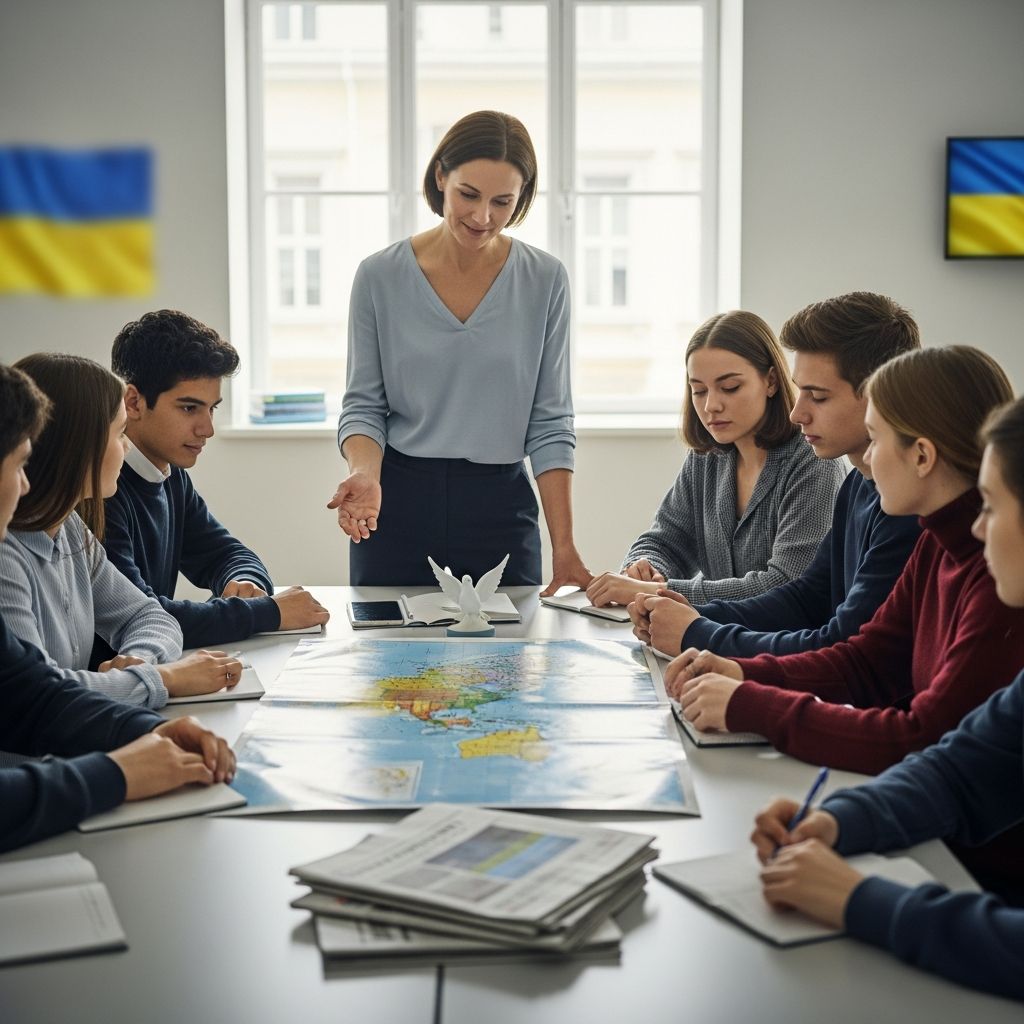
Educators play a pivotal role in helping students navigate complex global events like the war in Ukraine. By addressing these topics thoughtfully, teachers can alleviate fears, provide factual clarity, and build resilience. This article outlines practical, original strategies drawn from expert educational insights to support meaningful classroom dialogues.
Understanding the Educational Imperative
In today’s interconnected world, news of conflicts such as the one in Ukraine reaches classrooms swiftly through media, social platforms, and peer conversations. Students may arrive anxious, confused, or misinformed. Initiating structured discussions prevents rumors from spreading and models healthy emotional processing. Research from child psychology emphasizes that open dialogues reduce anxiety by framing distant events in context, reinforcing safety for learners far removed from the conflict zone.
Teachers must balance honesty with sensitivity, recognizing that children process information through their developmental lens. For instance, elementary students might fixate on immediate threats, while teens grapple with geopolitical nuances. Proactive engagement signals to students that their school is a safe space for tough questions.
Tailoring Conversations by Age Group
Customization is key to effective communication. Below, we break down approaches for different developmental stages, ensuring content matches cognitive and emotional readiness.
Early Childhood (Ages 3-6)
For the youngest learners, simplicity reigns. Begin with a neutral prompt like, “Have you heard about a faraway place called Ukraine where people are having a hard time getting along?” Use visuals such as a world map to illustrate distance: point to Ukraine and then your location, saying, “It’s so far that we’re safe here.” Define war briefly as “when grown-ups from different countries argue in a hurtful way,” avoiding graphic details.
Reassure repeatedly: “Adults here keep you safe, and many kind people are helping those far away.” This builds security without overwhelming tender minds.
Elementary School (Ages 7-10)
These children comprehend more but may personalize dangers. Ask, “What have you heard or seen about Ukraine?” Listen actively, then clarify facts: Ukraine is a country in Europe invaded by neighboring Russia, causing people to seek safety elsewhere. Emphasize global distance and helper figures like aid workers.
Incorporate questions: “How do you think families there feel? What might help them?” This fosters empathy without fear.
Middle and High School (Ages 11+)
Teens seek depth. Start with, “What’s your understanding of the Ukraine situation?” Discuss media bias, reliable sources (e.g., BBC, Reuters), and historical context like sovereignty disputes. Explore impacts: humanitarian crises, refugee flows, international responses.
Encourage debate: “What roles should world leaders play?” Guide toward critical evaluation of information.
Creating a Safe Dialogue Environment
A supportive classroom atmosphere is foundational. Establish ground rules: respect all views, no judgment, confidentiality. Model calm: your tone sets the pace. Use active listening—paraphrase student concerns: “It sounds like you’re worried about escalation; that’s valid.”
Monitor for distress signals like withdrawal or agitation. Have a quiet corner for one-on-one check-ins. Partner with counselors for escalated needs, especially if students have personal ties to Ukraine.
Harnessing Creative Expression
Words alone may not suffice; creativity aids processing. Encourage:
- Drawing: “Sketch how the world could help Ukraine.”
- Play: Allow dramatic reenactments in supervised playtime, intervening only if harmful.
- Writing: Journals or letters to “helpers” in Ukraine.
- Art Projects: Collaborative murals depicting peace symbols.
These outlets externalize emotions, as play therapy principles affirm. Debrief: “What did creating this teach you?”
Emphasizing Hope and Helpers
Counterbalance negativity by spotlighting positivity. Share stories of Ukrainian resilience, international aid from organizations like the UN and IRC, volunteer networks, and diplomatic efforts. Ask, “Who are the helpers you see?” This shifts focus from destruction to humanity’s capacity for good, echoing lessons in kindness and community.
| Organization | Role | Impact |
|---|---|---|
| International Rescue Committee (IRC) | Provides shelter, food, medical aid | Supports millions of displaced persons |
| UNHCR | Coordinates refugee assistance | Delivers essentials to borders |
| Red Cross | Emergency response and family reunification | Distributes supplies in conflict zones |
Navigating Media and Misinformation
Students encounter sensationalized content online. Teach source evaluation: check dates, authors, cross-reference with outlets like AP or official UN sites. Discuss algorithms amplifying fear. Recommend child-friendly resources like BBC Newsround.
For teens, analyze propaganda: “How might each side frame the story?” This builds media literacy.
Self-Care for Educators
Teachers aren’t immune to vicarious trauma. Practice self-regulation: deep breathing, peer debriefs, professional support. Your emotional steadiness reassures students. Limit personal news exposure during school hours.
Follow-Up and Long-Term Support
One talk isn’t enough; revisit as events unfold. Schedule check-ins: “How are you feeling about Ukraine now?” Integrate into curriculum—geography units on Europe, history of conflicts, empathy lessons.
Build networks: collaborate with parents via newsletters, offering home discussion tips. Track class mood through anonymous surveys.
Frequently Asked Questions (FAQs)
What if a student becomes very upset during discussion?
Validate feelings, move to a quiet space, offer comfort. Involve counselors if needed, and follow up later.
How do I handle differing student opinions?
Facilitate respectful exchange: “Everyone’s view matters; let’s hear why.” Model civil discourse.
Should I show news images?
Avoid graphic visuals, especially for younger groups. Use maps or positive aid photos instead.
What about students with Ukrainian heritage?
Be extra sensitive; allow space for their stories. Connect to culturally relevant support.
How often should we discuss this?
As news breaks or student interest peaks, but not daily to avoid fixation.
Building Classroom Resilience
Beyond Ukraine, these strategies equip students for future crises. Foster global citizenship: empathy, critical thinking, hope. Activities like “Kindness Chains”—linking paper strips of good deeds—reinforce community amid chaos.
Ultimately, these conversations transform fear into informed compassion, preparing youth for a nuanced world.
References
- Tips for Talking with Your Children About the War in Ukraine — Parish School. 2022. https://parishschool.org/tips-for-talking-with-your-children-about-the-war-in-ukraine/
- How to Talk to Kids About Ukraine, War and Other Difficult Topics — Southern New Hampshire University (SNHU). 2022. https://www.snhu.edu/about-us/newsroom/briefs/explain-ukraine-invasion-to-kids
- How To Talk To Your Child About The War In Ukraine — YoungMinds. 2022. https://www.youngminds.org.uk/parent/blog/top-tips-for-talking-to-your-young-person-about-the-events-in-ukraine/
- How to talk to kids about war and conflict — International Rescue Committee (IRC). 2024. https://www.rescue.org/uk/article/how-talk-kids-about-war-and-conflict
- How to Talk With Students About the Russia-Ukraine War: 5 Tips — CASP Online. 2022. https://casponline.org/how-to-talk-with-students-about-the-russia-ukraine-war-5-tips/

Medha Deb is an editor with a master's degree in Applied Linguistics from the University of Hyderabad. She believes that her qualification has helped her develop a deep understanding of language and its application in various contexts. Medha specializes in the areas of beauty, health, sports, and wellness and is committed to ensuring that the content on the website is…