
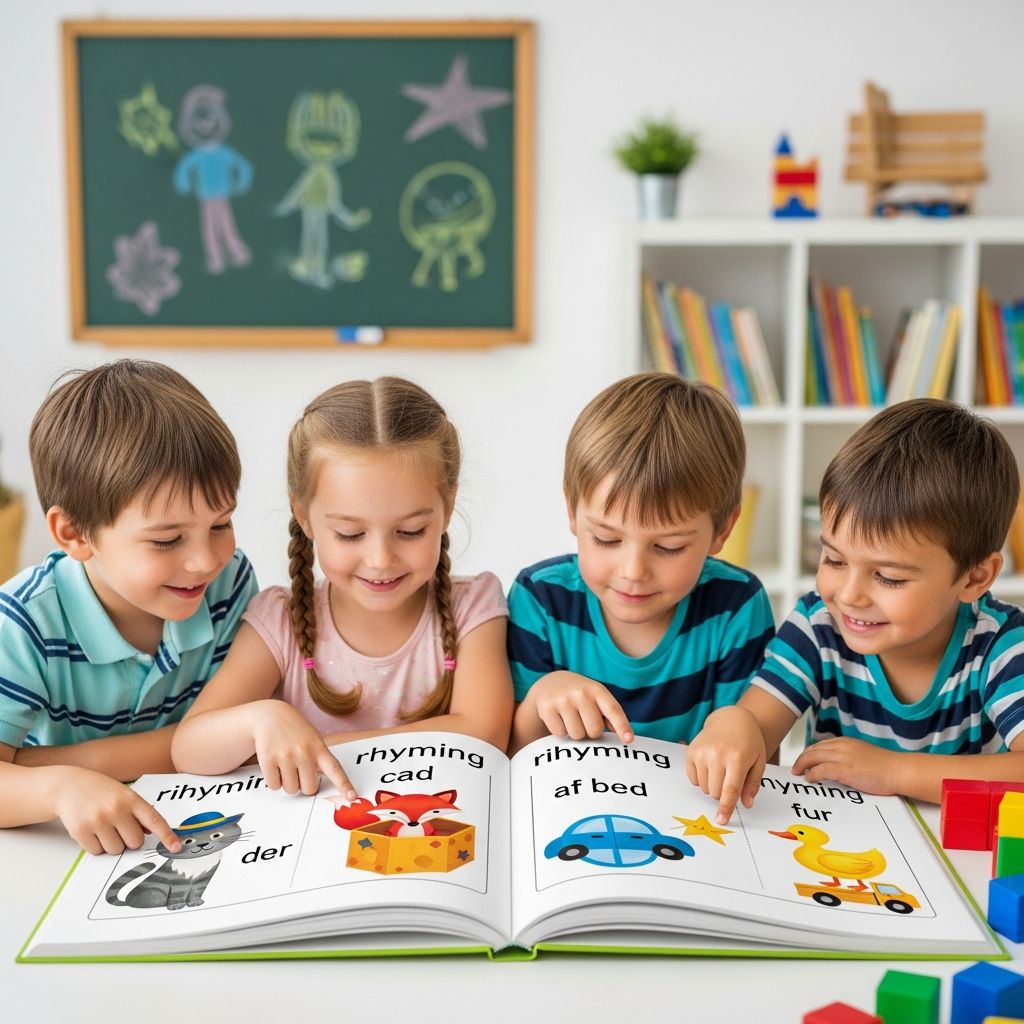
Rhyming forms a cornerstone of early literacy development, helping children recognize sound patterns that pave the way for reading proficiency. By integrating playful activities into daily routines, educators and parents can foster this vital skill effectively.
The Building Blocks of Rhyming in Early Education
Phonological awareness, which includes rhyming, predicts later reading success as children learn to segment and blend sounds. Research emphasizes direct instruction paired with interactive play to solidify these abilities in preschoolers and kindergarteners.
Young learners thrive when rhyming is introduced through multisensory experiences that engage hearing, touch, and movement. This approach not only makes learning enjoyable but also reinforces neural pathways for language processing.
- Sound Recognition: Children identify matching ending sounds in words like ‘cat’ and ‘hat’.
- Word Families: Explore groups such as -at, -og, building vocabulary organically.
- Prediction Skills: Anticipate rhymes in stories, enhancing comprehension.
Foundational Strategies to Introduce Rhyming
Begin with simple, explicit modeling to demystify rhyming. Define it clearly: words rhyme when their ending sounds match, regardless of spelling. Use everyday examples like ‘bed’ and ‘red’ to demonstrate.
Start lessons by reviewing prerequisites like sound isolation. Model by saying, “Bed and head rhyme because they share the /ed/ sound.” Gradually shift to guided practice where children chime in.
| Strategy | Description | Age Suitability |
|---|---|---|
| Explicit Definition | State: “Rhymes sound the same at the end.” | 3-4 years |
| Sound Breakdown | Segment: /b/ /ed/ vs. /h/ /ed/ | 4-5 years |
| Pair Matching | Provide word pairs for yes/no judgment | 3-5 years |
Interactive Games for Hands-On Rhyming Practice
Games transform abstract concepts into memorable play. Incorporate props like beanbags or blocks to add tactile elements, promoting kinesthetic learning.
Beanbag Rhyme Toss
Say a word like ‘hat,’ toss a beanbag, and have the child respond with a rhyme like ‘cat’ before tossing back. Continue until ideas run out, encouraging quick thinking and turn-taking.
Block-Building Word Families
Label blocks with onset letters (b, c, f) on short pieces and rimes (-at) on longer ones. Children stack to form ‘bat,’ ‘cat,’ ‘fat,’ visualizing sound structures.
Mystery Match Challenge
Place rhyming picture pairs in a bag. Students draw one, mingle to find matches, then share on a class chart. This builds community and reinforces pairs visually.
- Adapt for groups: Use pocket charts for sorting rhymes vs. non-rhymes.
- Extend: Add timers for excitement.
Leveraging Songs and Movement for Auditory Reinforcement
Music activates multiple brain areas, making rhymes stick. Songs with repetitive patterns, like name games, personalize learning.
Sing adaptations: “Sarah, Sarah, bo-barah, banana-farah,” cycling through class names. Pair with claps or jumps to sync rhythm with sounds.
Action songs from resources like Jack Hartmann’s collections add gestures, deepening recall through embodiment. Recite first without music, then layer in beats.
Video-Enhanced Rhyming Sessions
Incorporate short clips where kids echo rhymes, pausing for participation. This varies pacing, preventing fatigue from seated activities.
Curating a Rhyming Book Collection
Shared reading exposes patterns naturally. Pause to highlight rhymes: “Dog and log sound alike!” Predict next words to build anticipation.
Recommended titles include predictable texts with strong rhythms. Follow with discussions: “What other words rhyme with hog?”
- Classics: Nursery rhymes like ‘Humpty Dumpty’ for repetition.
- Modern Picks: Books with animal or action themes for engagement.
- DIY Books: Create personal rhyme journals with student drawings.
Classroom Tools and Visual Aids
Anchors like ‘Rhyming Rosie’ charts define concepts with pictures. Add interactive elements: Glue matching pairs as they discover them.
Pocket charts host sorting activities. Independent worksheets focus on vowel families (short a, e, i, o, u), transitioning to writing for advanced learners.
Kit Essentials
- Picture cards (color/BW options).
- Anchor headers and clip art.
- Practice pages and mini-books.
Differentiation for Diverse Learners
Tailor to needs: Use pictures for beginners, words for advanced. Oral games suit English learners; writing extends challenges.
For Pre-K, emphasize recitation; Kindergarten adds blending. Monitor with thumbs-up signals during reads.
Step-by-Step Rhyming Progression Plan
- Week 1: Introduce via songs and names.
- Week 2: Anchor charts and mystery games.
- Week 3: Books and prediction practice.
- Ongoing: Centers with blocks, charts.
Assess informally: Can they supply rhymes? Adjust pace accordingly.
Frequently Asked Questions (FAQs)
When should rhyming instruction begin?
As early as preschool, via nursery rhymes and play. It’s foundational for phonological awareness.
How do I know if my child grasps rhyming?
They identify matches (e.g., hat-cat) and generate new ones independently.
What if a child struggles?
Boost with multisensory tools like blocks; provide more modeling without pressure.
Are digital resources effective?
Yes, videos add variety, but balance with hands-on for best retention.
How often should we practice?
Daily short bursts (5-10 minutes) yield steady progress without overwhelm.
Sustaining Momentum: Long-Term Integration
Weave rhymes into transitions: Line-up rhymes or snack-time predictions. Home extensions include rhyme hunts in books or environment.
Track growth via portfolios of matched pairs or journals. Celebrate milestones to motivate.
Rhyming scaffolds decoding, spelling, and fluency. Invest early for lifelong literacy gains.
References
- How to Teach Rhyming: Fun & Easy Strategies for Kids — Pride Reading Program. 2020. https://pridereadingprogram.com/how-to-teach-rhyming/
- How to Teach Rhyming to Little Learners — Kindergarten Chaos. 2022-10-15. https://kindergartenchaos.com/how-to-teach-rhyming-to-little-learners/
- Teaching Rhyming in Pre-K — PreKinders. 2021. https://www.prekinders.com/rhyme/
- Rhyming Games — Reading Rockets. 2023-05-20. https://www.readingrockets.org/classroom/classroom-strategies/rhyming-games
- Explicitly Teach Rhyming — Reading Universe. 2024. https://readinguniverse.org/skill-explainer/onset-rime/rhyming/explicitly-teach-rhyming

- Integrated M.A. in Applied Linguistics, University of Hyderabad
- 5+ years in editorial, instructional, SEO, and research-based writing
Sneha is a relationships and lifestyle writer with a strong foundation in applied linguistics and certified training in relationship coaching. She brings over five years of writing experience to theskillvault, crafting thoughtful, research-driven content that empowers readers to build healthier relationships, boost emotional well-being, and embrace holistic living. Her writing and insights reflect the belief that beauty, happiness, and wellness…