
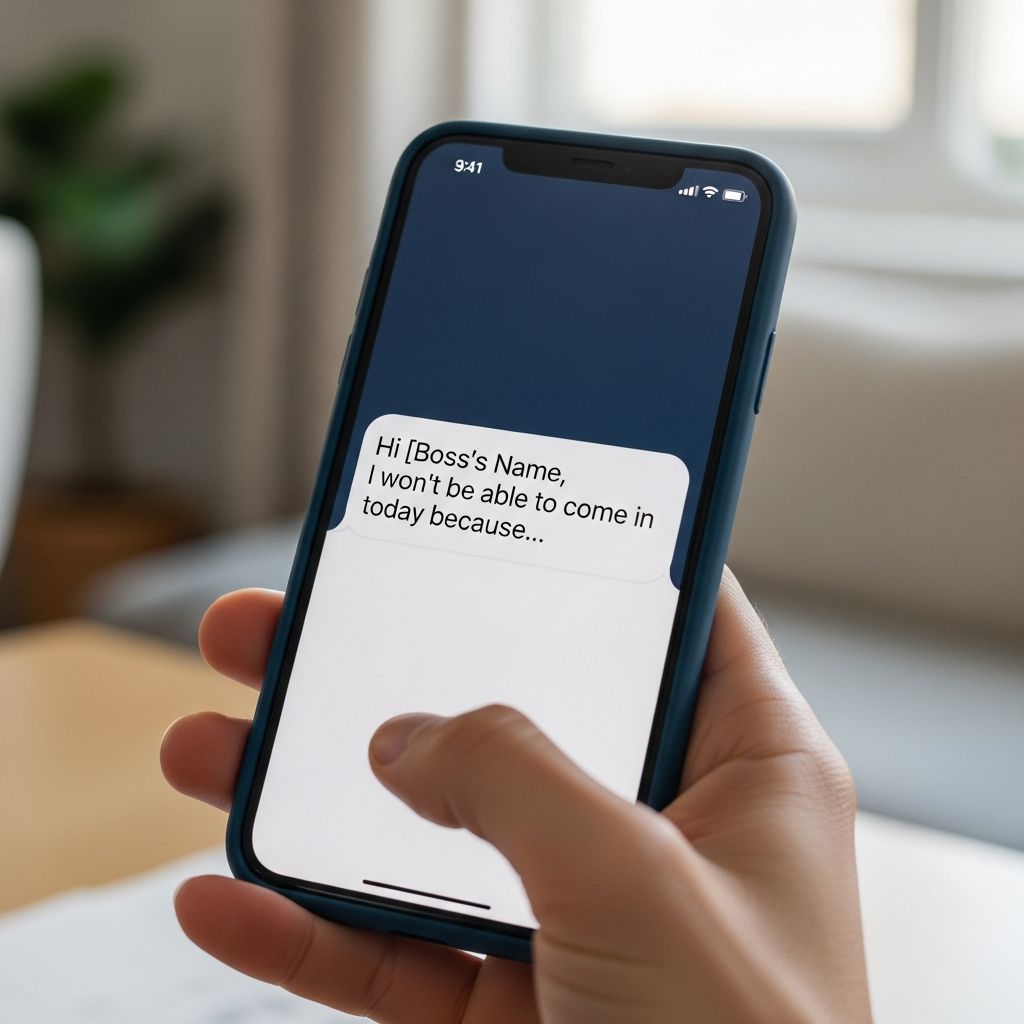
Texting your boss that you can’t come to work is now a normal part of modern workplace communication—but it still feels stressful. Your message is short, but the stakes are high: you want to protect your health or handle an emergency and keep your reputation intact.
This guide walks you through how to decide if a text is appropriate, what to include, what to avoid, and provides examples you can adapt to your situation—while staying professional and respectful.
Is Texting Your Boss Appropriate in Your Workplace?
Before you send a message, confirm whether texting is acceptable for calling out. Many organizations set expectations for how employees should report absences, usually through an employee handbook or HR policies.
| Workplace Type | Texting to Call Out is Usually… | Typical Preferred Method |
|---|---|---|
| Retail, service, hospitality | Common but often paired with a call | Phone call + text confirmation |
| Office / corporate roles | Varies by team culture | Email, HR system, or call to manager |
| Unionized / highly regulated roles | Sometimes discouraged | Following formal call-in procedures |
| Remote / hybrid teams | Often acceptable | Slack/Teams, text, or email |
Check:
- Your employee handbook or attendance policy.
- Onboarding materials or HR portal instructions.
- What your manager has explicitly asked for in the past.
If your company requires a call or system notification, use text only as a supplement—for example, to give a quick heads-up before you can make the required call.
Core Principles of a Professional Text
Effective workplace communication reduces confusion and supports trust between employees and managers. A short text can still be professional if it follows a few key principles.
- Be timely: Message your boss as soon as you know you cannot come in, giving them time to adjust schedules or coverage.
- Be clear: State directly that you will not be in, and for which day or shift.
- Be honest but brief: Give a simple reason without oversharing personal or medical details.
- Be considerate: Acknowledge the impact on the team and, when possible, offer a small gesture to ease the disruption.
- Be aligned with policy: If documentation (like a doctor’s note) is needed, mention that you’ll provide it.
Information to Include
A strong text usually covers:
- Clear notice you can’t come in.
- Date and, if relevant, time or shift.
- Short reason (illness, emergency, transportation issue, etc.).
- Whether you’re reachable or offline.
- Any next step, like updating your calendar or sending files.
Things to Avoid
- Vague messages like “Can’t come in today” with no context.
- Overly casual language, slang, or emojis (unless your boss clearly uses and expects them).
- Excessive detail about symptoms or personal matters.
- Complaints about coworkers or the job in the same message.
- Disappearing without any notice, which undermines trust and may violate policy.
Step-by-Step: How to Text Your Boss You Can’t Come In
1. Check the Clock and Your Schedule
Send your text as early as you reasonably can. Early notice helps your manager plan coverage, redistribute work, or delay meetings.
If you’re on a shift schedule, aim for several hours of lead time. For standard office hours, try to send a message before the workday starts unless an emergency makes that impossible.
2. Review Any Relevant Policy
Quickly review:
- Whether a phone call is also required.
- Who exactly you should notify (manager, HR, team alias).
- Any documentation or follow-up expectations, such as a return-to-work conversation.
3. Draft a Simple, Direct Message
You can use a basic structure and adapt it to different situations:
- Greeting
- Clear statement that you cannot come in
- Short reason
- Timing (today, this morning, the whole week, etc.)
- Next step or availability (optional)
- Thanks
4. Check Tone, Spelling, and Recipient
Before you tap send:
- Confirm you’re messaging the right person or group.
- Scan for typos that could change meaning (e.g., wrong date).
- Make sure the tone is respectful and neutral.
5. Follow Up if Needed
If your company requires it, follow up your text with:
- A call to your manager or main office.
- An entry in your HR or attendance system.
- An email with any required documents (like a doctor’s note).
Sample Text Messages for Common Situations
Use these as templates and customize them to match your tone, your relationship with your manager, and company norms.
Calling Out Sick (Short-Term)
- Example 1: “Hi [Name], I woke up with a bad fever and won’t be able to come in today. I’ll update you by this afternoon on how I’m feeling for tomorrow. Thanks for understanding.”
- Example 2: “Good morning [Name], I’m feeling unwell and need to stay home today. I’ve updated my calendar and will be offline to rest, but I can answer urgent questions by text. Thank you.”
Multi-Day Illness or Medical Issue
- Example 1: “Hi [Name], my doctor advised me to take the next two days off to recover. I’ll be out today and tomorrow and will send a doctor’s note if needed. I’ll check email briefly this evening to hand off anything urgent.”
- Example 2: “Hi [Name], I’m still not well enough to work and need to stay home again today. I’ve let the team know I’m unavailable and will follow the sick leave policy when I’m back. Thanks for your flexibility.”
Family Emergency
- Example 1: “Hi [Name], I’m dealing with an unexpected family emergency this morning and can’t come in today. I’ll be focused on that situation but will send a quick update later this afternoon if I know more about timing. Thank you for your understanding.”
- Example 2: “Good morning [Name], I have a family emergency that requires my full attention today. I’ll be unavailable during work hours, but I’ll check in this evening with an update about tomorrow.”
Mental Health or Burnout
You are not required to disclose specific mental health details; a simple health-related explanation is enough, as long as you follow any formal leave requirements.
- Example 1: “Hi [Name], I’m not feeling well and need to take a sick day today to focus on my health. I’ve rescheduled my meetings and noted my out-of-office. Thank you for your support.”
- Example 2: “Hi [Name], I need to take today as a sick day for health reasons. I’ve passed key updates to [colleague] and will be offline to rest.”
Transportation or Weather Issues
- Example 1: “Hi [Name], my car broke down and I’m waiting on a tow. I’ll be unable to make my shift today. I’ve let [colleague] know and can help answer questions remotely if needed.”
- Example 2: “Morning [Name], the roads are closed due to the storm and it’s not safe for me to drive in. I can work remotely if that’s helpful, or I’ll take a day of leave per our policy.”
Balancing Professionalism and Privacy
Many people worry about how much to say when they can’t come in. Research on workplace communication shows that clearly framed, supportive messages help maintain trust without requiring oversharing.
How Much Detail Is Enough?
Generally, you want to give:
- One-phrase reason: “I’m sick,” “I have a family emergency,” “I have an urgent appointment I can’t move.”
- Timeline: “Today only,” “today and tomorrow,” “for the rest of the week.”
- Impact statement: How you’ll reduce disruption—rescheduling meetings, updating your calendar, or transferring files.
Protecting Your Boundaries
When you’re out, especially for health reasons, it’s reasonable to set limits on availability. For example:
- “I’ll be offline to rest but will check text once this evening for anything urgent.”
- “I won’t be reachable during the day but will respond when I’m back.”
Organizations that respect boundaries and confidentiality build stronger engagement and trust, particularly around sensitive issues like health or family leave.
Strengthening Trust Before You Ever Need to Call Out
How your boss reacts to absence texts often depends on the trust and communication you’ve built over time. Clear, consistent communication can reduce misunderstandings and absenteeism issues overall.
Habits That Help
- Communicate early about known appointments: If you know about a surgery, court date, or major appointment in advance, give as much notice as possible and follow formal leave processes.
- Keep your manager informed about workload: Regular check-ins allow your manager to understand your responsibilities, making coverage easier when you’re unexpectedly out.
- Document your work: Simple documentation, shared folders, and clear notes help teammates step in smoothly if you’re unavailable.
- Follow through on commitments: If you say you’ll send a handoff or update, do it. Reliability in normal times builds goodwill when emergencies arise.
Common Mistakes When Texting Your Boss About an Absence
Even well-intentioned texts can cause confusion. Avoid these frequent pitfalls:
- Too late: Messaging right when your shift starts or after can make staffing difficult.
- No clear end date: Saying “I’m out for a while” without clarifying at least today or tomorrow makes planning harder.
- Emotional or defensive tone: Long justifications or blaming others can distract from the main point.
- Ignoring policy: Relying only on text when your employer clearly requires a phone call or formal notice.
- Going silent: Not sending any update after saying you’d follow up can harm trust.
FAQ: Texting Your Boss You Can’t Come In
Q: Is it unprofessional to text instead of call?
A: It depends on your workplace norms and policy. In some environments, text is standard; in others, a phone call or system notification is required, and a text is only a supplement. When in doubt, follow the formal method and use text for quick updates.
Q: Do I have to say why I’m not coming in?
A: You should give a basic reason—illness, emergency, transportation—so your manager can plan. You are not obligated to provide detailed medical or personal information, but you may need to follow documentation rules for certain kinds of leave.
Q: What if I’m too sick to make a phone call?
A: If calling is normally required but you’re genuinely too ill, send a clear text as early as possible and, if you can, follow up later with a call or email. Some workplaces allow a family member or partner to call or email on your behalf for serious illness.
Q: Can my boss text me back with work questions when I’m out sick?
A: Many organizations encourage boundaries and discourage work activity during medical leave, especially for more serious conditions. Still, some managers may reach out with brief, urgent questions. You can set expectations in your text—for example, saying you’ll be offline except for emergencies—and respond when your health allows.
Q: How often should I update my boss if I’m out for several days?
A: For short illnesses (one to three days), one clear notice and, if needed, a follow-up message may be enough. For longer absences, many HR professionals recommend a simple, consistent check-in schedule—such as updates after doctor’s appointments or every few days—aligned with your company’s leave guidelines.
References
- Managing Absences in the Workplace: Strategies for a Productive Workplace — ProHance. 2023-08-10. https://www.prohance.ai/blog/managing-absences-in-the-workplace-strategies-for-a-productive-workplace/
- Effective strategies for communicating with employees on leave — Stiira (Calvin Gower). 2023-06-27. https://www.stiira.com/effective-strategies-for-communicating-with-employees-on-leave/
- 6 Effective Strategies for Managing Employee Absences and Improving Productivity — Danton HR. 2022-11-15. https://www.dantonhr.com/blog/6-effective-strategies-for-managing-employee-absences-and-improving-productivity/
- Getting the Message Right: Evidence-Based Insights to Improve Organizational Communication in Disability Management — MacEachen et al., Journal of Occupational Rehabilitation. 2021-07-19. https://pmc.ncbi.nlm.nih.gov/articles/PMC8298326/
- Effects of Poor Communication in the Workplace (with Solutions) — Your Thought Partner. 2021-09-01. https://www.yourthoughtpartner.com/blog/poor-communication-in-the-workplace
- 8 Ways You Can Improve Your Communication Skills — Harvard Division of Continuing Education. 2022-03-10. https://professional.dce.harvard.edu/blog/8-ways-you-can-improve-your-communication-skills/
- 7 Strategies to Reduce Absenteeism in the Workplace — Cerkl. 2023-05-05. https://cerkl.com/blog/absenteeism-in-the-workplace

- Integrated M.A. in Applied Linguistics, University of Hyderabad
- 5+ years in editorial, instructional, SEO, and research-based writing
Sneha is a relationships and lifestyle writer with a strong foundation in applied linguistics and certified training in relationship coaching. She brings over five years of writing experience to theskillvault, crafting thoughtful, research-driven content that empowers readers to build healthier relationships, boost emotional well-being, and embrace holistic living. Her writing and insights reflect the belief that beauty, happiness, and wellness…