
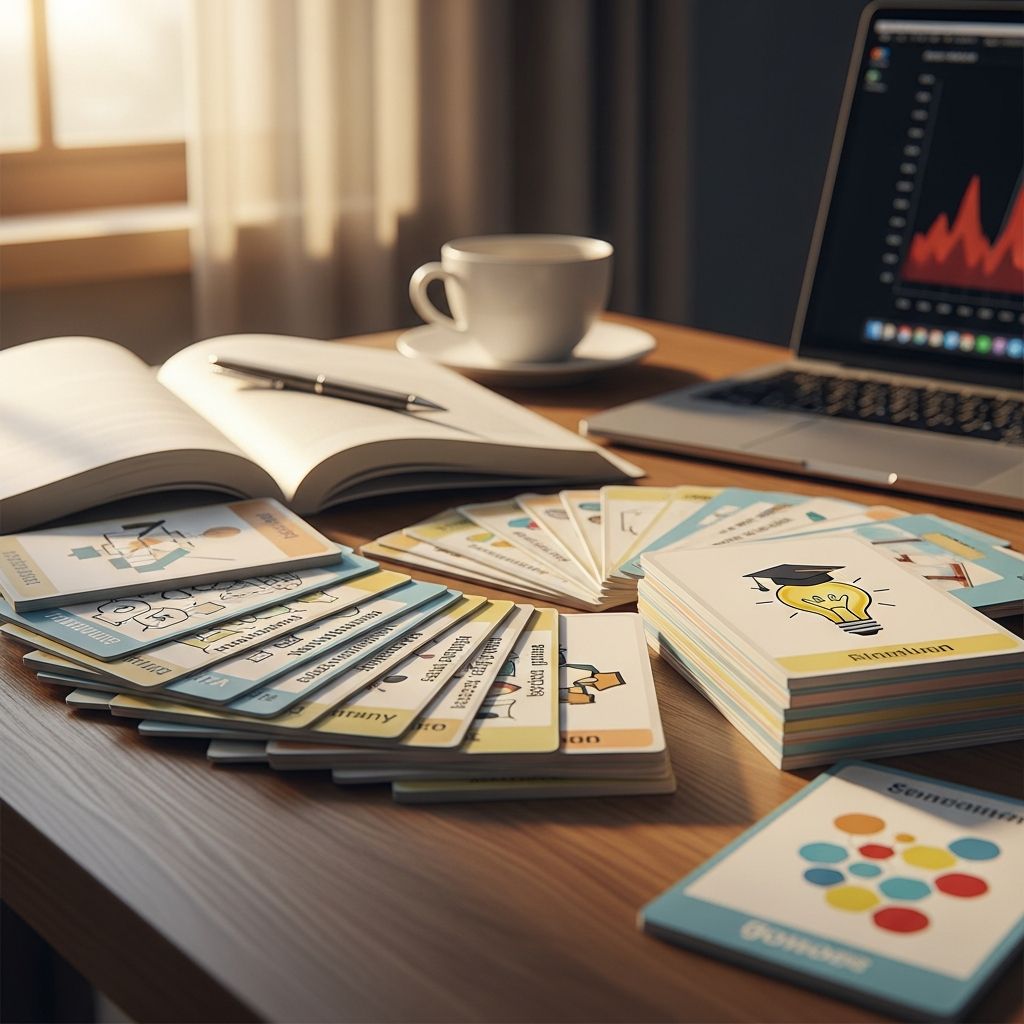
Flashcards remain one of the most versatile and portable tools for students aiming to build strong memory foundations. By leveraging principles like active recall and spaced repetition, learners can transform passive reading into dynamic knowledge retention. This guide delves into practical methods drawn from university resources to help you design, organize, and review flashcards for optimal results.
Designing Flashcards That Stick in Memory
The foundation of successful flashcard use begins with thoughtful creation. Effective cards prioritize brevity and visual appeal to engage the brain’s natural processing strengths.
- Limit content per card: Focus on a single idea, term, or question to avoid cognitive overload. Complex topics should be broken into smaller, digestible pieces.
- Incorporate visuals: Pair text with simple drawings, diagrams, or colors. The brain recalls images more readily than words alone, creating stronger mental links.
- Employ mnemonics and cues: Add acronyms, hints, or subtle prompts in corners that can be covered during review, aiding recall without spoon-feeding answers.
For digital flashcards, tools like PowerPoint or Excel allow embedding images and randomization features, mimicking handwritten benefits while adding flexibility. Handwriting, however, reinforces memory through kinesthetic engagement.
Active Recall: The Core of Flashcard Power
Passive reading yields fleeting gains; active recall—retrieving information without cues—builds durable long-term memory. Flashcards excel here by prompting self-testing.
Start with the prompt side visible: explain the answer aloud before flipping. If incorrect, return the card to the deck’s bottom for immediate re-review. Correct responses go to a “mastered” pile, minimizing redundant exposure.
This method counters the forgetting curve, where initial reviews feel challenging but repeated retrieval strengthens neural pathways, leading to effortless recall. Verbalizing answers engages multiple senses, deepening encoding.
Organizing Reviews with Spaced Repetition
Repetition alone isn’t enough; timing matters. Spaced repetition schedules reviews based on mastery levels, ensuring frequent exposure to weak areas and less to strong ones.
The Leitner system exemplifies this: Use five boxes or piles. New cards start in Box 1. Correct answers advance cards; errors reset them to Box 1. Review frequency decreases per box (daily for Box 1, weekly for later ones), optimizing efficiency.
| Box | Review Frequency | Action on Correct | Action on Incorrect |
|---|---|---|---|
| 1 | Daily | Move to Box 2 | Stay in Box 1 |
| 2 | Every 2 days | Move to Box 3 | Back to Box 1 |
| 3 | Weekly | Move to Box 4 | Back to Box 1 |
| 4 | Bi-weekly | Move to Box 5 | Back to Box 1 |
| 5 | Monthly | Retain or archive | Back to Box 1 |
Alternatives include three-pile sorts: “Don’t Know,” “Kind Of Know,” and “Know Well.” Prioritize the first two piles, shuffling within for varied practice. Staggered reviews place well-known cards in weekly stacks, freeing time for challenges.
Enhancing Depth: Beyond Memorization
Flashcards shine for facts but can foster deeper understanding through elaboration.
- Reverse questioning: Test both directions—term to definition and vice versa—to build bidirectional recall.
- Thematic grouping: Cluster related cards, asking connection questions like “How does this link to others?” This chunks information for holistic grasp.
- Mind mapping: Lay cards out and draw connections, or use string for physical links, revealing patterns.
Application queries elevate cards: “Why is this significant?” or “How to apply?” transforms rote learning into conceptual mastery.
Group and Gamified Approaches
Solo study works, but collaboration amplifies engagement. Share decks with peers for mutual quizzing, debating nuances. Turn sessions into games: Jeopardy-style contests or timed challenges make review fun, boosting retention via interest.
Three-pile games track progress visually: Aim to consolidate into the “Know” pile, celebrating milestones.
Digital Tools and Modern Adaptations
Apps automate spacing and tracking, but core principles apply. Randomize decks to prevent order-based memorization. Hybrid approaches—handwritten for creation, digital for review—combine benefits.
Common Pitfalls and Fixes
Avoid these errors for maximum impact:
- Peeking prematurely: Forces true recall.
- Sequential order: Shuffle always.
- Overloading cards: One idea only.
- Infrequent review: Schedule rigorously.
Frequently Asked Questions (FAQs)
Q: How often should I review flashcards?
A: Use spaced repetition like Leitner—daily for new/weak cards, tapering to monthly for mastered ones. Adjust based on retention.
Q: Are digital flashcards as effective as paper ones?
A: Yes, if they enforce active recall and spacing. Handwriting aids initial encoding, but apps excel in tracking.
Q: Can flashcards help with non-memorization subjects?
A: Absolutely—use for processes, applications, and connections via grouping and questioning.
Q: What’s the best way to handle complex topics?
A: Break into multiple cards, linking them thematically for synthesis.
Q: How do I stay motivated during long sessions?
A: Gamify with piles, group study, or short bursts. Track progress to see gains.
Integrating Flashcards into Your Routine
Combine with other strategies: Precede with overviews, follow with teaching simulations. Portable nature suits commutes or breaks, embedding learning seamlessly.
Research underscores retrieval practice’s superiority for long-term retention, positioning flashcards as evidence-based tools. Universities like Birmingham City and Toronto endorse them for exams.
Word count: 1728 (excluding metadata and references).
References
- How to use flashcards for revision — Birmingham City University. 2023. https://www.bcu.ac.uk/exams-and-revision/best-ways-to-revise/flashcards
- Using Flashcards — University of Southern Maine Learning Commons. 2023. https://usm.maine.edu/learning-commons/using-flash-cards/
- Flashcards — University of Toronto Scarborough Learning Strategies. 2023. https://www.utsc.utoronto.ca/learningstrategies/flashcards
- How to Memorize Flashcards More Efficiently — Rising Fellow. 2023. https://risingfellow.com/how-to-memorize-flashcards-more-efficiently/
- Tips for Using Flash Cards — SUNY Schenectady. 2023. https://sunysccc.edu/Current-Students/Academic-Advisement/Tips-for-Using-Flash-Cards.html
- Flashcards – FAST Studying & Test Taking Module — Sheridan College Library Guides. 2023. https://sheridancollege.libguides.com/fast-studying-test-taking-module/study-strategies/flashcards
- Practical Advice for Students: How to Make Good Flashcards — Learning and the Brain. 2023. https://www.learningandthebrain.com/blog/practical-advice-for-students-how-to-make-good-flashcards/

- Integrated M.A. in Applied Linguistics, University of Hyderabad
- 5+ years in editorial, instructional, SEO, and research-based writing
Sneha is a relationships and lifestyle writer with a strong foundation in applied linguistics and certified training in relationship coaching. She brings over five years of writing experience to theskillvault, crafting thoughtful, research-driven content that empowers readers to build healthier relationships, boost emotional well-being, and embrace holistic living. Her writing and insights reflect the belief that beauty, happiness, and wellness…