
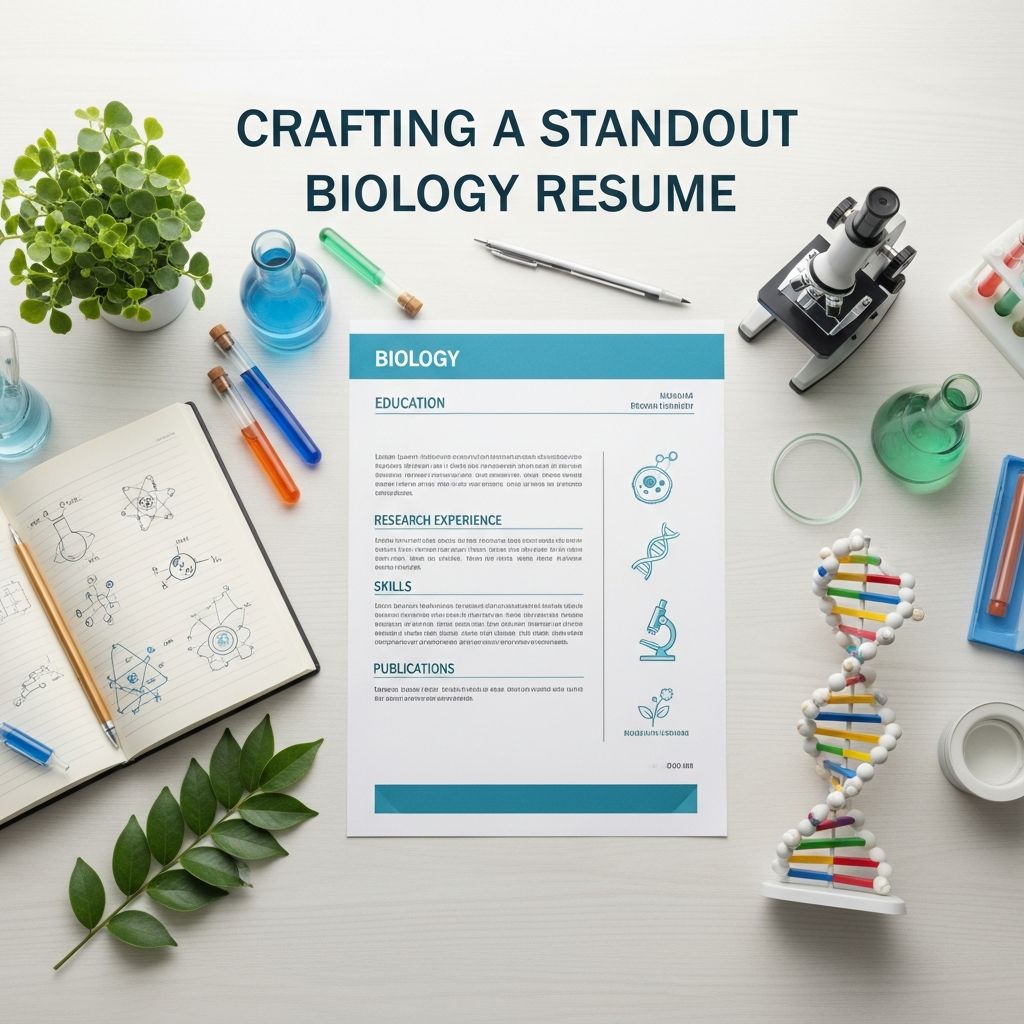
In the competitive world of biology, where roles in research labs, environmental agencies, and biotech firms demand precision and expertise, your resume serves as your primary introduction to potential employers. A well-constructed biology resume not only summarizes your qualifications but also tells a compelling story of your contributions to the field. This guide provides a comprehensive roadmap to building a document that highlights your technical prowess, research achievements, and professional potential, ensuring it passes applicant tracking systems (ATS) and captivates hiring managers.
Understanding the Biology Job Market
Biology encompasses diverse subfields like molecular biology, ecology, genetics, and microbiology, each with unique resume expectations. Entry-level candidates often emphasize academic projects and internships, while seasoned professionals focus on quantifiable impacts from lab work or fieldwork. According to career resources, resumes in this sector should be concise—one to two pages—and optimized for skimmability, prioritizing relevance to the job description. Tailoring your content to match specific postings increases your visibility, as many organizations use ATS software to filter applications based on keywords like ‘PCR analysis’ or ‘data sequencing.’
Recent trends show a surge in demand for biologists skilled in bioinformatics and sustainable practices, driven by advancements in genomics and climate research. Your resume must reflect these priorities, demonstrating not just knowledge but application in real-world scenarios.
Selecting the Optimal Resume Format
Choosing the right format is foundational. For those with limited professional experience, a functional or hybrid format foregrounds skills and education over chronology. Experienced applicants benefit from a reverse-chronological layout, which showcases career progression clearly.
- Reverse-Chronological: Ideal for mid-career biologists; lists jobs from most recent, emphasizing achievements.
- Functional: Best for recent graduates; groups experiences by skill categories like ‘Laboratory Techniques’ or ‘Field Research.’
- Hybrid: Combines both, starting with a skills summary followed by experience.
Regardless of format, maintain clean formatting: use standard fonts like Arial or Calibri (10-12 pt), 1-inch margins, and bold headings for readability. Avoid dense paragraphs; opt for bullet points to quantify accomplishments, such as ‘Analyzed 150+ genetic samples, identifying key mutations in 85% of cases.’
Developing a Powerful Professional Summary
The professional summary, positioned just below your contact information, acts as a 3-5 sentence elevator pitch. It distills your expertise, key achievements, and career goals. For entry-level biologists, highlight transferable skills from coursework or internships; veterans should quantify impacts.
Example Summary (Entry-Level):
Dedicated biology graduate with hands-on experience in molecular lab techniques and ecological fieldwork from university research projects. Proficient in DNA sequencing and data analysis using R and Python. Eager to contribute analytical skills to innovative biotech research teams.
Example Summary (Experienced):
Results-driven biologist with 8+ years in genetic research, leading projects that sequenced over 500 microbial genomes. Expertise in CRISPR editing and bioinformatics tools. Proven track record of publishing in peer-reviewed journals and securing $200K in grants.
This section often determines whether recruiters continue reading, so customize it per application, incorporating job-specific keywords.
Showcasing Technical and Soft Skills Effectively
A dedicated skills section bridges your experiences and the job requirements. Biology roles demand a mix of hard skills (e.g., gel electrophoresis, microscopy) and soft skills (e.g., collaboration, problem-solving). Draw from the job ad to prioritize 8-12 items, ensuring they appear elsewhere in the resume for ATS compatibility.
| Hard Skills | Soft Skills |
|---|---|
| PCR and qPCR | Team Collaboration |
| Flow Cytometry | Data Interpretation |
| Bioinformatics (BLAST, Python) | Technical Writing |
| Cell Culture | Adaptability in Field Conditions |
Pro tip: Verify skills with evidence. For instance, if listing ‘Bioinformatics,’ reference a project where you used it to model protein structures.
Detailing Professional Experience with Impact
The experience section is your canvas for achievements. List positions in reverse chronological order, including job title, employer, location, and dates. Limit to 4-6 bullets per role, starting with action verbs like ‘Designed,’ ‘Optimized,’ or ‘Collaborated.’ Focus on outcomes, not duties—use metrics to demonstrate value.
Sample Bullet Points:
- Conducted fieldwork surveys across 50+ sites, collecting data that informed a state conservation policy reducing habitat loss by 20%.
- Developed novel assay protocols, improving lab efficiency by 30% and reducing reagent costs annually by $15K.
- Mentored 10 undergraduate interns, resulting in two co-authored publications in Journal of Biological Chemistry.
For gaps or non-biology roles, frame transferable experiences positively, e.g., ‘Applied statistical modeling from finance role to analyze biological datasets.’
Elevating Your Education and Certifications
Education often anchors biology resumes, especially for early-career applicants. List degrees reverse-chronologically: institution, degree, major, graduation year. Enhance with relevant honors, GPA (if 3.5+), or coursework.
- B.S. in Biology, University of California, 2025 (GPA: 3.8; Thesis: ‘Genomic Adaptations in Coastal Ecosystems’)
- Ph.D. in Molecular Biology, Harvard University, 2020 (Dissertation published in Nature Genetics)
Include certifications like ‘Certified Laboratory Technician’ or ‘Bioinformatics Specialization (Coursera)’ to show ongoing development.
Highlighting Research, Publications, and Presentations
What sets biology resumes apart are sections for scholarly output. Under ‘Research Experience’ or ‘Publications,’ list projects with your role, methods, and results. Format publications as: Author(s). (Year). ‘Title.’ Journal, volume(issue), pages. DOI if available.
Research Example:
- Lead Researcher, ‘Antibiotic Resistance in Urban Microbiomes’ (NIH-funded, 2024): Isolated 200 strains, sequenced genomes, presented findings at ASM Conference.
Presentation bullets build credibility: ‘Keynote Speaker, Ecological Society of America Annual Meeting, 2025.’
Incorporating Unique Elements for Differentiation
Stand out with tailored sections like ‘Fieldwork,’ ‘Volunteer Experience,’ or ‘Professional Affiliations.’
- Fieldwork: Documented biodiversity in Amazon expeditions, using GIS mapping for 100+ species inventories.
- Volunteering: Organized community science workshops, engaging 500+ participants in citizen science initiatives.
- Affiliations: Member, American Society for Microbiology (ASM); Sigma Xi Honor Society.
These additions humanize your profile, revealing passion and leadership.
Proofreading and ATS Optimization
Errors undermine credibility in a precision-driven field. Proofread multiple times, use tools like Grammarly, and seek peer feedback. For ATS, incorporate exact phrases from the job description without keyword stuffing. Save as PDF to preserve formatting.
Frequently Asked Questions (FAQs)
Q: How long should a biology resume be?
A: One page for entry-level; up to two for experienced professionals with extensive research.
Q: Should I include a photo on my biology resume?
A: No, unless specified; U.S. employers prioritize content over visuals to avoid bias.
Q: How do I handle limited experience?
A: Emphasize academic projects, internships, and skills; use a functional format.
Q: Are references necessary on the resume?
A: No; state ‘References available upon request’ if space allows.
Q: How often should I update my resume?
A: After every significant achievement, like publications or conferences.
Final Thoughts on Resume Mastery
Building a biology resume is an iterative process of refinement. By strategically organizing your content, quantifying impacts, and aligning with employer needs, you’ll create a document that propels your career forward. Regularly update it to reflect evolving expertise, and pair it with a customized cover letter for best results.
References
- Biology Resume: Examples & Templates — Resume-Now. 2024. https://www.resume-now.com/resume/examples/biology
- Biology Resume Examples [Also for Entry-Level Biologists] — Zety. 2024. https://zety.com/blog/biology-resume-example
- Biology Resume Examples & Templates — MyPerfectResume. 2024. https://www.myperfectresume.com/resume/examples/biology
- 10 Tips for Writing Better Science Industry Resumes — American Society for Microbiology (ASM). 2023-01-15. https://asm.org/podcasts/microbeworld-video/episodes/10-tips-for-writing-better-science-industry-resume
- How To Write a Field Biologist Resume (With Example) — Indeed. 2024. https://www.indeed.com/career-advice/resumes-cover-letters/field-biologist-resume

Medha Deb is an editor with a master's degree in Applied Linguistics from the University of Hyderabad. She believes that her qualification has helped her develop a deep understanding of language and its application in various contexts. Medha specializes in the areas of beauty, health, sports, and wellness and is committed to ensuring that the content on the website is…