
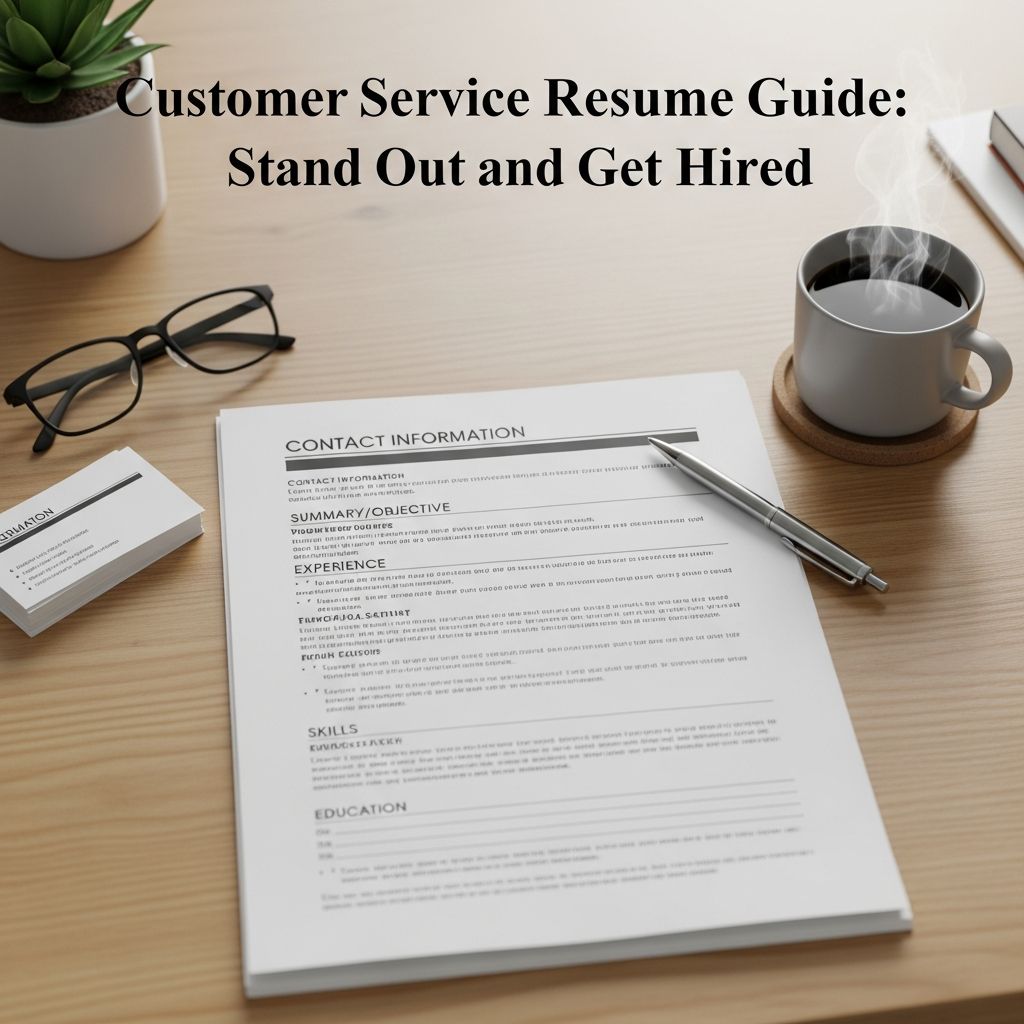
Customer service roles sit at the heart of most organizations. Whether you are answering phones at a call center, supporting users through chat, or assisting shoppers in a retail store, a well-crafted resume is your primary tool for landing interviews. This guide explains how to build a customer service resume that is clear, credible, and tailored to modern hiring practices, including applicant tracking systems (ATS).
Why a Strong Customer Service Resume Matters
Customer service hiring managers often review dozens of resumes for a single opening, sometimes spending only a few seconds on an initial scan. Your resume must quickly show that you can:
- Communicate clearly with diverse customers
- Resolve problems and de-escalate tense situations
- Work with technology, such as CRM tools or ticketing systems
- Deliver measurable results, like higher satisfaction scores or faster response times
Research from major career services centers emphasizes that resumes should be concise, factual, and focused on evidence of skills rather than generic statements.
Choosing the Right Resume Format for Customer Service
The format you select should make your strongest qualifications instantly visible. Three common options are:
| Format | Best For | Key Advantages | Potential Drawbacks |
|---|---|---|---|
| Reverse-chronological | Candidates with consistent customer service experience | Highlights recent roles and promotions; familiar to recruiters | Less ideal if you have gaps or frequent job changes |
| Functional (skills-based) | Career changers or those with limited experience | Emphasizes transferable skills like communication and problem-solving | Some employers are cautious if work history appears minimized |
| Hybrid (combination) | Most candidates, especially mid-level professionals | Balances skills and work history, useful for customer service specialists | Requires careful layout to stay concise and ATS-friendly |
Essential Sections Every Customer Service Resume Needs
Regardless of format, most effective customer service resumes include the following core sections:
- Contact details
- Professional summary or objective
- Work experience focused on achievements
- Skills (soft and technical)
- Education and relevant training
- Optional extras: certifications, awards, languages
Contact Details That Look Professional
Place your contact information at the top so a recruiter can reach you without searching.
- Name: Use your full first and last name in a clear font
- Phone: Provide a reliable number with voicemail enabled
- Email: Use a professional address, usually some variation of your name
- Location: City and state or region; full address is usually optional
- Links (optional): LinkedIn or a professional profile relevant to customer service work
Writing a Compelling Summary or Objective
The top third of your resume is prime space. Use a summary if you already have customer service experience, or an objective if you are new to the field or changing careers.
A strong summary usually includes:
- Your role and years of experience (for example, “Customer support specialist with 3+ years…”)
- 2–3 key strengths, such as conflict resolution or CRM proficiency
- One standout, quantified achievement, such as a satisfaction rating or efficiency gain
If you lack direct experience, an objective can highlight transferable skills and your motivation to grow in customer service.
Transform Work History into Achievement-Focused Experience
Many customer service resumes only list tasks: “answered calls,” “responded to emails,” and so on. Recruiters and hiring managers see these phrases repeatedly. To stand out, you should demonstrate impact.
Structuring Each Job Entry
Each role should generally include:
- Job title
- Company name and location
- Dates of employment (month and year)
- 3–6 bullet points focusing on achievements
Career experts recommend starting each bullet with a strong action verb and, where possible, including specific numbers to show scale and results.
Using the Action–Task–Result Pattern
A simple pattern for powerful bullet points is:
- Action verb – what you did
- Task or context – how or where you did it
- Result – what improved, ideally with a number
For example, instead of writing “Handled customer complaints,” you might say something like:
- “Resolved a high volume of daily customer inquiries while maintaining strong satisfaction ratings and minimizing escalations.”
Even when you cannot share exact metrics, approximate figures or qualitative outcomes still provide useful context, such as “reduced wait times,” “improved feedback scores,” or “streamlined processes.”
Customer Service Metrics You Can Highlight
Hiring managers appreciate measurable evidence of performance. Consider whether you can reference:
- Customer satisfaction or net promoter scores
- Number of calls, chats, or tickets handled per shift
- Average response or resolution time
- Percentage of issues resolved on first contact
- Reductions in refunds, complaints, or escalations
These indicators help employers compare candidates who may have similar job titles but different levels of impact.
Showcasing Core Customer Service Skills
Customer service roles rely on a combination of interpersonal strengths and technical abilities. A clear skills section helps both human reviewers and ATS software quickly see your fit.
Soft Skills that Employers Look For
Soft skills often determine how well you can interact with customers and teammates. Commonly valued abilities include:
- Active listening and empathy
- Clear communication, both spoken and written
- Patience under pressure
- Problem-solving and analytical thinking
- Conflict resolution and de-escalation
- Teamwork and collaboration
- Adaptability to changing procedures or tools
Guidance from resume experts notes that these skills should ideally be demonstrated through achievements in your work experience section, not simply listed in isolation.
Technical and Product Skills
Many customer service environments use specialized tools to track interactions and manage workflows. Depending on your background, you might include:
- Customer relationship management (CRM) systems
- Help desk or ticketing tools
- Live chat platforms and email support tools
- Point-of-sale or retail systems
- Basic spreadsheet or database tools for tracking information
If a job posting mentions specific systems, such as a CRM name or call management software, list them accurately so your resume aligns with the employer’s requirements.
Education, Training, and Certifications
Customer service positions often welcome candidates from diverse educational backgrounds. On your resume, keep this section focused and relevant.
Listing Your Education
For most roles, include:
- Degree or diploma
- Institution name
- Location
- Graduation date or expected completion
If you are early in your career or still studying, you may also mention relevant coursework related to communication, psychology, business, or information technology, especially if the employer highlights those areas in the posting.
Relevant Certifications and Short Courses
While not mandatory for most roles, short courses and certifications can show initiative and ongoing development. Consider including:
- Customer service training programs
- Communication or conflict management workshops
- Technical support or product-specific certifications
- Language proficiency tests if you support multilingual customers
These additions are particularly helpful when you are competing with candidates who may have more direct experience.
Tailoring Your Resume to a Customer Service Job Description
Generic resumes are less effective than resumes targeted to a specific role. According to major career services, customizing your resume helps highlight the skills and achievements that are most relevant for each employer.
Identifying Key Requirements
Begin by reviewing the job posting closely. Look for repeated words or phrases related to:
- Type of customer interaction (phone, email, chat, in-person)
- Industry knowledge (retail, technology, hospitality, healthcare)
- Required tools or systems (for example, a particular CRM platform)
- Performance expectations, such as response times or satisfaction goals
These clues help you decide which of your experiences and skills to emphasize.
Using Keywords Naturally
Modern hiring processes often use ATS to scan resumes. To help your resume pass these checks:
- Include relevant keywords from the job ad, such as “customer satisfaction,” “call center,” “technical support,” or “help desk.”
- Use the same or very similar phrasing as the posting where it accurately describes your background.
- Avoid keyword stuffing; ensure each term appears in a natural, meaningful sentence or bullet.
Well-placed keywords improve your chances of being flagged as a match, without compromising readability.
Designing an ATS-Friendly Customer Service Resume
A polished layout is important, but overly complex designs can confuse ATS software and cause information to be read incorrectly or missed. Career centers and hiring guides recommend simple, organized formatting.
Formatting Practices That Help
- Use a clean, readable font and standard section headings, such as “Experience” and “Skills”
- Rely on bullet points rather than text boxes or graphics
- Keep margins and spacing consistent to improve skimming
- Export your resume as a common file type requested by the employer, such as PDF or DOCX
Formatting Practices to Avoid
- Complex tables or multi-column layouts that may be misread by ATS
- Images, charts, or icons that contain text
- Unusual fonts that might not display correctly
- Excessive decorative elements that distract from content
Fine-Tuning Your Resume Before You Apply
Before sending your resume, take time to review and refine it. Leading career services encourage candidates to think like an employer: is it easy to see why you should be interviewed?
Checklist for Final Review
- Clarity: Can someone understand your background in 20–30 seconds?
- Relevance: Are the most important qualifications for this job clearly visible near the top?
- Accuracy: Are dates, job titles, and contact details correct?
- Consistency: Are fonts, bullet styles, and verb tenses uniform?
- Proofreading: Have you checked for grammar and spelling errors, ideally more than once?
You may also ask a trusted colleague, mentor, or career counselor to review your resume. They can often spot unclear phrasing or missing details.
Frequently Asked Questions About Customer Service Resumes
Q1: How long should a customer service resume be?
Most early and mid-career customer service resumes should be one page, especially when applying to high-volume roles like call centers or retail support. A second page is usually reserved for senior or specialized positions with extensive relevant experience.
Q2: What if I have no formal customer service experience?
Focus on transferable skills from other roles, volunteering, or school projects. Highlight times you communicated with the public, solved problems, worked in teams, or handled conflicts. An objective statement and a strong skills section are especially helpful when you are new to the field.
Q3: Should I customize my resume for each application?
Yes. Even small adjustments—such as reordering your bullet points to reflect the job’s priorities or adding keywords that match the posting—can make your resume more relevant and help it perform better in both ATS and human reviews.
Q4: Is it necessary to include metrics on a customer service resume?
While not strictly required, numbers make your achievements more concrete. Metrics related to satisfaction, volume of interactions, response time, or sales add credibility and help your resume stand out.
Q5: Can I use the same resume for in-person and remote customer service jobs?
You can start from a common base resume, but adjust it depending on the role. Remote positions may value skills like self-management, written communication, and familiarity with collaboration tools, while on-site roles may emphasize face-to-face communication and point-of-sale systems.
References
- How to Write the Best Customer Service Resume — Indeed Editorial Team. 2022-08-05. https://www.indeed.com/career-advice/resumes-cover-letters/best-customer-service-resume
- Customer Service Resume Template: Examples & Writing Guide — The Interview Guys. 2023-03-10. https://blog.theinterviewguys.com/customer-service-resume-template/
- Customer Service Skills for Resume With Examples — ResumeBuilder.com Career Center. 2023-05-18. https://www.resumebuilder.com/career-center/customer-service-skills-resume/
- Create a Strong Resume — Mignone Center for Career Success, Harvard University. 2022-09-01. https://careerservices.fas.harvard.edu/resources/create-a-strong-resume/
- Effective Job Search Strategies for Job Seekers — U.S. Bureau of Labor Statistics. 2022-09-29. https://www.bls.gov/careeroutlook/2022/article/job-search-strategies.htm

Medha Deb is an editor with a master's degree in Applied Linguistics from the University of Hyderabad. She believes that her qualification has helped her develop a deep understanding of language and its application in various contexts. Medha specializes in the areas of beauty, health, sports, and wellness and is committed to ensuring that the content on the website is…