
Building Your Data Analyst Resume: A Comprehensive Approach
In today’s competitive job market, your resume serves as your first and often only opportunity to capture the attention of hiring managers and applicant tracking systems (ATS). For data analyst positions, this becomes even more critical as employers seek candidates who can demonstrate both technical prowess and tangible business impact. The challenge lies not merely in listing your qualifications, but in presenting them in a way that resonates with the specific needs of each role you pursue. This guide walks you through the essential components of crafting a data analyst resume that opens doors and drives interviews.
Understanding the Foundation: Resume Structure and Length
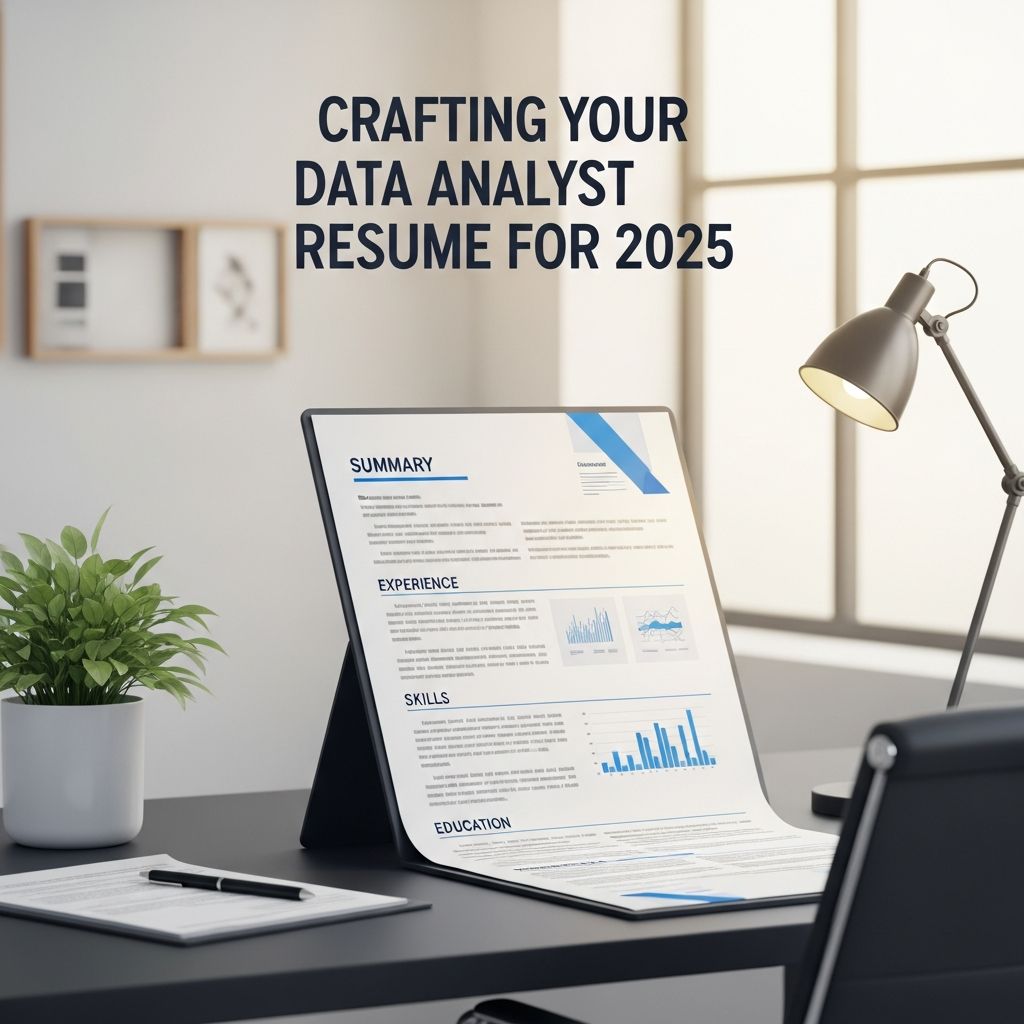
The backbone of any effective resume is its structure. Data analyst resumes thrive on clarity and organization, allowing readers to quickly identify your qualifications without unnecessary searching. The ideal length for a data analyst resume is a single page, though professionals with extensive experience may extend to two pages. However, every line should earn its place—there is no room for filler or generic statements that fail to add value.
The recommended allocation of space demonstrates where emphasis should lie. Your professional experience section should command 40-60% of your resume’s real estate, as this is where you demonstrate concrete application of your skills. Your summary deserves 10-15% of the space to make a compelling first impression. Education typically occupies 10-15%, skills sections take up proportional space, and any additional sections such as certifications or notable projects round out the remainder.
This structure recognizes that employers care most about what you have accomplished in actual work settings, followed closely by how you position yourself at the outset. Education credentials, while important, play a supporting role compared to demonstrated performance.
Crafting a Magnetic Professional Summary
Your professional summary functions as your elevator pitch—a concentrated dose of your most compelling qualifications delivered in 50-75 words. Rather than stating career objectives or general aspirations, focus on what you bring to the table. This section should answer three fundamental questions: What is your role and experience level? What technical tools and domains do you master? What quantifiable impact have you made?
An effective summary follows a natural progression. Begin by establishing your identity and tenure in the field. A statement like “Data Analyst with 3+ years of experience in SQL and Tableau, specializing in Marketing for eCommerce” immediately tells the reader your core qualifications and focus area. This opening line leverages specificity over vagueness—avoid phrases like “detail-oriented professional” that could describe anyone.
The second component expresses genuine interest in the prospective employer’s mission, demonstrating that you’ve done your homework. Rather than generic enthusiasm, connect your expertise to their specific needs or industry. For example, you might reference your excitement about working for a mission-driven organization that uses data to drive sustainable growth in their particular sector.
The final element of your summary should showcase one specific, quantified achievement that mirrors requirements in the job description. This might involve increasing efficiency by a certain percentage, reducing costs, or uncovering insights that drove strategic decisions. This concrete example primes the reader to expect measurable results throughout your experience section.
Positioning Your Professional Experience for Maximum Impact
Your experience section represents the heart of your resume, and how you present this information determines whether hiring managers see you as a strong candidate or merely someone with a job history. The critical distinction lies in transforming job duties into achievement statements. Rather than writing “Analyzed business operation costs,” reframe this as “Led in-depth analysis of business operation costs, which identified inefficiencies and decreased operating expenses by 20%.”
Each position should be presented in reverse chronological order, with your most recent role first. For each role, include the job title, company name, employment dates, and location. However, the substance comes through in your bullet points describing accomplishments. Aim for 3-5 bullets per position, focusing on those experiences most relevant to the role you’re pursuing.
When crafting accomplishment statements, employ action verbs that convey agency and impact. Words like “accelerated,” “enhanced,” “optimized,” “streamlined,” and “transformed” carry more weight than passive language. Pair these verbs with the specific methodologies you employed and the business outcomes you influenced.
The most compelling achievement statements follow a simple formula: Action verb + what you did + business impact. For instance, “Optimized SQL queries across 12 databases, reducing average query execution time by 35% and enabling real-time reporting for executive dashboards” conveys both technical proficiency and business value in a single sentence.
Demonstrating Technical Competency Through Your Skills Section
Data analyst positions demand specific technical proficiencies, and your skills section must clearly showcase your capabilities. Rather than creating an exhaustive list of every tool you’ve touched, prioritize strategically by placing your strongest competencies first. This ordering sends a signal about your depth of expertise.
Segment your skills into categories such as “Programming Languages,” “Data Visualization,” “Statistical Analysis,” “Databases,” and “Tools & Platforms.” This categorization helps both ATS systems and human readers quickly locate specific competencies they’re seeking. Include technologies directly mentioned in the job description, as these significantly improve your ATS compatibility and demonstrate you’ve thoughtfully aligned your qualifications with the role.
Avoid the temptation to claim proficiency in tools you barely understand. Hiring managers increasingly test technical knowledge during interviews, and overstating your abilities will quickly undermine your credibility. Instead, be honest about your proficiency levels—you might use descriptors like “Expert in SQL,” “Proficient in Python,” and “Familiar with Apache Spark” to communicate varying degrees of mastery.
Showcasing Projects That Demonstrate Real-World Application
Project experience often separates strong candidates from exceptional ones, particularly for those transitioning into data analysis or early-career professionals with limited formal employment history. Projects provide concrete evidence of your ability to manage data challenges from start to finish.
Each project entry should remain concise and focused, typically occupying 3-5 lines. Include the project title, your specific role, the problem or question you addressed, the tools and techniques you employed, and the results or insights you generated. If the project has a publicly accessible component—a GitHub repository, blog post, or portfolio page—include a link.
The most effective project descriptions balance technical depth with business context. Rather than simply stating “Built a Python dashboard,” explain the business question that motivated the project, such as “Developed an interactive Python dashboard analyzing customer churn patterns, identifying key behavioral indicators that enabled the retention team to reduce churn by 18%.” This context transforms a technical achievement into a business-focused accomplishment.
Education, Certifications, and Continued Learning
Your education section should list your degrees, the institutions where you earned them, and graduation dates. Include relevant coursework, academic honors, or certifications only if they meaningfully strengthen your candidacy. A bachelor’s degree in mathematics or computer science carries inherent relevance for a data analyst role, while general education requirements do not.
Industry certifications have become increasingly important in data analytics. Certifications from recognized providers—whether in SQL, Tableau, Google Analytics, or cloud platforms—demonstrate commitment to professional development and validate specific technical skills. Include these prominently if they match the job description requirements.
For entry-level analysts or those pursuing the field as a career change, including relevant coursework from formal programs, bootcamps, or online learning platforms (such as Python for Data Analysis, Advanced SQL, or Statistics Fundamentals) signals investment in developing domain expertise.
Strategic Resume Customization for Each Application
One universal mistake candidates make is submitting identical resumes to every employer. Successful data analyst candidates recognize that tailoring their resume for each position significantly increases their odds of success. This doesn’t mean rewriting your entire resume—rather, it involves strategic adjustments based on the specific job description.
Begin by identifying the core technical requirements and desired qualifications listed in the job posting. Reorder your skills section to prioritize tools and languages mentioned in the posting. If they emphasize SQL and Tableau, ensure these appear prominently in your skills, even if you’re also proficient in Python and Power BI.
Review your experience bullets and reorder them to highlight accomplishments most relevant to the posted role. A candidate with experience in retail analytics, financial analytics, and healthcare analytics should emphasize healthcare work when applying to a healthcare company, and rearrange their bullet points to showcase the most pertinent projects first.
Incorporate keywords from the job description throughout your resume. This approach serves a dual purpose: it helps your resume pass ATS screening algorithms that scan for specific terms, and it shows human readers that you’ve carefully considered the role and positioned yourself as an ideal fit.
Formatting for Both Human Readers and Applicant Tracking Systems
Your resume travels through multiple gatekeepers before reaching human eyes. Applicant tracking systems parse resumes to extract information and match it against job requirements. A beautifully designed resume with creative fonts and unusual formatting may impress the eye but confuse the ATS, causing your qualifications to be overlooked entirely.
Use standard fonts such as Arial, Calibri, or Times New Roman in 10-12 point size. Maintain consistent spacing and clear section headings. Avoid tables, graphics, images, and unusual symbols that ATS systems struggle to interpret. Stick to standard bullet points rather than custom characters or emoji.
Your filename matters more than many realize. Instead of “Resume.pdf” or “MyResume.docx,” use a professional format such as “FirstName_LastName_DataAnalyst.pdf.” This small detail signals professionalism and makes your resume easier to identify in hiring managers’ folders.
Save your final resume as a PDF to preserve formatting across different devices and applications. While some applicant systems request .doc or .docx files, PDF is the safer default choice when given the option.
Essential Contact Information and Header Design
Your resume begins with your header—the first element a reader encounters. This section should include your full name, phone number, professional email address, LinkedIn profile URL, and optionally a link to your portfolio or GitHub profile. Avoid nicknames or unprofessional email addresses; if your primary email is “datatoolmaster@” or similar, create a professional alternative using your name.
Your LinkedIn profile should mirror the content in your resume, including your headline, summary, and work experience. Many hiring managers verify candidate information by checking LinkedIn, and discrepancies between your resume and profile raise red flags. Keep both updated and consistent.
If you have a strong portfolio of projects—whether hosted on a personal website, GitHub, or a platform like Tableau Public—include this link in your header. A portfolio transforms abstract resume claims into concrete demonstrations of your capabilities. Ensure any portfolio links are tested and functional before submitting.
Common Pitfalls to Avoid
Even well-intentioned candidates often undermine their effectiveness through common mistakes. Avoid generic statements that could apply to any candidate in any field. Phrases like “detail-oriented,” “team player,” and “passionate about analytics” fill space without conveying value.
Don’t overextend your resume with irrelevant experience. A hiring manager doesn’t need to know about your summer job in retail management if you’ve been working in data analytics for five years. Older, less relevant positions should be excluded or consolidated under a brief “Additional Experience” section.
Resist the temptation to include a career objective statement. Hiring managers assume you want the job; instead of restating this obvious point, use your summary to demonstrate why you’re uniquely qualified for this particular role.
Finally, never submit a resume without thorough proofreading. Typos, grammatical errors, and inconsistent formatting signal carelessness in a profession where precision matters. Errors in your resume—the document you’ve had unlimited time to perfect—raise questions about the quality of your analytical work.
Keeping Your Resume Current and Relevant
Your resume is a living document that should evolve as your career progresses. Every few months or after completing significant projects, update your resume with new accomplishments. This habit ensures you don’t struggle to recall achievements when you’re ready to apply for a new position.
Stay informed about emerging tools, methodologies, and technologies within data analytics. The field moves quickly, and hiring managers expect candidates to stay current with trends in AI, cloud-based analytics platforms, and advanced statistical techniques. If you’ve recently completed a relevant course or earned a new certification, add it to your resume immediately.
Periodically reassess the impact statements in your experience section. If you’ve received feedback that certain accomplishments resonated strongly with recruiters, emphasize these more prominently. Conversely, if certain sections generate few interviews, consider revising the language or focus.
Frequently Asked Questions About Data Analyst Resumes
Q: Should I include a career objective on my data analyst resume?
A: No. Career objectives are outdated and waste valuable resume space. Hiring managers understand that you want the position. Instead, use your summary to highlight why you’re the ideal candidate for this specific role.
Q: How far back should my resume go in terms of work experience?
A: Typically, include the last 10-15 years of relevant experience. Earlier roles can be summarized briefly or omitted if they don’t strengthen your candidacy for the data analyst position.
Q: Is it better to use a functional or chronological resume format?
A: For data analyst positions, a reverse chronological format (most recent experience first) works best. It clearly shows your career progression and recent accomplishments, which ATS systems and hiring managers prefer.
Q: How many projects should I include on my resume?
A: Include 2-4 of your most relevant and impressive projects. Quality trumps quantity—one well-described project that demonstrates advanced skills is more valuable than five mediocre ones.
Q: Should I include GPA on my resume?
A: Only include GPA if it’s 3.7 or higher and you’re early in your career. For experienced professionals, GPA is generally irrelevant and takes up space better used for accomplishments.
Q: How do I quantify results if I worked on confidential projects?
A: Use percentages or relative metrics that don’t reveal proprietary information. For example, “improved efficiency by 25%” or “reduced processing time by one-third” conveys impact without compromising confidentiality.
Q: What should I do if I have limited professional data analyst experience?
A: Highlight relevant academic projects, bootcamp capstone work, personal projects from GitHub, and transferable skills from other roles. Emphasize your learning potential and passion for data analysis through your project descriptions and certifications.
References
- How to Craft a Data Analyst Resume 2025 — Interview Master. 2025. https://www.interviewmaster.ai/content/how-to-craft-a-data-analyst-resume-2025
- Data Analyst Resume Examples (2025 Guide) — BrainStation. 2025. https://brainstation.io/career-guides/data-analyst-resume-examples
- Data Analyst Resume Tips: What to Include — Coursera. 2025. https://www.coursera.org/articles/data-analyst-resume
- How to Write a Data Analyst Resume: Tips & Advice — Hays US. 2025. https://www.hays.com/career-advice/article/how-to-write-data-analyst-resume
- Data Analyst Resume Guide and Templates — Exponent. 2025. https://www.tryexponent.com/blog/data-analyst-resume

Medha Deb is an editor with a master's degree in Applied Linguistics from the University of Hyderabad. She believes that her qualification has helped her develop a deep understanding of language and its application in various contexts. Medha specializes in the areas of beauty, health, sports, and wellness and is committed to ensuring that the content on the website is…