
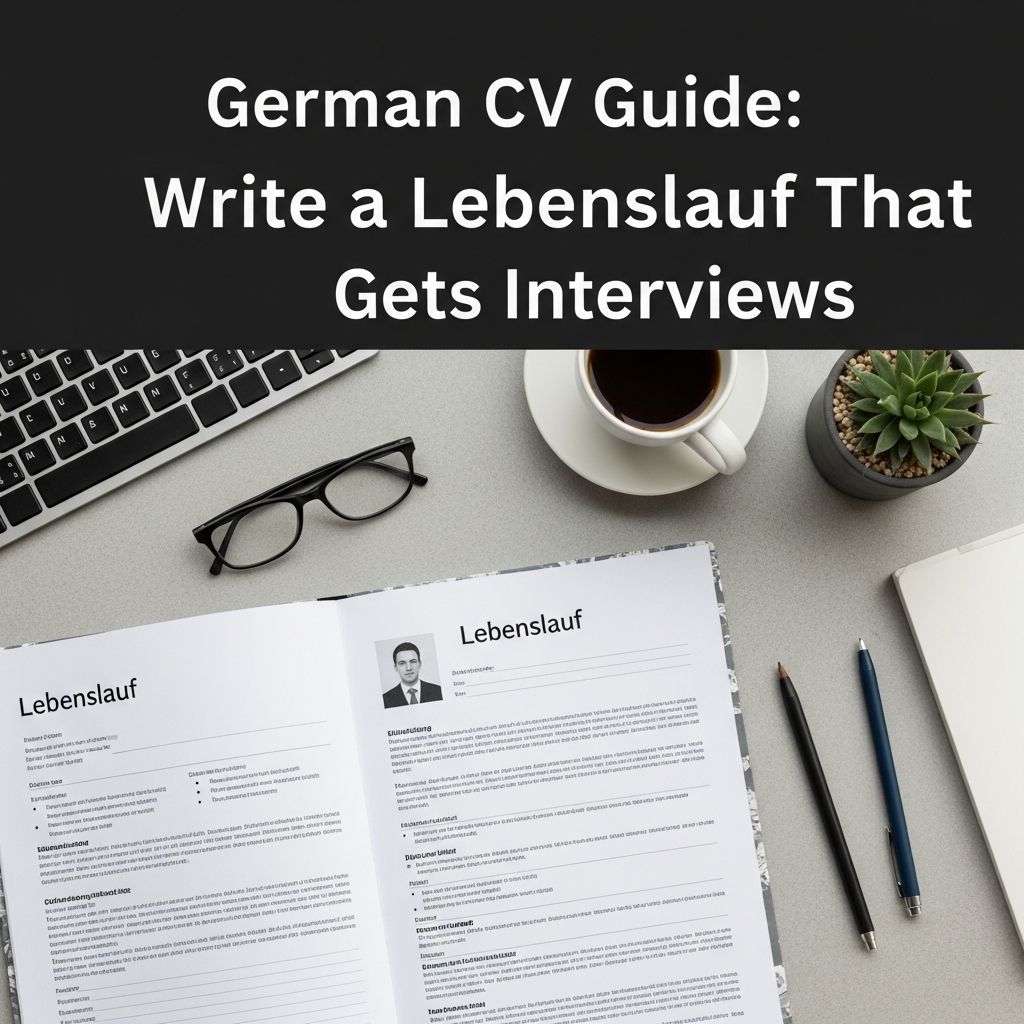
Applying for jobs in Germany means adapting your CV to local expectations. Recruiters are used to a specific document style called the Lebenslauf, and sending a generic international resume can quietly hurt your chances of being shortlisted.
This guide explains how to create a professional German CV from scratch, tailored both to German conventions and to modern hiring practices.
1. Understanding the German CV: What Makes It Different?
While a CV or resume in other countries often focuses on storytelling and design, a German CV is usually more structured, factual, and concise. Recruiters expect to find key information quickly, in a predictable order.
Typical expectations in Germany include:
- Clear chronological structure (usually reverse-chronological).
- Short, factual descriptions of tasks and achievements.
- Standardized headings such as personal details, work experience, education, and skills.
- Consistent dates (month/year) for each role or degree.
- One to two pages for most professionals, even with several years of experience.
Some practices common in Germany may be unusual elsewhere, such as including a place and date at the end of the document or optionally adding a photo. These are not strict legal requirements but still common in many sectors.
2. Choosing the Right Structure and Length
Most job seekers in Germany use a reverse-chronological CV: your most recent role appears first, then you move backwards in time. Functional or purely skills-based CVs are less common and can confuse recruiters.
Recommended length
- Students or recent graduates: 1 page is usually enough.
- Professionals with up to ~10 years of experience: 1–2 pages.
- Senior profiles or academics: 2 pages, occasionally more if justified.
Recruiters in Germany often screen dozens of applications for each role, so a concise, well-structured layout makes a better impression than a long, unfocused document.
3. Essential Sections of a German CV
Most Lebensläufe follow a standard order so that hiring managers can quickly scan for what they need.
| Section | Purpose | Mandatory? |
|---|---|---|
| Personal details | Basic contact information for the application | Yes |
| Professional summary or objective | Short snapshot of your profile and goals | Recommended |
| Work experience | Evidence of relevant skills and achievements | Yes (for non-students) |
| Education | Academic and vocational background | Yes |
| Skills and additional qualifications | Languages, technical abilities, certifications | Yes |
| Optional extras | Hobbies, volunteering, projects, publications | Optional |
4. Personal Details: What to Include (and Skip)
At the top of a German CV, you list your main personal information. The content has evolved in recent years, with less emphasis on private data.
Must-have details
- Full name.
- Current city and country (full address optional if privacy is a concern).
- Professional email address.
- Phone number with international code if applying from abroad.
- Optional: link to a professional profile (e.g., LinkedIn or XING).
Common but optional fields
- Date of birth.
- Nationality, especially if it clarifies work authorization.
- Place of birth (still seen in traditional formats but increasingly optional).
Information to avoid
- Religion or political affiliation.
- Marital status or number of children (not required and can be omitted).
- Full personal ID numbers or other sensitive data.
Photo: yes or no?
Including a professional photo is still common in Germany but not mandatory. A neutral, high-quality headshot with a simple background is preferred if you choose to add one. In very international or tech-focused companies, omitting a photo is more accepted.
5. Writing a Strong Summary or Objective
Directly under your personal details, add a brief paragraph that explains who you are professionally and what kind of role you are targeting. This helps recruiters quickly understand the relevance of your profile.
- Professional summary: Suitable if you already have relevant experience. Focus on years of experience, core areas of expertise, and one or two standout results.
- Career objective: Better for students, recent graduates, or career changers. Emphasize your skills, education, and what type of position you are seeking.
Keep this section to 2–4 concise sentences. Avoid generic claims like “hard-working team player” unless you back them with evidence in your work experience.
6. Work Experience: The Core of Your Lebenslauf
For most applicants, work experience is the most important part of a German CV. Employers expect reverse-chronological order and consistent date formatting.
What to include for each position
- Job title in the local language where appropriate (you can add a translation in brackets if needed).
- Employer name and location (city, country).
- Dates of employment in mm/yyyy format.
- Short description of your main responsibilities.
- 2–5 bullet points highlighting measurable achievements or concrete outcomes.
German recruiters value specific and verifiable information. Instead of writing only “responsible for projects,” highlight what you delivered, managed, improved, or saved.
Tips for strong bullet points
- Start with action verbs (e.g., “implemented”, “optimized”, “coordinated”).
- Include numbers where possible (e.g., percentages, time saved, budget size).
- Connect tasks to results (for example, impact on revenue, quality, or efficiency).
- Keep language factual and avoid exaggeration.
If you have limited formal employment, you can still include internships, student jobs, volunteering, or relevant projects as experience, clearly labeled.
7. Presenting Your Education the German Way
The education section shows your academic and vocational background. In Germany, both university degrees and vocational training (Ausbildung) are recognized pathways into professional roles.
Education entries should include
- Name of the institution and its location.
- Degree or qualification (e.g., B.Sc., M.A., apprenticeship title).
- Field of study or specialization.
- Start and end dates in mm/yyyy format.
- Optional: thesis title or key coursework if directly relevant to the job.
Students and recent graduates can place education before work experience if it is their main selling point. More experienced professionals usually list work first.
8. Skills, Languages, and Additional Qualifications
After your main sections, add a compact overview of skills that are not obvious from your job titles alone.
Language skills
Jobs in Germany often require at least basic German, and sometimes specific levels on the CEFR scale (A1–C2). Including both German and other languages with levels is standard practice.
- Use a clear format such as: German – B2, English – C1.
- If you have formal certificates (e.g., TestDaF, Goethe-Zertifikat), mention them.
Technical and professional skills
- Software and tools (e.g., ERP systems, project management tools, programming languages).
- Specialized methods or frameworks (e.g., Agile, Scrum, CAD, laboratory techniques).
- Professional certifications (e.g., PMP, PRINCE2, industry-specific licenses).
Group related skills together and avoid vague terms such as “good PC skills”; specify tools and levels instead.
Additional qualifications and activities
- Relevant workshops or short courses.
- Volunteering and board roles (especially if they show leadership or responsibility).
- Publications, conferences, or notable projects.
- Hobbies that add value (e.g., “volunteer youth coach” rather than “watching series”).
9. Layout, Formatting, and Language Tips
You do not need a flashy design to be successful in the German job market. Recruiters generally prefer a clean, professional layout with no clutter.
Formatting guidelines
- Use a standard font (e.g., Arial, Calibri) at 10–12 pt size.
- Keep margins and spacing consistent.
- Use bold text sparingly for headings and key elements.
- Avoid long paragraphs; use bullet points for responsibilities and achievements.
- Save and send your CV as a PDF to preserve formatting.
Language choice
- If the job ad is in German, a German-language CV is generally expected.
- For international companies or English-language postings, an English CV may be acceptable; still follow local structure.
- Do not translate proper nouns such as course titles, company names, or degree names; you can add explanations in brackets if helpful.
Always check your CV for correct spelling and grammar. Error-free documents are important in Germany and can influence how your professionalism is perceived.
10. Tailoring Your CV for the German Job Market
Beyond structure and formatting, a strong German CV shows that you have read the job description carefully and addressed its requirements.
How to tailor effectively
- Identify the main skills and qualifications mentioned repeatedly in the job ad.
- Reflect the same terminology (where accurate) in your work experience and skills sections.
- Reorder bullet points so the most relevant achievements appear first.
- Remove or shorten unrelated details that do not support your target role.
Modern hiring processes in Germany often use digital systems to pre-filter applications, so integrating keywords from the job advertisement into your CV can help ensure it passes initial screening.
11. Common Mistakes on German CVs (and How to Avoid Them)
Even strong candidates lose opportunities due to easily avoidable CV issues. When adapting to the German style, watch out for these pitfalls:
- Too much personal information (e.g., marital status, religion) that adds no professional value.
- Unclear dates such as only using years or mixing different formats.
- Unexplained gaps in your timeline. Briefly indicate what you did (e.g., parental leave, language course, job search) rather than leaving blank time.
- Overly creative job titles that make it hard for recruiters to understand your role.
- Long text blocks instead of succinct bullet points.
- Using casual email addresses or unprofessional photos.
A short, honest explanation is usually better than leaving questions open. German employers often appreciate transparency and clarity.
12. Frequently Asked Questions About German CVs
Q1: Is a photo mandatory on a German CV?
No, a photo is not legally required. However, it remains common practice in many sectors in Germany. If you decide to include one, use a professional headshot with neutral background and business-appropriate clothing.
Q2: Should I write my CV in German or English?
Match the language of the job advertisement. If the posting is in German, a German CV shows you can operate in that language. For roles in international companies or ads in English, an English CV is usually acceptable, though German skills should still be listed with their level.
Q3: How do I show my German language level?
Use the CEFR scale (A1–C2) and list it under languages, for example: “German – B2” or “German – C1”. If you hold recognized certificates (e.g., TestDaF, Goethe-Zertifikat), include them to provide formal proof.
Q4: Can my German CV be longer than two pages?
For most roles, especially in the private sector, one to two pages are preferred. Longer documents may be acceptable for senior managers, researchers, or academic CVs, but only if all content is relevant and clearly structured.
Q5: Do I need to sign or date my CV?
Traditional German CVs often ended with a place, date, and handwritten or digital signature. Today this is increasingly optional, but some applicants still include it as a formality. It is rarely a deciding factor, so focus first on content quality and clarity.
References
- How to write a German CV and cover letter — Alumniportal Deutschland. 2023-10-05. https://www.alumniportal-deutschland.org/en/digital-learning/career-development/german-cv/
- German CV Format: Structure, Formatting, and a Step by Step Guide — Fintiba. 2024-02-15. https://www.fintiba.com/germany/working/german-cv
- How to write a German CV — Princeton University German Department. 2022-12-08. https://german.princeton.edu/sites/default/files/2023-01/How%20to%20write%20a%20German%20CV(v.8.12.2022.1).pdf
- How to Write a German-Style CV and Cover Letter That Actually Get You Hired — Expatrio. 2024-01-10. https://www.expatrio.com/about-germany/german-cv-guide
- How to Write a German CV | Full Guide with Examples for 2025 — Novorésumé. 2025-01-01. https://novoresume.com/career-blog/german-cv
- How to Write a CV for the German Market in 2025 — Robert Walters Germany. 2025-03-05. https://www.robertwalters.de/en/insights/career-advice/e-guide/how-to-write-a-cv.html
- How to Build a Resume That Works in Germany (2025 Guide) — F.A. (AbroadSaathi). 2025-01-20. https://abroadsaathi.com/blog/17/how-to-build-a-resume-that-works-in-germany-2025-guide

- Integrated M.A. in Applied Linguistics, University of Hyderabad
- 5+ years in editorial, instructional, SEO, and research-based writing
Sneha is a relationships and lifestyle writer with a strong foundation in applied linguistics and certified training in relationship coaching. She brings over five years of writing experience to theskillvault, crafting thoughtful, research-driven content that empowers readers to build healthier relationships, boost emotional well-being, and embrace holistic living. Her writing and insights reflect the belief that beauty, happiness, and wellness…