
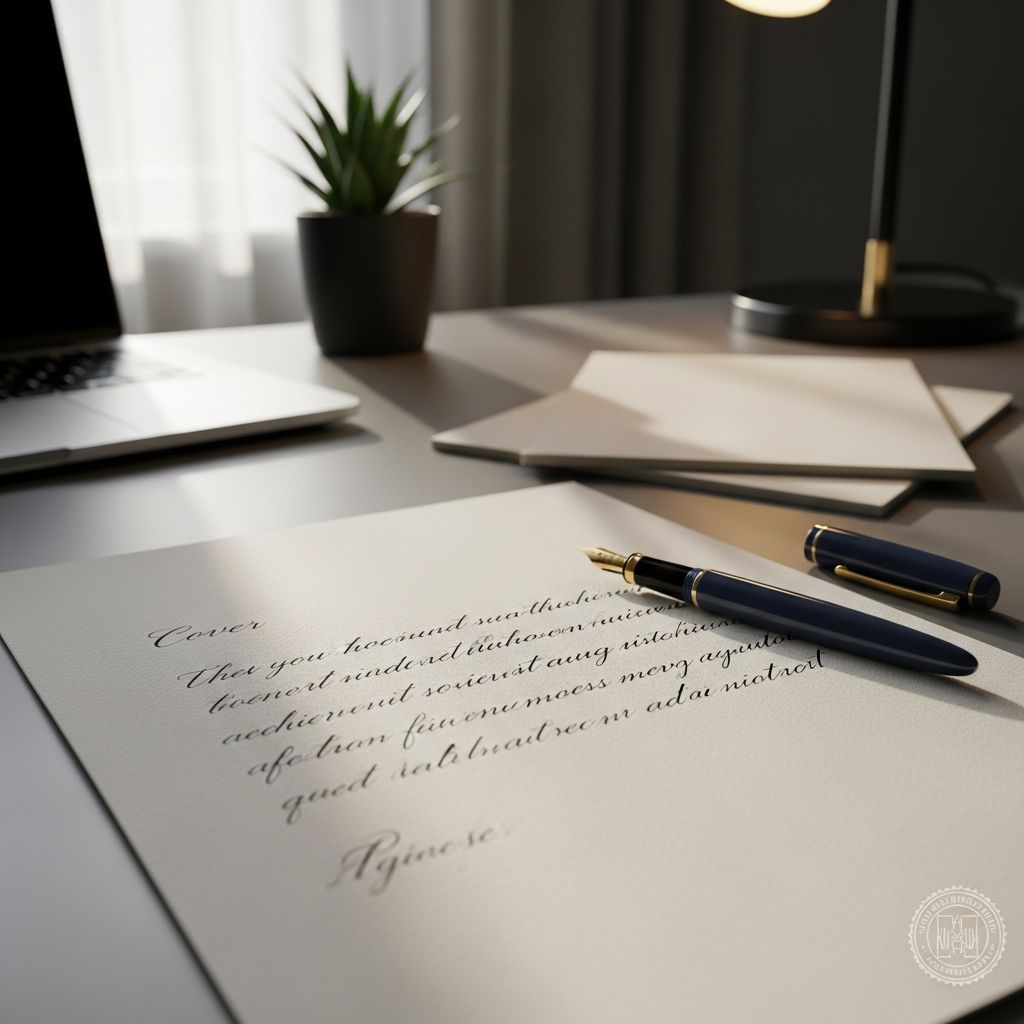
Typed cover letters dominate today’s hiring landscape, but there are still moments when a handwritten cover letter can help you stand out. Used strategically and executed well, it can convey warmth and personality without sacrificing professionalism.
This guide explains when a handwritten cover letter is a smart choice, how to format it correctly, and how to avoid the pitfalls that could hurt your application.
When a Handwritten Cover Letter Makes Sense
Before you put pen to paper, decide whether handwriting truly supports your candidacy. In many fields, employers expect polished, digital materials, but some situations reward a more personal touch.
- When it is explicitly requested: Some employers, especially in small businesses or traditional organizations, may ask for a handwritten letter to evaluate communication style or attention to detail.
- For creative or relationship-focused roles: Design, arts, boutique retail, hospitality, or customer-facing roles may value the added personality of well-done handwriting.
- For follow-up or thank-you notes: After an interview or networking meeting, a brief handwritten note can reinforce your interest and professionalism.
- When company culture is very personal: If a business emphasizes human connection and a small-team feel, a handwritten note can reflect those values.
In contrast, employers in highly technical, regulated, or large corporate environments generally expect typed materials and applicant tracking system (ATS)–friendly documents.
Key Principles of an Effective Handwritten Cover Letter
A handwritten letter should communicate the same core information as a typed cover letter: why you are applying, what you offer, and how to reach you. What changes is the medium, not the substance.
- Professional first, personal second: Warmth is welcome, but clarity, relevance, and structure come first.
- Legibility is non-negotiable: If the reader struggles to decipher your writing, the letter fails no matter how strong the content is.
- Concise and focused: Aim for one page; handwritten text fills space quickly, so be selective with examples.
- Same structure as a typed letter: Contact details, greeting, body paragraphs, closing, and signature should mirror a standard cover letter format.
Choosing the Right Paper and Pen
The materials you use send a strong visual signal about your professionalism before the first line is read.
Paper Guidelines
- Use clean, high-quality paper: Choose plain white or subtle off-white paper with enough thickness that ink does not bleed through.
- Avoid notebook sheets: Torn edges, visible perforations, or decorative pages look informal and undermine your message.
- Standard size: In most regions, use standard business sizes (e.g., US Letter or A4) so your letter fits in a standard folder or file.
Pen and Ink Basics
- Prefer black or dark blue ink: These colors are widely considered professional and are easy to scan or photocopy.
- Skip gel colors and pencil: Bright colors and pencil appear informal and can smudge or fade.
- Test the pen first: Practice on scrap paper to ensure smooth lines and consistent ink flow.
Structuring Your Handwritten Cover Letter
Even when handwritten, your cover letter should follow a recognizable structure so busy readers can quickly find key information.
| Section | Purpose | Key Elements |
|---|---|---|
| Header | Identify you and provide contact details | Name, phone, email, city/state, date |
| Employer Details | Show you know who you are writing to | Hiring manager name (if known), title, company, address |
| Greeting | Open respectfully and personally | “Dear [Name],” or a professional alternative |
| Opening Paragraph | State your purpose and interest | Role title, where you saw it, brief hook |
| Middle Paragraphs | Connect your background to the job | Relevant skills, achievements, alignment with role |
| Closing Paragraph | Summarize and invite next steps | Reiterate fit, express gratitude, suggest follow-up |
| Signature | End formally | Closing phrase and handwritten signature |
Drafting Before You Write by Hand
Because handwritten letters are harder to edit, drafting your content separately greatly reduces mistakes and crossed-out lines.
- Write a full draft digitally: Use a word processor to organize your ideas, check spelling, and refine phrasing first.
- Cut to one page: Remove repetitive phrases and focus on the examples that best match the job description.
- Read it aloud: This makes awkward phrases and long sentences easier to spot.
- Get feedback if possible: Career offices and mentors often recommend peer review to catch unclear statements and errors.
Handwriting for Clarity and Professionalism
Even neat handwriting can become difficult to read in a dense, one-page letter. Intentionally adjust how you write to maximize clarity.
- Write slightly larger than usual: Tiny letters blur together; moderate size improves readability.
- Use consistent spacing: Keep similar gaps between letters, words, and lines to create a clean appearance.
- Print if your cursive is hard to read: Block letters are acceptable if they remain professional and even.
- Take breaks: Hand fatigue leads to sloppy lines and uneven text; pause if your writing quality drops.
- Avoid rushed corrections: Excessive cross-outs, arrows, or squeezed-in lines can distract from your message.
Tailoring Your Message to the Role
Research consistently shows that cover letters are more effective when they are tailored to the specific position and employer, rather than generic.
- Study the job posting: Identify the top three to five skills or responsibilities emphasized.
- Match experiences to requirements: For each priority skill, think of a brief example or result that illustrates your competence.
- Reflect the organization’s language: Use keywords from the posting where they naturally fit, showing alignment with their needs.
- Connect to the mission or culture: In one or two sentences, explain why this employer specifically interests you.
Finishing Touches: Proofreading and Presentation
Minor errors and careless presentation can overshadow strong qualifications. Give your letter a final quality check.
Proofreading Checklist
- Names of people and the company spelled correctly.
- Job title matches the posting.
- Paragraphs are aligned and margins are reasonably even.
- No obvious grammar or spelling mistakes.
- No smudges, stains, or torn edges on the page.
Folding and Sending
- Use an appropriate envelope: Plain, professional, and sized so the letter folds neatly.
- Align with your resume: If you are mailing a resume, ensure the style and content are consistent with your handwritten letter.
- Consider a scanned copy: If you also submit materials online, you may scan the handwritten page for your records or to meet application requirements.
Common Mistakes to Avoid
Awareness of typical errors can help you avoid them before they reach a hiring manager’s desk.
- Unreadable handwriting: If you struggle to read your own writing, assume a busy recruiter will, too. In such cases, a typed letter is the safer choice.
- Overly casual tone: Slang, emojis, and text-message abbreviations can make you appear unprofessional.
- Ignoring standard structure: Skipping a greeting, closing, or contact details makes your application harder to process.
- Using decorative stationery: Bright colors, heavy patterns, or themed paper may distract from your qualifications.
- Excess length: Handwriting often expands page count; keep the letter to a single, focused page.
Sample Outline You Can Adapt
Use this brief outline as a planning tool before drafting your own unique letter.
- Header: Your name and contact information at the top, followed by the date.
- Employer Line: Hiring manager name (if known), title, company, and address.
- Greeting: A professional salutation addressing the correct person or a general but respectful alternative.
- Opening Paragraph: State the role, how you found it, and a concise statement of why you are excited to apply.
- Second Paragraph: Highlight one or two experiences that directly relate to the core responsibilities.
- Third Paragraph (optional): Emphasize cultural fit, soft skills, or specific contributions you can make.
- Closing Paragraph: Reiterate your interest, thank the reader for their time, and mention that you look forward to discussing your fit.
- Sign-off: A formal closing phrase and your handwritten signature above your printed name.
Handwritten vs. Typed Cover Letters: Quick Comparison
| Aspect | Handwritten | Typed |
|---|---|---|
| Impression | Personal, distinctive, but risky if poorly executed | Standard, expected in most modern hiring processes |
| Editing | Difficult; mistakes require rewriting the page | Easy; simple to revise and proofread |
| Compatibility with online systems | Usually scanned or mailed, not ATS-friendly | Designed for uploads and automated screening |
| Best Use Cases | Requested by employer, small or creative organizations, personal notes | Nearly all other job applications |
Frequently Asked Questions (FAQs)
Q: Do employers still want handwritten cover letters?
A: Most employers expect typed cover letters, especially for online applications, but some small businesses or traditional organizations occasionally request handwritten versions as part of their process.
Q: Is a handwritten cover letter unprofessional?
A: It is not inherently unprofessional as long as the employer’s instructions allow it, your handwriting is clear, and you use proper materials, structure, and tone.
Q: Should I handwrite my resume too?
A: No. Resumes are generally expected to be typed so they can be processed electronically and updated easily; career services and universities consistently recommend typed resumes.
Q: What if I make a mistake while writing?
A: Minor corrections may be acceptable, but multiple visible edits look messy. If you make more than one or two noticeable errors, it is better to start over on a fresh page.
Q: How long should a handwritten cover letter be?
A: Aim for a single page with focused content. Handwriting takes more physical space than typed text, so be selective about what you include and prioritize the most relevant experiences.
References
- Handwritten Cover Letter: A Good Idea to Stand Out? — Meet My Job. 2022-03-10. https://www.meet-my-job.com/en/en/articles/handwritten-cover-letter-a-good-idea-to-stand-out-1
- A Complete Guide to Handwritten Cover Letters — Jobseeker. 2023-08-01. https://www.jobseeker.com/en/cover-letter/articles/handwritten-cover-letter
- How to Sign a Cover Letter — Jobscan. 2023-05-15. https://www.jobscan.co/blog/how-to-sign-a-cover-letter/
- Cover Letter — Penn State Student Affairs, Career Services. 2023-01-05. https://studentaffairs.psu.edu/career/resources/marketing-materials/cover-letter
- Cover Letters — Ferrum College Career Services (PDF). 2020-09-01. https://www.ferrum.edu/downloads/careers/cover-letters.pdf

- Integrated M.A. in Applied Linguistics, University of Hyderabad
- 5+ years in editorial, instructional, SEO, and research-based writing
Sneha is a relationships and lifestyle writer with a strong foundation in applied linguistics and certified training in relationship coaching. She brings over five years of writing experience to theskillvault, crafting thoughtful, research-driven content that empowers readers to build healthier relationships, boost emotional well-being, and embrace holistic living. Her writing and insights reflect the belief that beauty, happiness, and wellness…