
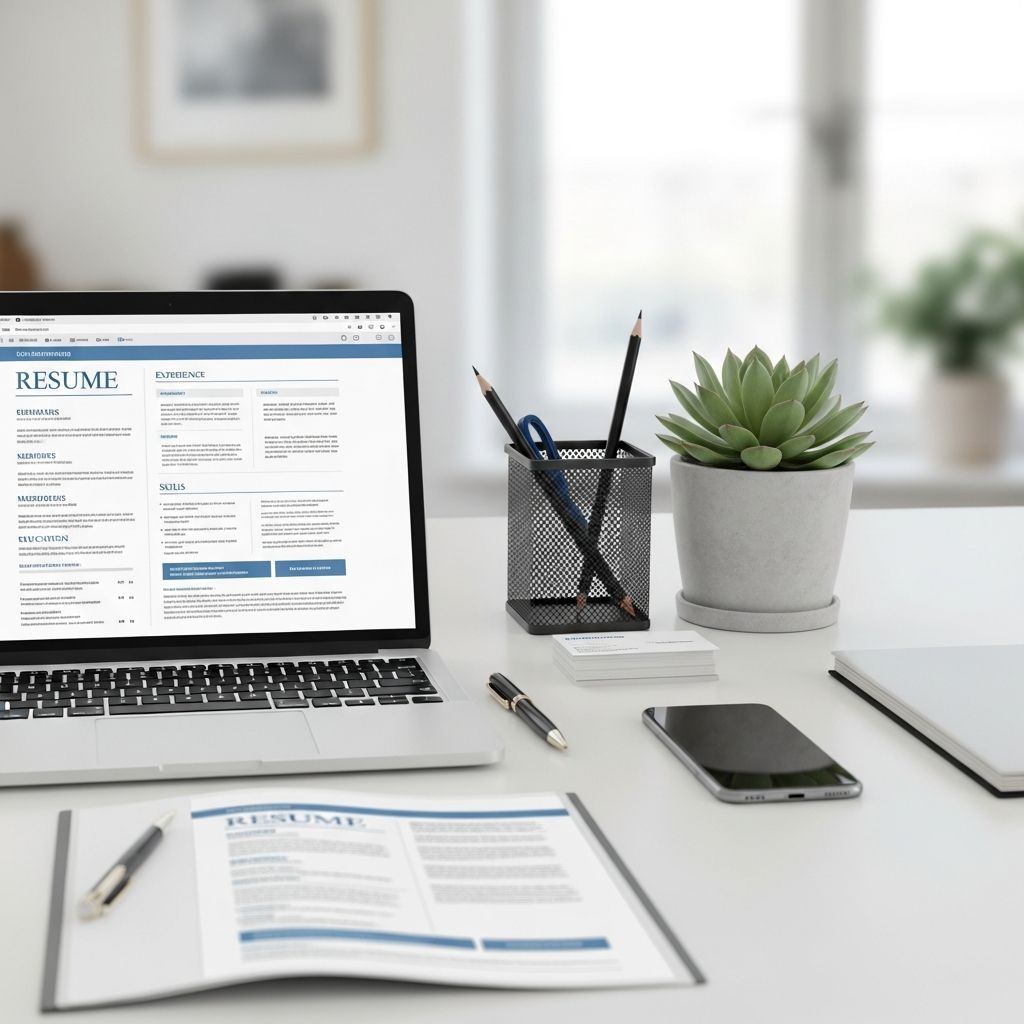
Remote hiring is now mainstream, and employers receive hundreds of applications for a single virtual role. To be noticed, your resume must do more than list job titles: it must prove that you can thrive without direct supervision, communicate clearly online, and deliver results from anywhere.
This guide explains how to create a resume that specifically targets remote positions, even if you have never worked fully remote before. You will learn what to highlight, how to structure each section, and which skills and tools matter most for distributed teams.
1. Clarify Your Remote Work Target Before Writing
Before typing a single line, decide what kind of remote work you are targeting. Clarity will help you choose the right keywords, examples, and metrics.
1.1 Define the Type of Remote Arrangement
Remote work is not one-size-fits-all. Employers use several terms with distinct meanings:
- Fully remote: You never need to visit a physical office; the company may be globally distributed.
- Hybrid: You split time between home and office, often with specific in-office days.
- Work from anywhere: Location-independent with no geographic restrictions, common in globally distributed companies.
- Remote within a region: You must live in a defined country, state, or time zone for legal or scheduling reasons.
Once you know which model fits your needs, you can state it clearly in your resume and align your examples with that expectation.
1.2 Identify the Skills Your Target Role Demands
Analyze 5–10 remote job postings you are interested in and note repeated requirements. Pay attention to both technical and interpersonal skills, such as:
- Specific software (e.g., project management, communication, or CRM platforms)
- Time zone overlap or flexible schedule expectations
- Experience working in distributed or cross-cultural teams
- Self-management, reliability, and written communication
These patterns should shape your wording, bullet points, and skills list.
2. Signal Remote Readiness in Your Contact & Headline
Recruiters often scan your contact details and headline first. Use this space to signal your interest and eligibility for remote work without cluttering the section.
2.1 Contact Information That Works for Remote Roles
At minimum, include:
- Name
- Email (professional address)
- Phone number (with country code for global roles)
- City & country or region (e.g., “Based in Berlin, EU work authorization”)
- Portfolio or LinkedIn URL, especially for knowledge work
To highlight remote interest, you can add a short note such as “Open to full-time remote roles in EU time zones” near your location, rather than writing a full sentence.
2.2 Craft a Headline That Mentions Remote Value
A brief headline under your name can immediately frame you as remote-ready, for example:
- “Senior Product Manager | SaaS & Remote Teams”
- “Customer Support Specialist | Async Communication & Global Customers”
- “Marketing Analyst | Data-Driven Growth & Remote Collaboration”
Keep this line concise and focused on your role plus one or two strengths that matter in remote environments.
3. Write a Summary Focused on Outcomes and Remote Skills
Your resume summary should be a short paragraph or a few bullet points that combine your experience, key achievements, and remote-related strengths.
3.1 Elements of a Strong Remote-Focused Summary
Include:
- Who you are: Role, years of experience, and industry focus.
- Top achievements: 1–3 quantifiable results that show business impact.
- Remote credibility: Mention remote, hybrid, or distributed team experience if you have it.
- Key strengths: Skills crucial for remote success, like self-management or async communication.
Even without prior remote roles, you can highlight relevant behaviors—autonomous projects, cross-location collaboration, or online client work.
3.2 Bullet vs. Paragraph Summaries
For remote roles, brevity and scannability are crucial because recruiters often review resumes quickly. Consider a hybrid summary:
- One concise sentence of context (role, experience, domain).
- Two to three bullets emphasizing achievements and remote-ready skills.
This format makes your profile easy to skim on small screens or applicant tracking systems (ATS).
4. Present Your Experience to Showcase Remote Capability
The work experience section is where you prove that you can deliver results in a remote or semi-remote context. Structure it so both humans and ATS can immediately see your most relevant experience.
4.1 Use a Reverse-Chronological Layout
Recruiters and major job platforms generally prefer a reverse-chronological format, where your most recent role appears first. This is especially important for remote roles because it highlights your current tools and processes, which are likely digital.
4.2 Mark Roles as Remote, Hybrid, or On-Site
For each job entry, include standard elements and note whether it was remote:
- Job title
- Company name
- Company location or “Remote / Hybrid”
- Dates in a consistent format (e.g., mm/yyyy – mm/yyyy)
If only part of your work was remote, you can specify that in a bullet point, such as “Transitioned to fully remote operations in 2021 while maintaining service levels.”
4.3 Turn Remote Duties Into Measurable Results
Remote employers want proof of outcomes, not just responsibilities. For each role, describe how you:
- Managed your workload and deadlines without direct supervision.
- Collaborated across time zones or departments.
- Used online tools to improve efficiency, quality, or customer satisfaction.
- Contributed to team culture or knowledge sharing from a distance.
Whenever possible, quantify impact. Numbers (percentage improvements, revenue, response times, error reductions) make your accomplishments more concrete and trustworthy.
| Weak Remote Bullet | Stronger Remote Bullet |
|---|---|
| “Handled customer chats from home.” | “Resolved 30–40 customer chats per day remotely while maintaining a 95% satisfaction rating.” |
| “Worked with remote team.” | “Coordinated with a 10-person distributed team across 4 time zones using Slack and Trello, cutting project delays by 20%.” |
4.4 Creating a Separate Remote Experience Segment (Optional)
If you have several remote or freelance roles, you may add a small subsection titled something like “Selected Remote Projects” or “Distributed Team Experience.” Use it to group:
- Remote contract work for multiple clients
- Short-term projects delivered fully online
- Volunteer work performed virtually
Ensure this section still uses concrete outcomes, not generic task lists.
5. Highlight Skills That Matter for Distributed Teams
A remote-focused resume must show both domain expertise and the ability to operate in a digital environment. Recruiters look explicitly for certain soft and hard skills when hiring remote workers.
5.1 Core Soft Skills for Remote Success
Consider including and illustrating these core competencies:
- Time management: Planning your day, prioritizing tasks, and meeting deadlines without close supervision.
- Self-motivation: Staying productive despite distractions, especially without external pressure.
- Written communication: Writing concise, clear, and professional messages, crucial for email and chat.
- Accountability: Owning results, admitting mistakes, and following through on commitments.
- Cross-cultural collaboration: Working respectfully with colleagues from different backgrounds.
Do not simply list these traits; use your bullet points in the experience section to show how you practiced them.
5.2 Technical Skills and Tools for Remote Work
Hiring managers also want evidence that you can operate standard remote-work technology. Depending on your role, your skills section might include:
- Communication tools (e.g., video conferencing and chat platforms)
- Project or task management software
- Cloud storage and document collaboration platforms
- CRM, analytics, design, or development tools specific to your field
- Basic cybersecurity awareness, such as using secure passwords and avoiding phishing
Group tools by category to keep the list readable. Only include platforms you are comfortable discussing in an interview.
5.3 Balancing Hard and Soft Skills
Research suggests that both technical and interpersonal skills influence hiring decisions, especially when tasks are complex or collaborative. For remote roles, that balance is even more important because misunderstandings are harder to resolve at a distance. Aim for a skills section that shows:
- Depth in your discipline (analysis, coding, design, teaching, etc.)
- Fluency with digital tools relevant to your role
- Behavioral strengths that keep remote teams functioning smoothly
6. Education, Certifications, and Remote-Friendly Learning
Your education section does not need to be lengthy, but you can emphasize elements that reinforce your ability to learn and work independently.
6.1 Formal Education Basics
Include:
- Degree(s) and field(s) of study
- Institution name and location
- Graduation date or expected graduation
If you are early in your career, you can add relevant coursework, academic projects, or research that aligns with the job description.
6.2 Online Courses and Remote-Specific Training
Massive open online courses and remote learning programs show that you can manage your own learning schedule. You might list:
- Credible online certificates related to your role (e.g., data analysis, UX design, cloud platforms)
- Training in remote collaboration, digital security, or project management
- Workshops on inclusive or cross-cultural communication
Only feature courses from recognized providers and those that are relevant to your target roles.
7. Tailor Your Resume to Each Remote Job Posting
Sending the same generic resume to every remote opening reduces your chances of passing both ATS filters and human screening. Customizing does not require rewriting everything, but you should adjust certain elements.
7.1 Align With the Job Description Keywords
Carefully review each job description and note:
- Skills and tools that appear multiple times
- Key responsibilities and recurring verbs
- Location or time zone constraints
Then reflect these terms in your summary, experience bullets, and skills list where they accurately describe you. This alignment helps your resume match automated filters used by many employers.
7.2 Reorder Content by Relevance
Two versions of your experience may be equally accurate but not equally effective. For each application:
- Move the most relevant accomplishments to the top of each role.
- Emphasize remote collaboration or leadership if the posting stresses distributed teams.
- Downplay older or less relevant experience by reducing bullet points or detail.
This simple reordering can significantly improve how quickly a recruiter recognizes your fit.
7.3 Adapt Location and Availability Information
Remote jobs often specify preferred time zones or legal work locations. To avoid confusion:
- Indicate if you already have work authorization for the company’s region.
- Mention your time zone or typical working hours if overlap is crucial.
- Clarify if you are open to occasional travel for on-site meetings.
Clear information up front can prevent your application from being discarded on eligibility grounds.
8. Formatting Choices That Support Remote Applications
Good formatting is essential for any resume, but remote hiring adds extra constraints because your document will almost always be read digitally and often scanned by ATS technology.
8.1 Keep the Layout Clean and ATS-Friendly
General best practices from large career platforms recommend:
- Using a simple font and standard section headings (e.g., “Experience,” “Education,” “Skills”).
- Avoiding text inside images or complex graphics that ATS cannot read.
- Saving your resume as a PDF or the format requested by the employer.
- Maintaining sufficient white space so the document is easy to scan.
Minimalist formatting also tends to display more reliably on mobile devices, where many recruiters now review candidates.
8.2 Use Bullets Strategically
Bullet points make your achievements easier to digest quickly. Aim for:
- 3–6 bullets for recent roles and 1–3 for older positions.
- One clear idea per bullet, ideally with a result or metric.
- Action verbs at the beginning, such as “led,” “designed,” “negotiated,” or “improved.”
For remote experiences, start bullets with verbs that signal collaboration and ownership, like “coordinated,” “facilitated,” or “implemented.”
9. Frequently Asked Questions About Remote Job Resumes
Q: Do I need remote experience to apply for remote roles?
No. Emphasize experiences where you worked independently, managed your own projects, or collaborated online (e.g., cross-office teams, virtual clients, or online courses). Then connect those experiences to the behaviors remote work requires.
Q: Should I write “remote” in my job titles?
Keep your official job title accurate, but you can add context next to the company location, such as “Company Name – New York (Remote)” or note in a bullet that the role transitioned to remote during a specific period.
Q: How long should a remote job resume be?
For most professionals, one page is ideal; two pages are acceptable if you have over a decade of relevant experience. Focus on impact and recent accomplishments rather than listing every task you have ever performed.
Q: Is a cover letter still useful for remote applications?
Yes. A tailored cover letter lets you explain why you are attracted to remote work with that specific company and how you handle typical remote challenges like communication, focus, and time zone coordination. Use it to complement, not repeat, your resume.
Q: How can I prove I am productive when working from home?
Use measurable achievements from remote or independent work: response times, project delivery dates, quality metrics, revenue generated, or customer satisfaction scores. Describe how your systems, routines, or use of tools helped achieve those results.
References
- Guide to hiring remote workers — International Labour Organization. 2021-09-30. https://www.ilo.org/global/topics/future-of-work/publications/WCMS_824366/lang–en/index.htm
- Telework in the EU: Regulatory frameworks, work organisation and employee well-being — Eurofound. 2020-06-25. https://www.eurofound.europa.eu/publications/report/2020/telework-regulatory-frameworks-work-organisation-and-employee-well-being
- Job search and networking: Résumés and cover letters — Harvard University Office of Career Services. 2022-08-01. https://ocs.fas.harvard.edu/resumes-cvs-cover-letters
- How to write a resume — Indeed Career Guide. 2024-03-15. https://www.indeed.com/career-advice/resumes-cover-letters/how-to-make-a-resume-with-examples
- Cybersecurity for remote workers — Cybersecurity & Infrastructure Security Agency (CISA). 2021-04-06. https://www.cisa.gov/news-events/news/telework-tips
- Skills and employment: Understanding soft skills — Organisation for Economic Co-operation and Development (OECD). 2020-11-10. https://www.oecd.org/skills/topics/skills-and-work/

- Integrated M.A. in Applied Linguistics, University of Hyderabad
- 5+ years in editorial, instructional, SEO, and research-based writing
Sneha is a relationships and lifestyle writer with a strong foundation in applied linguistics and certified training in relationship coaching. She brings over five years of writing experience to theskillvault, crafting thoughtful, research-driven content that empowers readers to build healthier relationships, boost emotional well-being, and embrace holistic living. Her writing and insights reflect the belief that beauty, happiness, and wellness…