
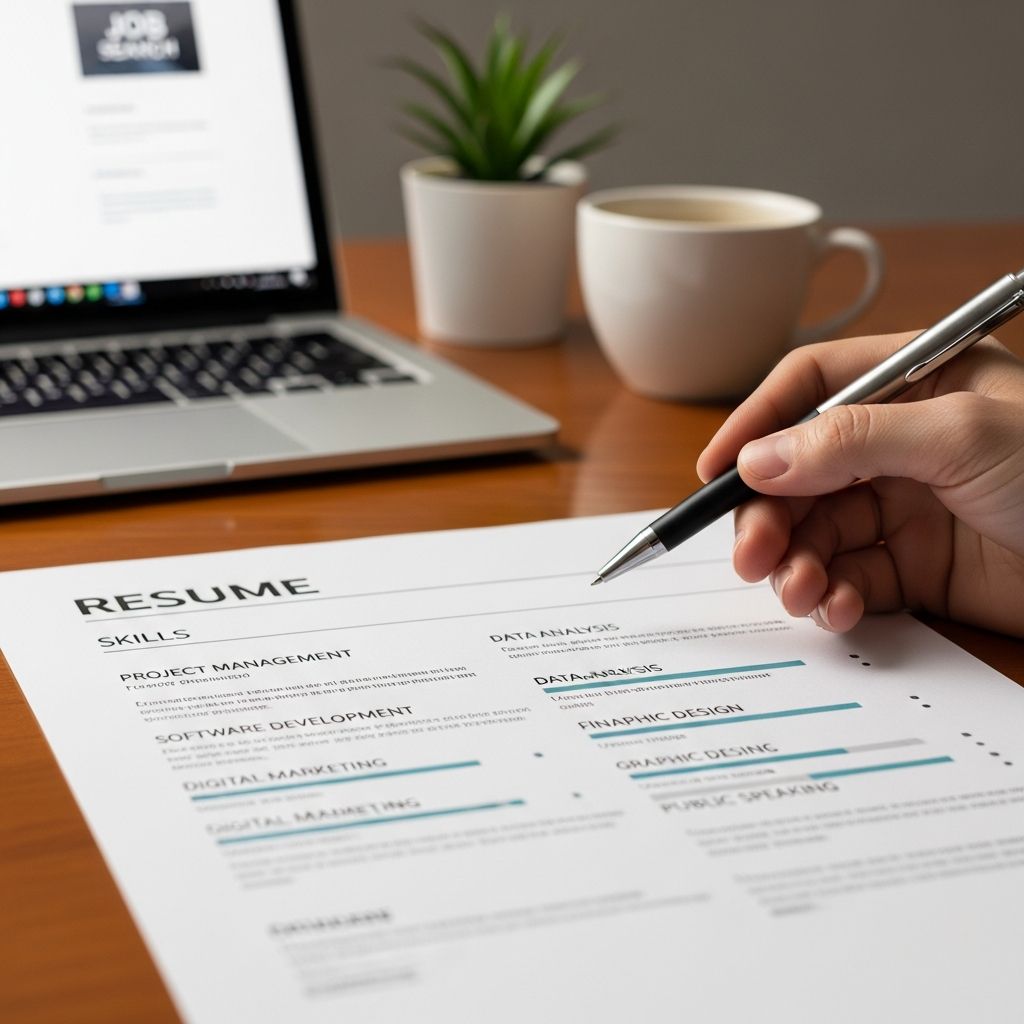
The skills section on your resume is more than a checklist of abilities. When it is thoughtful, targeted, and clearly formatted, it can influence both automated screening systems and human recruiters in your favor. This guide explains how to decide what to include, where to put it, and how to connect your skills to real results.
Why Your Resume Skills Section Matters So Much
Modern hiring processes often start with an Applicant Tracking System (ATS), a tool that scans resumes for specific keywords and qualifications before a human ever sees them.1 If your skills do not match the language of the job description, your resume may not make it to a recruiter even if you are qualified.1
At the same time, career services offices and employer surveys consistently highlight that hiring managers look for evidence of both technical and interpersonal skills—especially problem solving, communication, and teamwork—when evaluating candidates.23
That means your skills section has two jobs:
- Signal relevance to the role using targeted keywords and technical abilities.
- Hint at your broader value by reflecting the core strengths you demonstrate elsewhere on your resume.
Hard Skills vs. Soft Skills: What Recruiters Expect
Most employers want to see a mix of hard skills (job-specific, teachable abilities) and soft skills (interpersonal and self-management traits).3
| Type of skill | What it is | Typical examples | Best place to show it |
|---|---|---|---|
| Hard skills | Technical or domain-specific knowledge you can usually test or measure. | Programming languages, accounting, data analysis, CRM tools, CAD. | Dedicated skills section, plus job bullets where you apply them. |
| Soft skills | Interpersonal and cognitive abilities that affect how you work with others. | Communication, leadership, adaptability, critical thinking, teamwork. | Primarily in work experience bullets; add only a few to skills list. |
Career centers and employer guides emphasize that soft skills are most convincing when supported by examples and outcomes—such as leading a project or resolving conflicts—rather than just listed as traits.23
Deciding Which Skills Belong on Your Resume
Instead of listing everything you know how to do, narrow your skills section to the abilities that matter for a particular role. A practical target is about 6–10 carefully chosen skills that align directly with the job posting.15
Start with the job description
To target your skills effectively, work through the job posting systematically:
- Highlight required skills and technologies mentioned multiple times.
- Note any preferred skills that overlap with your background.
- Pay attention to wording—such as “data analysis” vs. “data analytics”—because ATS tools often look for exact phrases.1
Then compare several similar postings. Skills that appear repeatedly across listings in your field are strong candidates for your resume.
Balance depth and variety
Recruiters want to see depth in a few relevant areas more than a broad but shallow list. Consider grouping your abilities roughly as follows:
- 3–5 core hard skills central to the role (for example, specific tools, methods, or programming languages).
- 2–3 supporting hard or domain skills that complement the core (for example, related frameworks or platforms).
- 1–2 soft skills that you can demonstrate clearly in your experience bullets (for example, leadership, stakeholder communication).
Where to Place Skills on Your Resume
There is no single correct location for a skills section, but your layout should make it easy for both ATS and humans to find your key qualifications.28
- Near the top for early-career candidates or career changers, especially when your skills are your biggest asset.
- After your experience on a traditional chronological resume if your work history already demonstrates your capabilities.1
- In a sidebar on a two-column layout, as long as the text remains ATS-friendly and copyable.
Regardless of placement, use a clear heading such as “Skills,” “Technical Skills,” or “Core Skills” so automated systems recognize the section.1
Formatting a Clean, Readable Skills Section
Career centers and professional resume guides recommend simple, consistent formatting that avoids graphics, images, and unusual design elements that can confuse ATS tools.58
General formatting guidelines
- Use standard fonts (e.g., Arial, Calibri, Times New Roman).
- Keep section headings consistent in size and style across your resume.8
- Present skills in bulleted or clearly separated lists instead of dense paragraphs.
- Avoid graphics, icons, or skill bars that cannot be parsed by ATS tools.5
- Write each skill in plain text (for example, “Python,” “Project management,” “Salesforce”).
Labeling and grouping your skills
Depending on how technical your field is, grouping can make your skillset easier to scan. Common patterns include:
- By type: “Technical Skills,” “Tools,” “Languages,” “Soft Skills.”
- By function: “Data & Analytics,” “Project Delivery,” “Customer Engagement.”
- By domain: “Marketing Skills,” “Finance Skills,” “Clinical Skills.”
Use labels that mirror the language of the job description where appropriate, but keep them clear and straightforward.
Linking Your Skills to Real Outcomes
Your skills section lists what you can do; your experience section should prove it. Career guidance from universities stresses that strong resumes back up key skills with specific examples and measurable impact where possible.2
To connect skills to evidence:
- Identify 3–5 skills that are critical for the role.
- Make sure each one appears in at least one achievement-focused bullet under your work history.
- Start bullets with action verbs, and include outcomes, numbers, or scope when you can.
For example, instead of simply listing “project management” in your skills section, you could support it with a bullet such as:
- “Managed timelines, budgets, and communication for a multi-team initiative, completing all milestones on schedule and within budget.”
This approach demonstrates several skills at once—project management, communication, and organization—without having to name them all in the bullet.
Tailoring Skills for Different Career Situations
The right way to frame your skills depends partly on your background and goals. Here are practical approaches for common scenarios.
Students and recent graduates
If you have limited professional experience, your skills section and education can carry more weight.
- Include coursework, projects, labs, or research that show how you applied your skills.
- List relevant tools or methods you used in class (for example, R, AutoCAD, SPSS).
- Highlight transferable strengths such as collaboration, time management, and presentations, but link them to concrete activities like group projects or campus leadership.
Career changers
When you are moving into a new field, employers look closely at transferable skills—abilities that apply across roles and industries, such as communication, analytical thinking, or stakeholder management.4
- Study target job postings to identify the most valued transferable skills.
- Map your prior experience to those skills (for example, customer service to client relations; teaching to training and facilitation).
- Keep older or less relevant technical skills off the resume unless they directly support your new direction.
Experienced professionals and specialists
For candidates with several years of experience, the skills section should reinforce your positioning rather than attempt to catalog everything you can do.
- Prioritize advanced or in-demand tools and methods that set you apart.
- Remove basic software (like generic office suites) unless explicitly required.
- Use your skills section to reflect your current level—for example, listing architecture-level skills rather than entry-level tasks if you are a senior engineer.
Common Mistakes in Skills Sections (and How to Fix Them)
Even strong candidates undercut their resumes with avoidable errors in the skills section. Here are pitfalls to avoid.
- Being too generic: Long lists of vague traits like “team player” or “hard worker” add little value. Replace them with specific, job-relevant skills and show the rest through your achievements.
- Including outdated tools: Listing obsolete software or methods can make your skillset look dated. Remove anything that is no longer used in your target industry.
- Overstating proficiency: Exaggerating your skill level can backfire during interviews or on the job. If helpful, use simple markers like “advanced,” “intermediate,” or “basic” only when you can back them up.
- Mixing unrelated skills randomly: A scattered list of unrelated abilities makes it harder for recruiters to grasp your strengths quickly. Group related skills together or order them by relevance.
- Ignoring ATS keywords: If the job posting uses specific phrasing (for example, “customer success platforms” or a particular cloud provider), incorporate that language accurately when it reflects your experience.1
Sample Structures for Skills Sections
Below are three sample layouts you can adapt. The actual skills you list will depend on your field and experience level.
Example 1: General professional role
- Skills
- Project management
- Data analysis
- Stakeholder communication
- Process improvement
- Excel & spreadsheets
- Presentation design
Example 2: Technical or IT role
- Technical Skills
- Languages: Python, JavaScript
- Databases: SQL
- Tools: Git, Docker
- Methods: Agile, test automation
- Cloud: Experience with major cloud platforms
Example 3: Career changer focusing on transferable skills
- Core Skills
- Client relationship management
- Training & facilitation
- Conflict resolution
- Written and verbal communication
- Time and priority management
Frequently Asked Questions About Resume Skills
How many skills should I list on my resume?
Aim for about 6–10 targeted skills that are directly relevant to the job. Listing too many can dilute your message and make your resume feel unfocused.15
Should I separate hard and soft skills?
It can help to distinguish them, especially in technical fields, but it is not mandatory. What matters more is that hard skills are clear and specific and that soft skills are supported by examples in your work experience.3
Do I need a skills section if my experience already shows my abilities?
Yes, in most cases. A dedicated skills section makes it easier for ATS tools and busy recruiters to quickly confirm that you meet key requirements, even if your experience is strong.
Can I include skills I am still learning?
You can list skills at a basic or learning level if you are actively building them and would be comfortable discussing your current knowledge in an interview. Avoid presenting them as advanced until you have used them in real projects.
Where else should I highlight my skills besides the skills section?
Weave your strongest skills into your professional summary and your experience bullets. Career guides emphasize using action-oriented bullets to demonstrate how you applied your skills and what results you achieved.13
References
- How to List Skills on a Resume: The Complete 2025 Guide — The Interview Guys. 2024-03-01. https://blog.theinterviewguys.com/how-to-list-skills-on-a-resume/
- CREATE A STRONG RESUME — Mignone Center for Career Success, Harvard University. 2022-08-15. https://careerservices.fas.harvard.edu/resources/create-a-strong-resume/
- Resumes — UC Davis Career Center. 2023-05-10. https://careercenter.ucdavis.edu/resumes-and-materials/resumes
- 10 Best Skills To Put On Your Resume (With Examples and FAQ) — Indeed Editorial Team. 2023-11-07. https://www.indeed.com/career-advice/resumes-cover-letters/best-resume-skills
- 10 essential resume skills to showcase your value to employers — YouScience. 2023-04-20. https://www.youscience.com/resources/blog/skills-to-put-on-a-resume/
- How to Feature Key Skills on Your Resume — Coursera Career Resources. 2022-09-30. https://www.coursera.org/articles/resume-skills-section

Medha Deb is an editor with a master's degree in Applied Linguistics from the University of Hyderabad. She believes that her qualification has helped her develop a deep understanding of language and its application in various contexts. Medha specializes in the areas of beauty, health, sports, and wellness and is committed to ensuring that the content on the website is…