
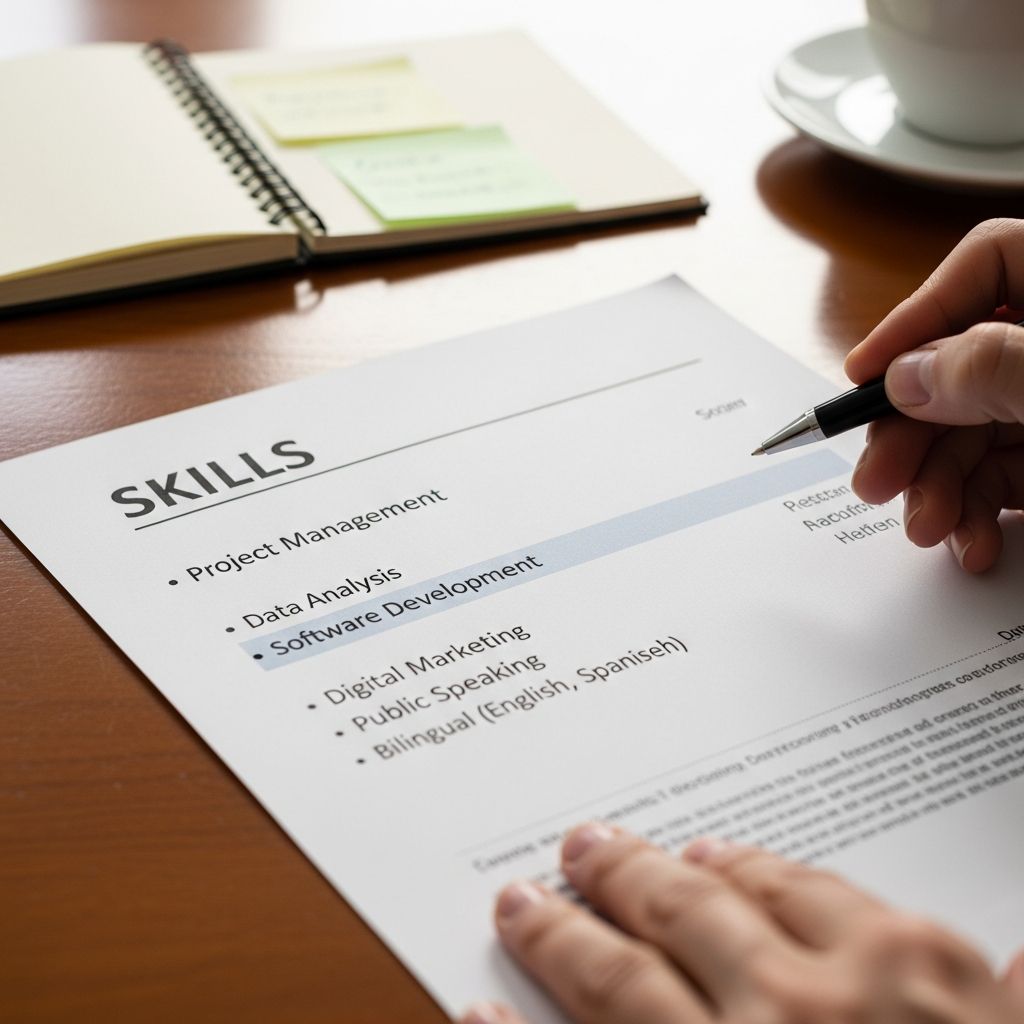
Your resume skills section is one of the first places employers and applicant tracking systems (ATS) look to decide whether you deserve an interview. When it is thoughtful, targeted, and clear, it can quickly position you as a strong match. When it is vague or generic, it can cause an otherwise solid resume to be ignored.
This guide walks you through how to decide which skills to include, how to format them, and how to support them with evidence throughout your resume.
Why Your Skills Section Matters More Than You Think
Most organizations now use some form of automated screening before a human reviews your resume. These systems scan for specific keywords and phrases taken directly from the job description, especially in sections labeled “Skills,” “Technical Skills,” or “Core Competencies.” At the same time, hiring managers skim resumes quickly and rely on the skills section to confirm that you can do the job.
- ATS screening: Skills written using the same language as the job description can improve your chances of passing automated filters.
- Human review: Clear and organized skills help recruiters decide in seconds whether to keep reading.
- Focus: Limiting yourself to the most relevant skills forces you to highlight what truly sets you apart, rather than everything you have ever tried.
Understanding Types of Skills Employers Look For
To build a strong skills section, you need to distinguish between the main categories of skills you can list on your resume.
Hard Skills
Hard skills are technical or job-specific abilities that are usually measurable or teachable, such as software tools, methods, or domain knowledge.
- Programming languages (for example, Python, Java)
- Financial modeling or budgeting
- Data analysis and visualization
- Foreign languages
- Graphic design tools
These skills are often explicitly listed in job descriptions as requirements or preferred qualifications.
Soft Skills
Soft skills are interpersonal and behavioral abilities that influence how you work with others and approach your tasks.
- Communication and active listening
- Teamwork and collaboration
- Problem-solving
- Leadership
- Time management
Employers consistently name communication, collaboration, and problem-solving as critical across many roles. However, these skills are more convincing when you demonstrate them through concrete achievements rather than just listing them as words.
Transferable Skills
Transferable skills are abilities that apply across multiple jobs or industries, such as project management, client communication, or data literacy. They are especially important if you are changing careers or applying for roles outside your current field.
| Skill Type | Examples | Best Place to Show It |
|---|---|---|
| Hard skills | SQL, Excel, CAD, bookkeeping, CRM tools | Skills section, work experience bullets, certifications |
| Soft skills | Leadership, adaptability, collaboration | Work experience achievements, summary statement |
| Transferable skills | Project management, research, analysis | Summary, skills section, accomplishments across roles |
How Many Skills to Include (and Which Ones)
Rather than listing every tool you have ever used, focus on a concise, targeted set of skills.
- Aim for 6–10 core skills that closely match the job you are applying for.
- Prioritize skills that appear repeatedly across similar postings for the same role.
- Exclude outdated tools, very basic abilities, or skills unrelated to the position.
Start With the Job Description
The job description is your roadmap. Review it carefully and highlight:
- Skills labeled as required or must-have
- Technical tools or methods mentioned multiple times
- Core soft skills emphasized in responsibilities, such as leading teams or managing stakeholders
Then cross-check this list with your experience and select the skills you can genuinely demonstrate.
Match the Employer’s Language
When two terms describe the same thing, use the wording from the job posting so that both human readers and ATS recognize the match.
- If the posting says “stakeholder management”, prefer that phrase over “client relations”.
- Include both the full term and its acronym when relevant (for example, “Search Engine Optimization (SEO)”).
Where to Place Skills on Your Resume
The ideal placement for your skills depends on your experience level and resume style, but there are common patterns that work well for most candidates.
Dedicated Skills Section
Most resumes benefit from a clearly labeled skills section. Common headings include:
- Skills
- Technical Skills
- Core Competencies
Career centers often recommend using straightforward section headings because they are easier for scanners and ATS to interpret.
Summary or Profile Section
A brief professional summary at the top of your resume can highlight two or three of your strongest skills in a single sentence, such as technical expertise or domain knowledge.
- This helps hiring managers see your strengths immediately.
- It also reinforces important keywords early in your document, which may help with some ATS configurations.
Work Experience
Your experience section is where you prove that the skills you list are real. Major career centers and recruiters encourage you to show your skills through specific actions and outcomes rather than broad claims.
- Include at least two key skills in each role and tie them to measurable results when possible.
- Use strong action verbs such as “implemented,” “designed,” “led,” or “reduced” to introduce your bullet points.
Formatting Options for an Effective Skills Section
Your formatting should make it easy to see your main skills at a glance while keeping the layout simple and ATS-friendly.
Simple Bulleted List
This is the most common option and works for nearly every resume:
- Use one column with short bullet points.
- Group similar skills together if you have many technical tools.
- Keep each skill to one or two words where possible.
Grouped by Category
If you have a wide range of abilities, you can divide them into categories, such as:
- Technical: Programming languages, platforms, software
- Analysis: Data analysis, statistics, reporting
- Languages: English (native), Spanish (advanced)
Career resources note that grouping skills and organizing them by relevance can help employers quickly identify strengths aligned with their needs.
Placement within the Page Layout
Universities and career centers recommend a clean layout with clear headings and bullet points so that your skills are easy to find and read.
- Use consistent font styles and bullet formatting across the document.
- Avoid graphics, skill bars, or complex tables that some ATS might not parse correctly.
How to Prove Your Skills with Evidence
A skills section alone will not convince employers. You need to support those claims with achievements throughout your resume.
Connect Skills to Measurable Impact
Recruiters often look for metrics, data, or outcomes that show how your skills created value.
- Link skills to increased revenue, reduced costs, improved efficiency, or higher quality.
- Include numbers when possible (for example, percentages, time saved, number of people impacted).
Show Soft Skills Through Situations
Instead of listing general traits like “team player” or “good communicator,” demonstrate them in context.
- Leadership can appear as: “Led a cross-functional team to deliver a major project ahead of schedule.”
- Communication can appear as: “Presented findings to senior leadership and secured approval for a new initiative.”
Be Honest and Current
Only list skills that you could comfortably discuss or demonstrate in an interview. If a skill is rusty, either refresh it or leave it off.
Common Mistakes to Avoid in the Skills Section
Even strong candidates sometimes undermine their resumes with avoidable errors. Watch out for the following issues:
- Overstuffing: Listing 20 or more skills without clear priority can make you look unfocused.
- Irrelevant skills: Including unrelated hobbies or very basic abilities (for example, “email” as a skill) distracts from what matters.
- Vague terms: Phrases like “hard worker” or “fast learner” are better demonstrated in accomplishments than placed in a skills list.
- Inconsistent wording: Using several different labels for the same skill can dilute your message and confuse scanners.
- Unclear proficiency: If language skills or technical tools vary by level, indicate which are advanced versus basic.
Adapting Your Skills Section for Different Situations
Your core abilities might stay the same, but the way you present them should shift depending on your experience level and career goals.
Students and Recent Graduates
- Highlight coursework, projects, and extracurricular activities where you used relevant skills.
- Emphasize foundational technical and transferable skills such as research, analysis, and teamwork.
- Place the skills section higher on the page if your work history is limited.
Experienced Professionals
- Focus on advanced tools, leadership abilities, and industry-specific expertise.
- Trim basic or entry-level skills that no longer distinguish you.
- Make sure your most important skills are reflected in major achievements within your work experience.
Career Changers
- Identify transferable skills that connect your past roles to your new target field.
- Use the skills section to bridge gaps while you gather more industry-specific experience.
- Draw from volunteer work, training, or self-directed projects to support new technical abilities.
Simple Checklist for a Strong Resume Skills Section
Before you submit your next application, review your resume against this quick checklist:
- My skills section contains roughly 6–10 closely targeted skills.
- Every skill directly relates to the job description or the broader requirements of the role.
- I use the employer’s language for skills and include key terms from the posting.
- My layout is clean, consistent, and easy to scan, with clear headings and bullets.
- Each important skill appears at least once more in my summary or work experience with evidence to back it up.
Frequently Asked Questions About Resume Skills
How many skills should I list on my resume?
For most roles, include about six to ten carefully chosen skills that align with the job description. Career resources commonly recommend focusing on a smaller set of targeted, relevant skills rather than long, generic lists.
Should I separate hard and soft skills?
You can, but you do not have to. Many candidates either group skills under headings such as “Technical” and “Languages” or mix them in one list while relying on work experience to prove soft skills. What matters most is clarity and relevance.
Can I include skills I am still learning?
You can list skills in which you have basic proficiency, but be ready to demonstrate them. If you are only beginning to explore a topic, it is better to leave it off until you can speak about it with confidence.
Where should the skills section go on my resume?
Most candidates place it after the summary and before or after work experience, depending on layout. If you are an early-career applicant, you might move it higher on the page. The key is that it is clearly labeled and easy to find.
Do I need to change my skills for every application?
Yes, at least slightly. Tailoring your skills section to each posting ensures that it reflects the employer’s exact requirements and language. Career advisors and recruiters strongly encourage customizing your resume rather than sending the same version to every role.
References
- How to List Skills on a Resume: The Complete 2025 Guide — The Interview Guys. 2025-01-10. https://blog.theinterviewguys.com/how-to-list-skills-on-a-resume/
- 10+ Resume Best Practices: A Complete Guide For Every Section — Teal. 2024-06-15. https://www.tealhq.com/post/resume-best-practices
- 10 Best Skills To Put On Your Resume — Indeed Career Guide. 2023-08-30. https://www.indeed.com/career-advice/resumes-cover-letters/best-resume-skills
- 10 Essential Resume Skills To Showcase Your Value To Employers — YouScience. 2023-05-02. https://www.youscience.com/resources/blog/skills-to-put-on-a-resume/
- Skills to Put on a Resume Employers Will Actually Read — Robert Half. 2024-02-21. https://www.roberthalf.com/us/en/insights/landing-job/skills-that-will-make-your-resume-pop
- Create a Strong Resume — Harvard University, Mignone Center for Career Success. 2023-09-05. https://careerservices.fas.harvard.edu/resources/create-a-strong-resume/
- Resumes — UC Davis Career Center. 2023-04-18. https://careercenter.ucdavis.edu/resumes-and-materials/resumes

Medha Deb is an editor with a master's degree in Applied Linguistics from the University of Hyderabad. She believes that her qualification has helped her develop a deep understanding of language and its application in various contexts. Medha specializes in the areas of beauty, health, sports, and wellness and is committed to ensuring that the content on the website is…