
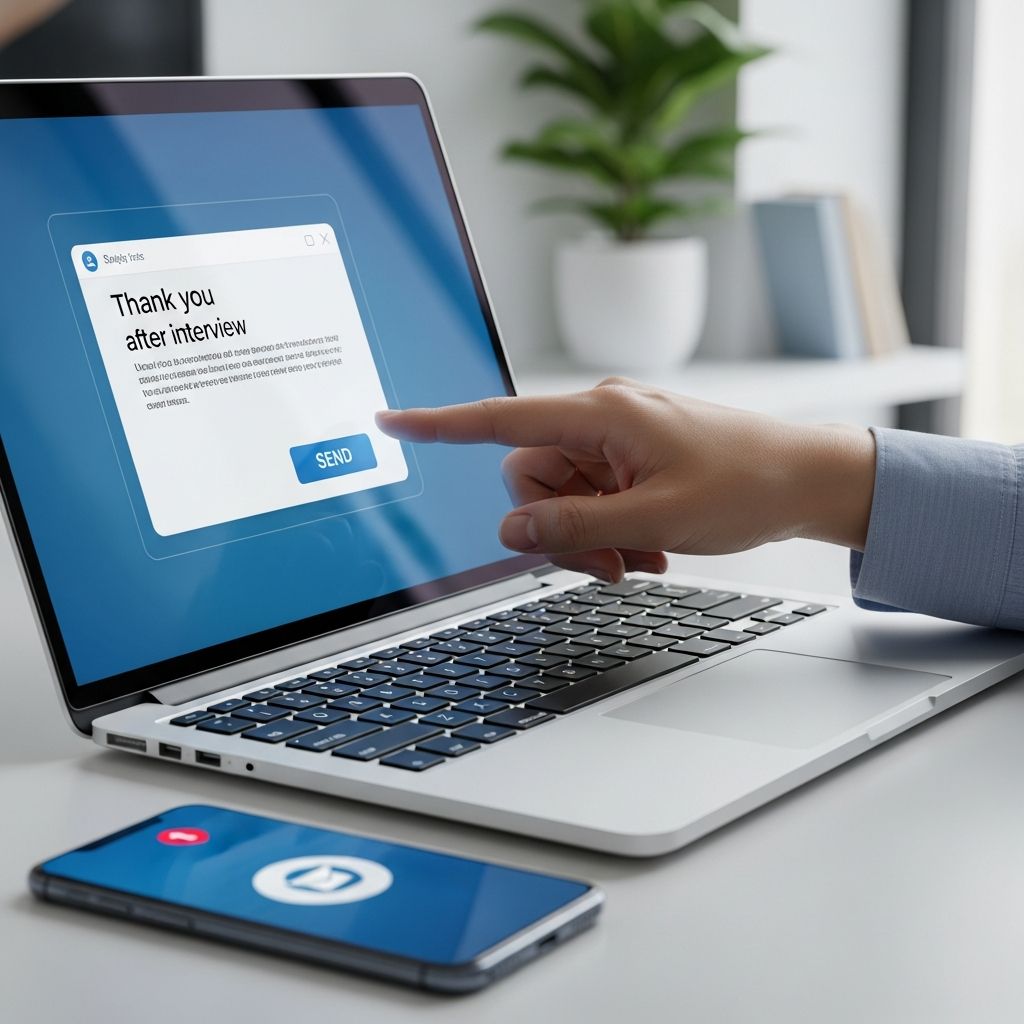
Sending a thoughtful thank-you email after an interview is one of the simplest ways to reinforce your interest, highlight your fit, and stay memorable in a competitive hiring process. While it may seem like a formality, research shows that follow-up communication can positively influence hiring decisions because it signals professionalism, motivation, and strong communication skills.
Why a Post-Interview Thank-You Still Matters
A post-interview thank-you is more than polite etiquette. It is a brief, strategic message that can influence how a hiring manager remembers you compared with other finalists.
- Shows professionalism: Following up promptly demonstrates reliability and respect for the interviewer’s time.
- Reinforces your interest: Employers often look for candidates who are both qualified and genuinely motivated to join the organization.
- Clarifies your fit: You can connect your skills more directly to what you learned about the role during the conversation.
- Corrects or adds information: If you forgot to mention something or want to clarify an answer, the thank-you email is an appropriate place to do it.
- Keeps you top of mind: When hiring teams debrief, your recent message can help them recall your strengths more easily.
When and How to Send Your Thank-You
Timing and delivery method influence how your message is received. Employers and career centers consistently recommend sending your note quickly while the conversation is still fresh.
| Aspect | Best Practice | Notes |
|---|---|---|
| Timing | Within 24 hours of your interview | Same day is ideal; no later than the end of the next day. |
| Format | Fastest and most common; suitable for nearly all professional roles. | |
| Additional touch | Optional handwritten note | May be appropriate for highly relationship-driven fields; use in addition to, not instead of, email. |
| Recipients | Each person you met with | Send individual, customized messages rather than one generic group email. |
Core Elements of an Effective Thank-You Email
Most strong thank-you emails share a similar backbone. Think in terms of clear, short sections rather than rigid templates.
1. Clear Subject Line
Your subject line should quickly communicate the purpose of your message.
- Keep it simple: Examples include “Thank you for the conversation” or “Thank you for meeting today.”
- Include context when helpful: Adding the role title can help busy hiring managers (e.g., “Thank you – Data Analyst interview”).
2. Professional Greeting
Address the interviewer the way they introduced themselves, keeping formality consistent with your interaction.
- Formal environments: “Dear Ms. Lopez,” or “Dear Dr. Chen,”
- More casual or startup settings: “Hi Alex,” or “Hello Jordan,”
3. Direct Expression of Thanks
Open with a concise, genuine thank-you. Reference the specific meeting to anchor their memory.
- Example phrasing: “Thank you for taking the time to speak with me about the Marketing Manager role yesterday.”
- Avoid overdoing it—one clear sentence of appreciation is usually enough.
4. Personalized Connection to the Conversation
A strong thank-you note does more than repeat your resume. It reflects something unique about your discussion.
- Mention a topic you found insightful, such as the team’s goals, a challenge they described, or an initiative they are launching.
- Reference something the interviewer shared about their own experience or the company culture.
- Briefly tie that detail to why you are excited about the position.
5. Reinforcement of Your Fit
Use one short paragraph to connect your most relevant strengths to what the team needs.
- Highlight two or three key qualifications that match the role (e.g., domain expertise, leadership, technical skills).
- Frame your skills in terms of outcomes, such as improving processes, driving revenue, or supporting a mission.
- If appropriate, clarify or expand on an answer you gave during the interview.
6. Clear Next-Step Signal
Close by signaling your continued interest and making it easy for them to move forward.
- Reiterate that you are enthusiastic about the opportunity.
- Offer to provide additional information, such as references, work samples, or a portfolio.
- Use a confident but not pushy closing line, such as “I look forward to hearing about next steps.”
7. Polite Closing and Signature
End with a professional sign-off and complete contact information.
- Closings that work well: “Best regards,” “Sincerely,” or “All the best.”
- Include your full name, phone number, and relevant links (portfolio, LinkedIn) under your signature.
Adapting Your Thank-You for Different Interview Types
The core structure stays similar across situations, but tone and details should vary slightly based on who you spoke with and how.
Thank-You to a Recruiter or HR Professional
Recruiters often focus on overall fit, communication skills, and logistics rather than deep technical details.
- Emphasize your overall interest in the company and role.
- Show that you are responsive and easy to coordinate with.
- Confirm any follow-up items or timelines discussed.
Thank-You to a Hiring Manager
Hiring managers care most about how you will solve their team’s problems.
- Reference specific challenges, goals, or metrics they mentioned.
- Connect your experience directly to those needs (e.g., leading projects, improving operations).
- Demonstrate that you understand the role’s priorities, not just its tasks.
Thank-You to Senior Leaders or Executives
Executives are typically focused on impact, vision, and long-term value.
- Emphasize how you can contribute to broader organizational goals, not only day-to-day duties.
- Show that you grasp the company’s strategy, mission, or market position.
- Keep the message especially concise and high-level.
Thank-You After Panel or Group Interviews
In a panel interview, try to obtain the names and emails of every participant.
- Send a separate, personalized note to each person.
- Mention something that stood out from your interaction with that individual (e.g., their description of the team, their questions).
- Avoid copying and pasting the same text; small customizations make a difference.
Common Mistakes to Avoid
Certain missteps can weaken your message or even harm your candidacy. Fortunately, they are easy to avoid with a simple review.
- Waiting too long: A thank-you sent a week later loses most of its impact and may signal a lack of urgency.
- Overly long emails: A full page of text can feel burdensome. Aim for a few short paragraphs rather than an essay.
- Generic copy-paste messages: Notes that could have been sent to any interviewer at any company rarely make a strong impression.
- Over-selling or sounding desperate: Express enthusiasm, but avoid begging for the job or overusing flattery.
- Typos and errors: Spelling the company or interviewer’s name incorrectly can undermine your professionalism.
- Overly casual tone: Unless the culture is clearly informal, err on the side of professionalism in greetings, wording, and sign-off.
Strategic Ways to Use Your Thank-You Email
Beyond courtesy, your message can play a tactical role in how you are evaluated. Use it intentionally to strengthen your candidacy.
Highlighting a Unique Value Point
Interviews move quickly, and it is common to leave wishing you had emphasized one more example or metric.
- Use one sentence to spotlight a particularly relevant achievement.
- Connect that achievement to a challenge or goal the team discussed.
- Keep it concise—your email should complement the interview, not redo it.
Clarifying an Uneven Answer
If you stumbled on a question or left something unclear, the thank-you email can provide a brief correction.
- Take ownership without over-explaining.
- Offer a short, clearer version of your response.
- Place this clarification in the middle of the email, surrounded by positive, forward-looking statements.
Linking to Relevant Work Samples
For roles that value a portfolio or tangible work, your email is an appropriate place to add or re-share links.
- Include a link to a portfolio, Git repository, writing samples, or case studies when relevant.
- Briefly explain what the recipient will see and why it is relevant.
- Do not overload the message with attachments; one or two items are usually sufficient.
Simple Example Structures You Can Adapt
Instead of rigid templates, think of flexible patterns you can customize to fit your experience and industry.
Concise Follow-Up Structure (Early-Round Interview)
- Subject line: Clear and brief.
- Opening: One sentence of thanks referencing the role and date.
- Middle: Two to three sentences mentioning a key part of the conversation and reinforcing a couple of strengths.
- Closing: One or two sentences expressing enthusiasm and openness to provide more information.
More Detailed Structure (Final-Round or Complex Role)
- Subject line: Thank-you plus role title for context.
- Opening: Direct thanks and appreciation for the time and insight provided.
- Paragraph 1: Reference to specific discussions (strategy, challenges, culture) that resonated with you.
- Paragraph 2: Brief alignment of your skills and experience with the top needs they described.
- Optional line: Clarification of any answer or short highlight of an additional relevant accomplishment.
- Closing: Reaffirmation of interest and a polite note about looking forward to next steps.
Checklist: Review Before You Hit Send
Use this quick checklist to ensure your email is polished and ready.
- Have you spelled the interviewer’s name and the company name correctly?
- Is your subject line clear and professional?
- Did you thank them explicitly in the first sentence?
- Have you mentioned at least one specific detail from your conversation?
- Did you connect your skills clearly to the role?
- Is the tone appropriate for the organization’s culture?
- Have you proofread for grammar, spelling, and formatting issues?
- Is the entire email short enough to read in under a minute?
Frequently Asked Questions About Post-Interview Thank-You Emails
Do employers really care if I send a thank-you email?
Hiring managers vary, but many report that a thoughtful thank-you can positively influence their perception of a candidate, especially in close decisions. It signals professionalism, attention to detail, and genuine interest—traits most employers value.
What if I forget to send a thank-you within 24 hours?
Earlier is best, but sending a late note is still better than sending nothing at all. Acknowledge the delay only briefly if it feels necessary, then focus the message on appreciation and enthusiasm rather than apologies.
Is it acceptable to send the same message to multiple interviewers?
It is acceptable to reuse the overall structure, but you should personalize at least a few lines for each person. Referencing a question they asked or a topic you discussed helps each note feel authentic and thoughtful.
Should I send a handwritten note instead of an email?
Email is the default because it arrives quickly and can be attached directly to your candidate record in an applicant tracking system. A handwritten card can be a nice supplement in highly relationship-driven or traditional fields, but it should not replace the email.
Can sending a thank-you email ever hurt my chances?
Only if it includes significant errors or crosses boundaries—for example, using an inappropriately informal tone, making demands, including confidential information, or sending a message with multiple typos and incorrect names. A short, careful note is highly unlikely to harm your candidacy.
What if the interviewer told me they do not expect a thank-you?
In that case, keep your message especially concise and low-pressure. A brief email expressing appreciation for the conversation and summarizing your interest is unlikely to be viewed negatively, but you can skip additional follow-ups unless invited.
References
- How to Write a Thank You Email After an Interview (with Examples) — Harvard Business Review. 2022-11-22. https://hbr.org/2022/11/how-to-write-a-thank-you-email-after-an-interview
- 4 Sample Thank-You Emails To Send After an Interview — Indeed Career Guide. 2022-05-18. https://www.indeed.com/career-advice/interviewing/sample-thank-you-letter-after-interview
- Thank You Letter After Interviewing — San Francisco State University Career Center. 2018-01-01. https://career.sfsu.edu/sites/default/files/documents/06%20-%20Thank%20You%20Letter%20After%20Interviewing.pdf
- After Interview Thank You Email — Wall Street Oasis. 2020-06-15. https://www.wallstreetoasis.com/forum/job-search/after-interview-thank-you-email
- How to Write a Thank-You Email After an Interview (with Samples!) — The Muse. 2023-03-10. https://www.themuse.com/advice/how-to-write-an-interview-thankyou-note-an-email-template

- Integrated M.A. in Applied Linguistics, University of Hyderabad
- 5+ years in editorial, instructional, SEO, and research-based writing
Sneha is a relationships and lifestyle writer with a strong foundation in applied linguistics and certified training in relationship coaching. She brings over five years of writing experience to theskillvault, crafting thoughtful, research-driven content that empowers readers to build healthier relationships, boost emotional well-being, and embrace holistic living. Her writing and insights reflect the belief that beauty, happiness, and wellness…