
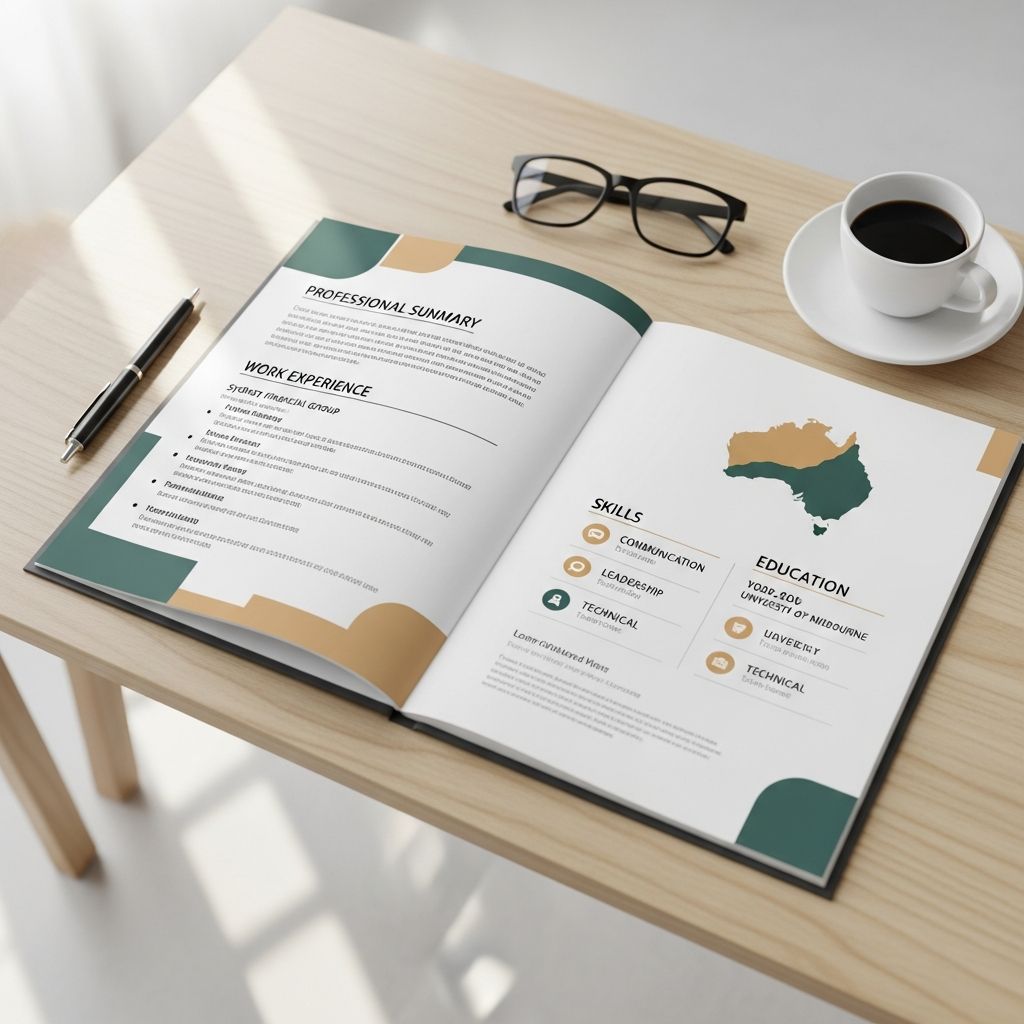
An effective Australian resume does more than list where you have worked. It clearly shows how your experience fits the role, follows local conventions, and makes it easy for recruiters and applicant tracking systems (ATS) to spot your value.
This guide walks you through the structure, style, and content expected on a resume in Australia, with practical tips and examples you can adapt to your own situation.
1. What Makes an Australian Resume Different?
While CVs around the world share common elements, the Australian market has some preferences that are worth following if you want to be taken seriously.
- Terminology: In Australia, people use both resume and CV for job applications in the private sector. Academic and research roles often expect a longer, more detailed CV.
- Length expectations: For early career candidates, 1–2 pages is common; mid to senior professionals often use 2–4 pages when content is relevant and achievement-focused.
- Language: Use Australian/British English spelling (e.g., “organise”, “recognise”, “programme”) rather than American spelling.
- Photo and personal details: It is standard to omit photos, marital status, date of birth, and other sensitive personal information to support fair hiring practices and anti-discrimination laws.
- Focus on impact: Recruiters expect achievement-focused statements rather than long lists of duties.
2. Ideal Resume Length, Layout, and File Format
Before you type a single word, decide how you will structure the document on the page.
2.1 Recommended Length by Career Stage
| Career stage | Typical length | Key focus |
|---|---|---|
| Student / recent graduate | 1–2 pages | Education, projects, internships, transferable skills |
| Early to mid-career professional | 2–3 pages | Relevant roles, measurable achievements, skills |
| Senior / executive | 3–4 pages | Leadership scope, strategy, quantifiable business impact |
2.2 Layout and Design Principles
- Simple formatting: Use a clean font (e.g., Calibri, Arial, Helvetica), 10–12 pt for body text, clear headings, and consistent spacing.
- Logical order: Put the most important information for the role higher on the first page (e.g., relevant experience or skills).
- ATS-friendly: Avoid text boxes, graphics, and columns that may confuse applicant tracking systems.
- Readable margins: Leave white space so the document does not feel crowded; aim for 2–2.5 cm margins where possible.
- File type: Unless the job ad specifies otherwise, send your resume as a PDF to preserve formatting.
3. Choosing the Right Resume Format for Australia
Australian employers are familiar with three main resume formats. Choose the one that presents your background in the strongest light.
| Format | Best for | Key features |
|---|---|---|
| Chronological | Most candidates with steady experience | Work history listed from most recent to oldest; highlights career progression. |
| Functional | Career changers, those with gaps | Emphasises skills and capabilities over exact dates and job titles. |
| Combination | Experienced professionals | Blends a skills overview with a chronological work history. |
In Australia, a reverse-chronological or combination resume is usually safest, because recruiters can quickly see your most recent roles and responsibilities.
4. Essential Sections of an Australian Resume
Most Australian resumes contain the following core sections, usually in this order:
- Contact details
- Professional profile or summary
- Key skills
- Professional experience
- Education
- Additional sections (certifications, volunteer work, publications, languages)
4.1 Contact Details
This is a simple but critical section at the top of your resume.
- Full name (no titles needed in most professions)
- Mobile phone number (Australian +61 format if applying from overseas)
- Professional email address
- City and state (full street address is optional)
- LinkedIn profile URL (ensure the profile is up to date)
Leave out personal information such as age, marital status, religion, or a photo to align with anti-discrimination standards.
4.2 Professional Summary or Profile
A professional summary is typically 3–5 concise lines that connect your background to the role you are targeting.
Use this section to communicate:
- Your profession and level (for example, “Senior Financial Analyst” or “Graduate Engineer”)
- Years and breadth of experience relevant to the role
- Core strengths (technical and soft skills)
- Types of environments or industries in which you have worked
- One or two compelling achievements (preferably quantifiable)
A profile is most persuasive when tailored to the specific position rather than copied across every application.
4.3 Key Skills Section
A short skills section helps recruiters quickly scan whether you meet core requirements in the job ad.
- Group related skills (e.g., “Technical Skills”, “Stakeholder Management”, “Data Analysis”).
- Reflect the language used in the advertisement where it truthfully matches your abilities.
- Include both hard skills (software, tools, domain knowledge) and soft skills (communication, leadership, collaboration).
- Avoid generic buzzwords (“hard worker”, “team player”) without evidence elsewhere in your resume.
4.4 Professional Experience
This is usually the most detailed section. Australian universities and career centres recommend listing roles in reverse chronological order with clear, outcome-oriented bullet points.
For each role, include:
- Job title
- Organisation name and (optional) brief description
- Location (city, state, country if not Australia)
- Employment dates (month and year)
- 3–7 bullet points that describe responsibilities and achievements
Use statements that follow an Action + Task + Result pattern, recommended by Australian university career guides.
- Action: Start with a strong verb (“led”, “implemented”, “analysed”).
- Task: Briefly describe what you did or improved.
- Result: Add an outcome, ideally quantified (“increased revenue by 15%”, “reduced processing time by 30%”).
Highlight roles and accomplishments most relevant to the jobs you are targeting; less relevant positions can receive shorter descriptions or be grouped under an “Earlier Career” or “Additional Experience” heading.
4.5 Education
Place this section near the top if you are a student or recent graduate; otherwise, it usually appears after your work history.
- Degree or qualification
- Institution and campus
- Location
- Years attended or completion year
- Honours, awards, key projects, or relevant subjects (if they strengthen your application)
If you have multiple qualifications, list them in reverse chronological order. For professionals with extensive experience, keep this section concise unless specific qualifications are critical to the role (e.g., teaching, nursing, law).
4.6 Additional Sections to Strengthen Your Resume
Include extra sections only when they add value for a particular role.
- Certifications and licences (e.g., CPA, White Card, Working With Children Check)
- Professional development courses or workshops
- Volunteer experience that demonstrates leadership or relevant skills
- Publications, presentations, or conference talks (especially for academic or specialist roles)
- Languages with proficiency levels
- Technical skills (software, programming languages, tools)
5. Tailoring Your Resume to the Australian Job Ad
Australian employers and recruiters often decide who to shortlist within seconds, so aligning your resume with the advertisement is essential.
5.1 Decode the Job Description
- Highlight keywords related to skills, tools, certifications, and responsibilities.
- Note any repeated phrases; repeated requirements are usually high priority.
- Pay attention to both technical requirements and expected behaviours (e.g., stakeholder management, collaboration).
5.2 Integrate Keywords Naturally
To help both human reviewers and ATS, integrate key phrases into:
- Your professional summary
- Key skills list
- Relevant bullet points under each role
Ensure you only include keywords you can genuinely back up with examples; you may be asked about them in interviews.
5.3 Align Your Evidence With Selection Criteria
Many Australian public sector and not-for-profit roles include selection criteria or capability frameworks. Use your resume to provide concise evidence for each criterion, then expand in a separate response document if required.
- Identify which of your achievements best demonstrate the required capability.
- Use measurable outcomes where possible (time saved, cost reduced, quality improved).
- Show progression: how your responsibilities have grown over time.
6. Writing Style: Language, Tone, and Tense
The way you write can influence how credible and professional you appear.
- Use clear, direct language: Avoid overly complex sentences and jargon that is not standard in your industry.
- Be concise: Each word should serve a purpose; delete repeated or vague statements.
- Write in the past tense for previous roles and present tense for your current role.
- Start bullets with action verbs: e.g., “delivered”, “managed”, “designed”, “coordinated”, “negotiated”.
- Demonstrate impact: Use numbers, percentages, and time frames when you can back them up reliably.
7. Common Mistakes on Australian Resumes
Avoiding a few frequent errors can significantly improve your chances of landing interviews.
- Too generic: One resume sent to every job, with no tailoring to the role or sector.
- Duty lists only: Describing what you were “responsible for” without explaining results or achievements.
- Overly long documents: Five or more pages of dense text that recruiters are unlikely to read.
- Inconsistent formatting: Random fonts, misaligned dates, and different bullet styles make your CV look unprofessional.
- Unprofessional email address: Novelty email accounts can undermine credibility.
- Including confidential information: Internal salary data or client details that should not be shared.
8. Quick Pre-Submission Checklist
Before you send your Australian resume, review it against this checklist:
- Is the length appropriate for your level and industry?
- Are all roles listed in reverse chronological order?
- Do your bullet points show achievements, not just responsibilities?
- Have you used Australian/British spelling consistently?
- Have you tailored the content and keywords to the specific job ad?
- Is the formatting consistent and easy to scan quickly?
- Have you removed photos and unnecessary personal details?
- Have you saved and named the file professionally (e.g., “Firstname-Lastname-Resume.pdf”)?
Frequently Asked Questions About Australian Resumes
Q1: Do I need to include referees on my Australian resume?
Most employers are comfortable with the phrase “Referees available on request”. You can keep referees on a separate document and provide them once you reach the reference-check stage, unless the job ad specifically asks you to list them.
Q2: Should I add a photo to my resume for Australia?
Photos are generally not recommended for Australian resumes outside of modelling, acting, or similar industries. Leaving out a photo aligns with anti-discrimination principles and keeps the focus on your skills and experience.
Q3: Is a cover letter still necessary?
Many Australian employers expect a tailored cover letter that connects your experience directly to the advertised role, especially for professional and graduate positions. It should complement, not repeat, your resume.
Q4: How far back should my work history go?
As a general guideline, include detailed information for the last 10–15 years of relevant experience. Older roles can be summarised briefly or grouped if they add important context.
Q5: Do I need separate resumes for different types of roles?
If you are applying to significantly different types of positions (for example, both project management and technical specialist roles), maintain a core master resume and create tailored versions so each one highlights the strengths most relevant to that role.
References
- Resume / C.V. Guide with Examples — UNSW Sydney Careers. 2023-04-01. https://www.unsw.edu.au/content/dam/pdfs/employability/2023-04-employability/2023-04-employability-resources-resume-guide.pdf
- How to Write a Resume for the Australian Market in 2025 — Robert Walters Australia. 2025-01-15. https://www.robertwalters.com.au/insights/career-advice/e-guide/how-to-write-a-resume.html
- Resume Format Guide (2025 Examples) — Indeed Australia Career Advice. 2025-02-10. https://au.indeed.com/career-advice/resumes-cover-letters/resume-format-guide-with-examples
- Resume Trends in 2025: What to Keep, What to Ditch, and What to Highlight — Elevate Career Services. 2025-05-23. https://elevatecareerservices.com.au/2025/05/23/resume-trends-in-2025-what-to-keep-what-to-ditch-and-what-to-highlight/
- How To Write An Australian Resume: A Step-By-Step Guide For 2025 — Arielle Executive. 2025-03-01. https://arielle.com.au/how-to-write-a-resume/
- 5 Resume Writing Tips to Help You Stand Out in 2025 — TwoScots Recruitment. 2025-04-18. https://www.twoscotsrecruitment.com.au/5-resume-writing-tips-to-help-you-stand-out-in-2025/

- Integrated M.A. in Applied Linguistics, University of Hyderabad
- 5+ years in editorial, instructional, SEO, and research-based writing
Sneha is a relationships and lifestyle writer with a strong foundation in applied linguistics and certified training in relationship coaching. She brings over five years of writing experience to theskillvault, crafting thoughtful, research-driven content that empowers readers to build healthier relationships, boost emotional well-being, and embrace holistic living. Her writing and insights reflect the belief that beauty, happiness, and wellness…