
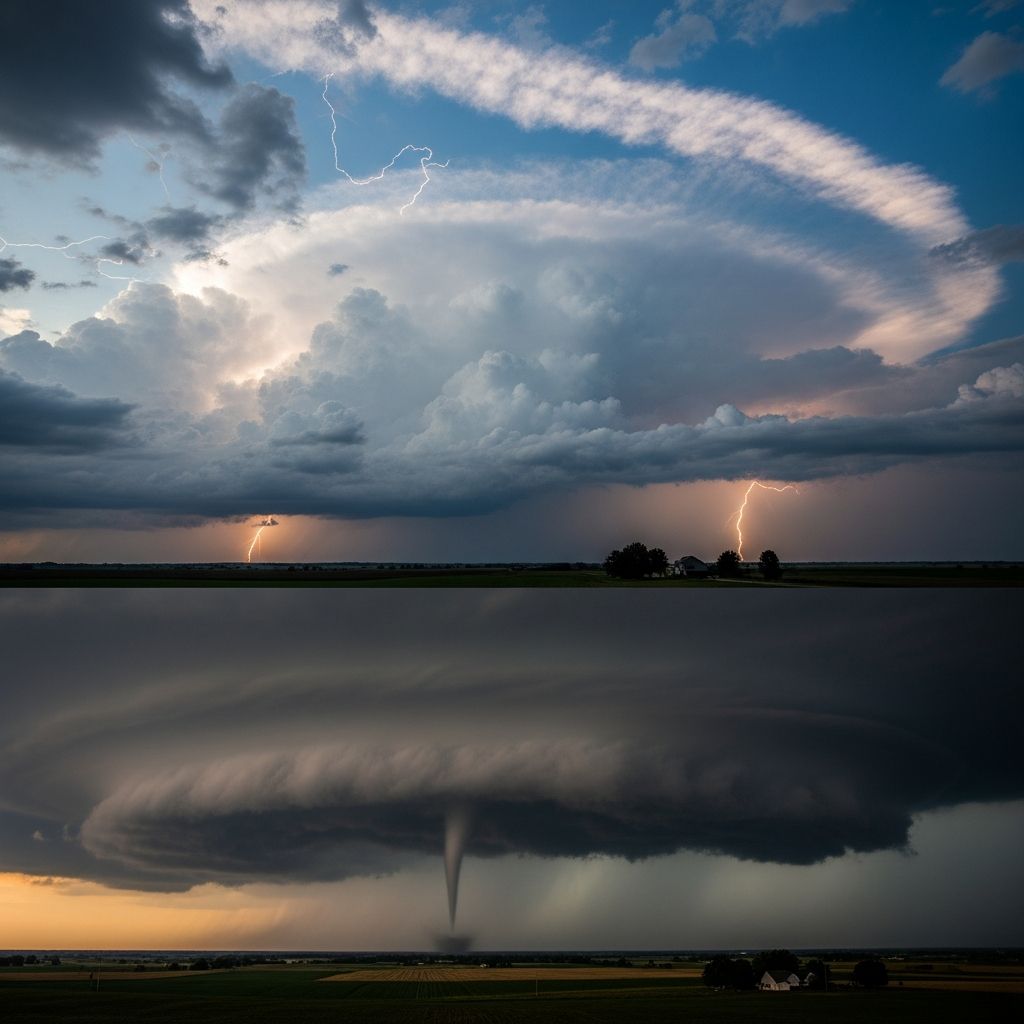
Tornadoes represent one of nature’s most destructive forces, characterized by rapidly rotating columns of air extending from thunderstorms to the ground. These phenomena typically emerge from supercell thunderstorms, where specific atmospheric conditions converge to produce intense rotation.
Essential Atmospheric Ingredients for Tornado Development
The birth of a tornado requires a unique blend of atmospheric elements. Primarily, **instability** arises when warm, moist air near the surface underlies cooler, drier air aloft. This setup allows parcels of air to rise vigorously, forming powerful updrafts that fuel thunderstorm development.
Another critical factor is **wind shear**, the change in wind speed and direction with altitude. Low-level wind shear, particularly in the lowest few thousand feet, is vital. On high-risk days, winds can shift dramatically—up to 50 mph—between the ground and cloud base, twisting horizontal air motions into vertical rotation.
- Warm, moist surface air: Provides fuel through latent heat release during condensation.
- Cool, dry air aloft: Creates instability for updrafts.
- Strong wind shear: Introduces rotation via horizontal vorticity.
- High humidity: Lowers cloud bases, enhancing low-level shear effects.
The Role of Supercell Thunderstorms
While all thunderstorms have tornado potential, **supercells** are the primary producers of significant twisters. These long-lived storms feature a persistent rotating updraft known as a mesocyclone, often several kilometers wide.
Supercells thrive in environments with ample instability and veering winds—winds that turn clockwise with height. The mesocyclone forms when horizontal rotation, generated by wind shear, is tilted and stretched by the updraft.
| Storm Type | Key Feature | Tornado Potential |
|---|---|---|
| Regular Thunderstorm | Non-rotating updraft | Low |
| Supercell | Rotating mesocyclone | High (EF2+) |
| Non-supercell | Quasi-linear convective system | Moderate (weaker tornadoes) |
Violent tornadoes (EF4-EF5) almost exclusively spawn from supercells, accounting for the most destructive outbreaks.
Step-by-Step Process of Tornadogenesis
Tornado formation, or tornadogenesis, unfolds in distinct stages within a supercell.
- Updraft Initiation: Warm, humid air rises rapidly, cooled by expansion and condensation, releasing heat to sustain the updraft.
- Horizontal Vorticity Creation: Wind shear rolls air into horizontal tubes of rotation.
- Tilting and Stretching: The updraft tilts these tubes vertical, stretching them like a figure skater pulling in arms—accelerating spin via conservation of angular momentum.
- Mesocyclone Development: A broad rotating column forms aloft.
- Low-Level Rotation: Downdraft air wraps around the mesocyclone, descending with rear-flank spin. Temperature contrasts sharpen rotation near the ground.
- Funnel Cloud and Touchdown: Intensifying low-level spin stretches downward, forming a funnel that reaches the surface.
Recent VORTEX2 research highlights downdraft dynamics: cooler air from precipitation-driven descent acquires horizontal vorticity, converging under the updraft.
Types and Characteristics of Tornadoes
Tornadoes vary widely in intensity, measured by the Enhanced Fujita (EF) scale based on damage.
| EF Rating | Wind Speed (mph) | Duration | Frequency |
|---|---|---|---|
| EF0-EF1 (Weak) | 65-110 | 1-10 minutes | Most common (~80%) |
| EF2-EF3 (Strong) | 111-165 | 10-20 minutes | Moderate |
| EF4-EF5 (Violent) | 166-200+ | 20+ minutes | Rare (<1%) |
Weak tornadoes dominate but cause less damage; violent ones, though rare, devastate communities.
Geographic and Seasonal Patterns
Tornado Alley in the central U.S. sees peak activity due to clashing air masses: moist Gulf air meets dry western air along the Dry Line.
Spring (April-June) hosts major outbreaks when jet stream shear peaks over unstable air. Winter tornadoes occur along warm fronts; fall along coastal hurricanes.
Detection and Forecasting Challenges
Doppler radar detects mesocyclones via rotation signatures aloft but misses ground-level confirmation. Storm spotters provide vital ground truth.
Forecasting hinges on CAPE (Convective Available Potential Energy) for instability and SRH (Storm-Relative Helicity) for shear. High-risk outlooks from NOAA’s Storm Prediction Center guide warnings.
Tornado Safety Guidelines
Survival depends on rapid response. The key rule: Put as many walls as possible between you and the storm.
- At Home: Interior room on lowest floor; avoid windows. Use a mattress or helmets for protection.
- In a Vehicle: Abandon for a sturdy building; if impossible, ditch and lie in a low spot.
- Mobile Homes: Evacuate to a shelter immediately.
- Warning Signs: Dark, greenish sky; large hail; loud train-like roar.
Heed NOAA Weather Radio and apps for alerts. Post-event, avoid downed lines and structural hazards.
Frequently Asked Questions (FAQs)
What conditions are needed for a tornado to form?
Instability (warm moist air below cool dry air), wind shear, and high humidity near the surface are essential, often in supercell thunderstorms.
Can all thunderstorms produce tornadoes?
All have potential, but supercells with mesocyclones produce the strongest and most frequent.
How fast do tornado winds blow?
From 65 mph (EF0) to over 200 mph (EF5), with violent tornadoes being rarest.
Why do tornadoes form in spring?
Peak jet stream shear overlaps maximum instability from heating and Gulf moisture.
What should I do during a tornado warning?
Seek shelter in an interior room or basement; stay away from windows and vehicles.
Recent Research and Future Insights
Projects like VORTEX2 reveal temperature gradients across downdrafts drive low-level rotation. Models suggest multiple pathways, but near-ground dynamics remain elusive.
Climate change may shift patterns: fewer in traditional Alley, more in Dixie Alley (Southeast). Enhanced radar and AI forecasting promise better predictions.
References
- How tornadoes form — Markowski Research Group, Penn State. 2023. https://sites.psu.edu/pmarkowski/how-tornadoes-form/
- How do tornadoes form? — Britannica. 2023. https://www.britannica.com/video/tornadoes/-240519
- How Tornadoes Form — UCAR Center for Science Education. 2024. https://scied.ucar.edu/learning-zone/storms/how-tornadoes-form
- How do tornadoes form? – James Spann — NOAA/NWS YouTube. 2013-01-17. https://www.youtube.com/watch?v=lmWh9jV_1ac
- How Does a Tornado Form? — History of Simple Things YouTube. 2023. https://www.youtube.com/watch?v=6HDTNwErf1c
- Severe Weather 101: Tornado Basics — National Severe Storms Laboratory (NSSL), NOAA. 2024. https://www.nssl.noaa.gov/education/svrwx101/tornadoes/
- What Tornadoes Are & What Causes Them — City of Brownsville, TX. 2023. https://www.brownsvilletx.gov/289/What-Tornadoes-Are-What-Causes-Them
- About Tornadoes — National Weather Service (NWS), NOAA. 2024-04-01. https://www.weather.gov/ffc/torntext

Medha Deb is an editor with a master's degree in Applied Linguistics from the University of Hyderabad. She believes that her qualification has helped her develop a deep understanding of language and its application in various contexts. Medha specializes in the areas of beauty, health, sports, and wellness and is committed to ensuring that the content on the website is…