
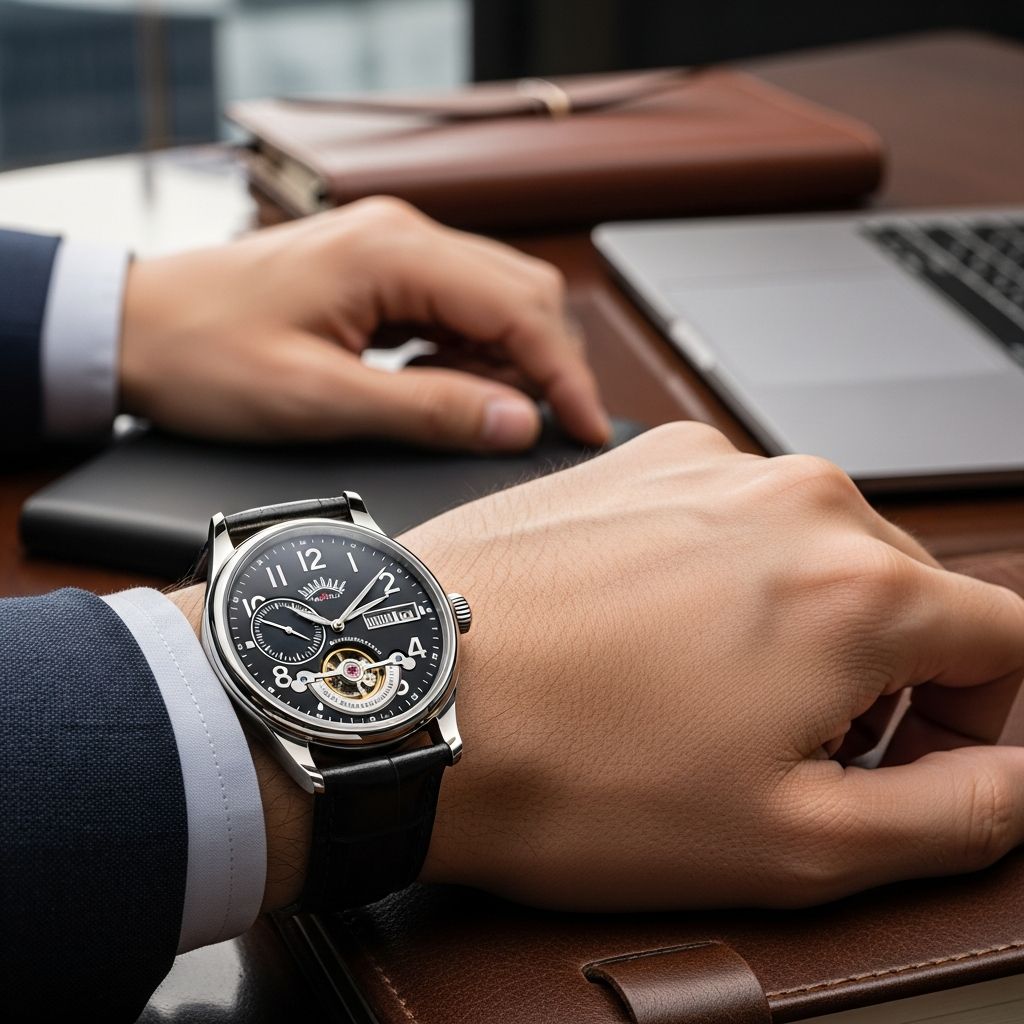
In an era dominated by smartphones and digital devices, the wristwatch might seem like an anachronism. Yet emerging research suggests that this timeless accessory holds surprising significance for professional achievement. Scientific investigations have uncovered compelling connections between regular wristwatch wearing and key traits that drive success in the workplace, including enhanced punctuality, stronger organizational habits, and improved professional perception.
The Conscientiousness Connection
One of the most striking findings from recent psychological research centers on conscientiousness—a personality trait characterized by organization, reliability, and attention to detail. University of Glasgow researchers conducting personality studies found that individuals who regularly wear wristwatches consistently rate themselves as significantly more conscientious compared to non-wearers. This distinction proves meaningful because conscientiousness directly correlates with professional performance, career advancement, and long-term success across virtually all industries.
The research methodology involved over 700 participants across multiple study phases, with participants completing standardized personality inventories that measured conscientiousness alongside other personality dimensions. The results remained consistent: wristwatch wearers demonstrated measurable differences in how they approached time, organization, and commitment to responsibilities. This wasn’t merely a matter of self-perception—behavioral observations confirmed that watch wearers actually exhibited more conscientious conduct in real-world situations.
What makes this finding particularly significant is that conscientiousness represents one of the strongest predictors of professional success. Individuals high in conscientiousness tend to meet deadlines, maintain organized workspaces, follow through on commitments, and demonstrate the reliability that organizations value in employees at every level.
Punctuality as a Professional Advantage
Beyond personality self-assessments, researchers observed tangible behavioral differences. In the third phase of the Glasgow study, wristwatch wearers arrived on average five minutes earlier to appointments compared to non-wearers. This seemingly small difference carries substantial professional implications. Punctuality signals respect for others’ time, demonstrates commitment to responsibilities, and establishes a reputation for dependability.
In professional environments, arriving early provides multiple advantages: time to prepare mentally, opportunity to establish the meeting’s tone, and reduced stress. These advantages compound over a career spanning decades. The person who consistently arrives early positions themselves as someone others can rely upon, a quality that translates into trust, better assignments, and advancement opportunities.
The mechanism behind this behavior appears to involve how wearing a watch fundamentally changes one’s relationship with time. Rather than periodically checking a smartphone, watch wearers maintain constant awareness of temporal progression. This continuous consciousness creates a psychological framework where time becomes a tangible resource requiring active management rather than something passively observed.
External Perception and Professional Credibility
While internal personality traits matter, external perception shapes professional outcomes equally. Research from the University of Michigan examined how watches influence observer perceptions of competence and professionalism. When researchers presented identical résumés with photographs of candidates wearing different types of watches, evaluators rated candidates wearing luxury mechanical watches 23 percent higher in competence.
Critically, this perception boost stemmed not from perceived wealth but from perceived intentionality. Observers interpreted wristwatch wearing as evidence that the candidate made deliberate choices, committed to quality, and paid attention to professional presentation. This perception gap translates directly into hiring decisions, promotion considerations, and negotiation outcomes.
The visual signal sent by a wristwatch operates subtly but powerfully. Unlike smartphones visible to only those closest to you, a wristwatch remains consistently visible during handshakes, presentations, and meetings. It functions as a non-verbal communication tool conveying organization and professionalism to everyone in your environment.
Enclothed Cognition and Performance Enhancement
Psychology introduces a concept called “enclothed cognition,” which describes how clothing and accessories directly influence cognitive function and behavior patterns. The principle suggests that what you wear physically changes how you think and act. When someone chooses to wear a wristwatch, they’re not merely selecting an accessory—they’re triggering psychological shifts that affect confidence, presence, and performance.
These changes manifest in multiple ways. Watch wearers report standing differently, speaking more deliberately, making stronger eye contact, and approaching challenges with greater assurance. These behavioral micro-adjustments—often imperceptible individually—compound into significant macro results in professional interactions. Someone who feels more organized because they wear a watch unconsciously adopts more organized physical behaviors, which others perceive as professional competence.
The psychological impact extends beyond self-perception. When individuals know they’re wearing an item associated with conscientiousness and professionalism, they unconsciously align their behavior with that expectation. This represents a form of self-fulfilling prophecy where the accessory itself becomes a catalyst for more professional conduct.
Negotiation Performance and Decision-Making
Harvard Business School researchers investigating negotiation dynamics discovered that individuals wearing mechanical watches achieved better outcomes in negotiations compared to those wearing smartwatches or no watches. This finding proves particularly striking given that smartwatches typically offer more functionality and real-time information access.
The superior negotiation performance of mechanical watch wearers likely stems from several converging factors. Mechanical watches represent intentional choices rather than default technology, signaling commitment and thought. Additionally, the psychological mechanism of enclothed cognition may enhance the confidence and deliberation that characterize successful negotiators. Someone wearing a watch appears more composed, deliberate, and considered—qualities that translate into better negotiation outcomes.
This research suggests that in high-stakes professional situations, the apparently minor choice of wearing a mechanical watch rather than checking time on a smartphone can measurably influence outcomes. The implications extend across salary negotiations, contract discussions, business partnerships, and countless other professional scenarios where better outcomes directly translate into career advancement.
Time Management and Organizational Excellence
Beyond personality traits and behavioral patterns, wristwatch wearing correlates with superior time management practices. The constant awareness of time that accompanies wearing a watch creates an external prompt for time-conscious decision-making throughout the day. Rather than allowing hours to pass without temporal awareness, watch wearers maintain active consciousness of how they allocate their time.
This heightened temporal awareness supports superior organizational practices. Watch wearers tend to schedule appointments with greater precision, allocate time blocks more intentionally, and maintain more accurate awareness of time allocation across projects and responsibilities. These practices directly enhance productivity and professional effectiveness.
The organizational excellence that characterizes watch wearers extends beyond time management into broader work habits. Research indicates that the same conscientiousness manifesting in punctuality also appears in email responsiveness, project completion, documentation standards, and professional communication generally. These accumulated habits create a reputation for reliability that opens professional doors.
Emotional Stability and Workplace Relationships
The Glasgow study revealed that watch wearers scored higher on emotional stability compared to non-wearers, while scoring lower on extraversion and openness. While lower extraversion might suggest introversion, the emotional stability component proves particularly valuable professionally. Emotionally stable individuals navigate workplace conflicts more effectively, respond to setbacks with resilience, and maintain composure in high-pressure situations.
In professional environments, emotional stability matters enormously. Someone who remains composed during crises, responds thoughtfully rather than reactively to criticism, and maintains consistent performance regardless of circumstances becomes invaluable to organizations. Colleagues increasingly trust individuals they can rely upon to respond professionally and calmly in difficult situations.
The correlation between watch wearing and emotional stability suggests that the deliberate, conscious approach to time and organization that watches encourage extends into emotional regulation. Someone actively managing their time and commitments experiences less stress and maintains greater equilibrium, creating the conditions for stronger emotional stability.
Professional Identity and Personal Branding
Beyond psychological mechanisms and behavioral patterns, watches function as identity markers that communicate professional self-concept. Choosing to wear a watch—particularly a quality mechanical watch rather than relying exclusively on smartphone time-telling—represents a deliberate statement about professional values and identity. This choice signals commitment to traditional professional standards, attention to detail, and intentional personal presentation.
In personal branding literature, such signals prove crucial. How individuals present themselves communicates their professional values before they speak. A wristwatch communicates that the wearer values organization, professionalism, and intentional decision-making. These signals become particularly important in first meetings, interviews, and professional networking situations where initial impressions shape ongoing relationships.
Different watch styles communicate different professional identities. A classic dress watch signals formal professionalism; a sport watch suggests active engagement and physical capability; a vintage watch implies appreciation for quality and craftsmanship. By selecting an appropriate watch, professionals actively curate the identity they present to colleagues and clients.
Distinguishing Smart Watches from Mechanical Watches
Interestingly, research distinguishes between traditional mechanical watches and smartwatches in terms of professional impact. While smartwatches offer technological advantages, they don’t appear to convey the same psychological benefits or professional perception gains. This distinction likely reflects that smartwatches function primarily as technology extensions, while mechanical watches represent deliberate choices separate from broader device ecosystems.
The superior negotiation performance of mechanical watch wearers compared to smartwatch wearers suggests that the simplicity and intentionality of mechanical watches may enhance their psychological impact. Smartwatches invite constant interaction and notification checking, fragments attention in ways counter to the focused presence that mechanical watches encourage.
Causation Versus Correlation
Researchers conducting watch studies carefully note that correlation doesn’t necessarily imply causation. The question remains whether conscientious individuals gravitate toward wearing watches or whether wearing watches enhances conscientiousness. The answer likely involves bidirectional causation: conscientious individuals select watches to support their organized approach to time, while wearing watches simultaneously reinforces and enhances conscientious behaviors through enclothed cognition effects.
Regardless of causation direction, the practical implication remains clear: wearing a wristwatch associates with and supports the personality traits and behaviors that drive professional success.
Practical Implementation for Career Advancement
For professionals seeking to enhance their impact and career trajectory, the research suggests several concrete steps. First, selecting and regularly wearing a quality wristwatch functions as a simple intervention supporting conscientiousness and professional presence. The investment in a reliable watch pays dividends through the psychological and behavioral changes it catalyzes.
Second, individuals should recognize wristwatch wearing as a legitimate professional strategy. Rather than viewing watches as merely functional or decorative, understanding the psychological mechanisms through which they influence behavior and perception allows professionals to harness their full potential. A watch becomes a tool for professional success rather than an anachronistic accessory.
Third, professionals preparing for important professional interactions—interviews, negotiations, presentations—might consider the specific watch choice they make, recognizing that this selection communicates professional values and influences their own performance through enclothed cognition mechanisms.
References
- Personality Traits and Wristwatch Wearing: A Research Study — University of Glasgow, College of Science & Engineering. Published in peer-reviewed research. https://www.hodinkee.com/articles/study-shows-that-yes-people-who-wear-watches-really-are-superior-humans
- Psychological Effects of Wristwatch Wearing on Professional Performance — Research synthesis examining enclothed cognition, negotiation studies, and behavioral analysis. 2024-2025. https://www.youtube.com/watch?v=ZhFX9C6_nRw

Medha Deb is an editor with a master's degree in Applied Linguistics from the University of Hyderabad. She believes that her qualification has helped her develop a deep understanding of language and its application in various contexts. Medha specializes in the areas of beauty, health, sports, and wellness and is committed to ensuring that the content on the website is…