
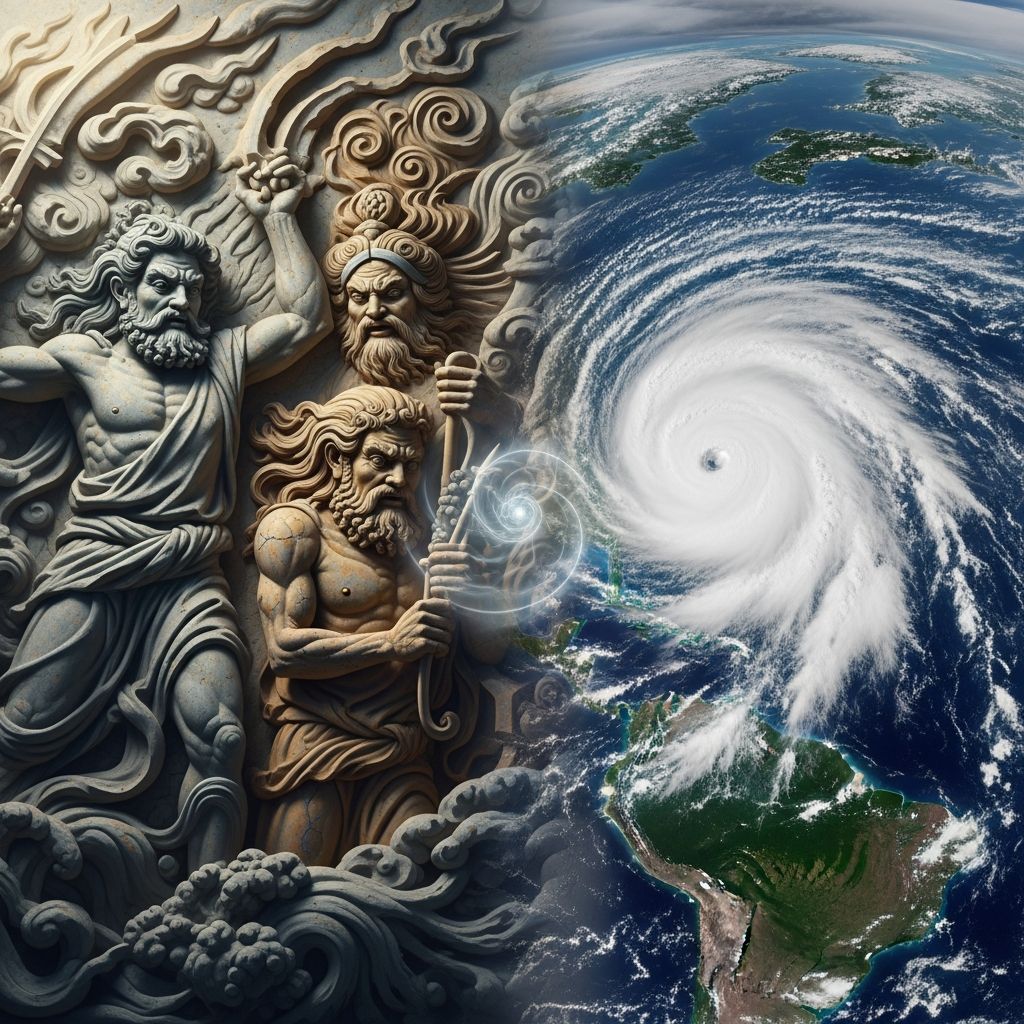
The word **hurricane** evokes images of powerful swirling winds, torrential rains, and devastating force. But where did this term originate? Its history weaves through indigenous languages, colonial explorations, and scientific naming conventions, connecting ancient mythologies to contemporary meteorology.
Indigenous Roots in the Caribbean
Long before European ships crossed the Atlantic, the Taíno people of the Greater Antilles—encompassing modern-day Puerto Rico, Cuba, Jamaica, and Hispaniola—had a name for the fierce storms that battered their islands. They revered a deity called Juracán, a god of chaos and destruction manifested in violent tempests. This supreme being controlled the winds and rains, embodying the unpredictable fury of nature.
The Taíno term Juracán likely drew from even older influences, possibly linking to the Mayan god Huracan, known as the heart of the sky and a creator-destructor figure in Mesoamerican lore. Archaeological evidence and colonial records suggest these cultures shared linguistic and mythological threads across the Americas. When Spanish explorers like Christopher Columbus arrived in 1492, they encountered these storms firsthand. Columbus himself documented an impending hurricane on June 29, 1502, during his fourth voyage, warning Spanish fleets of the danger based on indigenous signs he had learned.
Spanish chroniclers adapted the word into huracán or furacán, capturing the explosive onset of these storms. Pedro Mártir de Anghiera, chaplain to King Ferdinand and Queen Isabella, used furacan in his histories of the New World explorations around 1511. By the mid-16th century, Gonzalo Fernández de Oviedo y Valdés included it in his Historia General y Natural de las Indias (1547-1549), solidifying its place in European lexicon. The shift from ‘f’ to ‘h’ reflects common phonetic evolutions in Spanish borrowings from Arawakan languages.
Entry into European Languages
The word crossed into English around the 1550s, appearing in Richard Eden’s Decades of the New World (1555), where he described these “tempestes” as furacanes, contrasting them with Greek Typhones. Early spellings varied wildly—forcane, herrycano, hurlecane—with the Oxford English Dictionary noting 39 forms from the late 1500s. By 1650, hurricane standardized, influenced by widespread colonial encounters in the Atlantic.
William Shakespeare referenced hurricano in King Lear and Troilus and Cressida, likely alluding to waterspouts rather than full tropical cyclones. The term spread to other tongues: Portuguese rendered it furacão, and it inspired Scandinavian orkan for fierce windstorms. This diffusion mirrored the expansion of European empires, which frequently navigated hurricane-prone seas.
Global Cousins: Cyclones and Typhoons
While hurricane dominates the North Atlantic and Northeast Pacific, similar storms bear regional monikers elsewhere. Meteorologists unify them under tropical cyclone, a term emphasizing their low-pressure, rotating structure over warm oceans.
| Region | Name | Etymology Highlights |
|---|---|---|
| North Atlantic, NE Pacific | Hurricane | Taíno Juracán; Spanish huracán |
| Indian Ocean, South Pacific | Cyclone | Greek kúklos (circle); coined by Henry Piddington ~1840 |
| Western North Pacific | Typhoon | Possible Greek Typhôn, Chinese dà fēng, Hindi tūfān |
Cyclones trace to ancient Greek roots like kúklos (wheel or circle) or kuklóō (to encircle), aptly describing the storms’ spiral bands. Initially, cyclone applied broadly to any rotating system, including tornadoes. In the 1840s, British meteorologist Henry Piddington, working for the East India Company, repurposed it for Indian Ocean tempests, favoring classical nomenclature in scientific circles.
Typhoons present a more tangled etymology. Candidates include Greek Typhôn, a monstrous wind deity; Persian tūfīdan (to roar); Arabic tāfa (to spin); and Asian terms like Hindi/Urdu tūfān (storm) or Chinese tai fung (great wind), evolving into Japanese taifū. Portuguese sailors likely bridged these, adopting tufão in the South China Sea.
Evolution of Storm Naming Practices
Early naming drew from indigenous fears and religious calendars. Caribbean natives invoked gods like Mayan Hunraken or Guatemalan Quiché Hurakan. Spanish friars in Cuba tagged storms by saints’ days: Hurricane Santa Ana hit Puerto Rico on July 26, 1825; San Felipe struck twice on September 13 (1876 and 1928).
- Pre-20th century: Informal, often saint-based or descriptive.
- 1940s WWII: U.S. military named Pacific typhoons after women, inspired by George R. Stewart’s novel Storm (1941).
- 1950s onward: World Meteorological Organization (WMO) systematized lists, alternating genders, retiring destructive names (e.g., Katrina, Maria).
These practices humanize abstract forces, aiding communication during crises.
Cultural and Mythological Echoes
Beyond linguistics, hurricane lore permeates cultures. Taíno myths portrayed Juracán as a creator who separated sky from earth amid chaos. Similar deities appear globally: Norse Thor wielded thunder, Hindu Indra battled storm demons. Modern “medicanes”—Mediterranean hurricanes—blend these legacies, rare cyclones over the Med Sea.
In literature and media, the word symbolizes uncontrollable power, from Columbus’s logs to films depicting apocalyptic gales.
Modern Meteorological Context
Today, the National Hurricane Center classifies hurricanes by Saffir-Simpson scale (Category 1-5 based on winds). Formation requires sea temps above 26.5°C (80°F), low shear, and moisture. They rarely form in the South Atlantic due to cooler waters and shear.
Climate change intensifies these storms, raising sea levels and rainfall, per NOAA reports.
Frequently Asked Questions (FAQs)
What is the indigenous origin of the word hurricane?
The term derives from the Taíno god Juracán, a storm deity in the Caribbean, possibly linked to Mayan Huracan.
How did ‘hurricane’ enter the English language?
Via Spanish huracán in the 1550s, through explorers’ accounts like Richard Eden’s translations.
What’s the difference between hurricanes, cyclones, and typhoons?
Same phenomenon; names vary by basin: hurricanes (Atlantic/Pacific), cyclones (Indian/South Pacific), typhoons (NW Pacific).
Who started naming storms after people?
Inspired by George Stewart’s 1941 novel Storm; WWII meteorologists used women’s names.
Are there hurricanes in other oceans?
Rarely in South Atlantic; Mediterranean has ‘medicanes.’ All are tropical cyclones.
Conclusion: A Word Shaped by Storms
The etymology of hurricane reflects humanity’s awe before nature’s might—from Taíno worship to global science. Understanding these roots enriches our grasp of both language and peril.
References
- Hurricanes, Cyclones and Typhoons: What’s in a Name? — NESDIS/NOAA. 2023. https://www.nesdis.noaa.gov/news/hurricanes-cyclones-and-typhoons-whats-name
- Hurricane – Etymology, Origin & Meaning — Etymonline. Accessed 2026. https://www.etymonline.com/word/hurricane
- Name That Hurricane: The story of how and why we name hurricanes — Farmers’ Almanac. 1996 (updated). https://www.farmersalmanac.com/why-we-name-hurricanes

- Integrated M.A. in Applied Linguistics, University of Hyderabad
- 5+ years in editorial, instructional, SEO, and research-based writing
Sneha is a relationships and lifestyle writer with a strong foundation in applied linguistics and certified training in relationship coaching. She brings over five years of writing experience to theskillvault, crafting thoughtful, research-driven content that empowers readers to build healthier relationships, boost emotional well-being, and embrace holistic living. Her writing and insights reflect the belief that beauty, happiness, and wellness…