
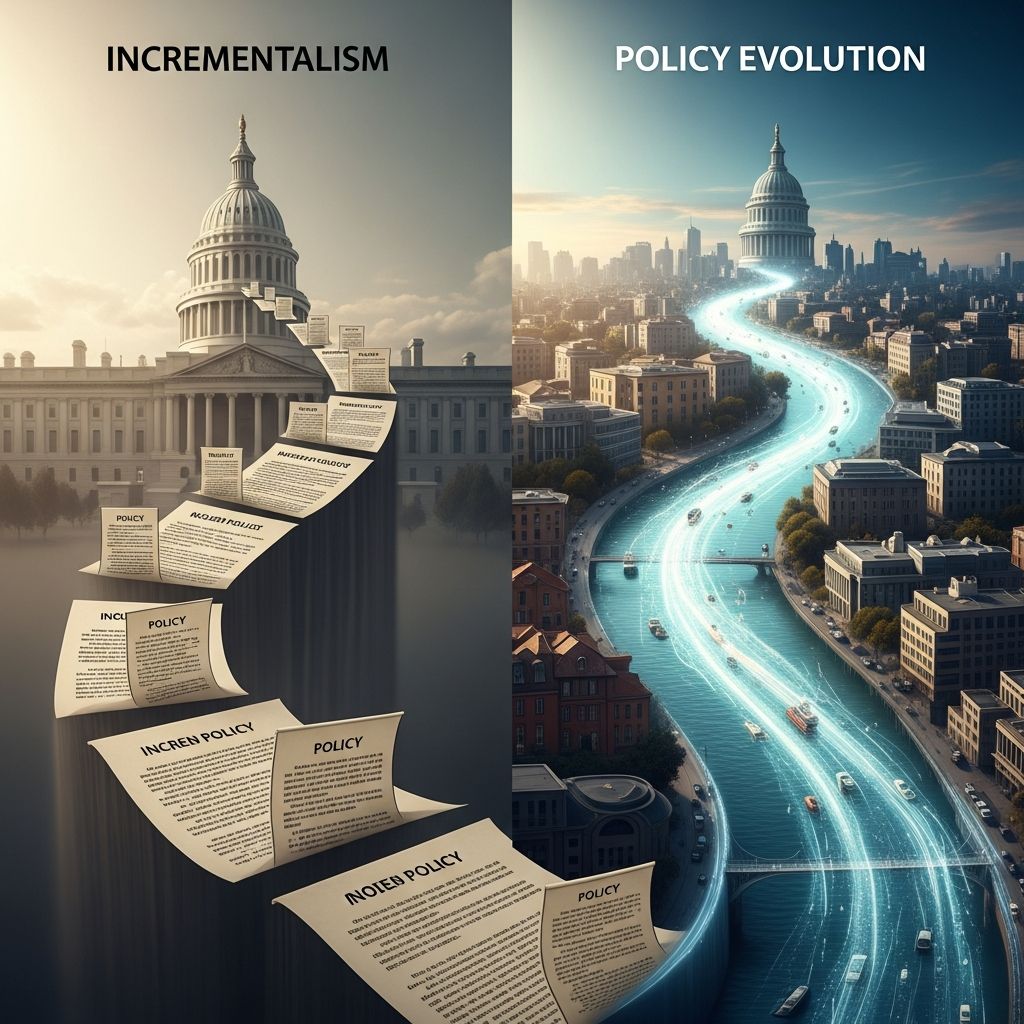
Incrementalism represents a pragmatic strategy in public administration where policymakers implement minor adjustments to existing frameworks instead of pursuing comprehensive overhauls. This method prioritizes stability, minimizes risks, and accommodates diverse stakeholder interests in complex political environments.
Defining the Core Principles of Incremental Decision-Making
At its heart, incrementalism involves crafting policies that build directly upon prior initiatives, introducing subtle modifications rather than inventing entirely new systems. Political scientist Charles E. Lindblom introduced this concept in the 1950s as a realistic alternative to the idealized rational model, which assumes perfect information and consensus on goals—conditions rarely met in practice.
In this approach, decision-makers focus on “satisficing,” or settling for acceptable outcomes, rather than optimizing for perfection. Policies emerge from ongoing negotiations among multiple actors, each bringing unique perspectives, values, and data. This process, termed “partisan mutual adjustment,” fosters compromise and serial adjustments over time.
- Key Features: Policies differ marginally from the status quo, reducing uncertainty and conflict.
- Focus on Feasibility: Emphasizes what is politically viable now, not abstract ideals.
- Adaptive Nature: Allows for course corrections based on real-world feedback.
This contrasts sharply with synoptic rationality, where exhaustive analysis precedes bold action. Lindblom argued that such rationality is unfeasible due to bounded knowledge and irreconcilable objectives.
Historical Foundations and Lindblom’s Revolutionary Insight
Charles Lindblom’s seminal 1959 essay, “The Science of ‘Muddling Through,'” challenged dominant views by portraying policy-making as a patchwork of small steps. He observed that governments rarely start from zero; instead, they tweak what exists to address immediate pressures.
Developed amid post-World War II optimism for scientific governance, incrementalism highlighted pluralism’s role—diverse groups advocating varied interests lead to balanced, if imperfect, evolution. Over decades, this theory has influenced analyses of budgeting, where annual adjustments dominate over revolutionary reallocations.
| Aspect | Rational Model | Incremental Model |
|---|---|---|
| Approach to Change | Comprehensive planning from first principles | Marginal tweaks to current policies |
| Information Needs | Complete data on all options | Limited focus on nearby alternatives |
| Actor Involvement | Centralized experts | Pluralistic bargaining |
| Risk Level | High due to bold shifts | Low through gradualism |
This table illustrates fundamental differences, underscoring why incrementalism prevails in pluralist democracies.
Advantages: Why Governments Favor Step-by-Step Reforms
Incrementalism offers tangible benefits in volatile political landscapes. It lowers resistance by avoiding drastic disruptions, giving affected parties time to adapt. In divided governments, small wins build consensus where big leaps falter.
Politically expedient, it sidesteps exhaustive debates, enabling quicker responses to needs. For instance, it supports continuous improvement in functional systems without overhauling viable structures. Research shows it enhances systemic rationality, where collective small decisions yield efficient outcomes despite individual limitations.
- Risk Mitigation: Tests ideas on a small scale before expansion.
- Conflict Reduction: Incremental steps foster negotiation over confrontation.
- Sustainability: Promotes long-term stability over short-term shocks.
Budgeting exemplifies this: Agencies negotiate modest increases, maintaining service continuity amid fiscal constraints.
Real-World Applications Across Policy Domains
Incrementalism manifests in diverse arenas. In U.S. abortion policy post-Roe v. Wade (1973), pro-life advocates secured state-level restrictions—waiting periods, parental consents—gradually eroding access without direct Supreme Court reversal.
Environmental regulations often advance incrementally: Initial clean air standards expand via amendments addressing specific pollutants. Foreign policy, too, relies on it; alliances evolve through summits yielding minor concessions rather than total realignments.
Local resource allocation involves bargaining among departments, prioritizing tweaks to budgets over wholesale redesigns. Even disability laws progress stepwise, from basic accommodations to broader mandates.
Critiques and the Case for Non-Incremental Alternatives
Despite strengths, critics argue incrementalism entrenches inefficiencies and delays urgent action. Charles Lindblom acknowledged rare non-incremental shifts during crises or via “punctuated equilibrium,” where pressures accumulate for breakthroughs.
Interest groups can exploit it, realigning to block progress or push agendas stealthily, as in piecemeal smoking bans shifting coalitions. Radical change suits emergencies, like pandemics demanding swift overhauls, but risks backlash amid declining trust.
In polarized eras, “partisan incrementalism” emerges, where parties advance agendas in small doses, potentially amplifying gridlock.
Incrementalism in Contemporary Challenges
Today’s issues test incrementalism’s limits. Climate policy sees incremental emissions targets amid calls for radical decarbonization. Healthcare reforms, like U.S. Affordable Care Act tweaks, illustrate gradual expansion.
Technology governance—AI regulations or data privacy—often starts with sector-specific rules, building toward frameworks. Divided governments favor this, enabling progress where consensus eludes.
Yet, crises like COVID-19 spurred non-incremental measures: Emergency funding and mandates bypassed usual haggling. Balancing both remains key for adaptive governance.
Comparing Incrementalism with Radical Policy Shifts
| Criteria | Incremental Change | Radical Change |
|---|---|---|
| Speed of Implementation | Slow, evolutionary | Fast, disruptive |
| Suitability | Ongoing improvements, stable systems | Crises, systemic failures |
| Political Feasibility | High in pluralist settings | Low without unified support |
| Long-Term Impact | Sustainable adaptation | Potential for transformation or reversal |
This comparison highlights contexts where each excels.
Future Prospects: Evolving Beyond Traditional Models
Hybrid approaches may dominate: Incremental bases punctuated by targeted overhauls. Scholars advocate recognizing “systemic rationality” to refine processes. In an era of populism and urgency, policymakers must weigh when to accelerate.
Training in behavioral insights could enhance incrementalism, countering biases. Ultimately, it endures as a testament to democracy’s messy wisdom.
Frequently Asked Questions (FAQs)
What is the main idea behind incrementalism in policy?
Incrementalism promotes policy changes through small, successive adjustments to existing frameworks, prioritizing practicality over grand designs.
Who developed the theory of incrementalism?
Charles E. Lindblom introduced it in the 1950s as a critique of rational policy-making models.
How does incrementalism differ from radical change?
Unlike radical change’s complete overhauls, incrementalism refines current systems gradually, reducing risks but potentially slowing urgent reforms.
Can you give an example of incremental policy-making?
Post-Roe v. Wade, U.S. states enacted layered abortion restrictions, incrementally shaping access over decades.
Is incrementalism always the best approach?
No; it suits stable environments but crises often demand non-incremental action like during public health emergencies.
Does incrementalism apply to budgeting?
Yes, public budgets typically see annual marginal adjustments rather than total reallocations.
References
- Incrementalism – Public Administration — Maricopa Community Colleges. 2023. https://open.maricopa.edu/pad100/chapter/69-incrementalism-public-policy-textbook/
- Incrementalism – Wikipedia — Wikimedia Foundation. 2023-10-15. https://en.wikipedia.org/wiki/Incrementalism
- Radical vs incremental change: what is the difference? — Go Vocal. 2022. https://www.govocal.com/blog/whats-the-difference-radical-vs-incremental-change
- Incrementalism | Definition, Benefits & Challenges — Encyclopædia Britannica. 2023. https://www.britannica.com/topic/incrementalism
- Incrementalism and Public Policy-Making — Oxford University Press. 2023. https://academic.oup.com/edited-volume/62239/chapter/550729113
- Interest Groups and the Problem with Incrementalism — University of Chicago Law & Economics. 2005. https://chicagounbound.uchicago.edu/cgi/viewcontent.cgi?article=1274&context=law_and_economics

- Integrated M.A. in Applied Linguistics, University of Hyderabad
- 5+ years in editorial, instructional, SEO, and research-based writing
Sneha is a relationships and lifestyle writer with a strong foundation in applied linguistics and certified training in relationship coaching. She brings over five years of writing experience to theskillvault, crafting thoughtful, research-driven content that empowers readers to build healthier relationships, boost emotional well-being, and embrace holistic living. Her writing and insights reflect the belief that beauty, happiness, and wellness…