
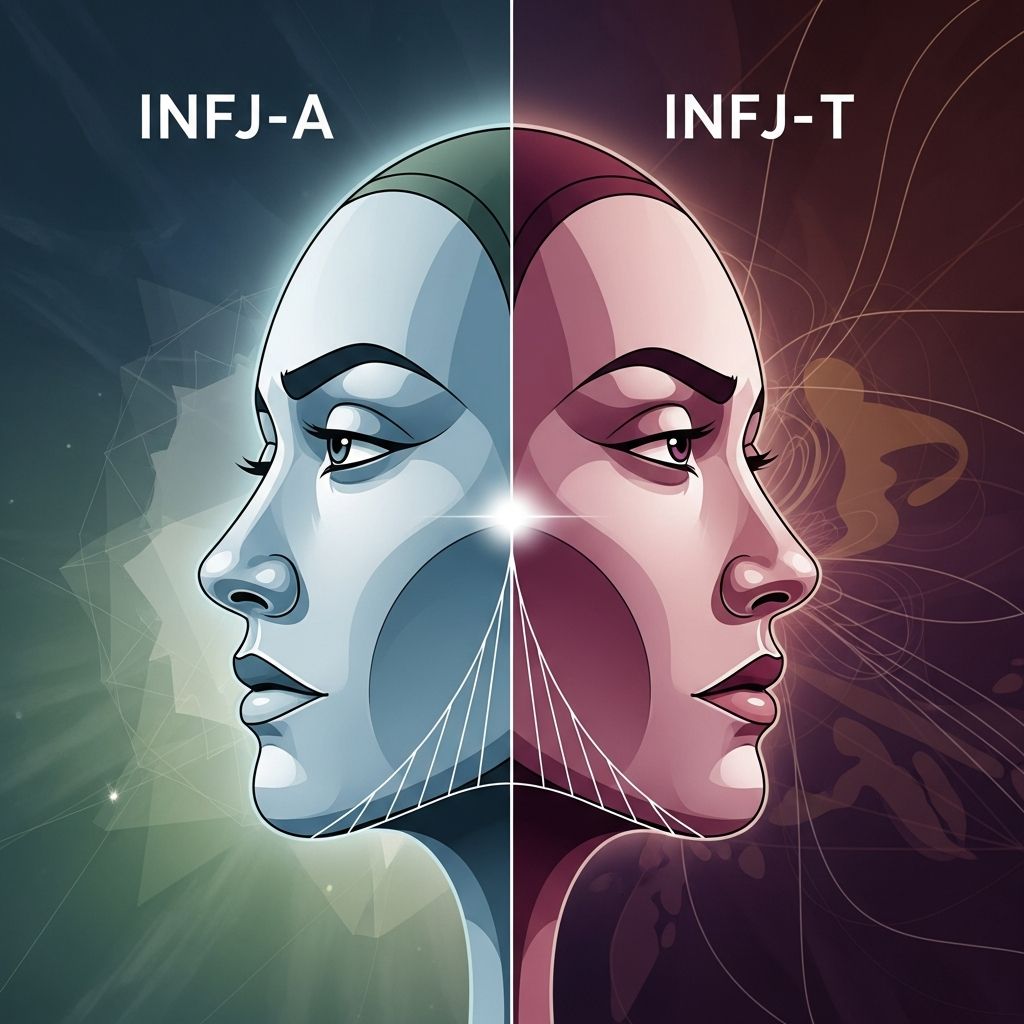
The Advocate personality (INFJ) is often described as rare, idealistic, and deeply compassionate. Yet within this single type, there are two distinct identity variants: Assertive INFJ-A and Turbulent INFJ-T. These identities do not change the core INFJ preferences (Introversion, Intuition, Feeling, Judging), but they strongly influence how Advocates handle stress, pursue goals, relate to others, and experience their inner world.
This article offers an original, in-depth look at these two Advocate identities. You will learn what sets INFJ-A and INFJ-T apart, how each shows up in everyday life, and how both variants can grow without trying to become something they are not.
1. What the A/T Identities Mean for INFJs
Most people know the four-letter type code, but many personality frameworks also include an additional letter that reflects identity: A for Assertive and T for Turbulent. Research in personality psychology consistently shows that people differ in emotional stability and self-confidence, often described using traits such as neuroticism or negative emotionality. The Assertive–Turbulent distinction is one way of capturing similar differences in everyday language.
- Assertive (A): more emotionally stable, self-assured, and resistant to stress.
- Turbulent (T): more self-questioning, sensitive to stress, and driven by concern about mistakes or external feedback.
Within the Advocate type, this creates two recognizable variants:
- INFJ-A (Assertive Advocate): idealistic, values-driven, but generally calmer and more confident in themselves.
- INFJ-T (Turbulent Advocate): equally idealistic, yet more intense, self-critical, and sensitive to their inner and outer environment.
2. Shared INFJ Core: What Does Not Change
Before highlighting the differences, it is important to understand what remains the same for both INFJ-A and INFJ-T. Both are still INFJs, shaped by the same underlying preferences and cognitive style.
- Introversion (I): Both variants recharge through solitude and reflection, even if they can appear sociable when their values are engaged.
- Intuition (N): Both naturally focus on patterns, meanings, and long-term possibilities instead of concrete details.
- Feeling (F): Both prioritize harmony, empathy, and personal values in decision-making.
- Judging (J): Both prefer structure, closure, and intentional planning over spontaneity.
Psychological models also describe INFJs as using Introverted Intuition (Ni) to synthesize abstract insights and Extraverted Feeling (Fe) to navigate social and emotional dynamics. Whether Assertive or Turbulent, Advocates tend to:
- Search for deeper meaning and long-term purpose.
- Care deeply about people and social impact.
- Carry a quiet but powerful sense of mission.
The A/T distinction does not turn an INFJ into a different type. It simply colors how their core traits are expressed.
3. Key Differences Between INFJ-A and INFJ-T
The contrast between these identities becomes most visible in confidence, emotional tone, and reaction to stress.
| Dimension | INFJ-A (Assertive Advocate) | INFJ-T (Turbulent Advocate) |
|---|---|---|
| Self-view | Generally confident, steadier self-esteem | More self-critical, fluctuating self-esteem |
| Response to stress | Recovers faster, less likely to ruminate | Prone to worry, overthinking, and regret |
| Focus of energy | Big-picture, purpose, long-term vision | Big-picture plus details; stronger focus on errors |
| Motivation style | Driven by internal values and calm determination | Driven by ideals and self-pressure to improve |
| Interpersonal sensitivity | Empathetic, but can let some criticism go | Deeply affected by criticism and tension |
3.1 INFJ-A: The Steady Advocate
Assertive INFJs often project a sense of calm conviction. They may still doubt or question themselves internally, but compared with their Turbulent counterparts, they:
- Worry less about others’ opinions.
- Feel more comfortable stepping into leadership roles.
- Let go of past mistakes more easily and move forward.
They are still sensitive and values-driven, yet their emotional tone is usually more even. This steadiness can make INFJ-A individuals appear grounded and reassuring in crises, since they tend not to show their inner turmoil as intensely.
3.2 INFJ-T: The Intense Advocate
Turbulent INFJs experience the same ideals, but often through a sharper emotional lens. They typically:
- Scrutinize their choices and replay conversations.
- Feel pressure to meet high internal standards.
- React strongly to feedback, conflict, or perceived failure.
Paradoxically, this self-criticism can fuel growth. Personality research suggests that people high in self-consciousness and anxiety sometimes channel this into preparation and improvement, especially when supported by strong values and purpose. For INFJ-T individuals, the challenge is to harness this drive without letting it become self-punishment.
4. How Each Variant Handles Stress and Change
Stress is a central area where Assertive and Turbulent identities diverge.
4.1 Stress Patterns in INFJ-A
When overwhelmed, INFJ-A individuals may still withdraw, feel misunderstood, or become uncharacteristically blunt. However, they are more likely to:
- Interpret setbacks as temporary and manageable.
- Maintain a basic level of optimism about the future.
- Recenter themselves through reflection and purposeful action.
They often trust their long-term vision enough to accept short-term mistakes. You might see them say, in essence, “I learned something; I will apply it and keep going.”
4.2 Stress Patterns in INFJ-T
INFJ-T individuals typically have a lower threshold for emotional strain. Under pressure, they may:
- Ruminate on what went wrong or what might go wrong.
- Fixate on small details that symbolize failure in their eyes.
- Internalize criticism more deeply, sometimes long after an event.
On the positive side, they can become highly motivated to adjust, refine, and improve their approach. Their heightened sensitivity may make them especially attuned to subtle changes in others’ moods or needs, which can be an asset in helping or mentoring roles.
5. Work, Ambition, and Everyday Productivity
In professional life, both Advocate variants seek meaningful, value-aligned work. Yet their identity influences how they pursue that mission and how they respond to demands.
5.1 INFJ-A at Work
- Leadership: More comfortable guiding teams, especially around purpose-driven projects.
- Risk tolerance: Slightly more willing to make big moves without exhaustive reassurance.
- Decision-making: Relatively quicker to commit to a strategy and stick with it.
Because they are less concerned with how every decision might be judged, INFJ-A professionals can appear strategic and composed. They may be inclined to:
- Champion long-term initiatives aligned with their values.
- Trust their intuition when data is incomplete.
- Model calm in emotionally charged environments.
5.2 INFJ-T at Work
- Quality control: Often more meticulous and detail-aware, especially when stakes feel high.
- Preparation: Likely to over-prepare to avoid letting others down.
- Feedback sensitivity: Strong responses to praise and criticism, which can impact motivation.
INFJ-T professionals may:
- Double-check facts and plans to minimize risk.
- Notice inconsistencies or overlooked issues that others miss.
- Struggle with imposter feelings despite real achievements.
While this can lead to stress and burnout, it can also produce high standards of work when balanced with realistic expectations and self-care.
6. Relationships, Boundaries, and Emotional Style
All Advocates seek deep, meaningful connections. But Assertive and Turbulent INFJs often experience relationships differently in terms of boundaries, conflict, and emotional expression.
6.1 INFJ-A in Relationships
INFJ-A individuals typically bring a calm presence to their close relationships. They may:
- Show steady loyalty and commitment once they choose a partner or friend.
- Find it slightly easier to communicate boundaries and needs.
- Recover more quickly after arguments or misunderstandings.
Because they are less prone to internalizing every conflict as a personal failing, they can maintain perspective and look at the relationship as a whole rather than focusing on each misstep.
6.2 INFJ-T in Relationships
INFJ-T individuals often experience relationships more intensely. They are likely to:
- Analyze subtle changes in behavior, tone, or wording.
- Worry about whether they are giving enough, saying the right thing, or being understood.
- Carry relational hurts for longer, even when they forgive.
This intensity can deepen empathy and emotional attunement, but it may also create cycles of anxiety. Clear communication, reassurance, and emotionally safe environments are especially important for them to thrive.
7. Growth Paths for Each Advocate Variant
Neither INFJ-A nor INFJ-T is “better.” Each has strengths and vulnerabilities that can be developed in healthy directions. Personality research generally supports the idea that self-awareness and deliberate habit-building can help people leverage their natural traits rather than fight them.
7.1 Growth Strategies for INFJ-A
Potential blind spots for Assertive Advocates include underestimating risk, dismissing constructive criticism, or overlooking their own emotional needs because they “feel fine” on the surface.
Helpful practices include:
- Inviting feedback from trusted people and reflecting on it without defensiveness.
- Checking assumptions before committing to a long-term path.
- Scheduling reflection not only about goals, but also about emotional wellbeing.
By consciously pausing to examine their choices, INFJ-A individuals can retain their confidence while adding nuance and humility.
7.2 Growth Strategies for INFJ-T
Turbulent Advocates may need to focus more on self-compassion, realistic standards, and nervous system regulation. Evidence-based approaches such as mindfulness and cognitive-behavioral techniques have been shown to help people manage self-critical thoughts and emotional reactivity.
- Self-compassion practices: Treating mistakes as learning experiences rather than proof of unworthiness.
- Setting “good enough” goals: Differentiating between tasks that need excellence and those that only require adequacy.
- Building supportive routines: Sleep, movement, and social connection can buffer stress reactivity.
These steps do not erase their intensity, but they help INFJ-T individuals turn that intensity toward sustainable growth instead of chronic self-doubt.
8. Quick Self-Check: Do You Lean More Assertive or Turbulent?
Formal assessments provide the clearest identity label, but you can informally sense your tendency by reflecting on questions like these:
- Do you usually trust your decisions once you have made them, or do you revisit them often?
- When something goes wrong, do you blame your circumstances more, or yourself more?
- Do you tend to feel generally steady inside, or do your mood and self-view swing with events?
- Does criticism feel like useful input, a personal wound, or both?
You may recognize elements of both identities. Human personality exists on spectrums; the A/T distinction highlights predominant tendencies, not rigid categories.
9. Frequently Asked Questions (FAQs) About INFJ-A and INFJ-T
Q1: Can an INFJ switch from Turbulent to Assertive over time?
Basic temperament tends to be relatively stable across adulthood, according to longitudinal personality research, but people can learn new coping strategies and mindsets that make them feel more steady and confident. An INFJ-T might never feel identical to an INFJ-A, yet they can become far less reactive and more self-assured than they once were.
Q2: Is being INFJ-T a sign of mental health problems?
No. The Turbulent identity reflects a tendency toward emotional sensitivity and self-consciousness, which does not automatically indicate a disorder. Clinical diagnoses involve specific patterns of distress and impairment assessed by professionals. Many INFJ-T individuals are psychologically healthy, creative, and high-functioning, even if they feel things more intensely.
Q3: Are INFJ-A better leaders than INFJ-T?
Not inherently. INFJ-A leaders may appear more confident and decisive, which can be reassuring. INFJ-T leaders often bring heightened empathy, attention to detail, and a strong desire to support their team. Leadership effectiveness depends on context, skills, and maturity, not just identity.
Q4: Do both INFJ variants need alone time?
Yes. Regardless of identity, INFJs are introverts who recharge in solitude and reflection. The Assertive/Turbulent dimension does not change their basic need for quiet time; it only influences how they feel and think during that time.
Q5: Which careers fit INFJ-A vs INFJ-T?
Both variants often gravitate toward work that aligns with their values, such as counseling, education, writing, advocacy, or mission-driven leadership. INFJ-A individuals might enjoy roles with visible responsibility or strategic influence; INFJ-T individuals might prefer roles where they can refine, support, and provide depth, especially in emotionally aware environments.
References
- McCrae, R. R., & Costa, P. T. Jr. (Personality in Adulthood, 2nd ed.) — Guilford Press. 2003-01-01. https://doi.org/10.4324/9780203428412
- INFJ Personality Profile — Personality Data. 2022-08-01. https://www.personalitydata.org/16-types/infj-extended-subtypes
- INFJ-A vs. INFJ-T: Personality Traits and Differences — MyPersonality.net. 2021-05-12. https://mypersonality.net/blog/article/infj-a-infj-t
- INFJ vs. ENFJ Personality Type: Similarities & Differences — Personality Junkie. 2018-03-15. https://personalityjunkie.com/01/infj-vs-enfj-personality-types/
- Personality Types Overview — 16Personalities. 2020-06-01. https://www.16personalities.com/personality-types
- Cognitive Behavioral Therapy — Basics and Effectiveness — Mayo Clinic. 2019-12-14. https://www.mayoclinic.org/tests-procedures/cognitive-behavioral-therapy/about/pac-20384610

- Integrated M.A. in Applied Linguistics, University of Hyderabad
- 5+ years in editorial, instructional, SEO, and research-based writing
Sneha is a relationships and lifestyle writer with a strong foundation in applied linguistics and certified training in relationship coaching. She brings over five years of writing experience to theskillvault, crafting thoughtful, research-driven content that empowers readers to build healthier relationships, boost emotional well-being, and embrace holistic living. Her writing and insights reflect the belief that beauty, happiness, and wellness…