
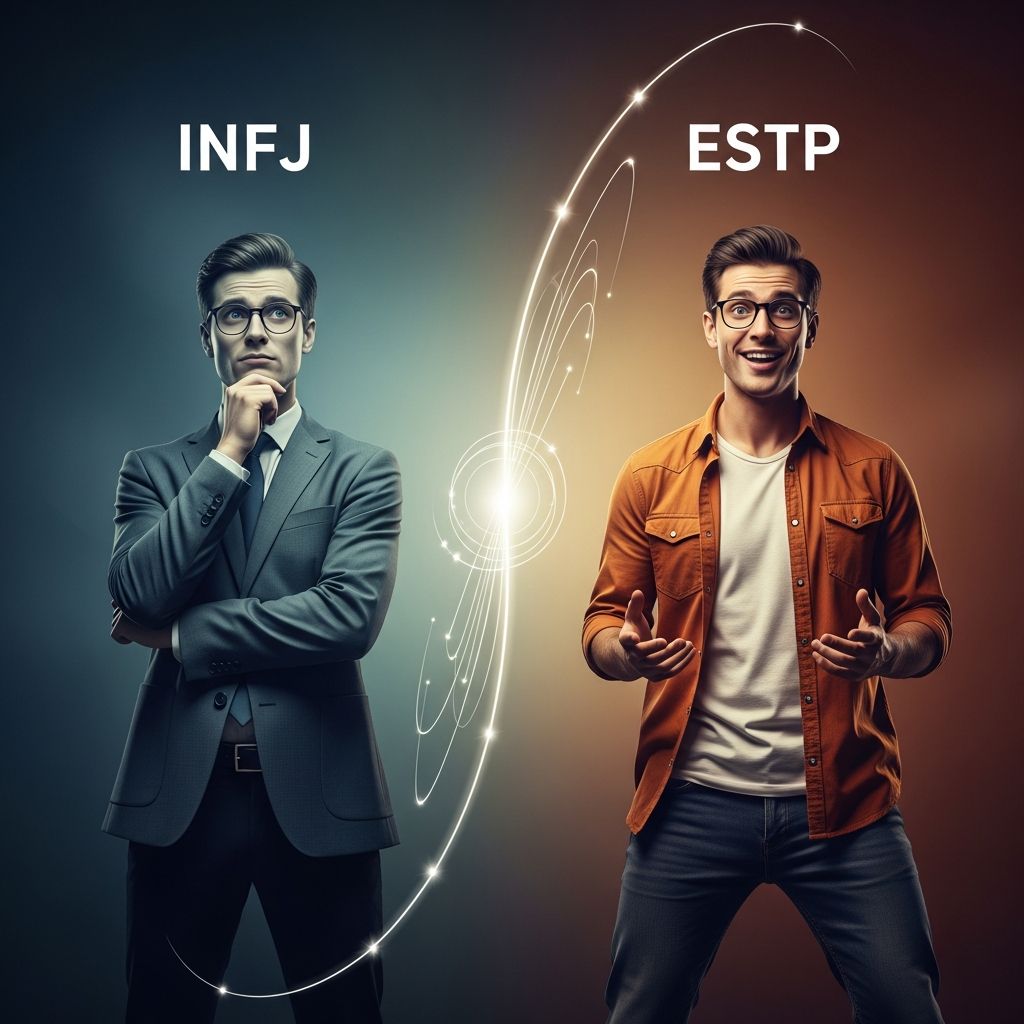
The Unlikely Magnetism of INFJ and ESTP
Some of the most compelling relationships are not between two people who mirror each other, but between those who seem to come from entirely different worlds. The pairing of an INFJ (Advocate) and an ESTP (Entrepreneur) is a classic example of this dynamic. At first glance, they appear to be opposites in nearly every way: one is introspective and future-focused, the other is outwardly energetic and immersed in the present. Yet, it is precisely this contrast that often creates a powerful, magnetic attraction.
INFJs are known for their depth, empathy, and desire for meaningful connection. They are driven by values, long-term vision, and a need to understand the deeper meaning behind people and events. ESTPs, on the other hand, thrive on action, spontaneity, and real-world experiences. They are quick thinkers, natural problem solvers, and lovers of freedom and excitement. When these two types come together, the result can be a relationship that is both exhilarating and challenging—a blend of idealism and realism, stillness and motion, reflection and action.
Why They Are Drawn to Each Other
The initial spark between an INFJ and an ESTP often comes from a sense of fascination with what the other represents. For the INFJ, the ESTP is a breath of fresh air: confident, decisive, and unafraid to dive into life headfirst. The ESTP’s ability to act without overthinking, to enjoy the moment, and to navigate social situations with ease can be deeply appealing to an INFJ who sometimes gets lost in their own thoughts.
For the ESTP, the INFJ offers something equally valuable: emotional depth, insight, and a sense of purpose. The INFJ’s ability to see patterns, understand motivations, and care deeply about people can be intriguing and even comforting to an ESTP who may not always pause to reflect on the emotional undercurrents of a situation. The INFJ’s quiet intensity and idealism can feel like a grounding force in a life that is often fast-paced and unpredictable.
This mutual admiration creates a strong foundation for attraction. The INFJ sees in the ESTP a partner who can bring their ideas into the real world, while the ESTP sees in the INFJ a partner who can add meaning and direction to their experiences. When both partners recognize and appreciate these qualities, the relationship can become a powerful synergy of vision and execution.
Core Differences That Shape the Relationship
Despite their strong attraction, INFJs and ESTPs are fundamentally different in how they perceive the world, make decisions, and interact with others. These differences are not flaws, but they do require awareness and intentional effort to navigate.
Perception: Intuition vs. Sensing
INFJs are intuitive (N) types, meaning they focus on patterns, possibilities, and the big picture. They are more interested in what could be than in what is immediately in front of them. ESTPs are sensing (S) types, meaning they are grounded in the present moment, relying on concrete information and direct experience.
This difference can lead to misunderstandings. The INFJ may feel that the ESTP is too focused on the here and now, missing deeper meanings or long-term implications. The ESTP, in turn, may feel that the INFJ is too abstract, overthinking situations that could be resolved with simple, practical action.
Decision-Making: Feeling vs. Thinking
INFJs make decisions based on personal values and the impact on people (Feeling), while ESTPs tend to rely on logic, efficiency, and objective criteria (Thinking). This can create tension in how conflicts are handled and how priorities are set.
The INFJ may prioritize harmony, emotional needs, and relational well-being, sometimes at the expense of practical considerations. The ESTP may prioritize efficiency, results, and personal freedom, sometimes appearing detached or insensitive to the INFJ’s emotional concerns.
Lifestyle: Judging vs. Perceiving
INFJs are judging (J) types, meaning they prefer structure, planning, and closure. They like to have a sense of direction and control over their environment. ESTPs are perceiving (P) types, meaning they value flexibility, spontaneity, and keeping options open.
This difference often shows up in daily life: the INFJ may want to plan dates, set goals, and create routines, while the ESTP may prefer to go with the flow, make last-minute decisions, and avoid rigid schedules. Without compromise, this can lead to frustration on both sides—feeling either constrained or neglected.
Strengths That Make the Relationship Thrive
When INFJs and ESTPs learn to appreciate their differences rather than see them as obstacles, their relationship can become remarkably balanced and fulfilling. Each partner brings unique strengths that can complement the other in powerful ways.
- Balance of Vision and Action: The INFJ’s ability to envision the future and set meaningful goals pairs well with the ESTP’s ability to take initiative and get things done. Together, they can turn ideas into reality.
- Emotional Depth and Practical Support: The INFJ provides emotional insight, empathy, and a safe space for vulnerability. The ESTP offers practical solutions, encouragement, and a sense of adventure that can help the INFJ step outside their comfort zone.
- Complementary Social Styles: The INFJ’s warmth and attentiveness can help the ESTP connect more deeply with others, while the ESTP’s confidence and social ease can help the INFJ feel more comfortable in group settings.
- Shared Desire for Growth: Both types, in their own ways, value personal development. The INFJ seeks growth through self-understanding and meaningful relationships, while the ESTP seeks growth through new experiences and mastery of skills. This shared drive can create a relationship that evolves and deepens over time.
Common Challenges and How to Overcome Them
No relationship is without its difficulties, and the INFJ-ESTP pairing is no exception. The key to a lasting bond is not avoiding conflict, but learning how to navigate it constructively.
Communication Styles
INFJs tend to be indirect, diplomatic, and cautious in expressing their feelings, especially when they sense potential conflict. ESTPs, by contrast, are often direct, blunt, and focused on solving problems quickly. This can lead to situations where the INFJ feels hurt by the ESTP’s honesty, while the ESTP feels frustrated by the INFJ’s perceived avoidance or ambiguity.
How to improve:
- INFJs can practice being more direct about their needs and boundaries, using clear, non-accusatory language.
- ESTPs can learn to pause before responding, considering how their words might affect their partner emotionally.
- Both partners can agree on a “safe space” for difficult conversations, where the goal is understanding, not winning an argument.
Different Needs for Space and Togetherness
INFJs typically need regular alone time to recharge and process their thoughts and emotions. ESTPs, being extroverted, gain energy from social interaction and physical activity. This difference can lead to misunderstandings: the INFJ may feel overwhelmed by the ESTP’s need for constant stimulation, while the ESTP may feel rejected or neglected when the INFJ withdraws.
How to improve:
- Establish clear expectations about personal space and social time.
- INFJs can reassure their partner that needing alone time is not a rejection, but a way to maintain emotional balance.
- ESTPs can respect their partner’s need for solitude while also communicating their own need for connection and shared experiences.
Different Approaches to Conflict
INFJs often prefer to avoid conflict, seeking harmony and emotional safety. ESTPs are more likely to confront issues head-on, seeing conflict as a way to resolve problems quickly. Under stress, these differences can intensify: the INFJ may withdraw or become passive-aggressive, while the ESTP may become impatient or overly critical.
How to improve:
- Agree on a conflict resolution style that works for both, such as taking a break when emotions run high and returning to the conversation later.
- INFJs can work on expressing their concerns before they build up, rather than waiting until they feel overwhelmed.
- ESTPs can practice active listening, focusing on understanding their partner’s feelings rather than immediately offering solutions.
Building a Balanced and Fulfilling Relationship
A successful INFJ-ESTP relationship is not about one partner changing to fit the other, but about creating a shared life that honors both personalities. This requires ongoing communication, mutual respect, and a willingness to grow together.
Practical Strategies for Daily Life
Here are some concrete ways INFJs and ESTPs can create harmony in their everyday lives:
| Area of Life | INFJ Preference | ESTP Preference | Compromise Strategy |
|---|---|---|---|
| Social Life | Smaller gatherings, deep conversations | Larger groups, active events | Alternate between quiet evenings and social outings; agree on a few “must-attend” events. |
| Daily Routine | Structured schedule, clear plans | Flexible, spontaneous plans | Plan key activities in advance but leave room for last-minute changes. |
| Decision-Making | Consider emotional impact, long-term effects | Focus on logic, efficiency, immediate results | Discuss decisions together, weighing both emotional and practical factors. |
| Conflict Resolution | Need time to process, prefer calm discussions | Want to address issues immediately, direct approach | Agree to take breaks when needed and return to the conversation when both are calm. |
Emotional and Intimate Connection
For the INFJ, emotional intimacy is essential. They need to feel deeply understood and valued. For the ESTP, intimacy often grows through shared experiences, physical connection, and mutual trust. Bridging these styles requires both partners to step outside their natural tendencies.
- INFJs can help the ESTP feel emotionally safe by expressing appreciation for their partner’s strengths and efforts, not just their emotional depth.
- ESTPs can deepen the connection by making time for meaningful conversations, even if they are not their natural preference.
- Both can explore love languages—words of affirmation, quality time, physical touch, acts of service, and gifts—to find ways to express care that resonate with each other.
Frequently Asked Questions
Can INFJ and ESTP have a long-term relationship?
Yes, INFJ and ESTP can have a long-term, fulfilling relationship if both partners are willing to understand and respect their differences. The key is open communication, mutual compromise, and a shared commitment to growth.
Why are INFJs attracted to ESTPs?
INFJs are often drawn to ESTPs because of their confidence, energy, and ability to take action. The ESTP’s spontaneity and social ease can be exciting and refreshing for an INFJ who tends to be more reserved and reflective.
Why are ESTPs attracted to INFJs?
ESTPs are often attracted to INFJs because of their depth, empathy, and insight. The INFJ’s ability to understand people and create meaningful connections can be both intriguing and comforting to an ESTP who values authenticity and trust.
How can INFJ and ESTP improve communication?
They can improve communication by being more direct about their needs, practicing active listening, and creating a safe space for honest, respectful conversations. INFJs can work on expressing their feelings more openly, while ESTPs can focus on being more considerate of their partner’s emotional experience.
What are the biggest challenges in an INFJ-ESTP relationship?
The biggest challenges include differences in communication style, needs for alone time vs. social interaction, and approaches to conflict. These can be managed through mutual understanding, clear boundaries, and a willingness to compromise.
Final Thoughts: A Relationship of Growth and Balance
The INFJ-ESTP relationship is not a simple, easy match. It is a dynamic, often intense pairing that requires effort, patience, and a deep willingness to understand each other. But for those who are willing to do the work, it can be one of the most rewarding relationships imaginable.
The INFJ brings depth, vision, and emotional richness. The ESTP brings energy, action, and a zest for life. Together, they can create a partnership that is both grounded and expansive, practical and meaningful, stable and adventurous. When they learn to see their differences not as obstacles, but as complementary strengths, they can build a love that is not just passionate, but enduring.
References
- Myers-Briggs Type Indicator Manual — CPP, Inc. 1998. https://www.cpp.com/products/mbti/MBTIManual.aspx
- Personality Types and Relationship Compatibility — The Myers & Briggs Foundation. 2023. https://www.myersbriggs.org/my-mbti-personality-type/mbti-basics/type-dynamics/type-and-relationships/
- Interpersonal Relationships and Personality Type — American Psychological Association. 2022. https://www.apa.org/topics/relationships

- Integrated M.A. in Applied Linguistics, University of Hyderabad
- 5+ years in editorial, instructional, SEO, and research-based writing
Sneha is a relationships and lifestyle writer with a strong foundation in applied linguistics and certified training in relationship coaching. She brings over five years of writing experience to theskillvault, crafting thoughtful, research-driven content that empowers readers to build healthier relationships, boost emotional well-being, and embrace holistic living. Her writing and insights reflect the belief that beauty, happiness, and wellness…