
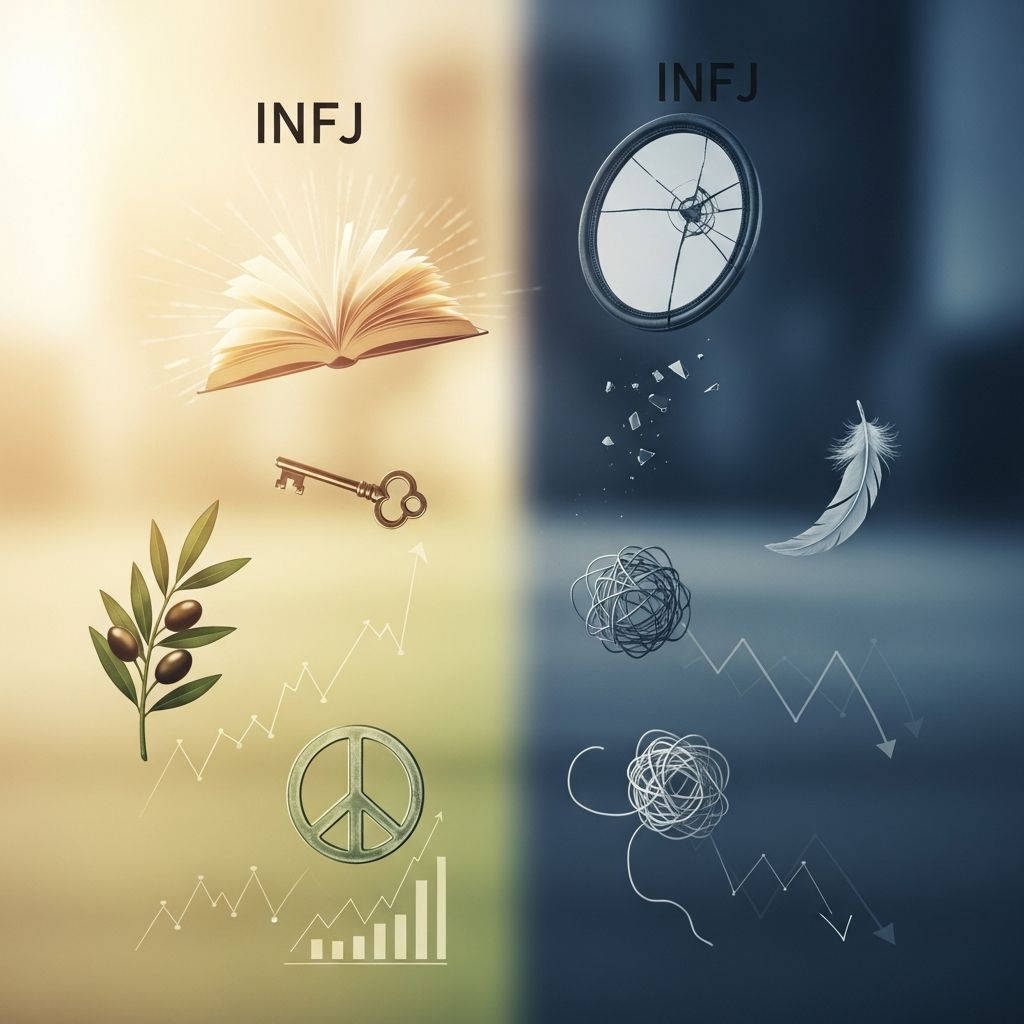
The INFJ personality type, often called the Advocate, is known for combining deep empathy, powerful intuition, and principled idealism. These qualities can make INFJs insightful change-makers and loyal companions, but they also come with vulnerabilities like burnout, self-criticism, and difficulty opening up to others.
This article offers a fresh, practical look at INFJ strengths and weaknesses, along with realistic strategies to harness their gifts while managing their challenges.
Who Are INFJs? A Brief Overview
INFJ is one of the sixteen personality types identified by the Myers-Briggs Type Indicator (MBTI). The letters stand for:
- Introverted (I) – Energized by time alone and deeper one-to-one interactions rather than large social gatherings.
- Intuitive (N) – Drawn to patterns, meanings, and possibilities more than concrete details.
- Feeling (F) – Guided by personal values and the impact on people when making decisions.
- Judging (J) – Prefers structure, planning, and closure over spontaneity and last-minute changes.
According to official descriptions, INFJs are typically compassionate, idealistic, imaginative, and visionary, with a strong desire to contribute to a more just and humane world.
Core INFJ Strengths
INFJs often bring a distinctive blend of emotional insight, conviction, and perseverance to everything they do. Below are some of their most characteristic strengths.
1. Deep Empathy and Emotional Insight
INFJs are often described as exceptionally empathetic, able to sense and understand the emotional states of others with unusual clarity. They combine their Feeling preference with strong intuition, which helps them notice subtle cues in tone, expression, and behavior.
- They tend to be excellent listeners, creating safe spaces where others feel understood.
- They anticipate emotional needs and often offer support before others explicitly ask for it.
- This emotional insight can make them effective counselors, mentors, or trusted confidants.
2. Strong Values and Moral Conviction
INFJs are typically guided by a clear internal code of ethics. Official personality profiles describe them as principled and strongly oriented toward fairness, honesty, and integrity.
- They are uncomfortable with deceit, manipulation, or taking advantage of others.
- They often feel called to defend the vulnerable or speak up about injustice, even when it is personally difficult.
- This moral compass can help them make consistent choices, even under pressure.
3. Visionary Idealism and Purpose-Driven Thinking
INFJs rarely feel satisfied with “good enough.” They tend to imagine how people, systems, and communities could be improved and feel energized by long-term, meaningful goals.
- They are drawn to humanitarian, social, or values-driven missions, often gravitating toward work that feels meaningful rather than purely profitable.
- They excel at envisioning better futures and inspiring others with that vision.
- Their idealism, when grounded, can make them persistent advocates for positive change.
4. Creativity and Original Thinking
INFJs frequently express themselves through creative or unconventional ideas. They often look beneath the surface of situations, noticing unexpected connections and possibilities.
- They may enjoy writing, art, design, or innovative problem-solving.
- They can translate complex emotional or abstract themes into clear, relatable expressions.
- Their originality helps them approach problems from fresh angles rather than defaulting to conventional solutions.
5. Determination and Quiet Persistence
Once INFJs commit to a goal that aligns with their values, they can be remarkably determined. Descriptions of this type emphasize their persistence and dedication, particularly when pursuing meaningful causes.
- They often work steadily behind the scenes, persistently moving a project forward.
- They are willing to make sacrifices when they believe in the outcome.
- This combination of conviction and perseverance can make them powerful long-term contributors in teams and communities.
Core INFJ Weaknesses
The same qualities that make INFJs so impactful can also lead to recurring challenges. Understanding these tendencies can help INFJs develop healthier patterns.
6. Sensitivity to Criticism
INFJs are often described as highly sensitive to criticism, especially when feedback touches on their values or sense of identity.
- They may interpret critique as a judgment of their character rather than of a specific behavior.
- Negative feedback can trigger rumination, self-doubt, or withdrawal.
- Harsh criticism from people they respect can feel especially painful and may be remembered for a long time.
7. Difficulty Opening Up About Their Own Needs
While INFJs often encourage others to share their struggles, they can be surprisingly private about their own. Official type descriptions note that they may be reluctant to open up, even with those close to them.
- They may avoid burdening others with their problems and try to “handle it alone.”
- This can lead to emotional distance in relationships, where others sense something is wrong but do not know what it is.
- Over time, unspoken resentment or exhaustion may build up.
8. Perfectionism and Unrealistic Standards
INFJs often hold themselves to high, sometimes unattainable, expectations. Their idealism combined with a judging preference can translate into perfectionistic tendencies.
- They may delay starting projects until they feel “fully ready,” which can result in procrastination.
- They can be highly self-critical when their performance does not match their internal vision.
- In work and relationships, this perfectionism may also spill over into expectations of others, causing frustration on both sides.
9. Avoidance of Conflict
Because INFJs place great value on harmony and emotional safety, they often go out of their way to avoid open conflict.
- They may suppress their own needs to keep the peace.
- Uncomfortable issues can remain unresolved for long periods, turning into subtle tension or passive withdrawal.
- Over time, this pattern can damage relationships more than a direct, respectful conversation would have.
10. Overcommitment and Burnout
INFJs frequently stretch themselves too thin in their desire to help others and live out their ideals. This can lead to overcommitment, chronic stress, and burnout.
- They may take on extra responsibilities at work, home, or in their communities because they feel morally compelled to help.
- They sometimes ignore their own limits until fatigue, irritability, or health issues force them to slow down.
- When they feel unappreciated or taken for granted, their motivation can abruptly collapse.
INFJ Strengths vs. Weaknesses at a Glance
| Area | Typical INFJ Strength | Related Vulnerability |
|---|---|---|
| Emotions & Relationships | Deep empathy, strong attunement to others’ feelings. | Absorbing others’ stress, difficulty expressing own needs. |
| Values & Ethics | Clear principles, strong sense of fairness and integrity. | Sensitivity to perceived moral criticism or hypocrisy. |
| Goals & Vision | Purpose-driven, idealistic, long-term focus. | Perfectionism, frustration when reality falls short of ideals. |
| Work Style | Persistent, organized, committed to meaningful tasks. | Overwork, difficulty saying no, risk of burnout. |
| Communication | Insightful, warm, and supportive in one-to-one discussions. | Avoids confrontation, may withdraw instead of addressing issues directly. |
Practical Growth Strategies for INFJs
Recognizing patterns is only the first step. Below are practical strategies to help INFJs use their best qualities more sustainably.
1. Reframing Criticism as Information
Because criticism can feel personal, INFJs benefit from building deliberate habits around feedback.
- Separate identity from performance: Remind yourself that feedback describes an action or outcome, not your worth as a person.
- Ask clarifying questions: “Can you give an example?” or “What would improvement look like to you?”
- Look for intent: Consider whether the person is trying to help, and if so, extract any useful information even if the delivery is imperfect.
2. Practicing Small, Honest Disclosures
To counter the “I must not burden anyone” belief, INFJs can practice sharing their inner world in manageable steps.
- Start by disclosing minor feelings or preferences, such as being tired or needing quiet time.
- Choose one or two trusted people and experiment with a bit more emotional honesty over time.
- Notice that sharing needs often strengthens relationships rather than harming them.
3. Setting Realistic Standards and Limits
Perfectionism and overcommitment often travel together. INFJs can protect their energy by consciously defining “good enough.”
- Define acceptable outcomes: Before starting a project, describe what a realistic success looks like given your time and resources.
- Use time boundaries: Decide in advance how much time you will devote to something, and stop when the time is up.
- Practice saying no: Prepare a few polite phrases for declining new commitments when your plate is full.
4. Addressing Conflict with Values-Based Communication
Since INFJs care deeply about harmony, reframing conflict as a tool for long-term understanding can make it less intimidating.
- Use “I” statements (e.g., “I felt overlooked when…”) to express impact without accusing.
- Link your concerns to shared values (fairness, respect, kindness) to keep discussions constructive.
- Approach difficult conversations when you are calm and have had time to organize your thoughts.
5. Prioritizing Self-Care as an Ethical Choice
Official descriptions note that INFJs may neglect self-care when focused on their ideals. Reframing rest as part of their responsibility can help.
- View rest and boundaries as conditions for sustainable service, not selfish indulgence.
- Schedule regular downtime just as you would schedule important appointments.
- Include emotionally replenishing activities (reading, nature, creative expression) in your routine.
Frequently Asked Questions (FAQs)
Q: Why are INFJs often called the “Advocate” personality type?
INFJs are frequently labeled “Advocates” because they pair strong personal values with a desire to improve the lives of others. Official profiles highlight their interest in addressing deeper societal issues and their sense of responsibility to stand up for what they believe is right.
Q: Are INFJs really the rarest personality type?
Many discussions of MBTI suggest that INFJs are one of the least common types in the general population, though precise prevalence estimates vary by study and sample. The main implication is that their combination of traits—introversion, intuition, feeling, and judging—is relatively uncommon compared with other patterns.
Q: What careers tend to suit INFJ strengths?
Materials from MBTI publishers indicate that INFJs often thrive in roles that align with their ideals and allow them to help others, such as counseling, teaching, social work, non-profit leadership, health care, ministry, writing, or creative professions. They tend to do best in environments that respect their values and give them time for deep, focused work.
Q: How can INFJs avoid burnout?
INFJs can reduce burnout risk by setting clearer boundaries, limiting the number of commitments they accept, reframing saying “no” as a way to protect the quality of their “yes,” and building consistent self-care routines. Paying attention to early signs of overload—such as irritability, emotional numbness, or sudden withdrawal—can help them adjust before exhaustion sets in.
Q: Do all INFJs experience these strengths and weaknesses in the same way?
No. While these patterns are commonly associated with the INFJ type, individuals are influenced by culture, upbringing, mental health, education, and life experience. MBTI publishers emphasize that personality type describes preferences rather than fixed abilities or destiny, and that people of any type can develop new skills over time.
References
- INFJ Personality (Advocate) — 16Personalities. 2023-05-19. https://www.16personalities.com/infj-personality
- Strengths & Weaknesses – INFJ Personality (Advocate) — 16Personalities. 2023-05-19. https://www.16personalities.com/infj-strengths-and-weaknesses
- INFJ: MBTI® personality profile — The Myers-Briggs Company. 2022-06-01. https://eu.themyersbriggs.com/en/tools/MBTI/MBTI-personality-Types/INFJ
- 10 characteristics of the Advocate personality type (INFJ) — Calm. 2023-03-15. https://www.calm.com/blog/advocate-personality-type-infj
- 8 Strange and Peculiar INFJ Traits — Introvert, Dear. 2021-09-14. https://introvertdear.com/news/infj-personality-type-unique-traits/

- Integrated M.A. in Applied Linguistics, University of Hyderabad
- 5+ years in editorial, instructional, SEO, and research-based writing
Sneha is a relationships and lifestyle writer with a strong foundation in applied linguistics and certified training in relationship coaching. She brings over five years of writing experience to theskillvault, crafting thoughtful, research-driven content that empowers readers to build healthier relationships, boost emotional well-being, and embrace holistic living. Her writing and insights reflect the belief that beauty, happiness, and wellness…