
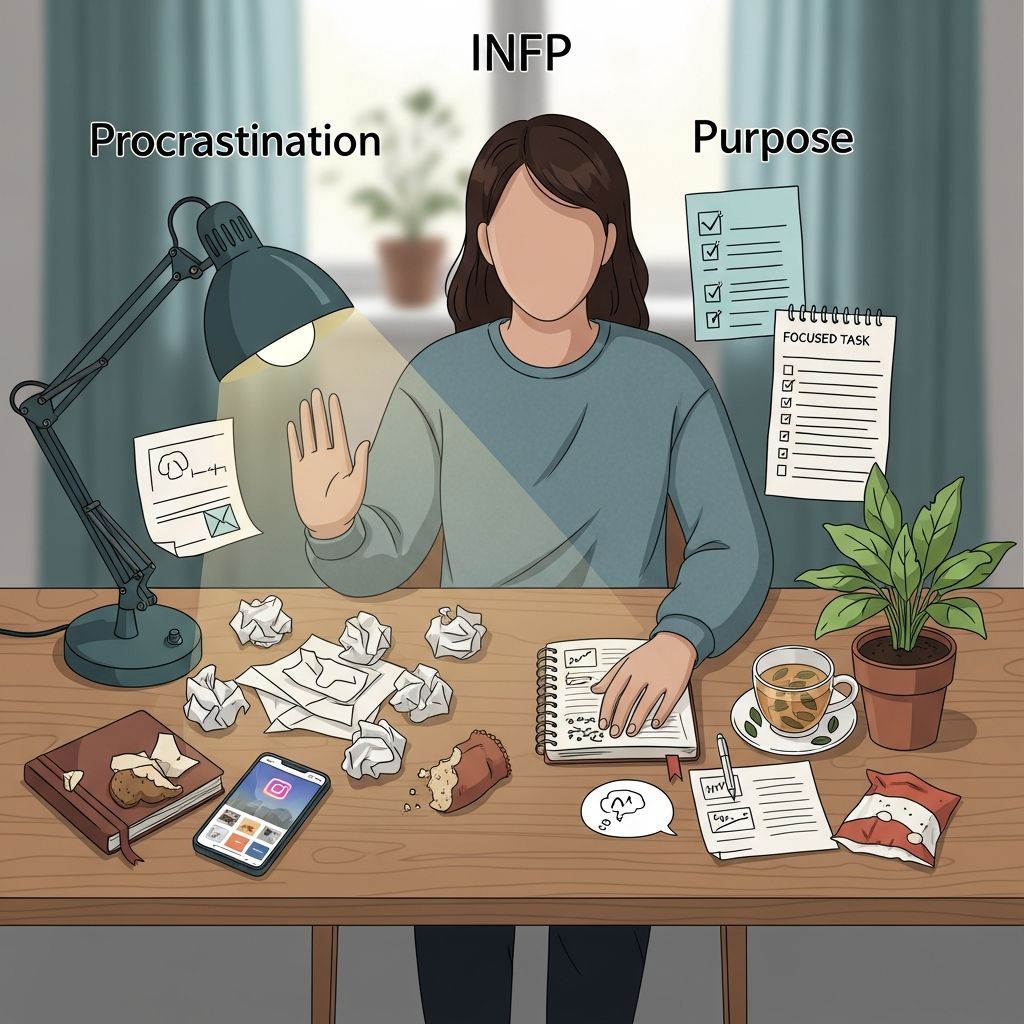
Mediator personalities (INFP) are often described as imaginative, idealistic, and deeply values-driven. Yet many of them quietly wrestle with a recurring challenge: putting things off, even when those things really matter to them. This article explores why procrastination can be so persistent for INFPs and how they can transform it into a more purposeful, compassionate way of taking action.
Understanding INFP Procrastination Beyond “Laziness”
Psychologists describe procrastination as a self-regulation problem: a tendency to delay tasks despite expecting that the delay will make things worse, both practically and emotionally.1 For INFPs, this delay is rarely about not caring or being lazy. It usually reflects an inner conflict between their values, emotions, and the demands of the outside world.
Research has shown that people with strong perfectionistic tendencies and high sensitivity to negative emotions are especially prone to procrastination, often using delay to avoid anticipated distress or failure.2 These patterns align closely with many INFP traits: idealism, self-criticism, and a deep concern about whether what they do will be truly meaningful.
| Common Assumption | INFP Reality |
|---|---|
| They procrastinate because they are careless. | They delay because they care too much about doing the right thing in the right way. |
| They just need more discipline. | They need more emotional alignment, clarity of purpose, and safe, manageable steps. |
| They are disorganized by nature. | They are organized internally around values and meaning more than external schedules. |
Why INFPs Put Things Off: Inner Mechanisms at Work
For many Mediators, procrastination is the visible symptom of several quieter inner processes. Understanding these can make self-compassion and change much easier.
1. Deep Feelings, Fragile Confidence
INFPs often experience emotions intensely and privately. When a task feels like a test of their worth, creative ability, or integrity, the stakes can seem enormous. Psychological research links procrastination to fear of failure and self-doubt, especially when people strongly tie performance to self-esteem.2
- A creative project can feel like a reflection of the soul, making it terrifying to start.
- Academic or work tasks may trigger “If I fail at this, maybe I’m not who I thought I was.”
- Instead of facing this fear, the INFP may drift into daydreams, distractions, or comforting activities.
2. Idealism Versus Imperfect Reality
Mediators often have rich inner visions of how things should be. But translating those visions into real-world action involves compromise, unfinished drafts, and awkward first attempts.
- They may hold an ideal image of the “perfect” outcome and fear starting until conditions feel just right.
- Data suggest that perfectionism is strongly associated with procrastination, particularly when people set unrealistically high standards and fear not meeting them.2
- This can lead to “all-or-nothing” thinking: if it can’t be beautiful or deeply meaningful right now, why start?
3. Boredom and Meaninglessness
INFPs are often energized by purpose, creativity, and authenticity. Routine tasks, paperwork, and mechanical responsibilities can feel painfully empty. Research on personality and self-regulation indicates that people are more likely to procrastinate when they perceive tasks as boring, unstructured, or lacking in personal relevance.1
- Emails, forms, or administrative chores may seem pointless compared with inner ideals.
- Without a clear sense of “why this matters,” attention naturally drifts elsewhere.
- Procrastination then becomes a way to escape a moment that feels disconnected from their deeper values.
4. Overwhelm and Decision Paralysis
Mediators tend to see many possibilities and nuances. This gift can also become overwhelming. When a project has multiple potential directions, or when the consequences feel significant, they may hesitate to act for fear of choosing the “wrong” path.
- Tasks stay stuck in the planning or imagining phase.
- Energy goes into rethinking, re-evaluating, and second-guessing instead of doing.
- This can create a loop: the longer they wait, the more pressure builds, and the harder it becomes to begin.
Reframing Procrastination: From Enemy to Information
Before changing behavior, Mediators benefit from changing the story they tell about their procrastination. Instead of treating it as a moral failure, it can be seen as a signal pointing to an unmet need.
Questions That Turn Judgment Into Insight
When you notice yourself avoiding something, ask:
- Is this task aligned with my values? If not, can it be adjusted or understood differently?
- What emotion comes up when I think about starting? Fear, boredom, shame, confusion?
- What am I protecting myself from by delaying? Criticism, discomfort, uncertainty?
- Is my standard for success realistic, or quietly perfectionistic?
This type of reflection echoes approaches in cognitive-behavioral and self-compassion–based therapies, which emphasize understanding underlying beliefs and emotions instead of simply forcing behavior change.3
Gentle Strategies That Suit Mediator Energy
Many mainstream productivity techniques focus on rigid schedules and external pressure. INFPs often resist these, feeling controlled or inauthentic. The most effective approaches for Mediators tend to respect their inner world while nudging them toward steady action.
1. Connect Every Task to a Meaningful “Why”
Research on motivation suggests that when people link tasks to personally important values, they are more persistent and less likely to procrastinate, even on unpleasant activities.4 For INFPs, this is especially powerful.
- Instead of “I have to finish this report,” try “Finishing this report helps me support people who rely on this information.”
- Reframe chores as ways of creating a peaceful, nurturing space for yourself and others.
- See administrative tasks as steps that protect your freedom, creativity, or future options.
Writing your reasons on a sticky note or at the top of a to-do list can keep this sense of purpose in view.
2. Shrink the First Step Until It Feels Safe
When tasks feel emotionally loaded, they also feel enormous. One evidence-based tactic for overcoming procrastination is to reduce the size and immediacy of what you must do right now, making it easier to begin.1
- Break projects into tiny, concrete actions (e.g., “Open the document,” “Write one messy paragraph”).
- Set a timer for 5–10 minutes and commit only to working until it rings.
- Allow the first attempt to be deliberately rough or imperfect, framing it as exploration, not a final product.
For many Mediators, once they have crossed the threshold of beginning, their natural immersion and creativity take over.
3. Design Emotion-Friendly Environments
Studies on behavior change emphasize the power of environment: people tend to do what is easiest, most visible, and emotionally comfortable in their surroundings.4 INFPs can leverage this by shaping spaces that invite gentle focus.
- Create a small, cozy “deep work corner” with calming aesthetics, music, or lighting.
- Keep tools for your important tasks visible and accessible, while placing major distractions (phones, entertainment) slightly out of reach.
- Pair challenging work with sensory comforts: tea, a soft blanket, or background sounds that put you at ease.
4. Use Rituals Instead of Rigid Schedules
Highly structured timetables may feel oppressive to Mediators, but gentle rituals can anchor their day without sacrificing flexibility.
- Begin each morning with a brief check-in: “What is one thing I can do today that my future self will thank me for?”
- Associate certain times with certain types of work (e.g., creative work after breakfast, routine tasks mid-afternoon).
- End the day by jotting down 2–3 small tasks for tomorrow, so you never start from zero.
5. Invite Support That Honors Your Autonomy
External accountability can reduce procrastination, especially when it is supportive rather than controlling.1 For INFPs, the key is to find people who respect their pace and values.
- Share your goals with a trusted friend who can check in gently, not push aggressively.
- Work alongside others (co-working sessions, virtual or in person) where everyone quietly focuses on their own tasks.
- Let someone know when you have completed a step; turning progress into a shared moment can feel rewarding.
Transforming Procrastination Into Passionate Focus
INFPs are capable of intense, sustained focus when they feel emotionally invested and aligned with what they are doing. The goal is not to become a different type of person but to harness this natural capacity more consistently.
From Avoidance to Curiosity
When you catch yourself putting something off, experiment with tiny shifts:
- Instead of saying, “I can’t face this,” try, “What would it be like to explore this for five minutes?”
- Instead of, “I’m bad at follow-through,” try, “I’m learning how to support myself in finishing things.”
- Instead of, “This has to be perfect,” try, “This can be a draft that I refine later.”
These small linguistic changes draw on principles from cognitive and acceptance-based therapies, which have been shown to help reduce avoidance and increase meaningful action over time.3
Align Projects With Your Core Values
List your top personal values—such as creativity, kindness, authenticity, learning, or justice. Then, for each ongoing project, write down how it reflects at least one of these values, or how you could adjust it so that it does.
- If a task supports compassion, imagine who benefits from your effort.
- If a task supports creativity, notice the parts where you can experiment or bring originality.
- If a task supports integrity, remember that following through is part of honoring your commitments.
This values-based framing is consistent with research indicating that acting in line with one’s core values can reduce internal conflict and foster resilience, even in the presence of discomfort.4
Frequently Asked Questions (FAQs)
Q: Is procrastination inevitable for INFPs?
Procrastination is common among Mediators, but it is not fixed or inevitable. By understanding their emotional patterns and designing gentle, values-aligned strategies, INFPs can significantly reduce avoidance and follow through more consistently.
Q: How can an INFP tell the difference between healthy rest and procrastination?
Rest usually feels restorative and intentional, while procrastination often comes with increasing guilt, tension, or mental distraction. If you feel more anxious after a break and still avoid the task, you are likely procrastinating rather than replenishing.
Q: What if a task truly has no personal meaning for me?
Not every task can be deeply meaningful, but many can be linked to a larger purpose—such as financial stability, supporting loved ones, or protecting future freedom. When no such link exists, you can minimize the task, seek help, or renegotiate expectations if possible.
Q: Are strict productivity systems helpful for Mediators?
Highly rigid systems often backfire for INFPs, who value autonomy and authenticity. Flexible structures—like short work sprints, simple lists, and value-based goals—are usually more sustainable than complex rules or minute-by-minute schedules.
Q: Can therapy help with chronic procrastination?
Yes. Approaches such as cognitive-behavioral therapy, acceptance and commitment therapy, and self-compassion–focused interventions have evidence for reducing procrastination and related emotional distress. A therapist can help tailor strategies to your personality, history, and goals.
References
- Piers Steel, “The Nature of Procrastination” — Psychological Bulletin. 2007-01-01. https://doi.org/10.1037/0033-2909.133.1.65
- Fuschia M. Sirois, Timothy A. Pychyl, “Procrastination and the Priority of Short-Term Mood Regulation” — Social and Personality Psychology Compass. 2013-05-01. https://doi.org/10.1111/spc3.12048
- Kristin D. Neff, “Self-Compassion” — The Guilford Press. 2011-01-01. https://self-compassion.org/the-book/
- Richard M. Ryan, Edward L. Deci, “Self-Determination Theory and the Facilitation of Intrinsic Motivation, Social Development, and Well-Being” — American Psychologist. 2000-01-01. https://doi.org/10.1037/0003-066X.55.1.68

Medha Deb is an editor with a master's degree in Applied Linguistics from the University of Hyderabad. She believes that her qualification has helped her develop a deep understanding of language and its application in various contexts. Medha specializes in the areas of beauty, health, sports, and wellness and is committed to ensuring that the content on the website is…