
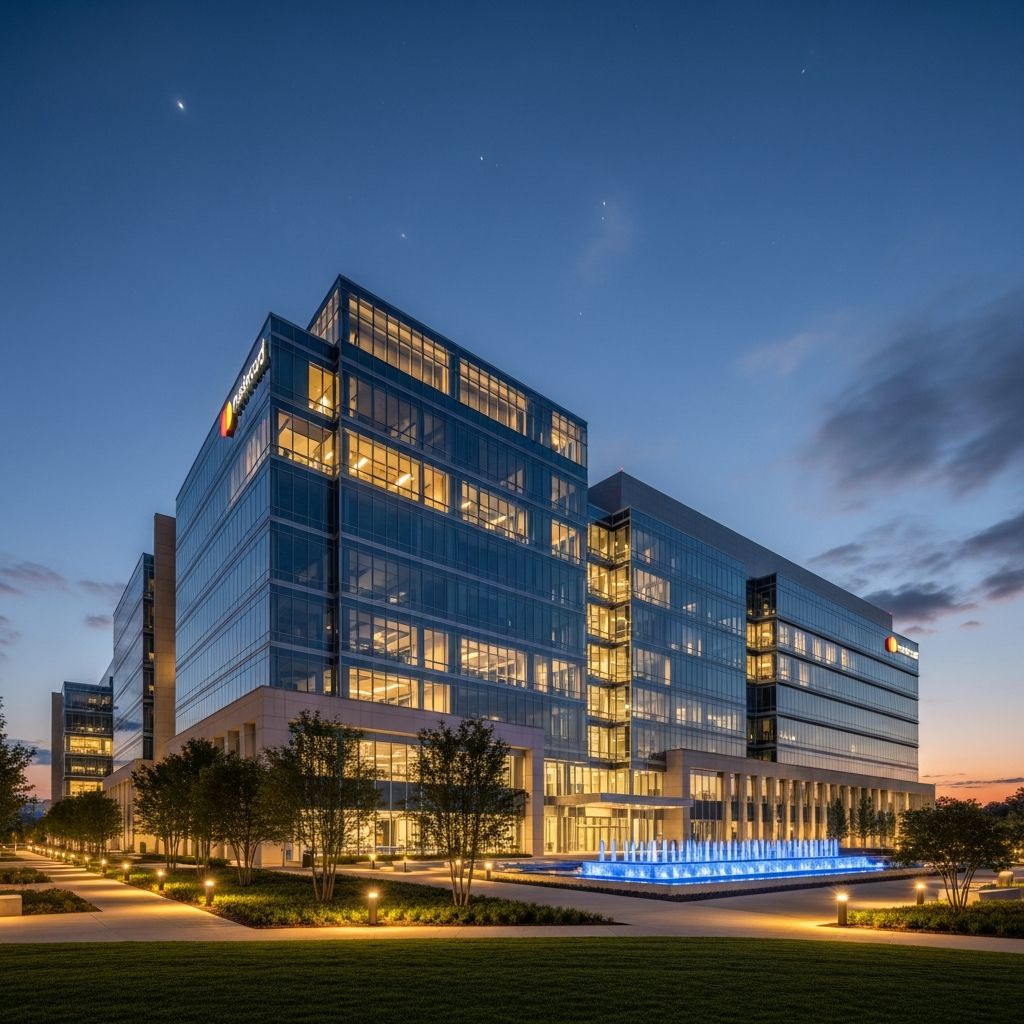
Mastercard’s St. Louis Tech Hub in O’Fallon, Missouri, is far more than a traditional office complex. It is a global nerve center for payment processing, cybersecurity, data innovation, and sustainable operations that support billions of secure transactions around the world every year.
This article offers an in-depth, original look at what makes the campus unique: its design, technology, culture, environmental commitments, and impact on the broader St. Louis region.
The Role of St. Louis in Mastercard’s Global Network
The St. Louis Tech Hub is one of Mastercard’s largest global technology and operations locations, home to thousands of employees working across technical, operational, and business disciplines.
- Global scale: Teams in St. Louis help support and monitor a network that has handled hundreds of millions of card transactions per day in recent years.
- Always-on operations: Mission-critical payment and security functions are managed 24/7, enabling cardholders and businesses to confidently transact across time zones.
- Strategic location: Mastercard has operated in the St. Louis area for decades, leveraging its central U.S. position to support coast-to-coast transaction flows.
Hosting a major data center and global mission control, the campus is often described as one of the “engines” that power Mastercard’s worldwide business.
A Campus Designed for Technology and People
The St. Louis Tech Hub occupies a modern, expansive corporate campus that combines robust infrastructure with people-centered spaces.
Key Campus Attributes
- Large-scale office footprint: The core office building spans hundreds of thousands of square feet of workspace, collaboration areas, and amenities.
- Hybrid-friendly environment: The design supports flexible work patterns, from focused individual work to hybrid meetings and cross-functional project rooms.
- Balancing comfort with resilience: Above ground, employees benefit from natural light, open layouts, and social spaces; below ground, industrial systems keep the global data center running reliably.
From the outside, the campus resembles a high-end corporate headquarters. Inside, it houses the physical infrastructure more akin to a critical utility, complete with backup power, advanced cooling, and round-the-clock monitoring.
The Heart of Operations: Data and Mission Control
At the core of the campus lies Mastercard’s largest data center worldwide, connected directly to a suite of operations teams that keep the network secure and available.
Data Center and Energy Backbone
Beneath and around the main office floors is a dense network of electrical, mechanical, and cooling systems that maintain continuous uptime for the data center.
- Redundant power: Multiple electrical feeds, backup generators, and battery systems are designed to provide uninterrupted power, even in severe weather.
- Industrial-grade cooling: Chillers, cooling towers, and airflow systems maintain stable temperatures for rows of high-density servers.
- Physical security: Restricted access, heavy doors, and layered controls protect critical infrastructure from unauthorized entry.
Mission Control & Operations (MC&O)
Near the data center is a mission-control-style operations center where teams monitor Mastercard’s global network.
- Continuous monitoring: Large displays show traffic patterns, system health, and alerts across regions and products.
- Incident response: Engineers and operators track anomalies, respond to disruptions, and coordinate with teams worldwide to restore service quickly.
- Visualization of global traffic: World maps and dashboards visualize connections to banks, merchants, and partners, highlighting how activity shifts by geography and time of day.
In combination, the data center and MC&O form a “factory floor” for digital payments, where reliability, speed, and security are engineered and managed at scale.
Security, Cyber Defense, and Digital Forensics
Because trust is central to digital payments, cybersecurity is deeply embedded across the St. Louis Tech Hub. Multiple specialized teams operate side by side to anticipate, detect, and respond to threats.
The Fusion Center
The Fusion Center brings together experts from security, technology, communications, legal, and operations to handle complex risks and crises.
- Integrated decision-making: Cross-functional teams collaborate in one space, improving the speed and consistency of responses to emerging threats.
- Scenario planning: Staff explore the implications of developing technologies such as 6G networks and advanced artificial intelligence, building playbooks before these risks fully materialize.
- Business continuity focus: The center works to ensure that critical services remain stable for customers even when incidents occur.
Security Operations Center (SOC)
The Security Operations Center monitors the company’s cyber and physical security posture in real time.
- Threat detection: The SOC processes and triages a large volume of security events every year, from routine scans to targeted intrusion attempts.
- Coordinated defense: Analysts use specialized tools to investigate anomalies, contain attacks, and share intelligence internally and with partners where appropriate.
- Global visibility: Activity from around the world is consolidated into a single picture, enabling faster recognition of widespread or coordinated threats.
Digital Forensics Lab
Adjacent to the SOC is a digital forensics laboratory that supports investigations of cyber incidents and fraud.
- Evidence handling: The lab uses controlled processes to preserve and analyze digital evidence such as hard drives, logs, or malware samples.
- Advanced tooling: Forensic platforms reconstruct timelines, extract artifacts, and identify behaviors used in attacks.
- Support for customers: Findings from investigations can be shared with external organizations to help them harden their systems and understand evolving threats.
Together, these functions make the St. Louis campus a central hub for Mastercard’s global security and cyber defense strategy.
Innovation, Engineering, and Product Development
Beyond day-to-day operations, the Tech Hub is a major center for experimentation and product engineering.
- Software development: Engineers build and refine platforms for transaction processing, digital wallets, tokenization, and fraud detection.
- Data & AI: Data scientists and architects explore ways to turn payment data into insights while preserving privacy and adhering to regulatory requirements.
- Emerging technology research: Specialists evaluate new telecommunications standards, identity technologies, and AI applications that could reshape payments.
- Cross-functional squads: Multidisciplinary teams connect engineers, product managers, designers, and risk experts to co-create new services.
Example Focus Areas
| Focus Area | Goals |
|---|---|
| Real-time payment processing | Increase speed, reliability, and scalability of global transactions. |
| Fraud and risk analytics | Identify suspicious activity with minimal disruption to legitimate customers. |
| Digital identity & authentication | Make verifying identity more secure and user-friendly across channels. |
| Developer platforms & APIs | Enable banks, fintechs, and merchants to easily integrate Mastercard services. |
Sustainability and Green Building Leadership
The St. Louis Tech Hub is also a flagship for Mastercard’s sustainability strategy, designed to reduce environmental impact without compromising reliability.
LEED-Certified Operations
The campus has achieved LEED Platinum certification under the LEED v4 for Operations and Maintenance standard, a top rating for sustainable buildings. LEED (Leadership in Energy and Environmental Design) is an internationally recognized system that evaluates buildings on criteria such as energy use, water efficiency, waste management, and indoor environmental quality.
- Efficient building systems: Upgrades to lighting, HVAC, and controls help reduce energy consumption while maintaining high reliability for critical systems.
- Performance-based management: LEED O+M focuses on how buildings perform over time, encouraging ongoing improvement rather than one-time retrofits.
- Indoor environmental quality: Attention to ventilation, lighting, and materials helps create a healthier workspace for employees.
Renewable Energy Investments
To address the sizable energy demands of a large data center, Mastercard has invested in renewable power near the St. Louis campus.
- On-site solar: Solar panels have been installed on and near the campus, including a solar array over parking areas and an adjacent solar farm on previously undeveloped land.
- Utility partnerships: Mastercard has engaged with local energy providers to source additional renewable energy and support regional clean power projects.
- Net-zero ambition: The company has set a goal of reaching net-zero emissions by 2040, and the St. Louis investments contribute to that broader objective.
These efforts align with trends in the data center industry, where large operators are increasingly using renewables and efficiency measures to manage both cost and climate impact.
Life and Culture at the St. Louis Tech Hub
Although the campus houses complex technology, it is also designed as a people-first workplace that emphasizes collaboration, inclusion, and community engagement.
Workspace and Amenities
- Flexible workspaces: A mix of open areas, meeting rooms, and quiet zones supports different work styles and tasks.
- Social and refresh areas: Coffee bars, break zones, and informal gathering spaces make it easier for colleagues to connect across teams.
- Campus feel: The environment is closer to a university or innovation park than a single office tower, making it easier to host large events, training, or cross-team programs.
Teams and Disciplines
Employees in St. Louis span a wide range of roles, including:
- Software and systems engineering
- Cybersecurity operations and research
- Data science and architecture
- Finance, HR, and global business services
- Product management and business analysis
- Customer support and network operations
This diversity of skills in one location helps the campus operate as an integrated hub rather than a single-function office.
Impact on the St. Louis Region
Mastercard’s presence in the St. Louis area extends beyond its own campus. The company collaborates with local institutions, supports workforce development, and contributes to the region’s growing reputation as a technology and financial services center.
- Job creation: With several thousand employees, the Tech Hub is a major regional employer in technology, operations, and professional services.
- Partnerships with educators: Mastercard has engaged with schools, colleges, and universities to support STEM learning and create pathways into tech careers.
- Support for local organizations: The company collaborates with non-profits, startups, and civic groups to help strengthen the local economy and innovation ecosystem.
- Signal for regional tech growth: A global player investing heavily in the region reinforces St. Louis’s position as a viable home for large-scale tech operations and digital finance.
Why the St. Louis Tech Hub Matters for the Future of Payments
The Mastercard St. Louis Tech Hub illustrates how modern payment networks are built at the intersection of technology, people, and place.
- Reliability at scale: Industrial-strength infrastructure and 24/7 operations ensure that payments can move quickly and securely, even as volumes grow.
- Security by design: Integrated cyber operations and forensics capabilities help Mastercard stay ahead of increasingly sophisticated threats.
- Continuous innovation: Co-located engineering, research, and product teams enable the rapid development of new services and network capabilities.
- Sustainable operations: LEED-certified building practices and renewable energy investments demonstrate that critical infrastructure can become more climate-conscious.
- Community integration: Deep ties to the St. Louis region support local talent development and economic growth.
As digital payments become a default mode of commerce, the work happening at this campus helps ensure that those transactions remain fast, secure, and dependable for people and businesses around the world.
Frequently Asked Questions (FAQs)
Q: What makes Mastercard’s St. Louis Tech Hub unique?
A: The campus combines Mastercard’s largest global data center with a mission-control-style operations center, cybersecurity teams, and business services, all within a LEED-certified, sustainability-focused environment.
Q: How does the St. Louis office contribute to global payment security?
A: Security operations, the Fusion Center, and a digital forensics lab in St. Louis monitor threats around the clock, investigate incidents, and develop strategies to defend Mastercard’s network and its customers worldwide.
Q: Is the St. Louis Tech Hub only for engineers?
A: No. While there is a strong engineering and technology presence, the campus also houses finance, HR, operations, risk, product, and customer-facing roles, creating a multidisciplinary environment.
Q: How is the campus addressing environmental sustainability?
A: The site has achieved LEED Platinum certification and draws on renewable energy, including on-site solar installations and partnerships with local utilities, as part of Mastercard’s broader goal of net-zero emissions by 2040.
Q: Why did Mastercard choose the St. Louis area for this hub?
A: Mastercard has operated in the St. Louis region for decades, initially leveraging its central location for national transaction processing. Over time, the company expanded its footprint into a major tech and operations hub, supported by local talent, infrastructure, and strong community partnerships.
References
- Mastercard St. Louis Tech Hub behind-the-scenes tour — Mastercard. 2025-05-07. https://www.mastercard.com/us/en/news-and-trends/stories/2025/mastercard-st-louis-tech-hub-behind-the-scenes.html
- Jobs in St. Louis, Missouri – Mastercard careers — Mastercard. 2024-06-01 (approx.). https://careers.mastercard.com/us/en/st-louis-missouri
- Mike at the Mastercard Technology Hub in St Louis! (Video) — Mastercard (via YouTube). 2018-10-01 (approx.). https://www.youtube.com/watch?v=kgqor07g3YA
- 2200 Mastercard Blvd Overview — Green Building Information Gateway (U.S. Green Building Council). 2021-04-19. https://www.gbig.org/buildings/30743
- 10 reasons to join Mastercard’s St. Louis Tech Hub in O’Fallon, Missouri — Mastercard Careers Blog. 2023-09-15 (approx.). https://careers.mastercard.com/us/en/blogarticle/10-reasons-to-join-mastercard-s-st-louis-tech-hub-in-o-fallon-missouri

- Integrated M.A. in Applied Linguistics, University of Hyderabad
- 5+ years in editorial, instructional, SEO, and research-based writing
Sneha is a relationships and lifestyle writer with a strong foundation in applied linguistics and certified training in relationship coaching. She brings over five years of writing experience to theskillvault, crafting thoughtful, research-driven content that empowers readers to build healthier relationships, boost emotional well-being, and embrace holistic living. Her writing and insights reflect the belief that beauty, happiness, and wellness…