
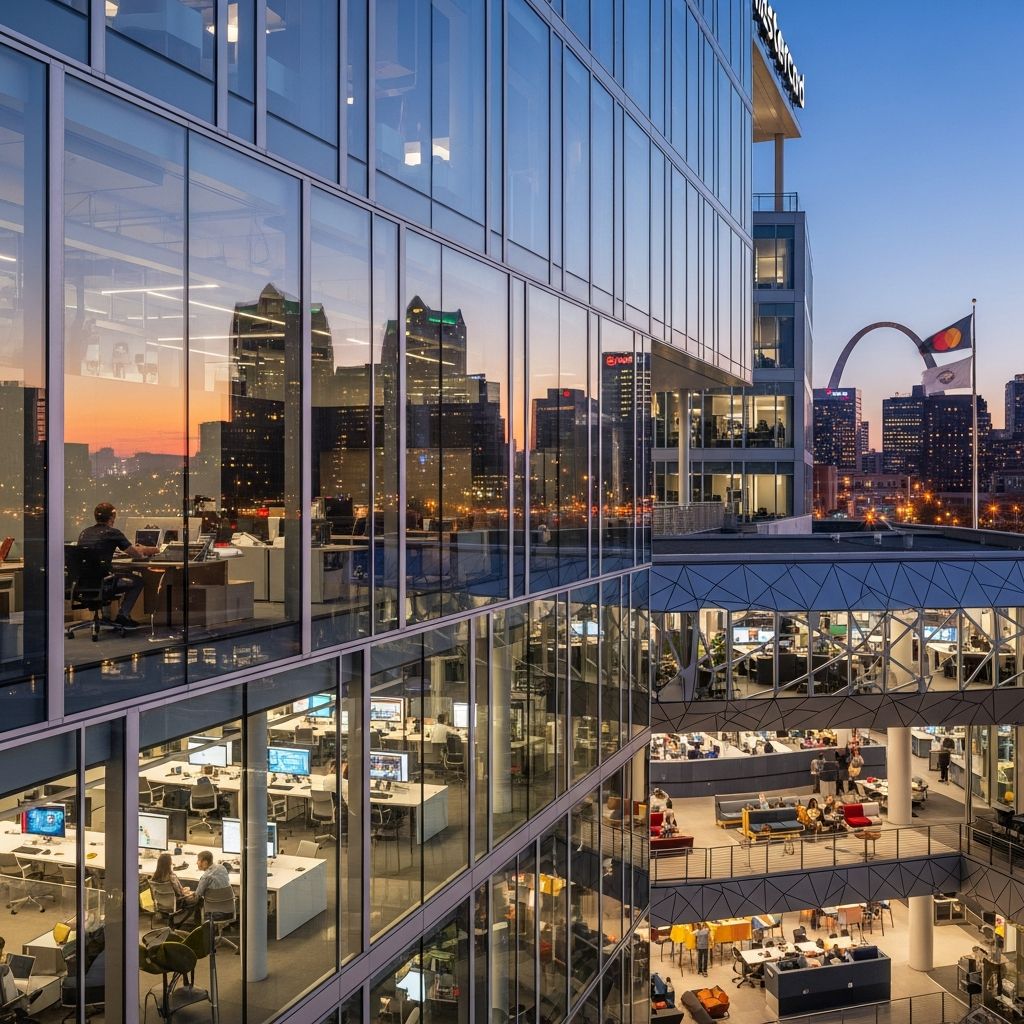
The Engine Behind Global Financial Transactions
Nestled in O’Fallon, Missouri, approximately 30 miles west of downtown St. Louis, Mastercard operates one of its most strategically important facilities worldwide. This sprawling technology campus serves as the backbone of global payment processing, handling the infrastructure that enables billions of people to conduct financial transactions seamlessly every single day. With more than 4,000 employees working across its environmentally conscious campus, the St. Louis Tech Hub represents a remarkable convergence of cutting-edge technology, operational excellence, and forward-thinking sustainability practices.
The significance of this location extends beyond mere geography. Mastercard established its presence in St. Louis decades ago when the company recognized the advantage of operating from the nation’s geographic center—a strategic position that allowed for efficient management of transactions flowing across the entire country. Today, the current facility, which opened in 2001 on the grounds of a former agricultural operation, has evolved into something far more sophisticated: a comprehensive technology hub that processes hundreds of millions of payments daily while maintaining the highest security standards.
Infrastructure at the Heart of Digital Commerce
The St. Louis Tech Hub comprises several interconnected operational centers, each playing a vital role in maintaining the integrity and efficiency of Mastercard’s global network. The facility houses the company’s largest data center worldwide, positioning St. Louis as a central processing nexus for network operations, advanced security measures, and research and development initiatives.
Mission Control & Operations Center
At the core of daily operations sits the Mission Control & Operations Center, known colloquially as MC&O. This sophisticated command center monitors the Mastercard network continuously throughout the year, functioning with the precision of aerospace operations. The facility features state-of-the-art monitoring systems with high ceilings, clusters of workstations, and banks of large display screens that track real-time network activity across the globe.
The operational scale managed by this facility is staggering. During the previous year, approximately 160 billion transactions flowed through the Mastercard network—translating to roughly 436 million transactions per day. On particularly busy days, the system processes as many as 40 million credit card authorizations, with an estimated annual transaction volume exceeding one trillion dollars. This extraordinary throughput requires constant vigilance and sophisticated management protocols to ensure reliability and security.
The MC&O represents one of six similar global operations centers maintained by Mastercard, demonstrating the company’s commitment to distributed, redundant infrastructure for maximum uptime and reliability. Staff members monitor animated world maps displaying real-time network connections, where circle sizes represent transaction volumes flowing through various connection points. The visual representation emphasizes the immense scale of activity—literally too dense to display every individual customer connection without overwhelming the display.
Energy Center and Infrastructure Management
Beneath the polished, modern office spaces lies the Energy Center, a heavily secured industrial facility that represents the true backbone of Mastercard’s technological prowess. This basement-level operation, marked by industrial-grade equipment and considerable operational noise, houses the mechanical and electrical systems essential for powering and cooling the data center above. Engineers working in this space ensure that the facility maintains optimal operating conditions even during extreme weather events, preventing service interruptions that could impact billions of people worldwide.
The Energy Center embodies the principle that visible innovation depends entirely upon invisible infrastructure. While the upper floors showcase contemporary meeting spaces with wooden accents and elegant design, the Energy Center represents the unglamorous but absolutely essential mechanical heart that sustains operations. This facility includes sophisticated cooling systems, electrical distribution networks, and backup power generation capabilities that maintain uninterrupted service regardless of external conditions.
Security and Cybersecurity Excellence
Mastercard’s commitment to security permeates every aspect of its St. Louis operations, with multiple specialized centers dedicated to detecting, preventing, and responding to security threats across both physical and digital domains.
Security Operations Center
The Security Operations Center maintains constant surveillance over Mastercard’s physical and cyber infrastructure, monitoring and analyzing a phenomenal volume of security events. The facility detects and evaluates approximately 105 million cyber events annually, ranging from routine security scans to sophisticated attacks from determined adversaries attempting to breach the network. This continuous vigilance allows Mastercard to distinguish between legitimate business activity and malicious threats, ensuring that only approved transactions proceed while blocking suspicious activities.
Fusion Center for Threat Intelligence
The Fusion Center operates as a collaborative intelligence hub where teams from diverse business units—including legal, communications, operations, technology, and fraud departments—converge to develop proactive crisis response strategies. Rather than responding reactively to emerging threats, teams within this center research and game out potential scenarios involving emerging technologies such as 6G telecommunications networks and artificial intelligence applications. This forward-thinking approach enables Mastercard to address security challenges before they materialize, maintaining a significant defensive advantage in an increasingly complex threat landscape.
Digital Forensics Laboratory
The Digital Forensics Lab represents a rare operational resource—one of only a handful of privately accredited forensic investigation facilities in the nation. This specialized laboratory provides forensic analysis services for both internal Mastercard investigations and external customers facing cybercrime challenges. The facility conducts detailed analysis of malware, suspicious files, and compromised hardware, generating threat intelligence that helps customers strengthen their own defensive postures. By understanding emerging malware and attack methodologies, Mastercard enables its partners to proactively secure their networks against similar threats.
Technological Innovation and Research
Beyond operational functions, the St. Louis Tech Hub serves as an incubator for technological innovation that extends across Mastercard’s global operations. The facility brings together software developers, data architects, cybersecurity specialists, and other technical experts who collaborate to create resilient systems capable of powering modern economies. These innovations, developed and refined in St. Louis, subsequently propagate throughout Mastercard’s worldwide network, enhancing security, efficiency, and functionality for billions of users globally.
Sustainability Initiatives and Environmental Responsibility
Mastercard has made significant commitments to environmental sustainability within its St. Louis operations, recognizing that power-intensive data center operations require thoughtful stewardship of resources. The company recently acquired 40 additional acres adjacent to its existing facility, utilizing a portion of this land to develop a substantial solar farm that generates renewable electricity.
This renewable energy initiative, complemented by existing solar panels installed atop the facility’s parking structures, enables Mastercard to power its energy-intensive data center operations using clean energy sources. These investments directly support the company’s target of achieving net-zero emissions by 2040. Additionally, Mastercard has established renewable energy partnerships with local utility providers in the St. Louis region, extending its environmental commitment beyond its immediate operations to benefit the broader community.
Workspace Design and Employee Experience
The St. Louis Tech Hub reflects modern workplace design philosophy, featuring collaborative spaces that facilitate knowledge sharing and innovation. The facility includes contemporary meeting pods accented with natural materials, barista services that encourage informal gathering and idea exchange, and panoramic windows offering views of a scenic 12-acre lake that borders the O’Fallon campus.
The campus accommodates more than 4,000 employees working across diverse functions—from core technology roles to global business services, finance operations, and administrative functions. The company emphasizes flexibility and hybrid work arrangements, recognizing that different roles benefit from different working arrangements. This commitment to employee choice and workspace variety fosters an environment where people can perform their best work, whether they’re collaborating in person or contributing remotely.
Economic Impact on the St. Louis Region
Mastercard’s presence generates substantial economic benefits for Missouri and the O’Fallon community. According to recent figures, the facility generates approximately 300 million dollars in annual revenue, with Missouri and O’Fallon receiving an estimated 18 million dollars in combined tax revenue. The facility also serves as a major employer, providing quality employment opportunities that support the regional economy and contribute to community stability.
Training and Professional Development
The St. Louis Tech Hub functions not merely as an operational center but also as an educational institution where employees develop expertise and advance their careers. The facility provides opportunities for professionals to work alongside industry experts, learn cutting-edge technologies, and contribute to meaningful projects that impact billions of people worldwide. This commitment to professional growth helps attract and retain top talent while building organizational capacity for future challenges.
Operational Resilience and Reliability
The multi-layered approach to security, redundancy, and infrastructure management ensures that Mastercard’s St. Louis operations maintain exceptional reliability standards. The facility operates continuously throughout the year, with teams rotating to provide 24/7 coverage. Backup systems, redundant connections, and comprehensive disaster recovery protocols ensure that even in adverse circumstances, payment processing continues without interruption.
Frequently Asked Questions
Q: What is the primary function of Mastercard’s St. Louis Tech Hub?
A: The facility serves as a global technology operations center that processes hundreds of millions of payment transactions daily while managing network security, conducting research and development, and supporting Mastercard’s worldwide financial infrastructure.
Q: How many employees work at the St. Louis facility?
A: The St. Louis Tech Hub employs more than 4,000 people across various departments including technology, security, operations, finance, and global business services.
Q: Why did Mastercard originally establish operations in St. Louis?
A: Mastercard chose St. Louis because of its geographic position in the center of the United States, which provided operational advantages for managing payment transactions flowing across the entire country when communication networks were slower and geographic centrality offered significant advantages.
Q: What security measures does the facility employ?
A: The facility includes multiple security centers—the Security Operations Center monitoring cyber and physical threats, the Fusion Center conducting proactive threat research, and the Digital Forensics Lab investigating cybercrime and malware threats.
Q: How does Mastercard address environmental concerns related to its data center operations?
A: The company operates solar farms on adjacent property and atop parking facilities, partnering with local utilities to source renewable energy and targeting net-zero emissions by 2040.
Q: What volume of transactions does the St. Louis facility process?
A: The facility processes approximately 160 billion transactions annually, or roughly 436 million transactions per day, with peak days reaching 40 million credit card authorizations.
Q: Does the facility offer remote work options?
A: Yes, Mastercard emphasizes flexibility and hybrid work arrangements, recognizing that different roles benefit from different working styles and allowing employees to choose arrangements that support their productivity.
The Future of Payments and Innovation
As the financial services industry continues evolving, Mastercard’s St. Louis Tech Hub remains positioned at the forefront of technological advancement. The facility’s ongoing investments in renewable energy, cybersecurity innovation, and technological research ensure that it will continue powering global commerce while maintaining the security and reliability that billions of customers depend upon daily. The convergence of operational excellence, security expertise, and innovative thinking at this location positions Mastercard to anticipate and address the financial challenges and opportunities that emerge in an increasingly digital world.
References
- Mastercard St. Louis Tech Hub behind-the-scenes tour — Mastercard. 2025-05-07. https://www.mastercard.com/us/en/news-and-trends/stories/2025/mastercard-st-louis-tech-hub-behind-the-scenes.html
- Jobs in St. Louis, Missouri – Mastercard careers — Mastercard Careers. 2025. https://careers.mastercard.com/us/en/st-louis-missouri
- MasterCard, WingHaven Fuel Growth for O’Fallon, Mo. — St. Louis Federal Reserve. 2005-04. https://www.stlouisfed.org/publications/regional-economist/april-2005/charging-onwardmastercard-winghaven-fuel-growth-spurt-for-ofallon-mo
- 2200 Mastercard Blvd Overview — Green Building Information Gateway. https://www.gbig.org/buildings/30743

Medha Deb is an editor with a master's degree in Applied Linguistics from the University of Hyderabad. She believes that her qualification has helped her develop a deep understanding of language and its application in various contexts. Medha specializes in the areas of beauty, health, sports, and wellness and is committed to ensuring that the content on the website is…