
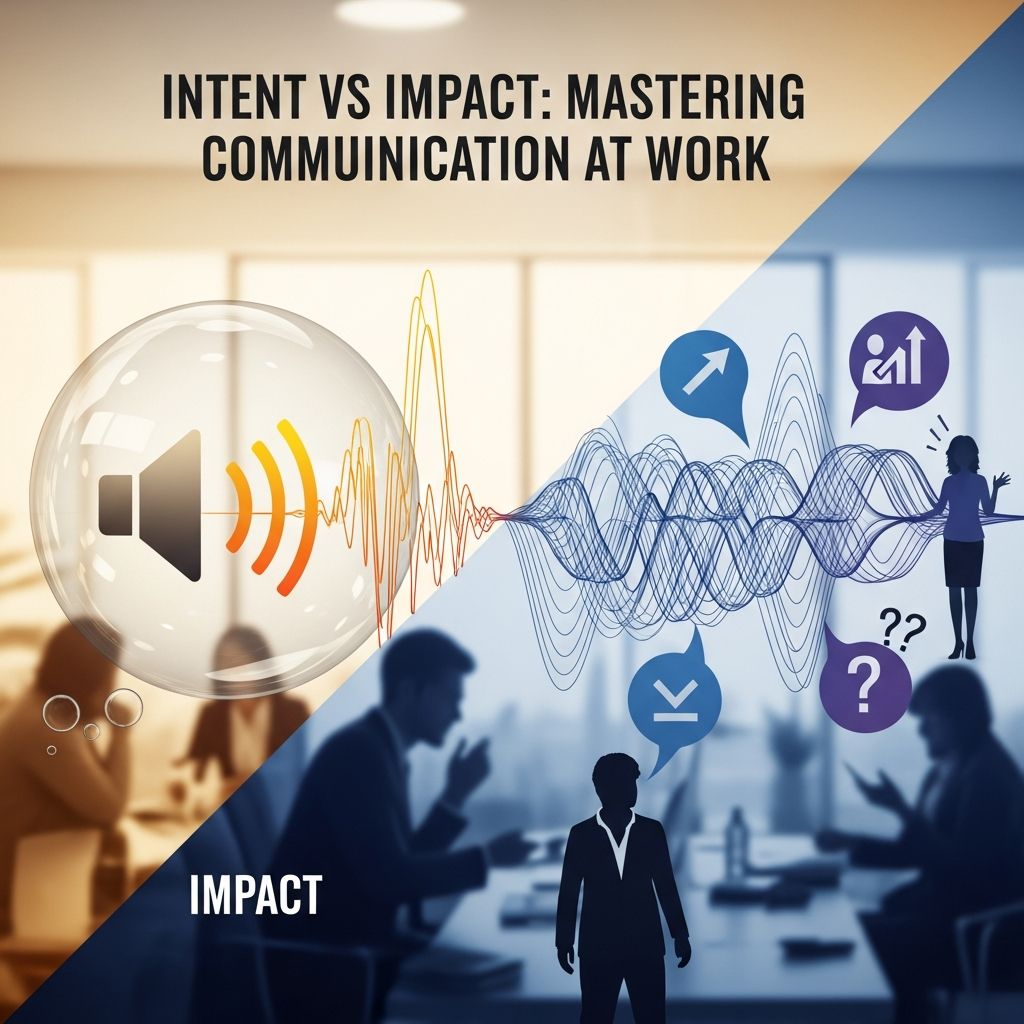
Why What You Mean Isn’t Always What Others Feel
Every conversation, email, and decision in the workplace carries two invisible forces: what you mean to communicate, and how it lands with others. These are often called intent and impact. When they align, communication feels clear, respectful, and productive. When they don’t, misunderstandings, frustration, and damaged trust follow—even when no harm was intended.
The gap between intent and impact is not a sign of failure; it’s a normal part of human interaction. But in professional environments where collaboration, inclusion, and psychological safety matter, leaders and teams must learn to recognize and close this gap deliberately.
Defining the Two Forces at Play
Intent is the internal driver behind your words and actions. It’s your goal, your motivation, the outcome you hope to create. For example:
- You give direct feedback because you want someone to improve.
- You send a quick message to keep things moving efficiently.
- You offer advice because you genuinely want to help.
In each case, your intent is positive. But impact is something else entirely: it’s the external result, the lived experience of the other person. Impact is shaped by:
- How the message was delivered (tone, timing, medium).
- The receiver’s current stress, past experiences, and emotional state.
- Organizational culture and power dynamics.
So the same feedback that you meant as helpful might land as harsh or dismissive. A quick message might feel rushed or disrespectful. Well-meaning advice might come across as micromanaging or undermining.
Why Impact Often Matters More Than Intent
In conflict or difficult conversations, people often default to defending their intent: “I didn’t mean it that way,” “I was just trying to help,” or “You’re overreacting.” While these statements may be true, they rarely resolve the situation. That’s because:
- Intent is invisible. Others can’t see your thoughts or motivations; they only experience your behavior and its consequences.
- Impact is real. The emotional and practical effects on the other person are tangible, regardless of your original purpose.
- Relationships are built on impact. How people feel in interactions shapes trust, engagement, and willingness to collaborate.
Research in organizational psychology consistently shows that perceived fairness and respect in communication are stronger predictors of team performance and retention than formal policies or compensation alone. When someone says, “That comment hurt me,” the appropriate response is not to argue about intent, but to acknowledge the impact and explore how to move forward.
The Hidden Cost of Ignoring the Gap
When leaders and teams consistently prioritize intent over impact, several problems emerge:
- Psychological safety erodes. People stop speaking up, sharing ideas, or admitting mistakes because they fear being misunderstood or dismissed.
- Feedback becomes transactional. Instead of a tool for growth, feedback feels like criticism, especially when it’s delivered without attention to tone or context.
- Microaggressions go unaddressed. Comments or behaviors that seem neutral or even positive to the speaker can carry negative weight for others, particularly across lines of identity, culture, or hierarchy.
- Conflict escalates. When someone’s experience is invalidated (“You’re taking this too personally”), resentment builds, and small issues turn into larger rifts.
Over time, this pattern doesn’t just affect individuals—it shapes culture. A culture that dismisses impact in favor of intent becomes one where only certain voices feel safe, and others learn to stay quiet or disengage.
How to Align Intent with Positive Impact
Aligning intent and impact isn’t about walking on eggshells or avoiding honest conversations. It’s about becoming more intentional, more aware, and more skilled in how you communicate. Here are practical strategies to bridge the gap:
1. Start with Self-Awareness
Before any important conversation, pause and ask yourself:
- What is my real goal here?
- What do I want the other person to think, feel, and do afterward?
- How might this land, given their current workload, mood, or relationship with me?
Self-awareness is the foundation of emotional intelligence. Leaders who regularly reflect on their own patterns—such as a tendency toward blunt feedback or rapid decision-making—are better equipped to adjust their approach.
2. Communicate Intent Explicitly
Since intent is invisible, make it visible. Instead of assuming others will infer your purpose, state it clearly:
- “I’m sharing this because I value your work and want to support your growth.”
- “I’m raising this now because I’m concerned about timelines, not because I doubt your effort.”
- “I’m offering this idea not to override your plan, but to add another perspective.”
Explicitly naming your intent doesn’t guarantee perfect reception, but it gives the other person a frame for interpreting your words and reduces the risk of misattribution.
3. Focus on Behavior, Not Character
When giving feedback, describe specific actions and their effects, not personality traits. For example:
- Instead of: “You’re disorganized,” say: “I noticed the report was submitted after the deadline, which delayed the client meeting.”
- Instead of: “You’re defensive,” say: “When I shared the feedback, you interrupted several times, which made it hard to finish my point.”
This approach, often formalized in models like Situation-Behavior-Impact (SBI), keeps the conversation grounded in observable facts and reduces defensiveness.
4. Invite the Other Person’s Perspective
After sharing your view, create space for the other person to share theirs. Ask open questions like:
- “How did that land for you?”
- “What was your experience of that conversation?”
- “Is there anything I missed or misunderstood?”
This shifts the interaction from a one-way message to a two-way dialogue. It also signals that you care about their experience, not just your own intent.
5. Separate Accountability from Blame
When impact is negative, it’s important to hold space for accountability without resorting to blame. This means:
- Acknowledging the effect: “I see that my comment made you feel undermined, and I’m sorry for that impact.”
- Taking responsibility for your part: “I should have chosen a different time or phrasing.”
- Collaborating on solutions: “How can we handle similar situations better in the future?”
Accountability builds trust; blame shuts down learning. The goal is not to punish good intentions, but to ensure that future actions create the impact you actually want.
Building a Culture That Values Impact
Individual skill is important, but lasting change happens at the cultural level. Organizations that successfully align intent and impact tend to share these characteristics:
Leaders Model the Behavior
When leaders openly acknowledge when their words or decisions had unintended consequences, it gives permission for others to do the same. For example:
- “I realize my email came across as urgent and stressful. That wasn’t my intent, but I see how it felt that way. Let’s clarify priorities together.”
- “I gave feedback in a way that didn’t land well. I’d like to understand your experience and adjust how I communicate going forward.”
Feedback Is Normalized and Structured
Feedback isn’t reserved for performance reviews or problems. It’s a regular, low-stakes practice embedded in daily work. Teams use shared frameworks (like SBI) to keep feedback specific, timely, and constructive.
Psychological Safety Is Actively Cultivated
People feel safe to say, “That didn’t land well for me,” without fear of retaliation or being labeled “too sensitive.” Leaders respond with curiosity, not defensiveness, and use these moments as learning opportunities.
Training Focuses on Communication and EQ
Workshops on emotional intelligence, active listening, and inclusive communication help employees at all levels understand how their behavior affects others. These aren’t one-off events but part of an ongoing development journey.
Practical Tools for Everyday Use
Here are a few simple tools that can be applied immediately in meetings, emails, and one-on-ones:
Pre-Communication Checklist
Before sending a message or entering a conversation, ask:
- What is my core intent?
- What might the other person be feeling or dealing with right now?
- Is this the right time and medium for this message?
- How can I make my intent clear without sounding defensive?
Impact Reflection Template
After a difficult interaction, reflect using this structure:
- Situation: Briefly describe what happened.
- Behavior: What specific words or actions were involved?
- Impact: How did it affect others (and you)?
- Intent: What was your goal?
- Alignment: Where did intent and impact match or diverge?
- Next steps: What could you do differently next time?
Feedback Conversation Flow
Use this sequence to keep feedback constructive:
- State your intent: “I’m sharing this because I want to support your success.”
- Describe the behavior: “In yesterday’s meeting, you interrupted several times while I was presenting.”
- Explain the impact: “That made it hard to finish my point and left me feeling unheard.”
- Invite their perspective: “How did that land for you?”
- Collaborate on solutions: “What can we do to ensure both of us feel heard in future discussions?”
Common Missteps and How to Avoid Them
Even with good intentions, people often fall into traps that widen the intent-impact gap. Watch out for these patterns:
- Leading with intent to dismiss impact: Saying “I didn’t mean it that way” before acknowledging how it was received. Better: “I hear that this landed poorly. I didn’t mean to hurt you, and I want to understand how it felt.”
- Assuming neutrality: Believing that “I’m just being honest” or “I’m direct” excuses harsh delivery. Better: Recognize that honesty and respect are not mutually exclusive.
- Overcorrecting into avoidance: Becoming so worried about impact that you avoid necessary conversations. Better: Prepare thoughtfully, choose the right time and place, and focus on shared goals.
- Ignoring power dynamics: Not considering how hierarchy, identity, or past experiences shape how messages are received. Better: Be especially mindful when giving feedback up, down, or across differences.
When Intent and Impact Are in Conflict
Not every misalignment requires a formal conversation, but some situations demand deeper attention:
- Repeated patterns: If the same person consistently feels hurt or dismissed by your communication style, it’s a signal to reflect and adjust, not to insist they “get used to it.”
- High-stakes situations: In performance reviews, promotions, or conflict resolution, the gap between intent and impact can have lasting consequences. Extra care in preparation and delivery is essential.
- Identity-related dynamics: Comments or behaviors that touch on race, gender, age, disability, or other aspects of identity often carry heavier impact, even when intent is neutral. In these cases, listening with humility and seeking to understand is critical.
FAQs: Intent vs Impact in Practice
Isn’t it unfair to judge people by impact when their intent was good?
It’s not about judgment; it’s about responsibility. You can have good intent and still cause harm. The question isn’t “Are you a bad person?” but “How can we ensure future actions create the impact you want?”
What if someone keeps taking things the wrong way?
First, check your own patterns. If multiple people have similar reactions, the issue may be in delivery, timing, or tone. If it’s truly an isolated pattern, address it directly but respectfully: “I’ve noticed that some of my messages seem to land differently than I intend. Can we talk about how we can communicate more effectively?”
How do I give honest feedback without damaging relationships?
Be specific, timely, and kind. Focus on behavior, not character. State your intent clearly, explain the impact, and invite dialogue. Honest feedback, when delivered with care, strengthens trust, not weakens it.
Should I always apologize when impact is negative?
Apologize for the impact, not necessarily for intent. For example: “I’m sorry that my comment made you feel undermined. That wasn’t my intention, and I want to make sure future conversations feel respectful.” This acknowledges the effect without conceding blame for malice.
Can coaching help with intent-impact alignment?
Absolutely. Coaching helps leaders and teams develop self-awareness, communication skills, and emotional intelligence. A coach can provide a safe space to reflect on patterns, practice difficult conversations, and build strategies for more effective interactions.
References
- Situation-Behavior-Impact (SBI) Feedback Model — Center for Creative Leadership. Accessed 2025. https://www.ccl.org/articles/leading-effectively-articles/closing-the-gap-between-intent-vs-impact-sbii/
- Emotional Intelligence and Leadership — Harvard Business Review. 2023. https://hbr.org/2023/05/emotional-intelligence-is-a-leadership-superpower
- Psychological Safety and Team Performance — Google re:Work. 2023. https://rework.withgoogle.com/guides/understanding-team-effectiveness/steps/foster-psychological-safety/

Medha Deb is an editor with a master's degree in Applied Linguistics from the University of Hyderabad. She believes that her qualification has helped her develop a deep understanding of language and its application in various contexts. Medha specializes in the areas of beauty, health, sports, and wellness and is committed to ensuring that the content on the website is…