
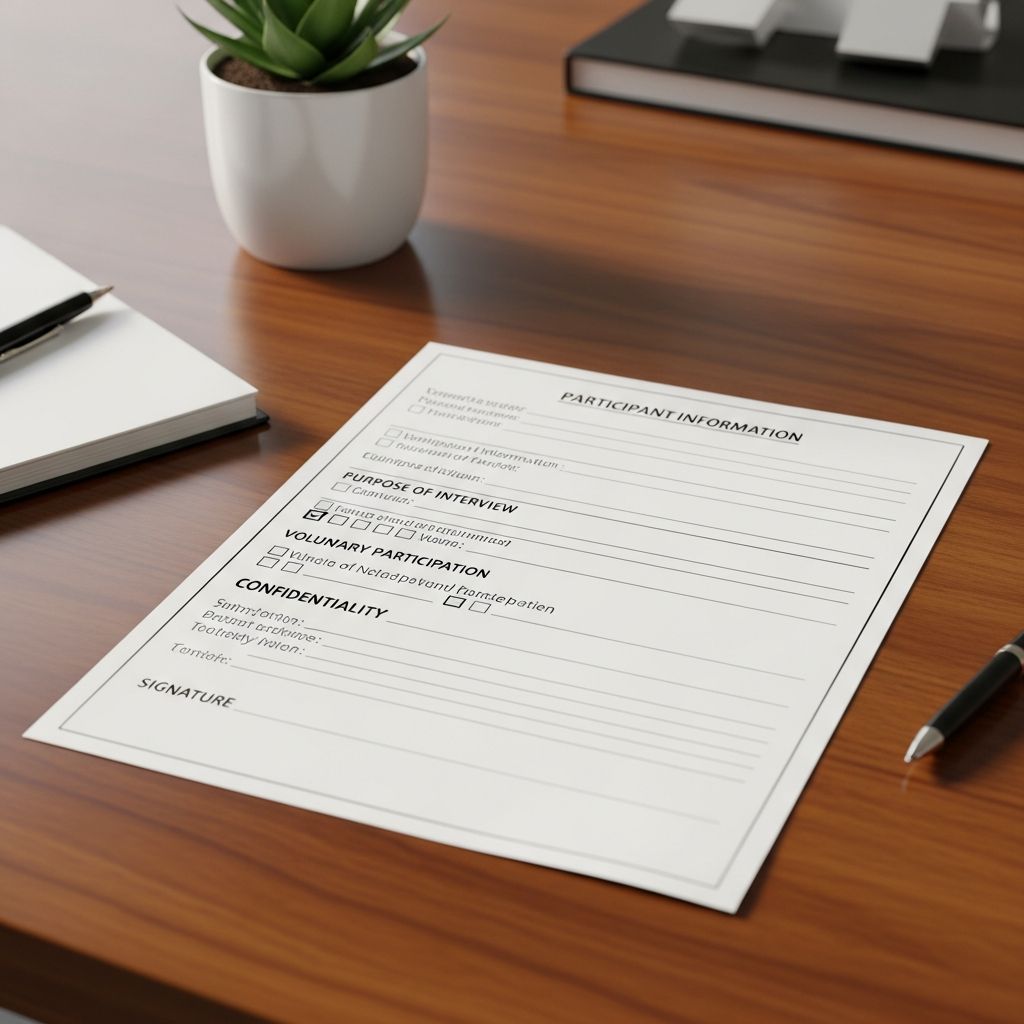
Interview consent forms are foundational documents in ethical research, ensuring participants understand their involvement and rights before sharing personal information. These forms promote transparency, voluntariness, and protection against potential harms in studies involving discussions or recordings.
Why Consent Forms Matter in Research Interviews
Protecting human subjects in research begins with informed consent, a process mandated by federal regulations like 45 CFR 46.116. For interviews, this means clearly communicating the study’s purpose, procedures, risks, benefits, and withdrawal options. Without proper consent, researchers risk violating ethical standards and institutional review board (IRB) approvals.
Consent forms serve multiple roles: they document agreement, provide participants with key information, and allow customization for anonymity or identifiability. Universities like Rutgers emphasize using templates for minimal-risk, non-interventional interview studies to streamline compliance.
Core Components of an Effective Consent Form
A well-structured consent form starts with a concise summary of key information, as required by the 2018 Common Rule revisions. This includes the research purpose, time commitment, procedures, and foreseeable risks.
- Study Overview: Briefly describe the research goals and your role as investigator.
- Procedures: Detail interview duration, format (in-person, phone, video), and any recording.
- Risks and Discomforts: Address emotional distress from sensitive topics or privacy concerns.
- Benefits: Note potential societal contributions, even if no direct gains for participants.
- Confidentiality: Explain data storage, anonymization, and sharing plans.
- Voluntariness: Affirm no penalties for declining or withdrawing.
Write at an 8th-grade reading level using plain language to ensure accessibility. Avoid jargon; test comprehension with non-experts.
Handling Identifiable vs. Anonymous Data
Distinguish between identifiable and anonymous interviews. For identifiable data, specify collected details like names or contacts, and outline storage separation from responses. Anonymous setups mean no linkage post-interview, limiting withdrawal after completion.
| Aspect | Identifiable Interviews | Anonymous Interviews |
|---|---|---|
| Data Linkage | Responses tied to identifiers | No identifiers collected |
| Withdrawal | Possible via written request to PI | Not feasible post-interview |
| Storage | Secure, separated files | No personal data stored |
| Best For | Follow-up studies | Sensitive topics |
This table highlights trade-offs, helping researchers choose based on study needs.
Step-by-Step Process for Obtaining Consent
- Prepare the Form: Use IRB-approved templates, customizing for your project.
- Present Verbally: Discuss details before handing the form; answer questions.
- Provide Copies: Give participants signed copies for reference.
- Document Agreement: Use signatures or verbal affirmation for low-risk studies.
- Store Securely: Keep forms in locked files or encrypted digital systems.
For remote interviews, tools like AdobeSign enable electronic consent. Always confirm understanding with teach-back questions.
Customization for Different Interview Types
Oral History Projects
In oral histories, consent covers recording, transcription, and public use. Include release clauses for archiving or publication, with options for restrictions.
Student-Led Research
Students must list faculty advisors’ contacts. Forms should note voluntary nature and no academic penalties.
International or Vulnerable Populations
Adapt for cultural contexts, using translators if needed. For minors or non-English speakers, assent forms and witnesses may be required.
Legal and Regulatory Framework
U.S. regulations under the Common Rule (45 CFR 46) dictate elements like key information upfront. IRBs like those at University of Michigan provide templates incorporating these. Globally, WHO guidelines stress two-part forms: information sheets and certificates.
Even exempt research benefits from consent processes to build trust and mitigate risks.
Common Mistakes and How to Avoid Them
- Overly Complex Language: Simplify; aim for 6th-8th grade level.
- Missing Key Elements: Checklist against federal requirements.
- No Copies Provided: Always supply participant versions.
- Inconsistent with Protocol: Align form exactly with IRB application.
- Ignoring Withdrawal Rights: Clearly state options and timelines.
Review forms with colleagues or IRBs pre-submission.
Sample Template Outline
Here’s a adaptable structure:
Consent to Participate in [Study Title]
Principal Investigator: [Name, Contact]What is this study about? [1-2 sentences]
How long? [Duration]
What will you do? [Procedures]
Risks? [Minimal description]
Confidentiality: [Plans]
Voluntary: You may withdraw anytime.I agree to participate: [Signature/Date]
This mirrors Rutgers and Michigan templates but is generalized.
Electronic and Verbal Consent Options
For online surveys or phone interviews, waivers of signature are common. Use scripts reading key elements, followed by verbal agreement recording. Platforms ensure audit trails.
FAQs
What if a participant changes their mind mid-interview?
Stop immediately and discard data if anonymous; for identifiable, honor written withdrawal requests.
Do I need IRB approval for consent forms?
Yes, submit for review; use approved templates to expedite.
Can consent be implied?
No; explicit documentation or process is required for most studies.
How to handle sensitive topics?
Include specific risk disclosures and support resources.
Is a witness needed?
Only for vulnerable groups or illiteracy cases.
Best Practices for Ongoing Compliance
Train teams on consent delivery. Update forms for protocol changes. Retain records per institutional policies, typically 3-7 years. Ethical consent fosters trust, enhancing data quality.
By prioritizing clear, participant-centered forms, researchers uphold integrity across disciplines.
References
- Adult Consent Template for Interview Research — Rutgers Office of Research and Sponsored Programs. 2021-01-26. https://research.rutgers.edu/sites/default/files/2021-01/adult_consent_template_for_interview_research_8.26.19.docx
- Informed Consent Guidelines & Templates — University of Michigan IRB-HSBS. 2023. https://hrpp.umich.edu/irb-health-sciences-and-behavioral-sciences-hsbs/informed-consent-guidelines-templates/
- Guide to Informed Consent — Saint Mary’s College of California. 2023-01. https://www.stmarys-ca.edu/sites/default/files/2023-01/InformedConsentProcess.pdf
- Templates for Informed Consent Forms — World Health Organization Research Ethics Review Committee. 2023. https://www.who.int/groups/research-ethics-review-committee/guidelines-on-submitting-research-proposals-for-ethics-review/templates-for-informed-consent-forms
- How to Obtain Consent — California State University East Bay Office of Research and Sponsored Programs. 2023. https://www.csueastbay.edu/orsp/compliance/irb/how-to-obtain-consent.html

- Integrated M.A. in Applied Linguistics, University of Hyderabad
- 5+ years in editorial, instructional, SEO, and research-based writing
Sneha is a relationships and lifestyle writer with a strong foundation in applied linguistics and certified training in relationship coaching. She brings over five years of writing experience to theskillvault, crafting thoughtful, research-driven content that empowers readers to build healthier relationships, boost emotional well-being, and embrace holistic living. Her writing and insights reflect the belief that beauty, happiness, and wellness…