
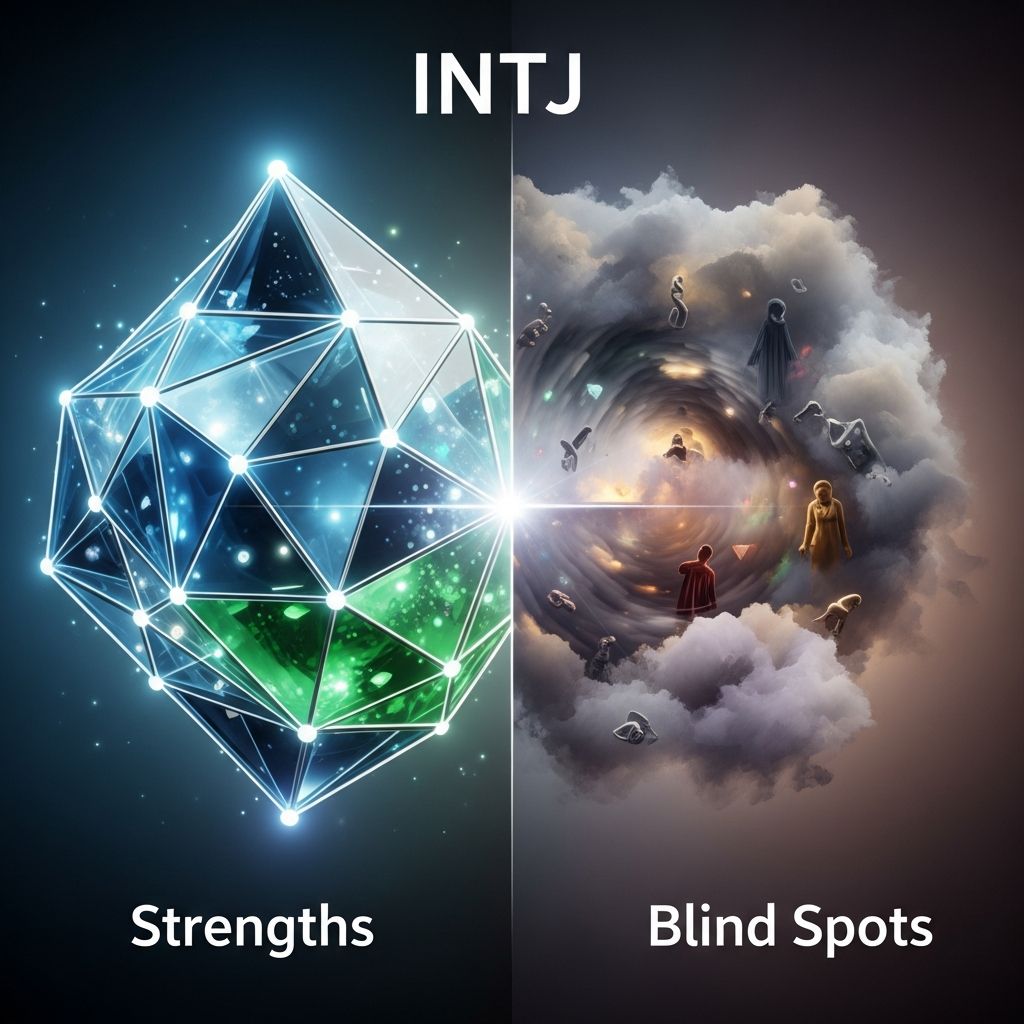
The INTJ personality type, often called the Architect or Strategist, combines independence, long-range vision, and rigorous logic. Properly understood, these traits can be a powerful advantage in careers, relationships, and personal growth. Mismanaged, they can lead to isolation, conflict, and burnout.
This guide explores the core strengths and blind spots of INTJs and offers concrete, research-informed ways to use their natural tendencies more effectively.
Foundations of the INTJ Personality
INTJ preferences are defined in the Myers-Briggs framework as Introversion (I), Intuition (N), Thinking (T), and Judging (J). People with this pattern tend to focus on internal ideas, abstract concepts, logical analysis, and structured decision-making.
| Preference | What It Means for INTJs |
|---|---|
| Introversion (I) | Energy from solitude and deep thought rather than frequent social interaction. |
| Intuition (N) | Focus on patterns, theories, and future possibilities over immediate facts. |
| Thinking (T) | Preference for logical criteria and objective analysis in decisions. |
| Judging (J) | Desire for planning, structure, and closure rather than open-ended flexibility. |
Researchers generally describe individuals with INTJ characteristics as analytical, independent, and future-oriented, often drawn to complex problem solving and long-term strategic work.
Core Strengths of INTJs
When INTJs use their natural preferences skillfully, several consistent strengths emerge.
1. Strategic and Long-Term Thinkers
INTJs are often most comfortable when they are looking years into the future, mapping out how today’s actions shape tomorrow’s outcomes. They tend to:
- Visualize complex systems and how parts interact over time.
- Spot long-term risks and opportunities that others overlook.
- Create structured plans to move from idea to implementation.
In many workplaces, this big-picture thinking aligns with what organizational psychology researchers describe as strategic leadership – the ability to anticipate, envision, and maintain flexibility while guiding others.
2. Deep Analytical Ability
INTJs usually prefer to base decisions on logic, evidence, and internal models rather than on social pressure or tradition. This often shows up as:
- Comfort with complex, data-heavy problems.
- Interest in refining systems to be more efficient or elegant.
- Confidence challenging existing assumptions when they seem flawed.
Psychological research on thinking styles suggests that this kind of analytic cognitive style supports success in scientific, technical, and strategic roles where dispassionate evaluation is valuable.
3. Independence and Self-Direction
People who fit the INTJ profile typically prefer to work autonomously and are comfortable making decisions without constant external input. They often:
- Set their own learning goals and teach themselves new skills.
- Value competence and self-sufficiency, both in themselves and others.
- Resist rules or customs that they see as irrational or inefficient.
Career guidance research notes that individuals who show strong independence often thrive in roles with broad responsibility and minimal micromanagement, such as research, consulting, or entrepreneurship.
4. Persistence and High Standards
INTJs frequently hold themselves and their work to demanding standards of quality. This can translate into:
- Long-term dedication to mastering complex subjects.
- Thorough preparation and attention to structural flaws in plans.
- Reluctance to settle for “good enough” when they see a better solution.
As personality theorists have observed, this blend of persistence and perfectionism can yield exceptional achievements, especially in specialized or highly technical fields.
5. Intellectual Curiosity
Many INTJs describe a near-constant drive to understand how and why things work the way they do. This curiosity supports:
- Rapid learning in new domains that capture their interest.
- Building broad conceptual frameworks that connect multiple fields.
- Adapting existing theories or tools in novel, creative ways.
Studies on lifelong learning suggest that such ongoing intellectual engagement can support career adaptability and cognitive resilience over time.
Common Blind Spots and Challenges for INTJs
The same traits that make INTJs effective strategists can create predictable difficulties if left unexamined.
1. Overconfidence and Dismissiveness
Because INTJs often trust their internal models and logic, they may overestimate the accuracy of their conclusions and underestimate other perspectives. This can lead to:
- Discounting input from people they perceive as less logical or informed.
- Appearing condescending or impatient in discussions.
- Missing important practical or emotional information held by others.
Interpersonal research shows that this style can erode trust and collaboration, especially in teams that rely on psychological safety and open dialogue.
2. Difficulty with Emotional Expression
INTJs often experience strong inner values and reactions but may struggle to express them in ways others easily recognize. Typical patterns include:
- Appearing detached or unemotional even when they care deeply.
- Prioritizing “rational” arguments while ignoring emotional context.
- Feeling misunderstood or overlooked in emotionally charged situations.
Personality research notes that when emotions remain primarily internal and unexpressed, others may misread the person as cold or indifferent, which can strain relationships.
3. Social Missteps and Misunderstandings
INTJs often report that casual social rituals – small talk, polite white lies, or unspoken norms – feel artificial or unnecessary. Consequences may include:
- Unintentionally blunt comments that others experience as rude.
- Underestimating the importance of reassurance, warmth, or encouragement.
- Feeling like an “outsider” in group settings.
Communication studies highlight that many workplaces and communities implicitly value social harmony, so overlooking these conventions can limit influence, even when ideas are sound.
4. Perfectionism and Risk of Burnout
High standards and persistence become problematic when they cross into rigid perfectionism. For INTJs, this can show up as:
- Delaying decisions until every variable feels controlled.
- Spending disproportionate time on low-impact refinements.
- Difficulty delegating because others “won’t do it right.”
Occupational health research links unrelenting standards and overwork with higher risk of emotional exhaustion and burnout, especially in demanding knowledge roles.
5. Impatience with Inefficiency
INTJs can feel intense frustration when they encounter bureaucracy, repeated mistakes, or processes they see as illogical. This can lead to:
- Fixating on “fixing the system” instead of working within constraints.
- Conflict with authority figures who defend existing structures.
- Reduced tolerance for people who adapt slowly to change.
While this drive can catalyze improvement, organizational research suggests that successful change efforts usually balance critique with political awareness and relationship-building.
INTJs at Work: Roles, Collaboration, and Leadership
INTJ strengths often align with knowledge-intensive, future-oriented environments, but effectiveness depends heavily on how they relate to others.
Ideal Work Features for INTJs
- Opportunities for independent analysis and long-range planning.
- Clear goals, resources, and authority to implement ideas.
- Minimal micromanagement and respect for expertise.
- Problems that reward depth of thought over quick, superficial fixes.
Career theory on personality–job fit suggests that individuals similar to INTJs often prefer roles in science, engineering, strategy, and systems design where complex thinking is rewarded.
Collaboration Tips for INTJs
To work more smoothly with others, INTJs can deliberately cultivate a few counterbalancing habits:
- Share the reasoning path, not just conclusions. Explaining how you reached an idea makes it easier for others to follow and contribute.
- Invite input early. Ask for practical and emotional reactions before plans are fully baked.
- Distinguish between core principles and minor preferences. Not every detail needs to be optimized your way.
- Acknowledge others’ contributions explicitly. Verbal recognition strengthens trust and motivation.
INTJs in Leadership Positions
When INTJs move into leadership, their strengths in vision and structure can be highly valuable, provided they also attend to people dynamics. Effective INTJ leaders tend to:
- Translate abstract visions into clear roadmaps and milestones.
- Use metrics and evidence to guide decisions while listening to human impact.
- Build teams with complementary strengths in communication and relationship management.
- Practice transparency so that people understand the “why” behind tough calls.
INTJs in Relationships and Everyday Life
Outside of work, the INTJ blend of intensity, privacy, and loyalty shapes how they show up with partners, family, and friends.
Relationship Strengths
- Commitment. Once INTJs decide a relationship matters, they often invest deeply and consistently over the long term.
- Problem-solving focus. They may proactively address recurring issues rather than ignoring them.
- Respect for autonomy. They typically value their partner’s independence and personal goals.
Typical Relationship Challenges
- Under-communicating affection because it feels inefficient or awkward.
- Trying to “fix” emotional concerns with purely logical solutions.
- Assuming that love is obvious from actions and doesn’t need to be verbalized.
Counseling literature often emphasizes that emotional attunement and explicit reassurance are central to relationship satisfaction, which may not come automatically to INTJ-style communicators.
Growth Strategies: Balancing Logic with Humanity
INTJ development is less about changing who they are and more about rounding out their style so that their strengths can operate without unnecessary collateral damage.
Practical Growth Ideas for INTJs
- Schedule regular reflection on impact. Periodically ask: “How did my delivery affect others, not just my accuracy?”
- Practice short, appreciative statements. Simple phrases like “I appreciate your effort on this” can go a long way.
- Experiment with “good enough.” For lower-stakes tasks, deliberately stop at 80–90% and note that the outcome is still acceptable.
- Seek diverse perspectives. Invite people with different backgrounds or styles to critique your ideas before finalizing.
- Protect recharge time. Respect your need for solitude to prevent social or work burnout.
Using INTJ Strengths Constructively
To leverage their natural advantages while minimizing drawbacks, INTJs can:
- Apply their strategic thinking not only to projects but also to their own habits and relationships.
- Channel perfectionism into areas where excellence truly matters and consciously relax elsewhere.
- Frame feedback as a data source, not a threat to competence.
- Remember that emotional information is another kind of signal, not a flaw in reasoning.
Frequently Asked Questions About INTJ Strengths and Weaknesses
Q1: Are INTJs really as unemotional as they seem?
No. Evidence from personality research indicates that people with INTJ traits often experience deep emotions and strong values, but they tend to process these feelings internally and express them less outwardly. This internal focus can make them appear cooler or more detached than they actually are.
Q2: Why do INTJs get frustrated so easily with other people?
INTJs often prioritize efficiency, logical coherence, and long-term thinking. When others make decisions based on tradition, social approval, or short-term convenience, INTJs may see those choices as irrational or shortsighted, which can create visible frustration.
Q3: What careers tend to suit INTJ strengths?
Research on personality and careers suggests that roles involving complex problem solving, strategy, and independent work often align well with INTJ preferences. Examples include scientific research, engineering, data analysis, architecture, strategic planning, and some leadership or consulting positions.
Q4: How can INTJs improve their relationships?
Helpful steps include practicing explicit expressions of appreciation, asking loved ones what makes them feel supported, and remembering that emotional reassurance is often as important as logical solutions. Small, consistent gestures usually matter more than perfect words.
Q5: Can INTJs become more flexible and less perfectionistic?
Yes. By consciously distinguishing between high-impact and low-impact tasks, INTJs can reserve their perfectionism for areas where excellence is critical and adopt a “good enough for now” standard elsewhere. Over time, this deliberate practice can reduce stress and improve productivity.
References
- INTJ Personality (Architect) — Simply Psychology. 2023-04-10. https://www.simplypsychology.org/intj-personality.html
- Strengths & Weaknesses | INTJ Personality (Architect) — 16Personalities. 2023-03-01. https://www.16personalities.com/intj-strengths-and-weaknesses
- INTJ Personality (Architect) Profile — 16Personalities. 2023-03-01. https://www.16personalities.com/intj-personality
- The INTJ Personality Type: In-Depth Profile & Analysis — Personality Junkie. 2022-06-15. https://personalityjunkie.com/the-intj/
- INTJ Personality Type Characteristics, Careers and Relationships — The Myers-Briggs Company / MBTIonline. 2021-11-05. https://www.mbtionline.com/en-US/MBTI-Types/INTJ

Medha Deb is an editor with a master's degree in Applied Linguistics from the University of Hyderabad. She believes that her qualification has helped her develop a deep understanding of language and its application in various contexts. Medha specializes in the areas of beauty, health, sports, and wellness and is committed to ensuring that the content on the website is…