
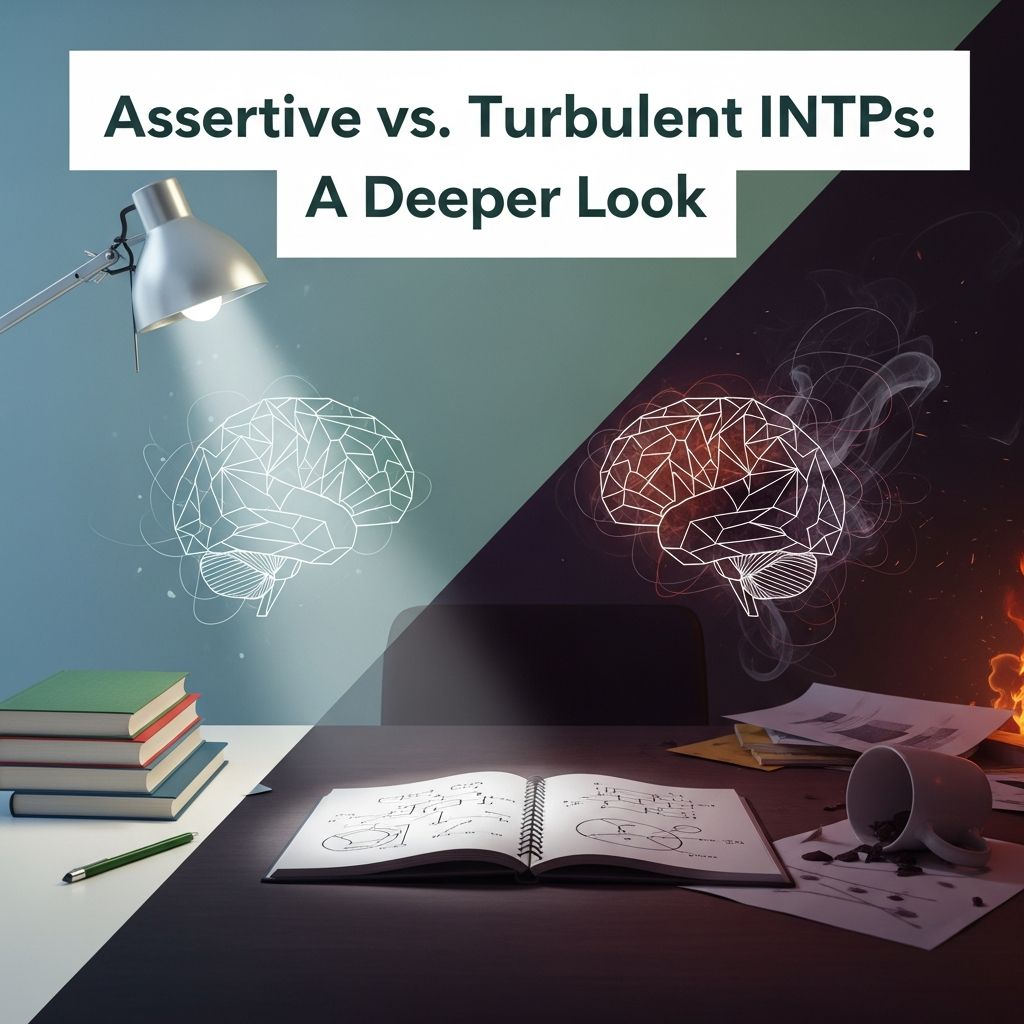
Within the INTP personality, the Assertive (A) and Turbulent (T) identity variants describe two distinct ways that the same core type handles pressure, self-doubt, and the outside world. Both are intellectually curious, analytical, and independent, yet they can feel like very different people in everyday life.
This article explores how these two identities shape an INTP’s confidence, emotions, relationships, work style, and growth. The aim is not to rank one above the other, but to help you recognize patterns in yourself and use that self-knowledge more effectively.
1. What the A/T Identity Dimension Adds to the INTP Type
The A/T identity dimension describes how strongly personality traits are expressed under stress and uncertainty. Research from large-scale personality datasets suggests that this layer is related to self-confidence, emotional reactivity, and sensitivity to mistakes.
- Assertive (A): More self-assured, less likely to ruminate about errors, generally steadier under pressure.
- Turbulent (T): More self-critical, quicker to notice potential problems, emotionally responsive to setbacks and feedback.
Because INTPs are already inwardly focused and analytical, this extra layer can significantly change how they come across to others—ranging from calm, detached philosophers to intense, restless idea machines.
2. Shared Core: What All INTPs Have in Common
Before comparing Assertive and Turbulent variants, it helps to remember what does not change. Both subtypes typically share:
- Love of analysis: A drive to understand systems, theories, and underlying principles.
- Preference for ideas over routine: Boredom with repetitive tasks and a pull toward exploration and problem-solving.
- Independence: A need for autonomy in thinking and often in work environment.
- Introverted recharge: Time alone is crucial to process information and restore energy.
- Selective social investment: Deep engagement with a few interests or people, rather than broad social activity.
The A/T layer does not alter these core preferences; it colors how confidently, consistently, and emotionally the INTP expresses them.
3. Confidence and Self-Doubt in INTP-A vs. INTP-T
| Aspect | Assertive INTP (INTP-A) | Turbulent INTP (INTP-T) |
|---|---|---|
| Baseline self-confidence | Higher; tends to trust own judgment and abilities | Lower; frequently questions own competence |
| Reaction to criticism | Can dismiss or calmly evaluate it | More likely to personalize and ruminate |
| Perfectionism style | “Good enough” is sometimes acceptable | Pushes for refinement; worries it’s never enough |
| Risk tolerance | More willing to take intellectual and career risks | May hesitate or overanalyze potential downside |
Personality research on similar “stability vs. volatility” traits shows that Turbulent-like individuals tend to report more negative emotions and self-consciousness, while Assertive-like individuals report higher subjective well-being and emotional stability.
3.1 Inner Voice: How Each Talks to Themselves
- INTP-A often thinks, “I’ll figure it out as I go,” and is comfortable starting without perfect preparation.
- INTP-T may think, “I should know more before I begin,” and delays action until they feel fully ready.
Both can be brilliant thinkers, but Turbulent INTPs are more likely to feel like impostors even when they are objectively capable.
4. Stress, Emotion, and Resilience
How INTPs handle stress is where the identity difference is often most obvious. Personality psychology consistently links higher emotional reactivity with stronger worry and rumination, but also with heightened vigilance to potential threats.
4.1 Stress Signals
- Assertive INTPs tend to:
- Show fewer visible signs of anxiety.
- Detach mentally from emotional drama and focus on analysis.
- Move on quickly after setbacks, sometimes without full reflection.
- Turbulent INTPs tend to:
- Feel pressure intensely and for longer periods.
- Replay conversations and mistakes in their heads.
- Experience sudden drops in confidence when things go wrong.
4.2 Hidden Strengths Under Stress
There are trade-offs to each pattern:
- INTP-A advantages:
- Greater emotional stability can protect mental health.
- Calm presence in emergencies; useful in analytical or technical crises.
- Less paralyzed by fear of failure, more experimental.
- INTP-T advantages:
- Heightened sensitivity to problems can catch important details.
- Stronger emotional responses may support empathy and relational depth.
- Discomfort can motivate preparation, practice, and improvement.
5. Work, Learning, and Decision-Making
Both INTP variants typically prefer roles that reward independent thought, complex problem-solving, and conceptual exploration—such as research, software development, strategy, or design. Yet their work habits and decisions can look quite different.
5.1 How They Approach Work
| Work Dimension | INTP-A | INTP-T |
|---|---|---|
| Starting tasks | Jumps in earlier; trusts ability to adjust later | Prefers to research extensively before starting |
| Deadlines | Less anxious; may cut it close without panicking | Anxiety can rise; may oscillate between bursts and paralysis |
| Feedback at work | Treats it as data; can be dismissive if poorly argued | Takes it personally; may overcorrect or second-guess |
| Risk-taking | More willing to propose bold ideas or challenge authority | More cautious; tends to test concepts privately first |
5.2 Learning and Skill Development
- Assertive INTPs often:
- Sample many areas quickly and trust they can ramp up when needed.
- Rely on natural talent and improvisation, especially in familiar domains.
- Risk underestimating how much practice is required for mastery.
- Turbulent INTPs often:
- Study deeply before feeling competent.
- Practice repeatedly to counteract self-doubt.
- Risk burnout from never feeling “ready enough.”
In education and career planning, these tendencies may influence whether an INTP chooses highly structured paths (where performance is constantly measured) or more flexible, project-based environments.
6. Relationships and Communication Styles
Regardless of identity, INTPs often value honesty, intellectual connection, and personal space in relationships. The A/T dimension influences how visible their feelings are and how much reassurance they seek.
6.1 Social Confidence
- INTP-A in social settings:
- Appears more detached, even when they care deeply.
- Less likely to seek validation for ideas or feelings.
- May underestimate how distant they seem to others.
- INTP-T in social settings:
- More sensitive to tone, body language, and implied criticism.
- May replay conversations and worry about saying the wrong thing.
- Often needs explicit reassurance, but may feel awkward asking for it.
6.2 Conflict and Emotional Expression
| Relational Aspect | INTP-A | INTP-T |
|---|---|---|
| Handling conflict | Debates logically; may appear cold or dismissive | Feels tension more acutely; may withdraw or over-explain |
| Sharing feelings | Understates emotions; focuses on facts and solutions | Emotions can leak out in tone, wording, or overthinking |
| Long-term bond | Shows love through consistency and problem-solving | Shows love through attentiveness, worry, and effort to improve |
Partners and friends often appreciate Assertive INTPs’ stability and calm, while valuing Turbulent INTPs’ depth of care and sensitivity.
7. Growth Paths for Each Variant
Personality traits are relatively stable over time, but research shows that deliberate habits and environments can modify how traits are expressed. For INTPs, this means working with, rather than against, their identity style.
7.1 Development Tips for Assertive INTPs (INTP-A)
- Invite constructive doubt: Regularly ask trusted people, “What am I missing?” to avoid blind spots.
- Respect preparation: Balance your improvisational confidence with realistic planning, especially for high-stakes projects.
- Practice emotional check-ins: Pause occasionally to notice how you feel—not just what you think—before making major life choices.
- Signal care explicitly: Calm detachment can be mistaken for indifference; use words or small actions to show appreciation.
7.2 Development Tips for Turbulent INTPs (INTP-T)
- Set “good enough” criteria: Define in advance what a satisfactory outcome looks like to avoid endless tweaking.
- Track evidence of competence: Keep a record of accomplishments and positive feedback to counteract negative self-talk.
- Use anxiety as information, not a verdict: Distinguish between genuine red flags and old emotional habits.
- Practice small, repeated risks: Present ideas in low-stakes settings to build confidence gradually.
8. How to Tell Whether You Lean Assertive or Turbulent
If you already know you are an INTP and are unsure which identity fits you better, reflect on the questions below. There is no formal clinical test for these variants, but self-observation grounded in trait research can still be helpful.
8.1 Quick Self-Reflection Checklist
- After making a mistake:
- Do you move on quickly (A) or replay it multiple times (T)?
- Before a big presentation or exam:
- Do you feel calmly prepared or improvise with confidence (A)?
- Or do you feel intense nerves and pressure to overprepare (T)?
- When someone criticizes you:
- Do you mainly evaluate whether their logic is sound (A)?
- Or do you immediately wonder what is wrong with you (T)?
- In day-to-day life:
- Do others describe you as unflappable (A) or intense and self-demanding (T)?
Many INTPs will recognize elements of both, and your level of stress, health, and life stage can shift how each side shows up.
9. Balancing Both Sides: An Integrated INTP
Neither Assertive nor Turbulent is “better”. Each identity carries strengths that can complement the other. Psychological research on trait balance suggests that well-being often comes from flexible use of multiple strategies rather than rigidly relying on one style.
- From Assertive traits, INTPs can borrow:
- Emotional steadiness under pressure.
- Freedom from paralyzing self-doubt.
- Willingness to experiment and fail.
- From Turbulent traits, INTPs can borrow:
- Sensitivity to relational and ethical implications.
- Motivation to refine ideas beyond the first draft.
- Awareness of how actions affect others.
Working toward this internal balance allows INTPs of either identity to become more grounded, humane, and effective—without losing their curiosity or independence.
Frequently Asked Questions (FAQs)
Q1: Can an INTP change from Turbulent to Assertive (or vice versa)?
Identity traits are relatively stable, but the intensity of Turbulent or Assertive behaviors can shift with life experience, mental health, and environment. You might always lean one way, yet learn to borrow strategies from the other side.
Q2: Is one variant more intelligent than the other?
No. Research on personality traits and cognitive ability finds that self-confidence and emotional style are separate from raw intelligence. Both INTP-A and INTP-T can be equally capable; they simply express their abilities differently.
Q3: Which variant is more common among INTPs?
Large online samples often show a relatively balanced split between Assertive and Turbulent identities across personality types. Exact percentages can vary by study and platform, so it is safer to treat both as common rather than rare.
Q4: Does my identity type affect which careers I should choose?
Your core INTP preferences—love of analysis, conceptual thinking, and independence—are more predictive of fit than the A/T identity. However, Assertive INTPs may feel more at home in high-pressure, visible roles, while Turbulent INTPs may prefer environments that offer psychological safety and thoughtful feedback.
Q5: How can others support an INTP-A vs. an INTP-T?
For INTP-A, invite deeper emotional sharing and offer honest, well-reasoned feedback. For INTP-T, provide reassurance grounded in evidence, acknowledge their efforts, and give them time to process rather than pushing immediate decisions.
References
- Nunes, A., & Garcia-Marques, T. “Using the Five-Factor Model to describe the 16 personalities model.” — Personality and Individual Differences. 2024-05-01. https://doi.org/10.1016/j.paid.2024.112804
- DeYoung, C. G. “Personality neuroscience and the biology of traits.” — Social and Personality Psychology Compass. 2010-12-01. https://doi.org/10.1111/j.1751-9004.2010.00327.x
- Myers, I. B., McCaulley, M. H., Quenk, N. L., & Hammer, A. L. “MBTI Manual: A Guide to the Development and Use of the Myers-Briggs Type Indicator.” — CPP. 1998-01-01. https://doi.org/10.1037/t07550-000
- Roberts, B. W., Kuncel, N. R., Shiner, R., Caspi, A., & Goldberg, L. R. “The power of personality: The comparative validity of personality traits, socioeconomic status, and cognitive ability for predicting important life outcomes.” — Perspectives on Psychological Science. 2007-11-01. https://doi.org/10.1111/j.1745-6916.2007.00047.x
- Denissen, J. J. A., Bleidorn, W., Hennecke, M., et al. “Uncovering the power of personality to shape income.” — Psychological Science. 2018-06-01. https://doi.org/10.1177/0956797618761660

Medha Deb is an editor with a master's degree in Applied Linguistics from the University of Hyderabad. She believes that her qualification has helped her develop a deep understanding of language and its application in various contexts. Medha specializes in the areas of beauty, health, sports, and wellness and is committed to ensuring that the content on the website is…