
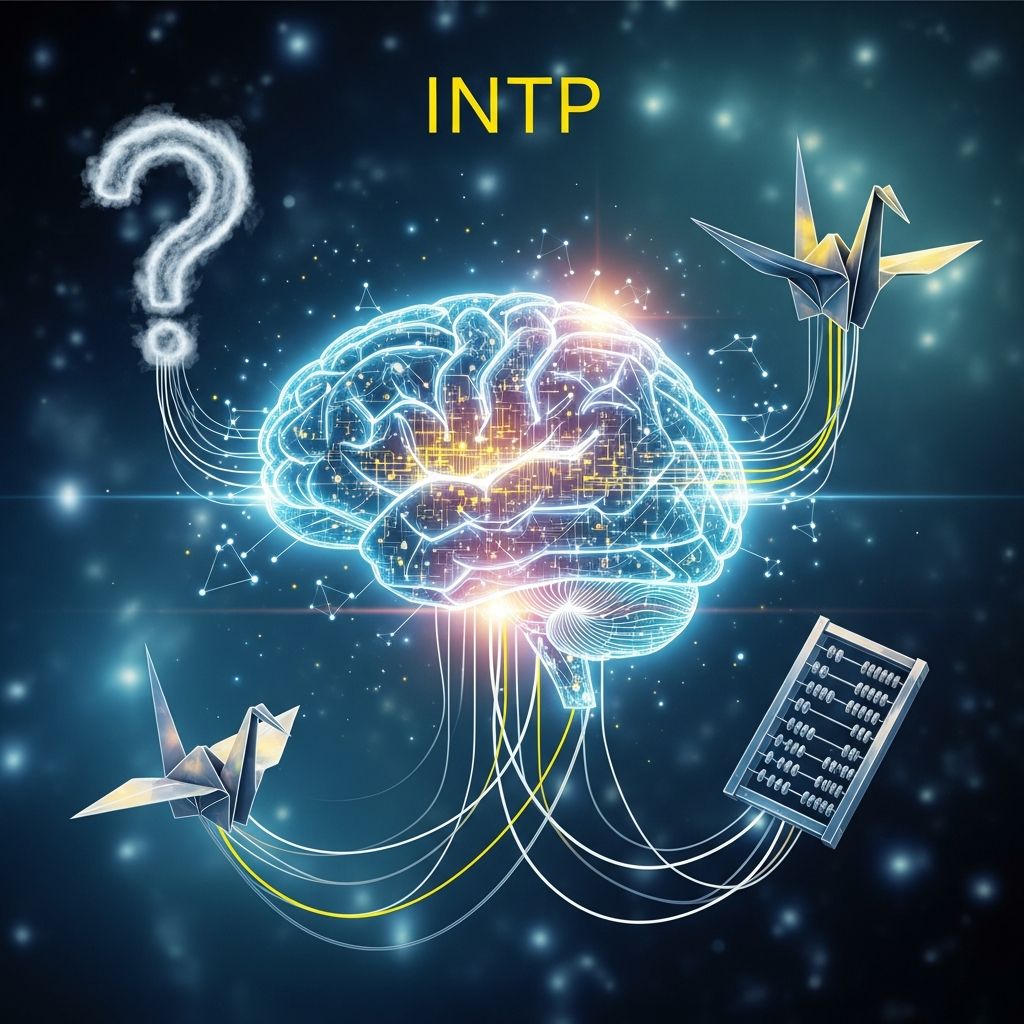
Among the 16 commonly discussed personality types, the INTP is often portrayed as the detached analyst, the person who lives in a world of ideas, theories, and mental frameworks. While that image contains some truth, it barely scratches the surface of what it is like to think, feel, and grow as an INTP.
This article offers an original, in-depth look at how INTPs typically operate: how they process information, where they shine, where they get stuck, and how they can build a life that respects both their need for independence and their desire for meaning and connection.
Core Characteristics of INTPs
INTP stands for Introverted, Intuitive, Thinking, Perceiving. These four preferences describe how people with this pattern usually gain energy, process information, make decisions, and approach structure.1
| Dimension | INTP Preference | Typical Expression |
|---|---|---|
| Energy | Introversion (I) | Recharges alone; prefers depth over breadth in social life. |
| Information | Intuition (N) | Looks for patterns, theories, and underlying principles. |
| Decision-making | Thinking (T) | Values internal logic, coherence, and accuracy. |
| Lifestyle | Perceiving (P) | Prefers flexibility, options, and open-ended exploration. |
Research on the Myers–Briggs framework suggests that types like the INTP are relatively rare in the general population, especially among women, which can contribute to a subtle sense of being out of step with typical expectations.2
How INTPs Think: The Inner Logic Engine
The defining feature of the INTP is an intense drive to build internally consistent mental models. Their primary interest is usually not who is right, but what is true and how things really work.
- Love of abstract problems: INTPs often gravitate toward puzzles, theories, and systems that can be analyzed and reconfigured in countless ways.
- Internal standards of logic: They hold themselves to strict standards of consistency and may be reluctant to share conclusions until they have tested them from multiple angles.
- Endless refinement: Ideas rarely feel “finished.” Instead, INTPs keep tweaking, updating, and reworking their models as new information appears.
- Detached observation: They are often more comfortable watching and analyzing events than immediately joining in.
This style of thinking can align with what cognitive psychologists describe as analytic cognitive style, a tendency to break complex issues into parts and reason through them deliberately rather than relying mainly on quick intuition.3
Strengths of the INTP Personality
When INTPs are in environments that respect their way of thinking, a distinct set of strengths often emerges.
1. Original, Independent Thought
INTPs do not simply accept received wisdom. They examine assumptions, question frameworks, and feel compelled to discover whether an idea stands on its own merits. This independence of thought makes them valuable in roles where challenging the status quo leads to improvement.
2. Talent for Complex Problem-Solving
Because they naturally build mental models of systems, INTPs often excel when they can:
- Detect hidden patterns that others miss.
- Notice contradictions or gaps in plans.
- Simulate hypothetical scenarios mentally before anything happens in the real world.
Research on expertise in fields like mathematics and computer science shows that strong abstract reasoning ability is related to better performance over time, which plays to typical INTP preferences.4
3. Intellectual Curiosity
INTPs often maintain a lifelong drive to learn, especially when they can connect new information to an existing web of concepts they care about. They may dive into:
- Formal disciplines like physics, philosophy, mathematics, or linguistics.
- Highly technical hobbies such as coding, game design, or DIY electronics.
- Obscure niche topics simply because an unanswered question keeps nudging at them.
4. Ability to Stay Emotionally Detached When Needed
In crisis situations, INTPs can sometimes remain surprisingly calm, focusing on facts and options instead of panicking. In environments where emotional reactivity is high, their cooler head can be an asset—provided they still acknowledge the feelings of the people around them.
Common Challenges and Blind Spots
Just as their strengths come from deep internal analysis, many of the INTP’s difficulties arise from that same inward focus.
1. Procrastination and the “Infinite Draft” Problem
Because possibilities feel more interesting than fixed conclusions, INTPs can struggle to finish projects. They may:
- Start multiple ideas but complete few of them.
- Keep refining, researching, or restructuring instead of delivering a final product.
- Wait for the “perfect” solution and stall on reasonable improvements.
Studies on perfectionism and procrastination suggest that a desire for flawlessness can be directly linked to delays in starting or finishing work, which many INTPs recognize in themselves.5
2. Difficulty Communicating Inner Complexity
Thoughts in an INTP’s mind may resemble a dense network of interconnected nodes. Translating that into clear, linear speech can be a major challenge. Others may see them as:
- Overly technical or abstract.
- Vague, because they are still working things out internally.
- Detached or disinterested, when they are actually processing deeply.
3. Tendency to Downplay Emotions
INTPs usually respect logic more than sentiment, and may treat feelings as data points rather than experiences that need to be shared and validated. This can lead to:
- Ignoring their own emotional needs until they feel unexpectedly drained.
- Appearing insensitive when they offer solutions instead of empathy.
- Difficulty navigating highly emotional environments such as conflict-heavy teams.
4. Social Drift and Isolation
Because solitary activities are so rewarding, INTPs may gradually withdraw from social life without fully realizing it. Over time, this can impact both mental health and career prospects. Large-scale mental health studies consistently find that social connection protects against depression and anxiety, even for people with introverted preferences.6
INTPs at Work: Roles, Environments, and Collaboration
INTPs tend to thrive in work settings that value ideas, give them room to experiment, and avoid unnecessary micromanagement.
Work Environments That Suit INTPs
- Autonomy and trust: Freedom to choose methods, tools, and schedules within clear outcome expectations.
- Complex intellectual challenges: Problems that genuinely require analysis and creativity, not just routine execution.
- Informal structure: Some flexibility with rules and processes, as long as the work gets done.
- Merit-based recognition: Ideas judged on quality rather than status or seniority.
Examples of Career Directions
While INTPs can be found in many fields, they are often drawn to areas where abstract thinking, modeling, or analysis is central:
- Scientific research and data analysis.
- Software development and systems architecture.
- Engineering disciplines, especially those involving design and optimization.
- Academic work in philosophy, mathematics, economics, or theoretical disciplines.
- Strategic or analytical roles in technology, finance, or consulting.
The official publishers of the MBTI instrument note that personality preferences can shape what people enjoy and find energizing at work, but do not dictate ability or success in any given role.1
INTPs on Teams
On teams, INTPs can be invaluable as conceptual problem-solvers, especially when they are paired with people who are more naturally focused on implementation and follow-through.
They often contribute:
- Insightful questions that clarify underlying assumptions.
- Alternative models or strategies when the current plan has flaws.
- Technical depth and precision in their areas of expertise.
They often need support with:
- Time management and realistic scoping of tasks.
- Communicating progress in ways that stakeholders easily understand.
- Accepting compromise when the “ideal” solution is impractical.
Relationships and Social Life
Despite their sometimes distant exterior, many INTPs care deeply about having a few meaningful connections. They often prefer:
- Small circles of close friends over large, casual networks.
- Conversations about ideas, possibilities, and long-term questions.
- Relationships where independence is respected and mutual trust is high.
How INTPs Tend to Show Care
Rather than grand emotional displays, INTPs may express affection by:
- Helping solve practical or intellectual problems.
- Sharing interesting articles, books, or theories tailored to the other person.
- Offering honest, unfiltered perspectives when asked for advice.
Common Relationship Tensions
A few recurring friction points for INTPs include:
- Emotional mismatch: Partners may want more verbal reassurance or visible enthusiasm than the INTP naturally provides.
- Need for space: INTPs may feel crowded if they lack quiet time, which can be misinterpreted as rejection.
- Over-analysis: They may dissect relationship dynamics intellectually instead of dealing with emotions directly.
Learning basic emotional communication skills—such as naming feelings, acknowledging others’ experiences, and offering empathy without immediately problem-solving—can dramatically improve relationship satisfaction.
Growth Strategies for INTPs
Personality preferences are not limits; they are starting points. Over time, INTPs can develop complementary skills that round out their gifts.
1. Practice Finishing, Not Just Starting
To counter endless exploration, INTPs can:
- Break large projects into small, clearly defined milestones.
- Set external deadlines and share them with someone they trust.
- Deliberately ship “good enough” versions with a plan for later improvement.
2. Build Communication Bridges
Since many misunderstandings come from the gap between internal complexity and external expression, helpful practices include:
- Summarizing key points in plain language before diving into details.
- Checking in: “Does this make sense?” or “Should I give an example?”
- Adjusting explanation depth based on the listener’s background and needs.
3. Honor Emotions as Data You Cannot Ignore
Instead of treating feelings as distractions, INTPs can learn to view them as another form of information about needs, values, and boundaries. Practical steps include:
- Noticing physical cues of stress or frustration and taking breaks before burnout.
- Scheduling regular, low-pressure social contact to maintain connection.
- Practicing simple statements like “I feel overwhelmed” or “I need some quiet time.”
4. Design a Sustainable Lifestyle
Because many INTPs are drawn to cerebral pursuits, they sometimes neglect basic pillars of physical and mental health. Public health guidelines consistently highlight the importance of sleep, movement, and social connection for long-term well-being.6
- Protect sleep as a non-negotiable foundation for clear thinking.
- Include at least some regular physical activity, even if it is minimalist and solitary (like walking while thinking).
- Cultivate a few dependable relationships, online or offline, where they can be themselves.
Frequently Asked Questions About INTPs
Q: Are INTPs always introverted and withdrawn?
A: INTPs usually need more alone time than average, but many enjoy social settings in short, meaningful bursts—especially with people who share their interests. They are often selectively social rather than universally withdrawn.
Q: Can an INTP be good in leadership or management roles?
A: Yes. INTPs can be effective leaders when the role emphasizes strategy, problem-solving, and intellectual honesty. Developing skills in communication, delegation, and follow-through helps them complement their natural strengths.
Q: Do INTPs lack emotions?
A: No. INTPs typically feel deeply, but may show emotions less visibly or process them privately. From the outside, they can look detached even when they are strongly affected inside.
Q: How can someone support an INTP partner or friend?
A: Give them mental space, respect their need for downtime, and engage their curiosity. Direct, honest communication works better than hinting. When conflict arises, they usually respond well to calm, fact-based discussions that still acknowledge emotions.
Q: Is personality type fixed for life?
A: Personality research suggests that broad traits are relatively stable, but people also change over time, especially as they gain experience and deliberately build new skills. Type descriptions are best used as tools for self-awareness, not rigid boxes.
References
- MBTI® Basics — The Myers-Briggs Company. 2022-05-01. https://www.themyersbriggs.com/en-US/Using-Type/MBTI-Basics
- MBTI® Type Tables for Occupations — The Myers-Briggs Company. 2018-03-15. https://www.themyersbriggs.com/en-US/Products-and-Services/MBTI/MBTI-Step-I/MBTI-Type-Tables
- Individual Differences in Reasoning: Implications for the Rationality Debate? — Keith E. Stanovich & Richard F. West, Behavioral and Brain Sciences. 2000-06-01. https://doi.org/10.1017/S0140525X00003435
- Sex Differences in Intellectual Performance — Diane F. Halpern, American Psychologist. 2004-01-01. https://doi.org/10.1037/0003-066X.59.1.1
- Perfectionism and Procrastination: A Meta-Analysis — Fuschia M. Sirois et al., Personality and Individual Differences. 2017-08-01. https://doi.org/10.1016/j.paid.2017.04.027
- Social Relationships and Health: A Flashpoint for Health Policy — Debra Umberson & Jennifer Karas Montez, Journal of Health and Social Behavior. 2010-09-01. https://doi.org/10.1177/0022146510383501

- Integrated M.A. in Applied Linguistics, University of Hyderabad
- 5+ years in editorial, instructional, SEO, and research-based writing
Sneha is a relationships and lifestyle writer with a strong foundation in applied linguistics and certified training in relationship coaching. She brings over five years of writing experience to theskillvault, crafting thoughtful, research-driven content that empowers readers to build healthier relationships, boost emotional well-being, and embrace holistic living. Her writing and insights reflect the belief that beauty, happiness, and wellness…