
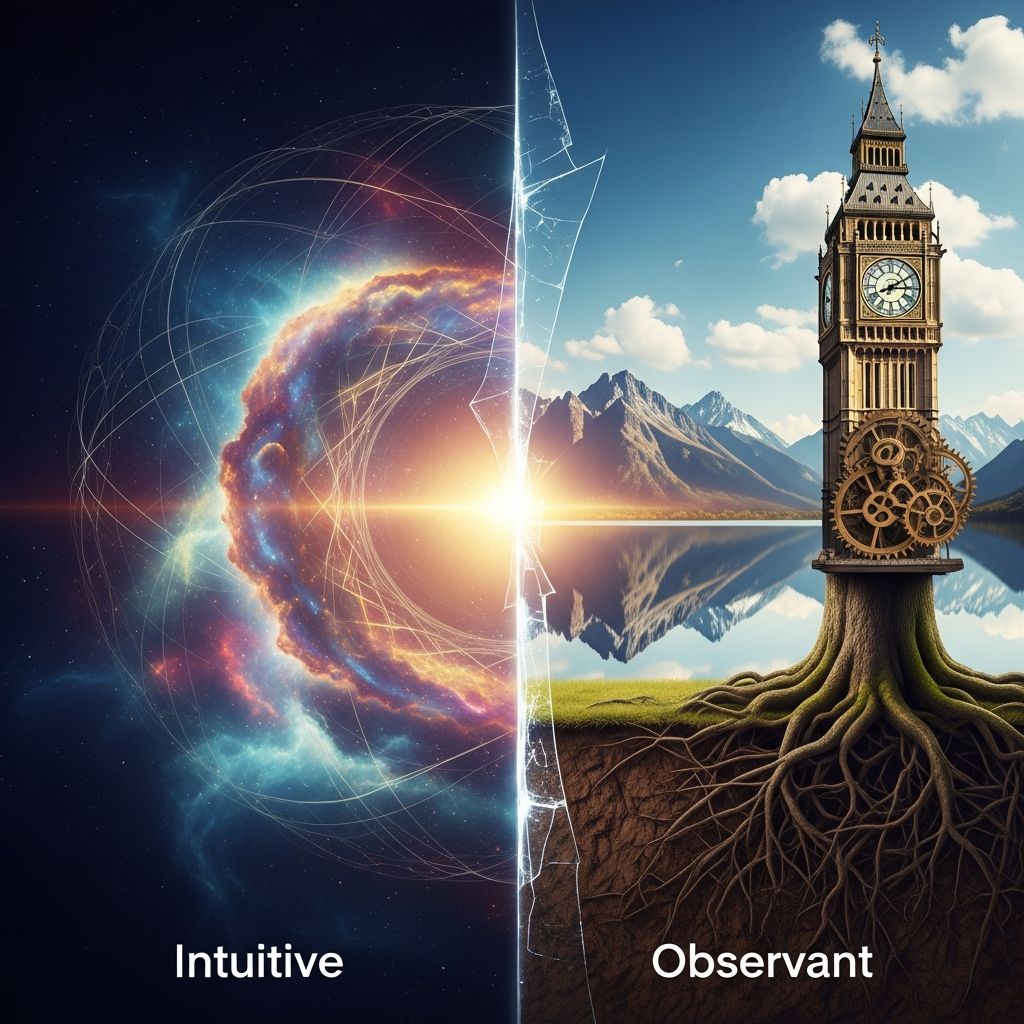
Personality models like the Myers-Briggs framework describe how people tend to take in information and interpret reality. One of the key differences is between people who are more Intuitive (N) and those who are more Observant/Sensing (S). Understanding this distinction can clarify why some people love big ideas and possibilities, while others prefer concrete facts and what is directly in front of them.
This guide explains what Intuitive and Observant traits mean, how they show up in everyday life, and how you can recognize them in yourself and others, using an original structure while drawing on established personality research.
1. What Do “Intuitive” and “Observant” Really Mean?
In personality psychology, these terms describe how you prefer to perceive information, not how intelligent, emotional, or rational you are. Both tendencies can be highly capable; they simply specialize in different aspects of reality.
1.1 The Intuitive Preference
People with a stronger Intuitive preference are drawn to:
- Patterns and meanings behind what they see
- Future possibilities rather than present conditions
- Abstract ideas, theories, symbols, and concepts
- Imaginative “what if” thinking and novel approaches
In cognitive science, intuition is often linked with rapid, pattern-based judgment that relies on accumulated experience rather than step-by-step analysis, sometimes labeled as “System 1” processing. This does not mean it is mystical; it is a fast, automatic way the brain recognizes regularities.
1.2 The Observant (Sensing) Preference
People with a stronger Observant or Sensing preference tend to prioritize:
- Concrete facts and verifiable data
- The present moment and the immediate environment
- Practical experience and what has worked before
- Clear, realistic, step-by-step information
Research on individual differences shows that some people naturally favor detail-rich, sensory information, which helps with tasks that require accuracy, vigilance, and implementation of specific procedures. Observant personalities often excel in such settings.
2. Core Differences at a Glance
The table below summarizes how Intuitive and Observant styles typically contrast. These are probabilities, not strict rules—real people can show traits of both.
| Dimension | Intuitive Style | Observant Style |
|---|---|---|
| Main focus | What could happen next | What is happening now |
| Information type | Patterns, meanings, concepts | Facts, details, direct evidence |
| Thinking style | Abstract, imaginative, big-picture | Concrete, realistic, grounded |
| Decision emphasis | Long-term implications and possibilities | Past results and current practicality |
| Typical language | Metaphors, theories, “what if” questions | Examples, instructions, “how” questions |
3. How Each Type Experiences Everyday Life
One of the clearest ways to tell these traits apart is to notice where a person’s attention naturally goes in ordinary situations.
3.1 Attention and Perception
- Intuitive: Quickly jumps from what is happening to what it might mean. A casual comment can spark a chain of associations, hypothetical scenarios, or new ideas.
- Observant: Tunes into what is directly observable—tone of voice, specific wording, physical surroundings. They often recall concrete details later with high accuracy.
Laboratory research on cognition shows that people differ in how strongly they rely on top-down interpretation (using expectations and concepts) versus bottom-up sensory data when processing information. Intuitive people lean more top-down; Observant people more bottom-up.
3.2 Time Perspective
- Intuitive: Frequently thinking about future outcomes, possibilities, and “better” versions of situations. They may mentally live slightly ahead of the present.
- Observant: Anchored in what is currently real and what has already been tried. They see value in stabilizing and refining existing systems before chasing new ideas.
These different time perspectives affect what each type finds motivating: Intuitive people often pursue change; Observant people often secure continuity and reliability.
4. Decision-Making: Possibilities vs Practicality
Even small choices—like switching apps, routines, or brands—can reveal whether someone leans Intuitive or Observant.
4.1 Exploring Options
- Intuitive personalities are statistically more likely to keep searching for something “even better,” even when a current solution works adequately. They enjoy optimizing, experimenting, and imagining alternative ways to reach their goals.
- Observant personalities are more inclined to stick with what is already effective, questioning the value of changing a system that functions reliably.
Organizational psychology studies report similar patterns at work: some individuals naturally push for innovation and re-design, while others support standardization, risk control, and procedural stability—both of which are essential in healthy systems.
4.2 Risk and Evidence
- Intuitive: More comfortable acting with incomplete data when they can see an emerging pattern or conceptual logic.
- Observant: Prefers decisions anchored in clear evidence, past performance, and verifiable outcomes.
This does not mean Intuitive people ignore facts or Observant people lack imagination. Instead, they weigh different kinds of information more heavily when making choices.
5. Communication Styles and Conversation Clues
Casual conversation often exposes the Intuitive–Observant difference within a few minutes.
5.1 Topics That Energize Each Trait
- Intuitive types often enjoy:
- Speculative questions (“What if…?”)
- Philosophical or theoretical discussions
- Exploring trends, systems, and hidden connections
- Observant types frequently prefer:
- Concrete stories from real life
- How-to explanations and practical tips
- Discussions linked to current responsibilities or experiences
When conversations drift into distant hypotheticals, some Observant people disengage, viewing such talk as disconnected from real needs. Intuitive people, in contrast, can find purely practical topics draining if there is no room for imagination.
5.2 Language Patterns
Listen for how people frame their thoughts:
- Intuitive: “This reminds me of a bigger pattern…”, “In the long run…”, “The underlying issue is…”
- Observant: “Specifically what happened was…”, “Step one is…”, “In practice, we need to…”
While these are just tendencies, over time they provide powerful clues about a person’s preferred way of processing information.
6. Work, Learning, and Problem-Solving
Research on personality in the workplace has shown that different cognitive preferences are linked to different strengths at work and in education, especially around problem-solving and learning style.
6.1 Strengths of Intuitive Personalities
Intuitive-leaning people often stand out when tasks require:
- Strategy and vision: Defining long-term goals and imagining new directions.
- Innovation: Generating novel ideas, models, or approaches.
- Conceptual learning: Grasping theories, principles, and abstractions quickly.
- Integrating diverse information: Seeing how seemingly unrelated facts fit into a larger system.
Roles involving research, design, forecasting, and creative problem-solving often make strong use of Intuitive strengths.
6.2 Strengths of Observant Personalities
Observant-leaning people tend to shine when tasks require:
- Operational reliability: Maintaining systems, workflows, and routines.
- Accuracy and detail: Handling data, logistics, or procedures with precision.
- Hands-on learning: Learning by doing, observing, and practicing in concrete situations.
- Crisis response: Staying grounded in facts and immediate needs under pressure.
Many fields—such as healthcare, law enforcement, manufacturing, and technical trades—rely heavily on Observant-style strengths.
7. Relationships and Daily Life Dynamics
In close relationships, the Intuitive–Observant difference can both enrich and complicate connection.
7.1 When One Partner Is Intuitive and the Other Is Observant
Common patterns include:
- Different conversation preferences: One partner seeks deep, speculative talks; the other prefers concrete, day-to-day updates.
- Contrasting priorities: One keeps redesigning the future; the other protects current stability and routines.
- Misinterpretation of motives:
- The Observant partner may see the Intuitive one as impractical or restless.
- The Intuitive partner may see the Observant one as resistant to growth or change.
Studies on personality compatibility suggest that couples can benefit when they develop a shared language for their differences and explicitly value both vision and practicality as complementary gifts.
7.2 Practical Ways to Support Each Other
- For Intuitive people:
- Translate your ideas into concrete steps and timelines.
- Acknowledge the value of proven methods and routines.
- Invite your Observant partner to test and refine your concepts.
- For Observant people:
- Allow space for brainstorming, even if not every idea is realistic.
- Share specific feedback rather than dismissing possibilities outright.
- Ask how a proposed change could improve your shared life long-term.
8. How to Tell If Someone Is More Intuitive or Observant
You cannot determine someone’s preference with one question, but over time patterns appear across their attention, language, and choices.
8.1 Questions to Ask Yourself
Consider which options feel more natural and energizing for you:
- Do I usually care more about new possibilities or about making the current system work smoothly?
- When learning, do I prefer theory and big ideas or examples and step-by-step instructions?
- In conversations, do I tend to shift toward “what this could mean later” or “what exactly is happening now”?
- When something works, am I inclined to optimize and experiment or to maintain and protect it?
If most of your answers lean toward the first option in each pair, you likely favor the Intuitive side. If they lean toward the second, you likely lean Observant.
8.2 Behavioral Signs in Others
- Intuitive indicators:
- Frequently raises hypothetical or “big picture” questions.
- Enjoys discussing abstract topics with no immediate application.
- Often reimagines how systems, routines, or tools could be improved.
- Observant indicators:
- Focuses conversations on current tasks, events, or problems.
- Shows strong recall of specific details from past experiences.
- Gets impatient when talk becomes speculative without action steps.
9. Developing Balance: Using Both Intuition and Observation
Although personality models talk about preferences, modern psychology emphasizes that both intuitive and observational processing are important and trainable.
9.1 If You Lean Intuitive
You can strengthen your Observant side by:
- Practicing detailed note-taking in meetings or classes.
- Running small experiments before fully committing to new ideas.
- Asking, “What actually happened?” before interpreting what it means.
- Building routines that support your long-term vision with consistent action.
9.2 If You Lean Observant
You can develop your Intuitive side by:
- Setting aside time for brainstorming without self-criticism.
- Looking for patterns across different projects or experiences.
- Asking, “If nothing were stopping us, how else could this work?”
- Exploring conceptual or theoretical material alongside practical guides.
By intentionally practicing the opposite style, you do not change your core preference but expand your flexibility, which has been linked in research to better adaptation and problem-solving under changing conditions.
Frequently Asked Questions (FAQs)
Q1: Is being Intuitive better than being Observant?
Neither trait is inherently better. Intuitive styles excel in innovation, long-term strategy, and conceptual thinking, while Observant styles excel in realistic planning, implementation, and attention to detail. Healthy teams, relationships, and organizations typically need both perspectives.
Q2: Can someone be both Intuitive and Observant?
Everyone uses both modes of processing, but most people have a natural preference for one. Personality frameworks talk about what you do by default, not what you are capable of. With practice, you can deliberately strengthen your less-preferred style and use it when the situation calls for it.
Q3: Does stress change how Intuitive and Observant people behave?
Yes. Research-informed personality work indicates that under stress, Intuitive people may become overwhelmed by possibilities and “what if” scenarios, while Observant people may narrow their focus too much to immediate details, losing sight of context. Understanding this can help you support others more effectively.
Q4: Are these traits linked to intelligence or education level?
No. Intuitive and Observant describe style, not ability. Both highly educated experts and people with little formal training can be either Intuitive or Observant. Studies of cognitive styles consistently show that different preferences simply organize strengths in different areas rather than indicating overall intelligence.
Q5: How accurate are online personality tests about Intuitive vs Observant?
Online tests can provide useful starting points, especially when they are based on well-researched instruments and large validation samples. However, no quick quiz is perfect. The most reliable approach is to combine test results with careful self-reflection about your long-term behavior patterns, values, and everyday choices.
References
- Intuitive vs. Observant: Key Differences, Traits & Relationship Impact — NeuroVizr Blog. 2024-03-01. https://neurovizr.ch/blogs/general-wellness-lifestyle/intuitive-vs-observant-key-differences-traits-relationship-impact
- Intuitive vs. Analytical Personality Traits at Work — Hire Success. 2023-09-15. https://www.hiresuccess.com/help/intuitive-vs-analytical-personality-types-at-work
- How to Tell Intuitive and Observant Personality Types Apart — 16Personalities. 2022-11-10. https://www.16personalities.com/articles/how-to-tell-intuitive-and-observant-personality-types-apart
- Intuitive vs. Observant: What’s the Difference? — Nikki Novo Co. 2022-07-12. https://www.nikkinovo.com/blog/intuitive-vs-observant-whats-the-difference
- How to Lead Intuitive and Observant Personalities Through Stress — 16Personalities Substack. 2023-04-20. https://16personalities.substack.com/p/how-to-lead-intuitive-and-observant-personalities-through-stress
- Differences between Personality Types when it Comes to Visualisation & Memorization — Art of Memory Forum. 2016-05-19. https://forum.artofmemory.com/t/differences-between-personality-types-when-it-comes-to-visualisation-memorization/32432

Medha Deb is an editor with a master's degree in Applied Linguistics from the University of Hyderabad. She believes that her qualification has helped her develop a deep understanding of language and its application in various contexts. Medha specializes in the areas of beauty, health, sports, and wellness and is committed to ensuring that the content on the website is…