
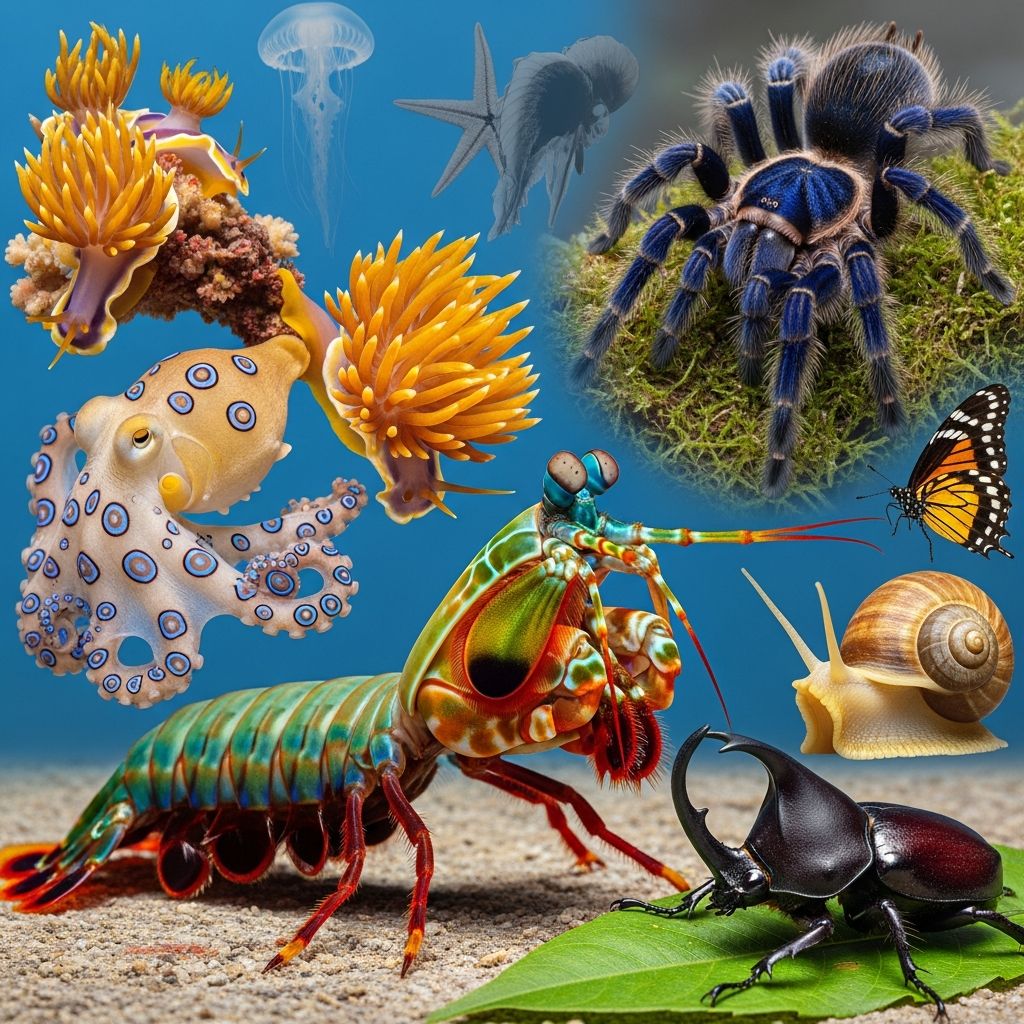
Invertebrates represent the overwhelming majority of animal life on Earth, comprising approximately 97% of all animal species. These remarkable organisms share a single defining characteristic: the complete absence of a vertebral column or backbone. Despite this shared feature, invertebrates display extraordinary diversity in body structures, behaviors, habitats, and ecological functions. From microscopic organisms measuring just 10 micrometers to the colossal squid reaching 9-10 meters in length, invertebrates have successfully colonized nearly every environment on the planet, including deep oceans, rainforests, deserts, and freshwater ecosystems.
What Defines an Invertebrate?
The term “invertebrate” refers to any animal that lacks a rigid internal skeletal structure composed of bone. Rather than possessing the centralized vertebral column that characterizes vertebrates, invertebrates employ diverse skeletal strategies. Many species feature fluid-filled hydrostatic skeletons, similar to jellyfish and various worms, which provide structural support through pressurized body cavities. Others have evolved hard exoskeletons—rigid external coverings that serve dual purposes of body protection and muscle attachment points, as seen in insects and crustaceans.
The remarkable diversity of invertebrates extends beyond skeletal systems. These animals are distributed across more than 30 distinct phyla, each representing fundamentally different body plans and evolutionary strategies. In stark contrast, all vertebrates are contained within a single phylum, demonstrating the incredible evolutionary success and specialization of invertebrate groups.
Major Phyla and Their Characteristics
Invertebrates are scientifically organized into distinct phyla, each containing animals with shared structural and evolutionary characteristics. Understanding these major groups provides insight into the complexity and variety of spineless life:
Porifera: The Foundation of Animal Life
Sponges constitute the phylum Porifera and represent the most primitive invertebrates. These organisms lack traditional organs and nervous systems, filtering nutrients directly from water through specialized pores in their bodies. Despite their simple appearance, sponges demonstrate remarkable regenerative capabilities and play crucial roles in marine ecosystem filtration.
Cnidaria: Stinging Cells and Radial Symmetry
The phylum Cnidaria encompasses jellyfish, corals, sea anemones, and sea pens. Members of this group possess stinging cells called nematocysts, which they use for capturing prey and defense. These organisms typically exhibit radial symmetry, with body parts arranged around a central axis. The phylum contains approximately 2,175 described species and plays vital roles in marine food webs and reef ecosystems.
Platyhelminthes: The Flatworm Assemblage
Flatworms represent an ancient invertebrate lineage characterized by bilateral symmetry and unsegmented bodies. These organisms were originally considered primitive but are now understood to have descended from more complex ancestors. They lack body cavities—a condition known as being acoelomate—and possess a single opening in their digestive system that functions simultaneously as both mouth and anus.
Nematoda: Microscopic Yet Ubiquitous
Roundworms constitute perhaps the second-largest animal phylum and are found in virtually every aquatic environment on Earth. These typically microscopic organisms feature differentiated mouth and anus structures, representing an evolutionary advance over flatworms. Nematodes occupy diverse ecological niches, from soil organisms to parasitic forms affecting plants and animals.
Annelida: Segmented Innovation
Annelids include earthworms, sandworms, leeches, and bristleworms, characterized by distinctly segmented bodies. Members of this phylum are triploblastic animals, meaning their bodies develop from three distinct tissue layers: the ectoderm, mesoderm, and endoderm. This three-layered construction represents a significant evolutionary advancement, allowing for more complex organ development and physiological functions. The segmented body plan of annelids provides flexibility and enables specialized functions within different body regions.
Mollusca: Varied Body Plans
The phylum Mollusca encompasses an astonishing variety of invertebrates, including snails, mussels, octopuses, and squid. Gastropods represent the largest mollusk group with approximately 85,000 described species, followed by bivalves with 20,000 species, and the notably intelligent cephalopods with only 900 species. Despite their diversity, mollusks share fundamental characteristics including muscular feet for locomotion and, in many species, calcium carbonate shells for protection.
Arthropoda: The Dominant Phylum
Arthropods represent the most successful animal phylum in terms of species diversity and ecological dominance. This group includes insects, arachnids, crustaceans, and various other forms. With over one million described insect species alone, arthropods account for the vast majority of invertebrate biodiversity and include virtually all flying animals, most predators in terrestrial ecosystems, and countless aquatic species.
Echinodermata: Radial Symmetry in Motion
Sea stars, sea urchins, and sea cucumbers comprise the phylum Echinodermata, characterized by radial body symmetry and water vascular systems that enable movement and feeding. These marine organisms possess specialized structures allowing them to cling to surfaces, regenerate lost body parts, and navigate complex ocean floor environments.
Functional Groupings of Invertebrates
Beyond phylogenetic classification, invertebrates can be organized into functional groups based on shared ecological or morphological characteristics:
The Three Familiar Groups
While invertebrate diversity is staggering, three groups are particularly recognizable to most people:
- Insects: Characterized by six segmented legs and often possessing wings, insects represent the most numerous group of invertebrates. Examples include beetles, butterflies, bees, dragonflies, and ants, each playing specific ecological roles ranging from pollination to pest control.
- Arachnids: These eight-legged invertebrates lack antennae and possess two body segments. Spiders and scorpions are the most familiar arachnids, though often feared, they provide valuable ecosystem services by controlling insect populations and are generally harmless to humans.
- Crustaceans: Featuring 10-14 legs and four antennae, crustaceans include crabs, lobsters, and shrimp. While predominantly aquatic, some species like pillbugs have successfully adapted to terrestrial life.
Terrestrial and Aquatic Habitats
Invertebrates have colonized virtually every terrestrial and aquatic environment, each species adapted to specific ecological niches:
| Environment Type | Representative Groups | Characteristics |
|---|---|---|
| Terrestrial | Insects, Spiders, Worms, Centipedes, Millipedes | Adapted to land with reduced water loss and locomotion strategies for soil and vegetation |
| Freshwater | Dragonfly nymphs, Aquatic snails, Freshwater mussels, Crayfish | Specialized for freshwater environments with osmoregulation mechanisms |
| Marine | Sea stars, Corals, Jellyfish, Crustaceans, Cephalopods, Sponges | Adapted to saltwater with diverse feeding and locomotion strategies |
Behavioral and Physiological Diversity
Invertebrates display remarkable behavioral and physiological variation despite their lack of backbone. Some species possess extraordinary locomotion capabilities, with squid achieving rapid swimming through jet propulsion and insects such as bees and dragonflies executing complex aerial maneuvers. Conversely, other invertebrates including corals, sea anemones, fan worms, and sponges remain essentially stationary throughout their lives, filtering food directly from surrounding water or capturing passing prey.
Sensory capabilities also vary dramatically across invertebrate groups. Some species, including crabs and snails, possess clearly recognizable features such as distinct heads, eyes, and mouths. Others display radically different body plans entirely lacking obvious heads or traditional sensory organs, such as sea stars, sponges, and corals.
Ecological Importance and Biodiversity
Invertebrates provide essential ecosystem services and maintain planetary biological balance through diverse mechanisms. Insects pollinate flowering plants, decompose organic matter, and form the foundation of countless food webs. Mollusks filter water in marine and freshwater systems, maintaining water quality and nutrient cycling. Soil invertebrates including worms and arthropods aerate soil and facilitate nutrient mineralization critical for plant growth.
The sheer abundance of invertebrate species provides biological redundancy ensuring ecosystem resilience. When one species declines, others can occupy similar ecological niches, maintaining ecosystem function. This diversity also represents an enormous reservoir of genetic material and biochemical compounds with potential applications in medicine, agriculture, and biotechnology.
Special Invertebrate Groups
Beyond the major phyla, several lesser-known groups demonstrate the remarkable diversity of spineless animals:
- Onychophora (Velvet Worms): These 165 described species share characteristics with both arthropods and annelids, featuring soft bodies rather than hardened exoskeletons.
- Tardigrada (Water Bears): Microscopic organisms sharing close relationships with arthropods, capable of surviving extreme environmental conditions.
- Rotifera (Rotifers): Common aqueous organisms featuring specialized feeding structures called wheels of cilia.
- Chaetognatha (Arrow Worms): Marine invertebrates representing an ancient lineage with transparent bodies and specialized predatory structures.
Size Extremes and Diversity
Invertebrate size variation is extraordinary, encompassing the complete spectrum of metazoan life. The smallest invertebrates include myxozoans measuring only 10 micrometers, essentially invisible to the naked eye. At the opposite extreme, the colossal squid represents the largest known invertebrate, reaching lengths of 9-10 meters, with intelligence and sensory capabilities rivaling many vertebrates.
This size diversity reflects fundamental ecological strategies: smaller invertebrates often populate soil and water column environments, filling niches requiring minimal space, while larger invertebrates occupy apex predator positions or exploit abundant food resources in specialized habitats.
Frequently Asked Questions
Q: What percentage of all animal species are invertebrates?
A: Invertebrates comprise approximately 97% of all animal species identified by scientists, representing the dominant form of animal life on Earth.
Q: How many distinct phyla do invertebrates comprise?
A: Invertebrates are distributed across more than 30 distinct phyla, each representing unique evolutionary lineages and body plans. This contrasts dramatically with vertebrates, which are contained within a single phylum.
Q: Are invertebrates found only in water environments?
A: No. While many invertebrates inhabit aquatic environments, numerous groups have successfully adapted to terrestrial habitats. Insects, arachnids, worms, and many crustaceans thrive on land, with insects particularly dominating terrestrial ecosystems.
Q: What distinguishes insects from arachnids?
A: Insects possess six legs and typically have wings, while arachnids have eight legs and lack wings or antennae. Both belong to the arthropod phylum but represent distinct evolutionary adaptations.
Q: Why are invertebrates important ecologically?
A: Invertebrates provide essential ecosystem services including pollination, decomposition, water filtration, soil aeration, and food web support. They maintain ecosystem balance and resilience through their extraordinary diversity.
Q: How do invertebrates without backbones maintain structural support?
A: Invertebrates employ two primary strategies: fluid-filled hydrostatic skeletons, as seen in jellyfish and worms, and rigid external exoskeletons, as found in insects and crustaceans.
References
- Types of Invertebrates and their Characteristics — BYJU’S. 2024. https://byjus.com/biology/invertebrates/
- A World of Invertebrates — National Geographic Education. 2024. https://www.youtube.com/watch?v=liXAZob8WEM
- Invertebrates — National Wildlife Federation. 2024. https://www.nwf.org/Educational-Resources/Wildlife-Guide/Invertebrates
- Invertebrate — Wikipedia. 2025. https://en.wikipedia.org/wiki/Invertebrate
- What is an Invertebrate? — Butterfly Pavilion. 2024. https://butterflies.org/what-is-an-invertebrate/
- Introduction to Invertebrates — University of Hawaii at Manoa. 2024. https://manoa.hawaii.edu/exploringourfluidearth/biological/invertebrates/introduction-invertebrates
- Invertebrate: Definition, Characteristics, Examples, Groups, & Facts — Britannica. 2024. https://www.britannica.com/animal/invertebrate

- Integrated M.A. in Applied Linguistics, University of Hyderabad
- 5+ years in editorial, instructional, SEO, and research-based writing
Sneha is a relationships and lifestyle writer with a strong foundation in applied linguistics and certified training in relationship coaching. She brings over five years of writing experience to theskillvault, crafting thoughtful, research-driven content that empowers readers to build healthier relationships, boost emotional well-being, and embrace holistic living. Her writing and insights reflect the belief that beauty, happiness, and wellness…