
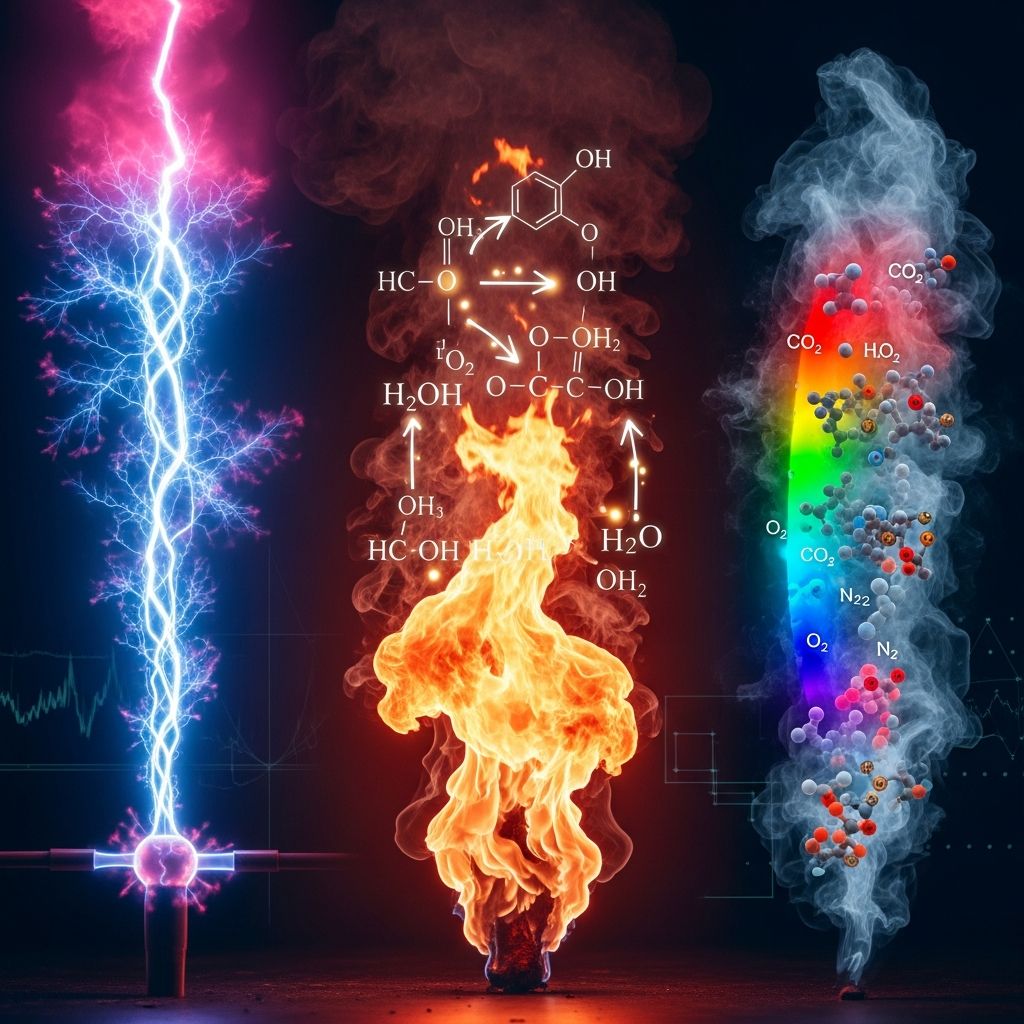
Fire has captivated humanity for millennia, serving as a source of warmth, light, and transformation. Yet, despite its familiarity, fire resists simple categorization within the traditional states of matter—solid, liquid, or gas. Scientists describe it as a dynamic process involving rapid chemical reactions in a mixture of hot gases, often luminous due to incandescence. This article delves into the physics and chemistry of fire, examining why it doesn’t fit neatly into conventional categories and exploring its closest resemblance to plasma, the fourth state of matter.
Understanding the Basics of Matter States
To grasp fire’s elusive nature, first consider the fundamental states of matter. Solids maintain a fixed shape and volume due to tightly packed particles with strong intermolecular forces. Liquids flow, taking the shape of their container but retaining a fixed volume, as particles slide past one another. Gases expand to fill their container, with particles moving freely and collisions driving pressure.
These states describe equilibrium conditions where matter exists stably. Fire, however, is transient and reactive, ceasing when fuel or oxygen depletes. Unlike stable gases, it doesn’t persist indefinitely and exhibits behaviors unique to combustion.
The Chemistry Powering Flames
At its core, fire is combustion: an exothermic oxidation reaction requiring fuel, oxygen, and heat—the fire triangle. Solid or liquid fuels vaporize first, reacting with gaseous oxygen to produce heat, light, carbon dioxide, water vapor, and sometimes soot.
In a typical candle flame, paraffin wax vaporizes, mixes with air, and ignites. The visible flame is a zone of ongoing reactions where hot gases emit light. This process forms a teardrop shape because reactions occur at the fuel-oxygen interface, with rising hot gases creating convection currents. Flames from hydrocarbons primarily consist of carbon dioxide, water vapor, oxygen, and nitrogen, glowing due to incandescent soot particles or excited molecules.
Why Fire Isn’t a Solid, Liquid, or Gas
Fire fails basic tests for traditional states. It lacks a fixed shape or volume like solids or liquids—your hand passes through it, though painfully due to heat. As a gas? Gases fill containers and exist stably, but fire expands only with oxygen supply and extinguishes without it.
| Property | Solid | Liquid | Gas | Fire |
|---|---|---|---|---|
| Fixed Shape | Yes | No | No | No |
| Fixed Volume | Yes | Yes | No | No (depends on reaction) |
| Expands to Fill Container | No | No | Yes | No |
| Persistent Existence | Yes | Yes | Yes | No (requires fuel/oxygen) |
This table highlights fire’s distinct profile. Its ephemerality stems from chain reactions that self-sustain until inputs cease.
Fire’s Resemblance to Plasma
Plasma, the fourth state, forms when gas atoms ionize, freeing electrons from nuclei, creating charged particles that conduct electricity and respond to magnetic fields. High-energy plasmas, like lightning, are fully ionized; fire occupies a gray area.
Many flames qualify as low-level or partially ionized plasmas. Electrons break free in hot regions, enabling collective electromagnetic behavior, though not as cohesively as in arcs. Hot flames, like oxy-acetylene at 3100°C, ionize sufficiently for plasma traits, unlike cooler candle flames at ~1500°C. Magnesium flames reach plasma conditions.
- Key Plasma Traits in Fire: Ionization from heat, luminous emission from electron transitions, quasi-neutrality.
- Limitations: Flames don’t fully fill containers or exhibit strong electrodynamic cohesion.
Types of Flames and Their Matter States
Flame nature varies by fuel and conditions:
- Diffusion Flames (e.g., candles): Fuel and oxygen mix gradually, producing yellow-orange glow from soot.
- Premixed Flames (e.g., Bunsen burners): Uniform mixture yields blue, cooler combustion without soot.
- High-Temperature Flames: Metals like magnesium create plasma via intense ionization.
Wood fires involve vaporized volatiles burning in air, with char glowing red from solid combustion.
Historical Perspectives on Fire
Ancient Greeks viewed fire as an element alongside earth, air, water—echoing modern states but missing its reactive essence. Today, we recognize fire as a process, not a substance, challenging Aristotelian models.
Modern Scientific Insights
Advanced studies reveal fire’s complexity. Spectroscopy shows emission spectra from excited species. Fluid dynamics models convection shaping flames. Nanotechnology explores combustion at microscales.
In space, microgravity flames form spherical shapes, underscoring convection’s role.
Practical Implications of Fire’s Nature
Understanding fire aids firefighting: Remove heat, fuel, or oxygen to extinguish. In engineering, controlled combustion powers engines. Plasma-like properties inspire fusion research and welding.
Frequently Asked Questions
Is fire a chemical reaction or a state of matter?
Fire is primarily a chemical reaction occurring in hot gases, not a stable state of matter. It resembles plasma in some cases but is defined by combustion dynamics.
Can fire exist without oxygen?
No, oxygen (or another oxidizer) is essential for typical combustion. Without it, the reaction halts.
Why do flames have colors?
Colors arise from emission spectra: Blue from CO/CH radicals, yellow from soot incandescence, varying by temperature and fuel.
Is all fire plasma?
Not all; only sufficiently hot flames ionize enough. Candle flames are hot gases with partial ionization.
How does fire spread?
Heat vaporizes nearby fuel, igniting via chain reactions, propagating while the fire triangle persists.
Debunking Common Myths
Myths persist: Fire isn’t “alive” but a self-sustaining reaction. It’s not purely energy—gases carry mass. Nor is it always destructive; controlled fire enables life.
Fire’s study bridges chemistry, physics, and engineering, revealing matter’s fluidity under extreme conditions.
References
- What state of matter is fire? — Royal Society of Chemistry (RSC) Education. 2022-09-01. https://edu.rsc.org/everyday-chemistry/what-state-of-matter-is-fire/4015393.article
- What’s the Matter: Is Fire a Plasma? — AstroCamp Science Camp. 2019-07-15. https://astrocamp.org/blog/fire-plasma/
- Is fire a solid, liquid or gas? — BBC Science Focus Magazine. 2023-05-12. https://www.sciencefocus.com/science/is-fire-a-solid-liquid-or-a-gas
- Is fire a solid, a liquid, or a gas? — MIT School of Engineering. 2021-10-20. https://engineering.mit.edu/ask-an-engineer/is-fire-a-solid-a-liquid-or-a-gas
- Fire — Wikipedia (referencing primary combustion science). 2026-04-01. https://en.wikipedia.org/wiki/Fire

- Integrated M.A. in Applied Linguistics, University of Hyderabad
- 5+ years in editorial, instructional, SEO, and research-based writing
Sneha is a relationships and lifestyle writer with a strong foundation in applied linguistics and certified training in relationship coaching. She brings over five years of writing experience to theskillvault, crafting thoughtful, research-driven content that empowers readers to build healthier relationships, boost emotional well-being, and embrace holistic living. Her writing and insights reflect the belief that beauty, happiness, and wellness…