
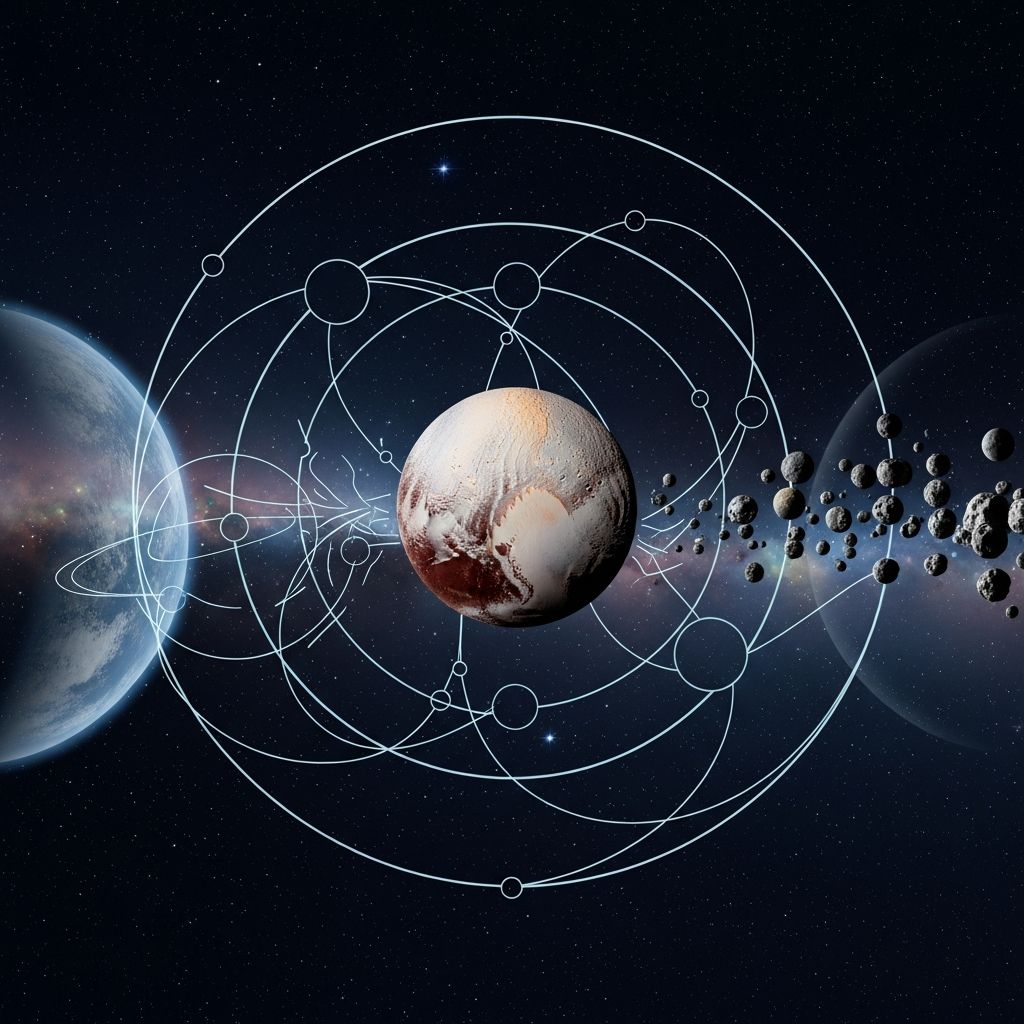
Pluto’s journey from the ninth planet to a dwarf planet has sparked one of the most enduring controversies in modern astronomy. Discovered in 1930, it held planetary status for over seven decades until the International Astronomical Union (IAU) redefined what constitutes a planet in 2006. This decision, made during a meeting in Prague, relegated Pluto to dwarf planet status, leaving only eight planets in our solar system. Yet, the debate rages on, fueled by new data from NASA’s New Horizons mission and differing views between astronomers and planetary scientists.
Historical Context of Pluto’s Discovery
Pluto was first spotted by astronomer Clyde Tombaugh at the Lowell Observatory in Arizona. At the time, its discovery was hailed as the culmination of a long search for a planet beyond Neptune, predicted by irregularities in Uranus and Neptune’s orbits. For decades, Pluto was embraced as the solar system’s outermost world, appearing in textbooks and inspiring generations. However, its small size—smaller than Earth’s Moon—and highly elliptical orbit raised questions early on.
By the late 20th century, the discovery of the Kuiper Belt, a vast ring of icy bodies beyond Neptune, began to contextualize Pluto. Rather than a solitary outlier, Pluto emerged as one of the largest members of this population, challenging its unique planetary pedestal. Events like Neil deGrasse Tyson’s 1999 panel debate highlighted growing divisions among experts, with “plutophiles” defending its status and others viewing it as just another Kuiper Belt object.
The IAU’s Official Planet Definition
In response to the discovery of numerous large trans-Neptunian objects like Eris, the IAU convened to establish clear criteria. Their 2006 resolution defines a planet as a celestial body that:
- Orbits the Sun.
- Is massive enough to assume hydrostatic equilibrium, meaning it achieves a nearly round shape due to its own gravity.
- Has cleared the neighborhood around its orbit, meaning it gravitationally dominates other objects in its path.
Pluto satisfies the first two: it orbits the Sun and is spherical. But it fails the third—”clearing its orbit.” Sharing its region with thousands of Kuiper Belt objects, Pluto controls only about 7% of the mass in its orbital zone, far less than giants like Mars, which dominates over 5,000 times more than nearby bodies.
| Planet | Orbital Dominance Example |
|---|---|
| Mars | >5,000x mass of next largest object |
| Pluto | ~7% of orbital zone mass |
| Earth | Effectively cleared via resonances |
This table illustrates the stark contrast in gravitational control, underscoring why dynamists—those focused on orbital dynamics—support the IAU’s stance.
Why Pluto Fell Short: The Clearing Criterion Explained
The “cleared the neighborhood” rule stems from dynamical astronomy, emphasizing a body’s ability to shape its orbital environment through gravitational influence. For inner planets, this means scattering asteroids; for gas giants, shepherding rings or ejecting debris. Pluto, residing in the Kuiper Belt, coexists with objects like Eris and Haumea, preventing it from achieving dominance.
Critics note the term’s vagueness—no precise mathematical threshold exists for “cleared.” Does it mean 99% mass control? 50%? The IAU’s compromise blended geophysical (shape-based) and dynamical (orbit-clearing) views, but favored the latter, demoting Pluto and similar bodies to “dwarf planets.”
Scientific Discoveries Reviving the Debate
NASA’s New Horizons flyby in 2015 transformed our view of Pluto. Images revealed a geologically active world with nitrogen ice plains, mountains, and possible cryovolcanoes—features rivaling Mars or Europa. Planetary scientist Alan Stern, New Horizons’ principal investigator, argues Pluto’s complexity demands full planetary recognition. He contends the IAU definition excludes not just Pluto but potentially all eight planets under strict interpretation, as none are perfectly cleared.
Stern and others highlight geophysical merits: Pluto’s differentiated interior, thin atmosphere, and five moons indicate a bona fide planet by physical properties, not mere dynamics. NASA’s own site describes Pluto as a “dwarf planet in the Kuiper Belt,” yet emphasizes its significance without fully endorsing the demotion.
Two Camps in the Planetary Classification War
The schism pits dynamical astronomers against planetary geologists. Dynamists prioritize motion: Pluto’s crowded orbit disqualifies it. Geophysicists counter that planets should be defined by intrinsic properties like composition and geology, potentially expanding the list to dozens, including Ceres and Eris.
Key figures illustrate this: Plutophiles like Stern and Richard Binzel advocate retention; populists like Neil deGrasse Tyson and Mike Brown see Pluto as one of many. A 1999 debate captured this, with indeterminate voices like Mike Brown later influencing the IAU vote.
Implications for Solar System Understanding
The IAU decision streamlined classification amid discovery overload but stifled nuance. Recognizing more planets could enrich education and exploration. For instance, Pluto’s heart-shaped Tombaugh Regio and hazy atmosphere suggest ongoing processes, making it a prime study for icy world formation.
Reclassifying Pluto might invite Eris (slightly more massive) and others, ballooning the count. Yet, Stern argues this reflects reality: our solar system hosts many planetary bodies, not just eight.
Public and Educational Impact
The demotion confused students and fueled memes, but also sparked interest. Museums removed Pluto models; textbooks updated overnight. Today, petitions and talks, like those featuring Stern, keep the conversation alive, blending science with cultural nostalgia.
Future Prospects for Redefinition
Planetary scientists are pushing alternatives, like a tiered system: “true planets” by geophysics, with dynamical subclasses. The IAU’s astronomer-heavy vote excluded many geologists, prompting calls for broader input. As missions to Eris or Sedna loom, pressure mounts to revisit the definition.
Ultimately, classification serves science. If Pluto’s geology merits study as a planet, labels should adapt. The debate underscores astronomy’s evolution, reminding us definitions aren’t fixed truths but tools for understanding.
Frequently Asked Questions (FAQs)
What are the three IAU criteria for a planet?
A: A body must orbit the Sun, be nearly spherical due to self-gravity, and clear its orbital neighborhood.
Why did New Horizons change opinions on Pluto?
A: It revealed active geology, mountains, and an atmosphere, showcasing planetary complexity.
Is Eris a planet too?
A: No, like Pluto, it’s a dwarf planet for failing the clearing criterion, though it’s more massive.
Do all scientists agree Pluto isn’t a planet?
A: No—planetary scientists like Alan Stern strongly disagree with the IAU.
Could there be a ninth planet?
A: Hypothetical Planet Nine is proposed based on orbital anomalies, but unconfirmed.
References
- Actually, Pluto IS a planet. Here’s why the IAU got it wrong. — Digital Astronaut (YouTube). 2023. https://www.youtube.com/watch?v=kXQ_bBYqvkk
- The Pluto Debate: The International Astronomical Union Defines a Planet — Elon University (PDF). 2006. https://facstaff.elon.edu/acrider/pluto/pluto-instructions.pdf
- The Pluto problem: Is it time to rethink our definition of a planet? — Space.com. 2023-09-20. https://www.space.com/pluto-problem-time-to-rethink-definition-of-a-planet
- Why is Pluto no longer a planet? — Library of Congress (.gov). 2023. https://www.loc.gov/everyday-mysteries/astronomy/item/why-is-pluto-no-longer-a-planet/
- Is Pluto a planet? The experts break it down. — Astronomy.com. 2023-08-25. https://www.astronomy.com/science/is-pluto-a-planet-the-experts-break-it-down/
- Pluto – NASA Science — NASA (.gov). 2024-01-23. https://science.nasa.gov/dwarf-planets/pluto/

- Integrated M.A. in Applied Linguistics, University of Hyderabad
- 5+ years in editorial, instructional, SEO, and research-based writing
Sneha is a relationships and lifestyle writer with a strong foundation in applied linguistics and certified training in relationship coaching. She brings over five years of writing experience to theskillvault, crafting thoughtful, research-driven content that empowers readers to build healthier relationships, boost emotional well-being, and embrace holistic living. Her writing and insights reflect the belief that beauty, happiness, and wellness…