
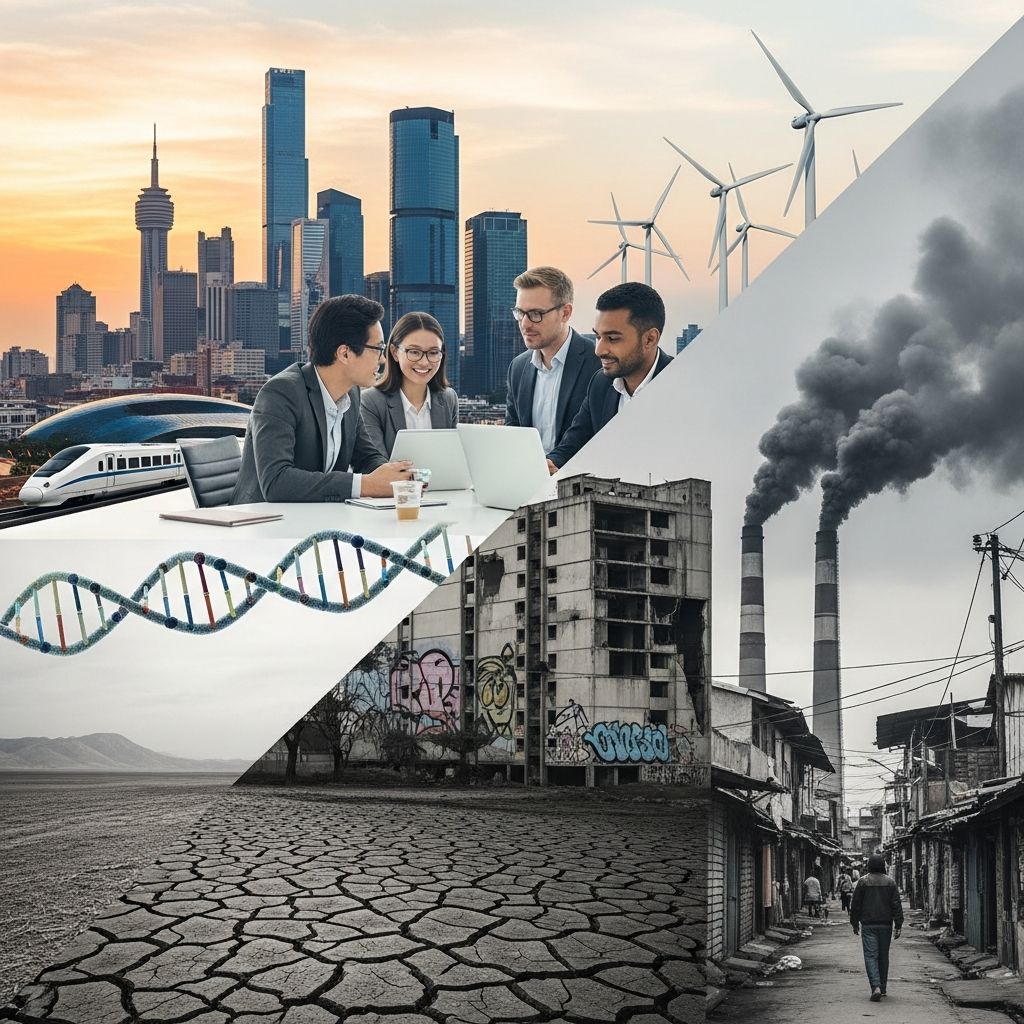
People who care about making a difference often face a deceptively simple question: is the world fundamentally improving, or are we heading toward disaster? The answer is neither “everything is getting better” nor “everything is collapsing”. Instead, the data show a complex mix of dramatic progress, serious stagnation, and emerging risks that could shape humanity’s entire future.
This article draws on global statistics, official reports, and long-run trends to unpack that picture. It is written for readers who are not only curious about the state of the world, but who also want to use this understanding to decide where they can do the most good.
How to Think About Global Progress
Before looking at specific trends, it helps to be clear about what we even mean by “better” or “worse”. Three lenses are especially useful:
- Current living conditions: How well off are people alive today, on average and at the bottom?
- Trajectories and inequality: Are things improving or declining, and who is left behind?
- Long-term risks: What are the chances that future generations face catastrophic or irreversible harms?
These lenses can easily point in different directions. Many indicators of material wellbeing have improved dramatically over the last century, while several environmental and geopolitical trends look worrying, and some technologically driven risks might be higher than ever.
| Dimension | Long-run trend | Recent pattern | Main concern |
|---|---|---|---|
| Extreme poverty & basic health | Strong improvement over decades | Progress slowed or stalled in some areas | Setbacks from shocks (pandemics, conflict) |
| Peace, institutions & rights | Large gains compared with early 20th century | Mixed: some regression on conflict & safety | Violence, civic space, democratic backsliding |
| Environment & climate | Rapid deterioration over decades | Some policy gains, but overall off track | Crossing ecological and climate thresholds |
| Technological & existential risks | New threats emerging with growth | Risk awareness rising, governance lagging | Low-probability but high-impact catastrophes |
Where the World Has Gotten Much Better
In many core aspects of human wellbeing, conditions today are far better than they were for much of recorded history. Recognizing this progress matters, not to be complacent, but because it reshapes what is now possible and where extra effort can be most powerful.
Health and Survival
Global health is one of the clearest success stories of the last century. Since 1990, mortality in children under five has declined sharply worldwide, driven by vaccines, better nutrition, improved sanitation, and wider access to basic healthcare.
- People born today can expect to live far longer than their great-grandparents, on average.
- Deaths from many infectious diseases are substantially lower thanks to coordinated public health efforts.
- Reproductive health, maternal care, and access to essential medicines have expanded in many countries.
At the same time, recent disruptions such as the COVID-19 pandemic have temporarily pushed some mortality indicators in the wrong direction, and progress is uneven between and within countries.
Poverty and Material Living Standards
On income and basic material needs, the world has also changed dramatically. Over the past few decades, hundreds of millions of people have escaped extreme income poverty as economies have grown and some basic services expanded.
Looking more broadly than income, several composite measures of social development, such as the Social Progress Index, show that many countries have made sustained improvements in areas like access to education, information, and basic safety nets.
- Fewer people lack access to primary schooling than in previous generations.
- Information and communication technologies have spread rapidly, allowing many more people to benefit from digital tools.
- More countries have invested in legal and institutional frameworks that support social protections.
However, these gains sit alongside widening inequality in some contexts and persistent deprivation in others. Many communities still lack reliable access to clean water, energy, or secure livelihoods, particularly in low-income and fragile states.
Measuring Social and Youth Progress
Modern data efforts make it easier to see these improvements and where gaps remain. For example, the Youth Progress Index combines dozens of social and environmental indicators to track outcomes for young people over time, showing areas of both advancement and stagnation across 153 countries.
Similarly, broader tools like the Global Social Progress Index track non-economic aspects of wellbeing across a large set of countries, helping policymakers and advocates identify specific domains where progress has been strongest and where renewed effort is needed.
Where Progress Has Stalled or Reversed
Despite real long-run gains, several global trends have lost momentum since around the mid-2010s, with the COVID-19 pandemic, economic shocks, and conflict slowing or reversing progress in key areas.
Falling Behind on the Sustainable Development Goals
The most comprehensive international framework for tracking global progress is the set of 17 Sustainable Development Goals (SDGs), which cover poverty, health, education, equality, environment, peace, and institutions through 2030.
According to the United Nations’ midpoint assessment, the world is significantly off track:
- Only a small minority of measurable targets are currently on pace to be met by 2030.
- Almost half of assessed targets are moderately or severely off track.
- More than a third of targets show no progress or have regressed compared with their 2015 baselines.
The UN attributes much of this slowdown to overlapping crises, including the climate emergency, the war in Ukraine, a weak global economy, and the lingering social and economic impacts of the COVID-19 pandemic.
Conflict, Safety, and Institutions
While the world is still less violent in some respects than during the early and mid-20th century, recent years have seen worrying developments in peace and security. A joint global progress report on SDG 16 (which covers peace, justice, and strong institutions) highlights several areas of concern:
- The number of civilian deaths in armed conflict increased sharply between 2022 and 2023, with a reported 72% rise in civilian casualties in that period.
- Killings of journalists and media workers in conflict zones have risen, undermining press freedom and accountability.
- Many countries still face challenges around corruption, access to justice, and inclusive institutions, even where some indicators such as bribery rates have modestly improved over the longer term.
These trends suggest that progress on safety, trust in institutions, and civic space is fragile and can quickly be undermined by political crises and conflict.
Data Gaps Hide Parts of the Story
Understanding where the world is getting better or worse also depends on the quality of the data we have. Even though coverage has improved over the last decade, significant data gaps remain. For example, by early 2024, the UN’s global SDG indicator database still lacked sufficient country data for dozens of indicators, particularly in lower-income and conflict-affected settings.
This means that some of the places and issues people care most about are also the least well measured. For anyone trying to allocate resources effectively, part of the challenge is not just responding to known problems, but also identifying where we are flying blind.
Areas Where the World Is Clearly Getting Worse
In contrast to the mixed picture on poverty and health, some domains have unambiguous negative trends. Environmental and climate indicators, in particular, highlight growing risks and missed opportunities.
Climate Change and Environmental Degradation
Greenhouse gas emissions continue to accumulate in the atmosphere, and global efforts remain insufficient to meet agreed climate targets. UN assessments emphasize that current trajectories are not compatible with limiting warming to safer levels, threatening ecosystems, livelihoods, and long-term development.
- Climate impacts, including more intense heatwaves, floods, and droughts, are already undermining progress on health, food security, and poverty reduction.
- Environmental pressures such as biodiversity loss, land degradation, and pollution interact with social vulnerabilities to deepen inequality.
- Many of the poorest and most vulnerable populations bear the brunt of these impacts, despite contributing least to historical emissions.
From a “better vs worse” perspective, climate change is a clear case where physical indicators have moved in the wrong direction for decades, and where delayed action today constrains the options and safety of future generations.
Risks from New Technologies and Global Interdependence
Technological innovation is central to many success stories in health and development. At the same time, some new technologies may create systemic, hard-to-control risks, especially as the world becomes more interconnected. Examples that are widely discussed in expert communities include:
- Potential misuse of advanced biological tools for creating or modifying pathogens.
- Emerging risks from powerful AI systems if they are misaligned with human values or used in destabilizing ways.
- Cybersecurity vulnerabilities that could affect critical infrastructure or financial systems.
Many of these risks are difficult to quantify and are not fully captured in traditional development indicators. Nonetheless, they matter enormously when we think about whether the world is getting safer or more fragile on longer time horizons.
Why This Mixed Picture Matters for Doing Good
For people deciding how to contribute—through careers, donations, or advocacy—whether the world is getting better or worse is not an academic debate. It affects which problems look neglected, which strategies seem promising, and how urgent different interventions feel.
Progress Shows What Is Possible
Long-run improvements in health, education, and poverty demonstrate that large-scale change is possible when knowledge, resources, and political will align. Initiatives that once seemed ambitious—like major vaccine rollouts or global campaigns against specific diseases—have saved millions of lives.
From a practical perspective:
- Evidence of past success is a strong argument for investing in interventions with demonstrated impact.
- Many of the most cost-effective ways to help people today still lie in areas like global health, nutrition, and basic services for the poorest communities.
- Better data and indices now allow more precise targeting of efforts toward populations and issues with the greatest gaps.
Setbacks and Risks Highlight Neglected Priorities
The fact that the world is off track on many SDG targets means that there are domains where additional effort could make an outsized difference. For example:
- Conflict prevention, peacebuilding, and support for inclusive institutions are critical in contexts where violence and weak governance stall progress across many goals at once.
- Climate mitigation and adaptation are increasingly central to protecting health, livelihoods, and development gains, particularly for vulnerable regions.
- Strengthening global capacity to manage systemic risks—from pandemics to advanced technologies—may be crucial for safeguarding the interests of future generations.
These issues often lack the straightforward metrics or success stories that characterize some health interventions, but they may be highly leveraged from a long-term, global perspective.
Frequently Asked Questions
Q: So, is the world mainly getting better or mainly getting worse?
Both. On many concrete measures—like child survival and access to basic education—the world is far better than it was decades ago. At the same time, global progress toward agreed goals is off track, environmental and climate trends are deteriorating, and several conflict and governance indicators have worsened in recent years.
Q: Does acknowledging progress lead to complacency?
Not if it is combined with an honest view of current risks. Understanding where we have succeeded can inspire confidence that ambitious action works, while also revealing which strategies and institutions have historically been most effective. The existence of progress is evidence that additional effort can matter, not a reason to relax.
Q: Are global averages hiding extreme inequality?
Yes, averages can mask very large differences between and within countries. Many people still live with severe deprivation, and in some places conditions have stagnated or worsened even as global metrics improved. That is one reason why indices that disaggregate outcomes for specific groups, such as young people or marginalized communities, are increasingly important.
Q: How reliable are the statistics we use to judge progress?
Data for major indicators have improved substantially over the past decade, with more agreed methodologies and wider coverage. But gaps remain, especially in fragile settings, and some areas—such as institutional quality or certain types of violence—are intrinsically hard to measure. Ongoing investment in national and international statistics is essential for accurately tracking progress and targeting interventions.
Q: If I want my career or donations to help most, what should I prioritize?
There is no single answer, but a helpful approach is to look for problems that are large in scale, comparatively neglected, and where additional resources can clearly make a difference. For some people, that might mean focusing on global health or extreme poverty; for others, it could mean working on climate solutions, peace and governance, or reducing catastrophic risks from pandemics or advanced technologies.
References
- Progress Chart — SDG Indicators 2023 — United Nations Statistics Division. 2023-07-10. https://unstats.un.org/sdgs/report/2023/progress-chart/
- The Sustainable Development Goals Report 2023: Special Edition — United Nations Department of Economic and Social Affairs. 2023-07-10. https://unstats.un.org/sdgs/report/2023/
- Youth Progress Index 2023 — European Youth Forum. 2023-10-01. https://www.youthforum.org/policy-library/youth-progress-index-2023
- Global Progress Report on Sustainable Development Goal 16 Indicators — UNDP, UNHCR & UNODC. 2024-07-01. https://www.undp.org/sites/g/files/zskgke326/files/2024-07/undp-unhcr-unodc-global-progress-report-on-sdg16-indicators-v2.pdf
- National indicators for measuring progress with SDGs — United Nations Economic Commission for Europe. 2024-01-16. https://w3.unece.org/sdg2024/story-17.html
- Global Social Progress Index — Social Progress Imperative. 2023-09-01. https://www.socialprogress.org/social-progress-index
- SDG Tracker: Measuring progress towards the Sustainable Development Goals — Our World in Data. 2023-01-01. https://ourworldindata.org/sdgs

Medha Deb is an editor with a master's degree in Applied Linguistics from the University of Hyderabad. She believes that her qualification has helped her develop a deep understanding of language and its application in various contexts. Medha specializes in the areas of beauty, health, sports, and wellness and is committed to ensuring that the content on the website is…