
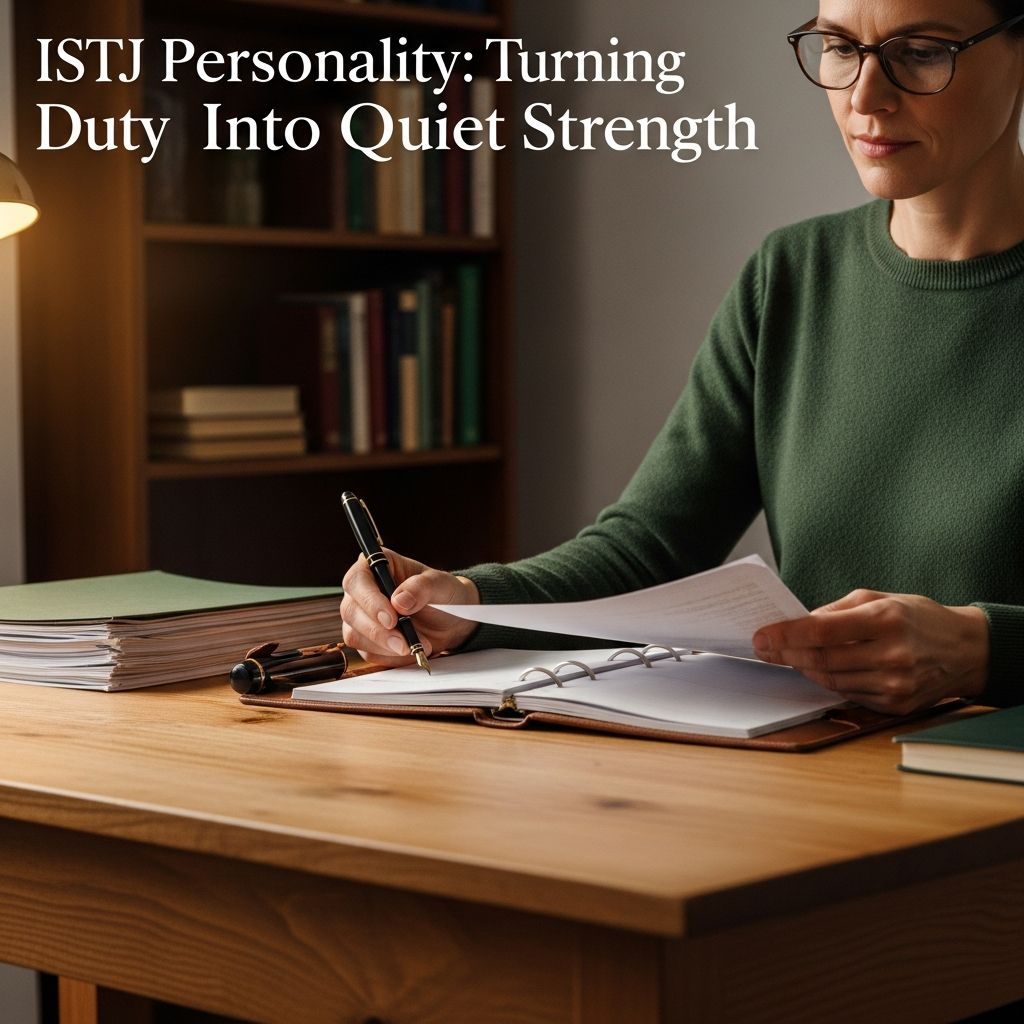
The ISTJ personality type is often described as the backbone of families, workplaces, and communities. Calm, structured, and deeply responsible, people with this type quietly keep systems running, promises kept, and details managed. Behind that reserved exterior is a powerful combination of realism, discipline, and loyalty that can create a life of remarkable stability and integrity.
Understanding the ISTJ Blueprint
In the Myers–Briggs framework, ISTJ stands for Introverted, Sensing, Thinking, Judging. These preferences shape how ISTJs gain energy, process information, make decisions, and organize their lives.
| Preference | What It Means for ISTJs |
|---|---|
| Introverted (I) | Refuel through solitude, reflection, and focused one-to-one interaction rather than large, highly social environments. |
| Sensing (S) | Notice concrete details, rely on lived experience, and prefer practical, real-world information over theory or speculation. |
| Thinking (T) | Use logic, consistency, and objective criteria to make decisions, aiming for fairness more than harmony. |
| Judging (J) | Value order, planning, and closure; prefer clear schedules, rules, and defined expectations. |
Psychological models describe ISTJs as combining a strong memory for facts with a pragmatic, organizing mindset. They tend to compare current situations to what has worked well before and then enforce clear, logical procedures to keep things running smoothly.
Core Strengths: Where ISTJs Quietly Shine
ISTJs are often underestimated because they are not loud or flashy. Once you look more closely, a set of robust strengths becomes obvious.
- Reliability you can plan around
When ISTJs give their word, they intend to keep it. Deadlines, obligations, and commitments are taken seriously, and others quickly learn that an ISTJ’s “yes” is solid. - Thoroughness and attention to detail
They naturally notice inconsistencies, missing steps, and small but crucial facts. This makes them excellent at quality control, compliance, and any task where mistakes carry a cost. - Structured problem-solving
In stressful situations, ISTJs are likely to fall back on checklists, procedures, and evidence. This can be calming for teams who need clear direction in a crisis. - Loyalty and long-term commitment
They tend to stay the course – with employers, partners, friends, and responsibilities – especially when they believe others are acting with honesty and pulling their weight. - Realistic judgment
ISTJs are rarely carried away by hype or trends. They ground decisions in what is feasible, proven, and sustainable over time.
Hidden Challenges and Blind Spots
The same traits that make ISTJs dependable can create friction when taken to extremes. Research on personality suggests that highly structured, rule-oriented individuals can struggle in situations demanding rapid change, ambiguity, or high emotional sensitivity.
- Rigidity and resistance to change
Because ISTJs trust what has worked in the past, they may dismiss new approaches too quickly, especially if evidence is incomplete or presented in a vague way. - Blunt communication style
Focusing on facts over feelings can make them sound harsher than intended. They may offer unvarnished feedback that others experience as criticism. - Over-reliance on rules
When rules or procedures conflict with human needs or evolving realities, ISTJs may struggle to flex, even when adaptation would lead to better outcomes. - Difficulty sharing emotions
They often experience feelings privately and may have trouble expressing vulnerability, which can leave loved ones guessing about what is really going on internally. - Judgment toward different styles
People who prioritize spontaneity, intuition, or emotional expression over concrete evidence can be seen as unreliable or “irrational.”
ISTJs in Relationships: Love Through Actions
In close relationships, ISTJs tend to show care by doing more than by talking. They are the partner who keeps the household running, the friend who shows up on moving day, and the family member who remembers practical details, like appointments and bills.
What ISTJs Typically Offer
- Steady, long-term commitment once they decide to invest in a relationship.
- Reliability in daily routines: they often handle logistics, planning, and follow-through.
- Honest feedback – sometimes uncomfortable, but rarely manipulative.
- Respect for privacy and boundaries; they are unlikely to pressure others for oversharing.
What ISTJs Often Need
- Clear expectations about roles, responsibilities, and future plans.
- Respect for their need for quiet time and predictable routines.
- Direct, concrete communication rather than hints or emotional guessing games.
- Reassurance that their practical contributions are noticed and valued, not taken for granted.
Partners who thrive with ISTJs tend to appreciate stability, are comfortable with straightforward conversations, and do not expect constant overt emotional display. At the same time, they can help ISTJs grow by gently inviting more emotional expression and flexibility, without attacking their core values.
ISTJs at Work: Systems, Standards, and Results
Workplaces often rely heavily on people whose style resembles the ISTJ profile: consistent, methodical, organized, and duty-driven. Descriptions from psychological organizations emphasize that ISTJs typically do well in environments with clear structures, procedures, and measurable outcomes.
Ideal Work Environments
- Clear hierarchies and defined lines of responsibility.
- Stable policies, documented processes, and low tolerance for chaos.
- Concrete tasks with observable results, rather than open-ended brainstorming.
- Leaders who value accuracy, reliability, and integrity over showmanship.
Roles That Often Fit ISTJ Strengths
(These are tendencies, not rules; individuals may thrive in many other fields.)
- Compliance, auditing, and quality assurance.
- Operations, logistics, and project coordination.
- Finance, accounting, and data management.
- Technical, legal, or administrative roles requiring precision and documentation.
- Supervisory positions in organizations with clear rules and standards.
ISTJs may become frustrated in workplaces that constantly change priorities without explanation, ignore established procedures, or reward style over substance. They typically shine when entrusted with responsibility, given time to plan, and evaluated on objective results.
Growth Strategies for ISTJs
Personality traits are relatively stable, but research in personality psychology shows that people can learn to stretch beyond their default patterns, especially when they understand their tendencies and practice new skills over time.
Balancing Logic with Empathy
- Pause before offering blunt criticism; ask yourself, “What outcome do I want, and how will this land on the other person?”
- Experiment with adding one sentence of validation (for example, “I see how hard you worked on this”) before delivering corrective feedback.
- Notice nonverbal cues: tone of voice, posture, and facial expressions can fill in emotional context that your mind may overlook.
Building Flexibility Around Change
- When change is proposed, ask for specific data and expected benefits instead of rejecting it outright.
- Try small, low-risk experiments with new methods; treat them as trials rather than permanent commitments.
- Remind yourself that some discomfort in the short term can lead to greater efficiency or stability in the long term.
Expressing Inner Feelings
- Schedule regular check-ins with trusted people where the goal is sharing perspectives, not solving a problem.
- Use concrete language for emotions (for example, “I’m worried we’ll miss the deadline,” “I’m frustrated that expectations changed”).
- Consider journaling; translating internal experiences into words privately can make it easier to communicate selectively with others.
ISTJ Myths vs. Reality
Popular descriptions of personality types can drift into stereotypes. Separating myths from more accurate tendencies helps ISTJs and those around them set realistic expectations.
| Common Myth | More Accurate View |
|---|---|
| “ISTJs don’t have emotions.” | They often feel deeply but prioritize keeping emotions private and under control; they may show care through actions, not overt displays. |
| “ISTJs can’t be creative.” | Their creativity tends to be practical: improving systems, refining processes, and finding better ways to apply existing knowledge. |
| “ISTJs never change their minds.” | They do change course when presented with solid evidence and clear reasoning; they are cautious, not incapable of change. |
| “ISTJs are controlling.” | They value order and predictability; if they trust others to be responsible and transparent, they are often relieved to delegate. |
Practical Tips for Living Well as an ISTJ
Using your natural strengths while gently stretching your comfort zone can help you build a life that feels both secure and meaningful.
- Lean into your planning skills to protect downtime and personal priorities, not just obligations to others.
- Choose a few relationships to invest in deeply; quality matters more than quantity for your introverted nature.
- Allow some unstructured time each week to explore new interests, ideas, or experiences without a strict agenda.
- Communicate your preferences openly at work and at home so others understand your need for clarity and follow-through.
- Set realistic standards for yourself and others; perfection in every detail is rarely necessary, and over-striving can lead to burnout.
Frequently Asked Questions About ISTJs
Q: Are ISTJs always introverted and quiet?
ISTJs usually recharge alone and may seem reserved, especially in new situations, but many become quite talkative and expressive with people they trust. Their style is more focused and practical than socially expansive.
Q: Do ISTJs get along with more spontaneous types?
They can, provided there is mutual respect. More spontaneous types may need to honor the ISTJ’s need for planning and follow-through, while ISTJs can practice leaving some room for experimentation and last-minute ideas.
Q: What stresses ISTJs the most?
Unclear expectations, constantly shifting rules, and people ignoring agreed procedures are common stressors. Highly emotional conflicts without a clear path to resolution can also be draining.
Q: Can ISTJs be effective leaders?
Yes. They often excel in leadership roles that require consistency, fairness, and operational excellence. Developing stronger skills in inspiration, empathy, and change management can make their leadership even more impactful.
Q: How accurate is an ISTJ label?
Personality type results are best viewed as a starting point for self-reflection, not a rigid box. Research suggests people show both stable traits and the capacity to adapt over time, especially when motivated to grow.
References
- ISTJ Personality (Logistician) — 16Personalities. 2022-05-10. https://www.16personalities.com/istj-personality
- 10 Characteristics of the Logistician Personality Type (ISTJ) — Calm. 2023-03-15. https://www.calm.com/blog/istj
- Strengths & Weaknesses: ISTJ Personality Type — 16Personalities. 2022-06-02. https://www.16personalities.com/istj-strengths-and-weaknesses
- ISTJ: MBTI Personality Profile — The Myers-Briggs Company. 2021-11-01. https://eu.themyersbriggs.com/en/tools/MBTI/MBTI-personality-Types/ISTJ
- ISTJ Personality Type: In-Depth Profile & Analysis — Personality Junkie. 2020-09-18. https://personalityjunkie.com/istj/

- Integrated M.A. in Applied Linguistics, University of Hyderabad
- 5+ years in editorial, instructional, SEO, and research-based writing
Sneha is a relationships and lifestyle writer with a strong foundation in applied linguistics and certified training in relationship coaching. She brings over five years of writing experience to theskillvault, crafting thoughtful, research-driven content that empowers readers to build healthier relationships, boost emotional well-being, and embrace holistic living. Her writing and insights reflect the belief that beauty, happiness, and wellness…