
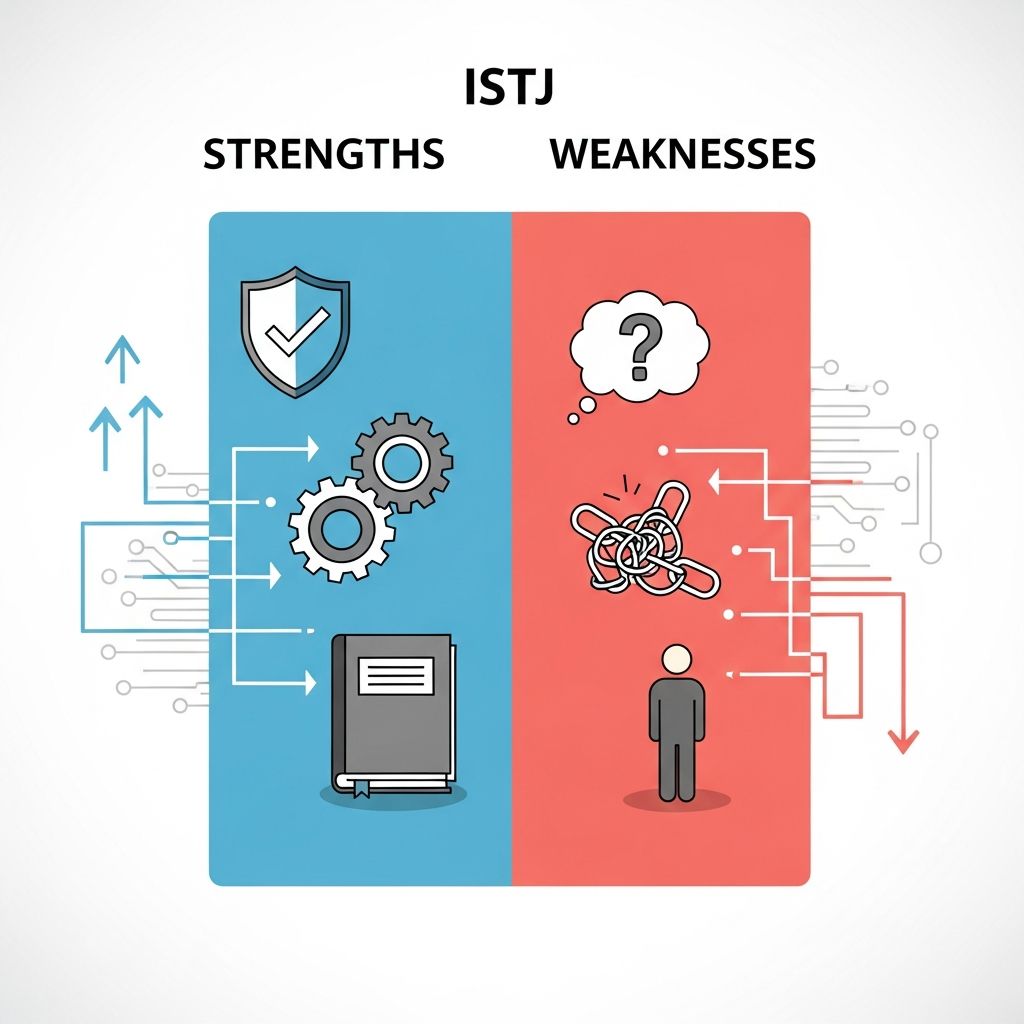
The ISTJ personality type, often called the Logistician, is known for reliability, structure, and a grounded sense of responsibility. These qualities can make ISTJs indispensable at work and deeply steady in relationships—but they can also create blind spots, especially around flexibility and emotions.
This guide explores the core strengths and weaknesses of ISTJs, how these traits show up in everyday life, and what ISTJs (and the people around them) can do to balance their natural tendencies in healthy ways.
Who Are ISTJs? A Brief Overview
ISTJ stands for Introversion, Sensing, Thinking, Judging, one of the 16 personality types described by the Myers–Briggs Type Indicator (MBTI). The official MBTI framework describes ISTJs as practical, responsible, and detail-focused people who prefer structure and predictability.
- Introversion: Recharge through solitude and quiet reflection.
- Sensing: Focus on concrete facts and present realities over abstract theories.
- Thinking: Make decisions using logic and objective criteria.
- Judging: Prefer order, planning, and closure rather than open-ended ambiguity.
From a cognitive-function perspective, ISTJs rely heavily on Introverted Sensing (Si) to store and compare detailed past experiences, and Extraverted Thinking (Te) to organize the outside world logically and efficiently.
Core ISTJ Strengths
ISTJs bring a distinctive set of strengths that are highly valued in families, workplaces, and communities. Below are some of their most notable advantages.
1. Rock-Solid Reliability and Duty
ISTJs are often perceived as the people who show up, follow through, and keep promises. Once they commit, they feel a strong inner obligation to finish what they started, especially when others are counting on them.
- Take deadlines and agreements very seriously.
- Prefer clear expectations and are uncomfortable with leaving things “up in the air.”
- Often become the informal “backbone” of teams, families, or organizations.
This sense of duty is closely related to their Si–Te combination: they remember what has been promised and use structured planning to deliver on it.
2. Precision, Structure, and Attention to Detail
ISTJs tend to notice inconsistencies, missing steps, and factual errors that others overlook. They enjoy well-defined systems and are often drawn to tasks that require accuracy and thoroughness.
- Excel at maintaining procedures, records, and routines.
- Spot factual mistakes quickly in documents, schedules, or processes.
- Prefer step-by-step methods, checklists, and documented instructions.
In structured environments—such as regulated industries, public service, logistics, or finance—this meticulous approach is a major asset.
3. Practical, Fact-Based Problem Solving
When faced with a challenge, ISTJs instinctively ask: What are the facts? What has worked before? Their decisions are grounded in evidence and prior experience rather than speculation or group sentiment.
- Use concrete data and past examples to evaluate options.
- Prefer proven methods over untested innovations.
- Stay calm and methodical in crises, focusing on what can be done right now.
This level-headed realism helps create stability during uncertainty, especially when others feel overwhelmed or disorganized.
4. Integrity and Consistency
ISTJs typically have a clear internal standard of what is right and responsible, and they work hard to live up to it. Official MBTI descriptions highlight their honesty, conscientiousness, and realistic outlook.
- Value fairness and objectivity in decision-making.
- Dislike cutting corners or bending rules for convenience.
- Prefer to be straightforward rather than persuasive or performative.
Others may not always agree with their conclusions, but they rarely doubt that an ISTJ is being sincere.
5. Steadiness in Relationships
In close relationships, ISTJs often express care through actions more than words: fixing problems, providing financial or practical support, and ensuring that plans are realistic and sustainable.
- Show loyalty through long-term commitment and consistent behavior.
- Prefer stability over dramatic emotional highs and lows.
- Often create a sense of safety by handling logistics and responsibilities.
For partners and friends who appreciate reliability and follow-through, this can feel deeply reassuring.
Key ISTJ Weaknesses and Blind Spots
The same traits that make ISTJs dependable can also create recurring challenges. Recognizing these patterns is the first step toward growth.
1. Rigidity and Resistance to Change
Because ISTJs trust what has already proven to work, they can be skeptical of new approaches—even when change is necessary or beneficial.
- May cling to existing rules or routines long after circumstances have shifted.
- Can interpret new ideas as unnecessary risks rather than potential improvements.
- Might label unconventional methods as “wrong” rather than simply different.
Under pressure, this can escalate into stubbornness, making it hard for teams or families to adapt quickly when conditions change.
2. Difficulty Expressing and Reading Emotions
Research and clinical descriptions note that ISTJs often keep their emotions highly private and may struggle to articulate feelings in the moment.
- Prefer solving problems practically instead of talking about feelings.
- Can overlook or minimize others’ emotional cues if they don’t see a concrete problem to fix.
- May appear detached, even when they care deeply inside.
This can leave more emotionally expressive people feeling unseen or dismissed, especially during conflict or stress.
3. Blunt Communication and Perceived Insensitivity
ISTJs tend to prioritize accuracy and clarity over tact. Their Extraverted Thinking style favors direct, fact-based statements that may unintentionally hurt more sensitive listeners.
- May critique work or decisions without softening the delivery.
- Can struggle to understand why “just being honest” is upsetting to others.
- Might appear judgmental when they call out inconsistencies or illogical behavior.
Over time, this communication style can create distance if people begin to associate the ISTJ’s honesty with personal criticism.
4. Overemphasis on Rules and Traditions
While structure can be healthy, ISTJs may place so much value on established systems that they overlook individual needs or special circumstances.
- May insist on doing things “the right way” even when flexibility would help.
- Can struggle in highly unstructured or rapidly changing environments.
- Risk prioritizing procedure over people, especially under stress.
This rule-focused mindset can be especially challenging in roles that demand improvisation, rapid innovation, or constant pivoting.
5. Tendency to Shoulder Too Much Responsibility
Because ISTJs take commitments seriously, they may hesitate to delegate or ask for help, even when they are overloaded.
- May quietly work long hours rather than risk letting anyone down.
- Can become resentful if others do not match their standard of reliability.
- Risk burnout when they feel solely responsible for maintaining order.
This pattern can make ISTJs highly productive in the short term but exhausted and disengaged over the long term if it goes unrecognized.
ISTJ Strengths vs. Weaknesses at a Glance
| ISTJ Trait | When It Helps | When It Hurts |
|---|---|---|
| Reliability | Builds trust; others know they can depend on follow-through. | Leads to overcommitment and reluctance to say no. |
| Attention to detail | Prevents errors and creates high-quality, thorough work. | Can cause perfectionism or getting stuck in minor issues. |
| Rule orientation | Supports fairness, consistency, and safety in systems. | Becomes inflexibility when rules no longer fit reality. |
| Emotional reserve | Helps them stay calm and objective in stressful situations. | Makes them hard to read; others may feel emotionally distant. |
| Direct honesty | Clarifies expectations and avoids confusion or hidden agendas. | Can be perceived as criticism or lack of empathy. |
Growth Tips for ISTJs
ISTJs do not need to become different people to grow. Instead, development involves balancing their strongest tendencies with complementary skills.
1. Experiment with Small, Low-Risk Changes
To soften rigidity, ISTJs can practice flexibility in areas where the stakes are low.
- Try a new method for a routine task and compare outcomes.
- Invite a trusted colleague or partner to suggest a different approach.
- Use language like “Let’s test this” instead of “That won’t work.”
This keeps their respect for evidence intact while opening the door to innovation.
2. Name Feelings, Even Briefly
ISTJs rarely enjoy long emotional conversations, but simply pausing to name feelings can dramatically improve communication.
- Use short statements such as “I’m frustrated,” “I’m worried,” or “I’m tired.”
- Ask others, “How are you feeling about this?” before giving advice.
- Practice active listening: reflect back what you heard before offering solutions.
Over time, this builds emotional literacy without abandoning their natural problem-solving style.
3. Add Tact to Honesty
ISTJs do not need to become less honest, only more strategic about how they share truths.
- Lead with what is working before describing what needs improvement.
- Replace “This is wrong” with “Here’s a concern I see and a way to fix it.”
- Pause and consider: “If I heard this in my worst mood, how would it land?”
This preserves clarity while protecting relationships from unnecessary friction.
4. Practice Delegation and Boundaries
To counter burnout, ISTJs benefit from consciously sharing workloads and setting realistic limits.
- List tasks that truly require your expertise versus those that could be delegated.
- Communicate capacity clearly: “I can commit to X by Friday; beyond that, I’ll need help.”
- Remind yourself that saying no to one request can protect more important obligations.
This allows ISTJs to maintain high standards without sacrificing their own health and well-being.
How Others Can Support ISTJs
Partners, friends, and colleagues can dramatically improve collaboration with ISTJs by understanding their core motivations.
- Be clear and concrete. Give specific expectations, deadlines, and definitions of success.
- Respect their time and commitments. Last-minute changes should be the exception, not the rule.
- Appreciate their contributions. Acknowledging reliability and thoroughness goes a long way.
- Share data, not just ideas. Provide examples, evidence, or past results when proposing changes.
- Create safe spaces for disagreement. Emphasize that questioning a plan is not a personal attack.
When ISTJs feel that their effort and structure are valued—not taken for granted—they are often more open to compromise and experimentation.
Frequently Asked Questions About ISTJ Strengths and Weaknesses
Q: Are ISTJs always serious and unemotional?
ISTJs often appear serious because they focus on responsibilities and avoid unnecessary drama, but that does not mean they lack emotions. Research on ISTJs indicates that they experience deep feelings and a strong internal value system; they simply tend to keep those feelings private and may struggle to express them outwardly.
Q: Why do ISTJs dislike sudden changes so much?
ISTJs rely heavily on past experience and established routines to navigate life, so abrupt changes can feel like stepping into chaos without a safety net. Their preference for structure and predictability means they do best when they have time to prepare, plan, and gradually adjust to new circumstances.
Q: Can ISTJs be creative, or are they only good at routines?
ISTJs can be creative, but their creativity often takes a practical form—such as improving systems, optimizing workflows, or finding efficient ways to apply known techniques. They may not gravitate toward abstract brainstorming, yet they excel at refining ideas into workable, sustainable processes.
Q: What careers best use ISTJ strengths?
Official MBTI resources highlight that ISTJs thrive in roles requiring reliability, analytical thinking, and organization—such as accounting, law, engineering, logistics, public administration, and many technical or supervisory positions. These environments reward their attention to detail, respect for rules, and commitment to quality.
Q: How can an ISTJ work on being less judgmental?
ISTJs can soften judgment by intentionally separating facts from interpretations. Asking questions (“What led you to that decision?”), considering context, and recognizing that values differ across people and cultures can help. This preserves their respect for evidence while reducing the tendency to label others as simply right or wrong.
References
- ISTJ Personality (Logistician) — Simply Psychology. 2023-05-10. https://www.simplypsychology.org/istj-personality.html
- 10 Characteristics of the Logistician Personality Type (ISTJ) — Calm. 2023-08-01. https://www.calm.com/blog/istj
- ISTJ: MBTI Personality Profile — The Myers-Briggs Company. 2022-11-15. https://eu.themyersbriggs.com/en/tools/MBTI/MBTI-personality-Types/ISTJ
- ISTJ Personality Type: In-Depth Profile & Analysis — Personality Junkie. 2021-04-20. https://personalityjunkie.com/istj/
- ISTJ Personality (Logistician) — 16Personalities. 2023-04-30. https://www.16personalities.com/istj-personality

- Integrated M.A. in Applied Linguistics, University of Hyderabad
- 5+ years in editorial, instructional, SEO, and research-based writing
Sneha is a relationships and lifestyle writer with a strong foundation in applied linguistics and certified training in relationship coaching. She brings over five years of writing experience to theskillvault, crafting thoughtful, research-driven content that empowers readers to build healthier relationships, boost emotional well-being, and embrace holistic living. Her writing and insights reflect the belief that beauty, happiness, and wellness…