
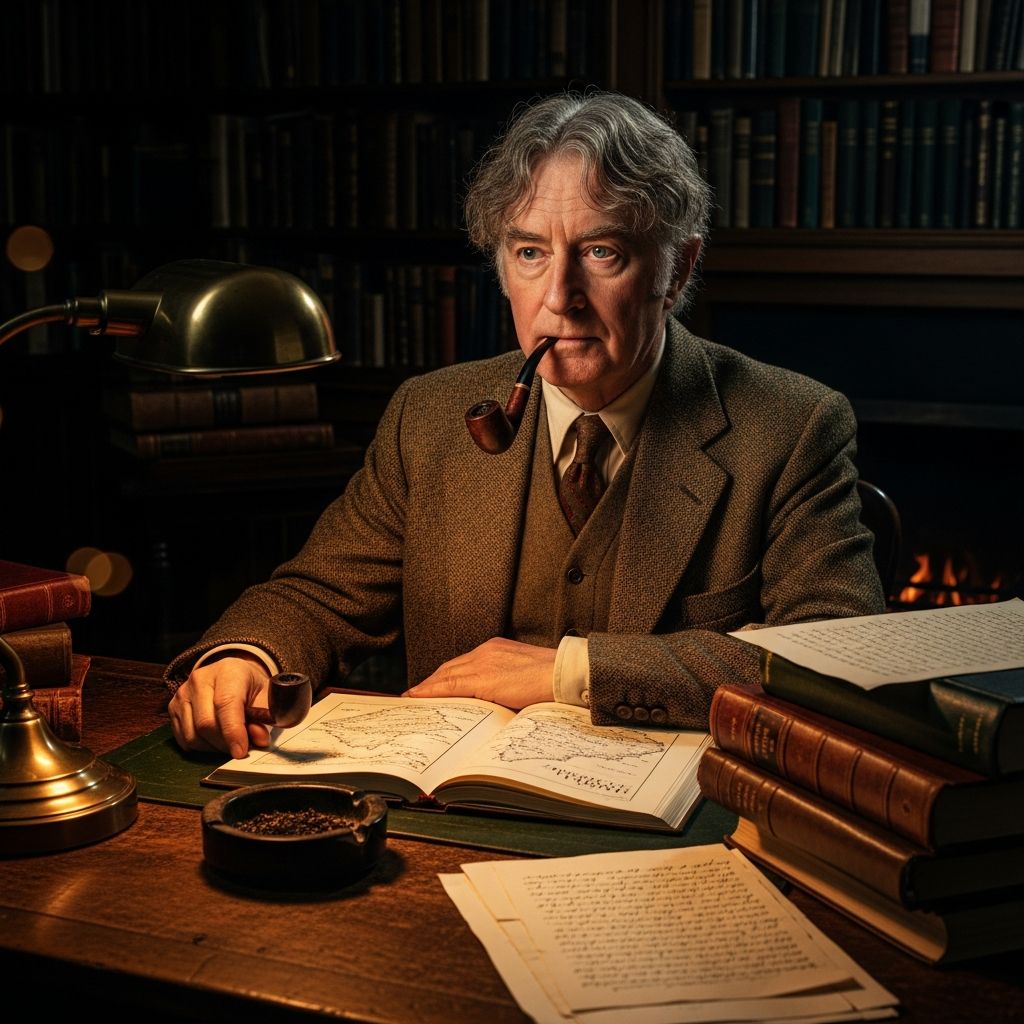
J.R.R. Tolkien is best known as the author who gave the world The Hobbit and The Lord of the Rings, yet behind the sprawling maps and invented languages stood a quiet, intensely private man with a rich inner life. Understanding his personality offers a deeper window into why Middle-earth feels so real, why its themes resonate so strongly, and how one scholar’s imagination reshaped modern fantasy.
From Quiet Scholar to Architect of a Mythic World
Tolkien was born in 1892 in Bloemfontein, South Africa, and raised in England after his father’s death. Early loss, financial struggle, and a strong attachment to his mother’s faith and storytelling all helped form a temperament that leaned toward introspection, loyalty, and tradition.
Over time, several defining features of his character became evident:
- Deep inward focus: He preferred the world of languages, myths, and private notes to the spotlight of public fame.
- Attachment to history and continuity: As a philologist and professor of Anglo-Saxon at Oxford, he devoted his career to old languages and texts, valuing what was ancient, subtle, and easily forgotten.
- Stubborn idealism: He held strong views about beauty, morality, and art, and he pursued them with little regard for literary fashion.
- Quiet discipline: Decades of patient world-building, note-taking, and revision reveal a personality comfortable with long, solitary effort.
These traits did not merely influence Tolkien; they permeated the very structure and spirit of Middle-earth.
Personality Patterns Reflected in Tolkien’s Life
Modern personality frameworks (like the MBTI or similar models) were developed long after the periods Tolkien studied, but they can still be used today as interpretive tools. Without forcing him into a strict label, we can observe recurring patterns in his behavior, preferences, and work habits.
Introversion and the Love of Solitude
Tolkien spent most of his professional life in libraries, classrooms, and at his writing desk, rather than in public lectures or interviews. Even at Oxford, he preferred small, familiar circles—family, select colleagues, and close friends in the Inklings—to broader social fame.
- He bicycled to work, kept to a regular routine, and described himself half-jokingly as a “hobbit” who liked simple comforts, books, and the familiar.
- He poured his most passionate energies into private projects: linguistic notes, invented histories, and intricate family trees for fictional peoples.
This inward orientation is mirrored in characters like Frodo and Faramir—individuals who do not seek glory but accept it when duty calls.
Intuition and Pattern-Seeking
As a philologist, Tolkien was fascinated by how words carry the traces of forgotten cultures and stories. This naturally intuitive way of thinking—seeing possibilities and patterns beneath the surface—is visible everywhere in his legendarium.
- He often began with a name or phrase that “felt right” and then spent years uncovering the history that made it meaningful.
- He used linguistic evolution as a scaffold for myth: if two Elvish dialects diverged, there had to be a story—migration, exile, or tragedy—to explain why.
Rather than plotting from the outside in, Tolkien seemed to grow Middle-earth from seeds of language, sound, and half-remembered northern myths.
Thinking, Values, and Rigorous Consistency
Tolkien combined a strong sense of logic with equally strong moral convictions. His academic work demanded painstaking precision, and he applied the same standards to his fictional world.
- He halted work on The Lord of the Rings repeatedly to resolve linguistic inconsistencies or historical gaps, sometimes for months at a time.
- He created genealogies, calendars, and phonetic rules not because readers demanded them, but because his own internal logic required it.
This balance of head and heart—reason applied in service of deeply held values—helps explain why Middle-earth feels morally coherent without becoming didactic or simplistic.
Judging, Structure, and Long-Term Vision
Tolkien’s correspondence reveals a man who carefully planned long arcs of history, even when he struggled to finish specific manuscripts. He was not casual about his creations; he was methodical.
| Aspect | Tolkien’s Tendency | Reflected in Middle-earth |
|---|---|---|
| Time horizon | Thinks in decades and centuries | Detailed Ages, chronologies, and timelines |
| Work style | Slow, iterative, revision-heavy | Multiple drafts and versions of key stories |
| Commitment | Returns to the same project for life | Continuous refinement of the legendarium |
This structured mindset made it possible for Tolkien to sustain an interconnected world-spanning legend over more than half a century.
How Life Experiences Shaped His Inner World
Personality does not develop in a vacuum. Tolkien’s traits were tested, deepened, and sometimes wounded by events such as war, grief, and professional life.
War, Loss, and the Shadow Over Middle-earth
Tolkien served as an officer in the British Army during World War I and fought in the Battle of the Somme, where many of his closest friends were killed. He later described that by 1918, “all but one” of his intimate school friends were dead.
These experiences left clear traces in his fiction:
- The sense of irreparable loss: The fading of the Elves, the breaking of the Fellowship, and the scouring of the Shire echo a world that cannot simply return to innocence.
- Trauma without graphic detail: Battles in The Lord of the Rings are often described from the perspective of ordinary soldiers who feel fear, exhaustion, and grief, rather than from a detached military vantage point.
- Stubborn hope: Despite the darkness, Tolkien repeatedly affirms that courage, loyalty, and small kindnesses still matter, even when victory seems impossible.
This combination of realism about suffering and commitment to hope reflects a personality forged in hardship but resistant to despair.
Academic Roots and the Craft of World-Building
Tolkien’s academic career was central to his creative identity. He worked briefly as a lexicographer on the Oxford English Dictionary and later became a professor first at Leeds and then at Oxford, focusing on Old and Middle English, Anglo-Saxon, and Germanic literature.
His scholarship shaped his creative practice in several ways:
- Respect for old stories: His deep engagement with epics like Beowulf convinced him that myth carries truths that cannot be reduced to mere allegory or propaganda.
- Linguistic world-building: He treated Elvish and other tongues as real languages—with internal grammar, sound changes, and ancestral forms.
- Historical layering: Middle-earth has ruins, legends, and songs about older ages, mimicking how real cultures remember their own past.
This blend of scholar and storyteller required a rare personality: one that could enjoy both the minute detail of a dictionary entry and the grandeur of an invented age.
Friendship, Feedback, and the Inklings
Although deeply introverted, Tolkien found crucial encouragement in a small group of literary friends at Oxford known as the Inklings, which included C.S. Lewis and other writers.
- Safe space for reading aloud: He first shared substantial portions of The Lord of the Rings in these informal meetings, reading drafts to trusted companions.
- Challenge and affirmation: Lewis’s enthusiastic support pushed Tolkien to continue during periods of discouragement, while other Inklings offered critiques.
This pattern fits a personality that values depth over breadth in relationships: a few meaningful, enduring friendships rather than wide social networks.
Middle-earth as a Mirror of Its Maker
Tolkien denied that his work was a simple allegory for his own life, yet his personality and experiences are woven into the fabric of Middle-earth.
Characters as Facets of Tolkien’s Inner Landscape
Rather than being direct self-portraits, many characters seem to express different aspects of Tolkien’s temperament and outlook.
- Hobbits: Their love of home, gardening, and simple pleasures reflects Tolkien’s affection for the English countryside and domestic comfort.
- Gandalf: The wise guide who nudges others toward courage resembles a dedicated teacher—patient, sometimes stern, but deeply invested in his pupils’ moral growth.
- Faramir: His rejection of power for its own sake, preference for lore and contemplation, and quiet nobility come close to Tolkien’s own stated ideals.
- Treebeard and the Ents: Their anger at wanton destruction of trees echoes Tolkien’s lifelong love of forests and dislike of industrial blight.
Themes Aligned With His Values
Across his fiction, several recurring themes align closely with what we know of Tolkien’s personal convictions and temperament:
- Humility over heroics: Salvation of Middle-earth depends on small, seemingly insignificant people rather than on obvious champions.
- Limits of power: The Ring corrupts not only villains but well-meaning characters, reflecting a wary attitude toward domination and control.
- Long defeat and eucatastrophe: Tolkien often spoke of history as a “long defeat” occasionally interrupted by sudden grace—a pattern that blends realism with transcendent hope.
- Restoration, not escape: Even when characters return home, the home itself has changed, and they must work to heal and rebuild it.
Why Tolkien’s Personality Still Matters Today
Middle-earth continues to captivate readers, scholars, and filmmakers decades after Tolkien’s death in 1973. Understanding the personality behind these works can enrich how we read them and inspire our own creative or scholarly efforts.
Lessons for Creators and Thinkers
Tolkien’s life offers several practical lessons for modern readers:
- Depth takes time: A coherent world can emerge from many small, patient acts of creation—notes, sketches, and experiments that may not seem impressive at first.
- Honor your obsessions: Tolkien’s fascination with obscure languages and old poetry seemed narrow to some contemporaries, yet it became the foundation of a cultural phenomenon.
- Small circles, big impact: A few supportive friends who understand your vision can be more important than broad public approval.
- Integrate pain into meaning: Tolkien did not erase his wartime trauma; he transmuted it into a story-world that acknowledges sorrow while insisting on hope.
Reading Middle-earth Through a Personality Lens
Approaching Tolkien’s work with his personality in mind can reveal new dimensions:
- You may notice how the text lingers on languages, place names, and histories as expressions of his philological passions.
- You may read the bittersweet endings not as pessimism, but as the response of someone who had seen real devastation and still believed in meaning.
- You may recognize in the Shire a love letter to a pre-industrial England that Tolkien felt was vanishing in his own lifetime.
This does not reduce Middle-earth to autobiography; instead, it highlights how one personality, deeply engaged with both scholarship and imagination, can create a world spacious enough for millions of readers to inhabit.
Frequently Asked Questions (FAQs)
Q: Did Tolkien fit a modern personality type like MBTI?
Many readers speculate that Tolkien might resemble an intuitive, introverted, and structured type (such as an INTJ or INFJ in MBTI terms) because of his long-term vision, private inner life, and systematic world-building. However, these frameworks were not designed from his own context, and any specific label is only a modern approximation, not a definitive diagnosis.
Q: How did Tolkien’s experiences in World War I affect his stories?
His wartime service at the Somme, where many of his closest friends were killed, left a deep mark on him. This is visible in the pervasive sense of loss, the depiction of exhausted soldiers, and the awareness that even victory comes at a great cost. Yet he also emphasizes loyalty, endurance, and hope, suggesting that human virtues still matter amid devastation.
Q: Why was Tolkien so focused on language?
Tolkien was a professional philologist—a scholar of languages and their histories—who worked on the Oxford English Dictionary and taught Old and Middle English at Leeds and Oxford. For him, language was not just a tool but a living archive of culture and memory. Inventing Elvish and other tongues was his way of giving life to imagined cultures that felt as rich and layered as real ones.
Q: Was Tolkien a reclusive person?
He was private and often shy in large groups, but not a hermit. He maintained close family ties, participated in academic life, and met regularly with the Inklings. His personality leaned toward quiet routines and intimate circles rather than public celebrity.
Q: How can understanding Tolkien’s personality improve my reading of The Lord of the Rings?
Knowing more about his inner life and values can help you recognize why he pays such attention to languages, place, and history; why themes of loss and hope recur; and why seemingly small choices—like hospitality, pity, or keeping a promise—carry so much weight. It encourages you to read not only for plot, but for the worldview and temperament that shaped the story.
References
- J.R.R. Tolkien Biography — TolkienLibrary.com. (n.d.). https://tolkienlibrary.com/abouttolkien.php
- Five Seriously Excellent Books about J.R.R. Tolkien — Alexander T. Kirk. 2019-05-30. https://www.alexandertkirk.com/five-books-about-tolkien
- J.R.R. Tolkien: A Biography — Rainbow Resource Center (publisher information page). (n.d.). https://www.rainbowresource.com/013270.html
- J.R.R. Tolkien: A Biography — Whistlestop Bookshop (publisher information page). (n.d.). https://www.whistlestoppers.com/tolkien/jrr-tolkien-a-biography

Medha Deb is an editor with a master's degree in Applied Linguistics from the University of Hyderabad. She believes that her qualification has helped her develop a deep understanding of language and its application in various contexts. Medha specializes in the areas of beauty, health, sports, and wellness and is committed to ensuring that the content on the website is…