
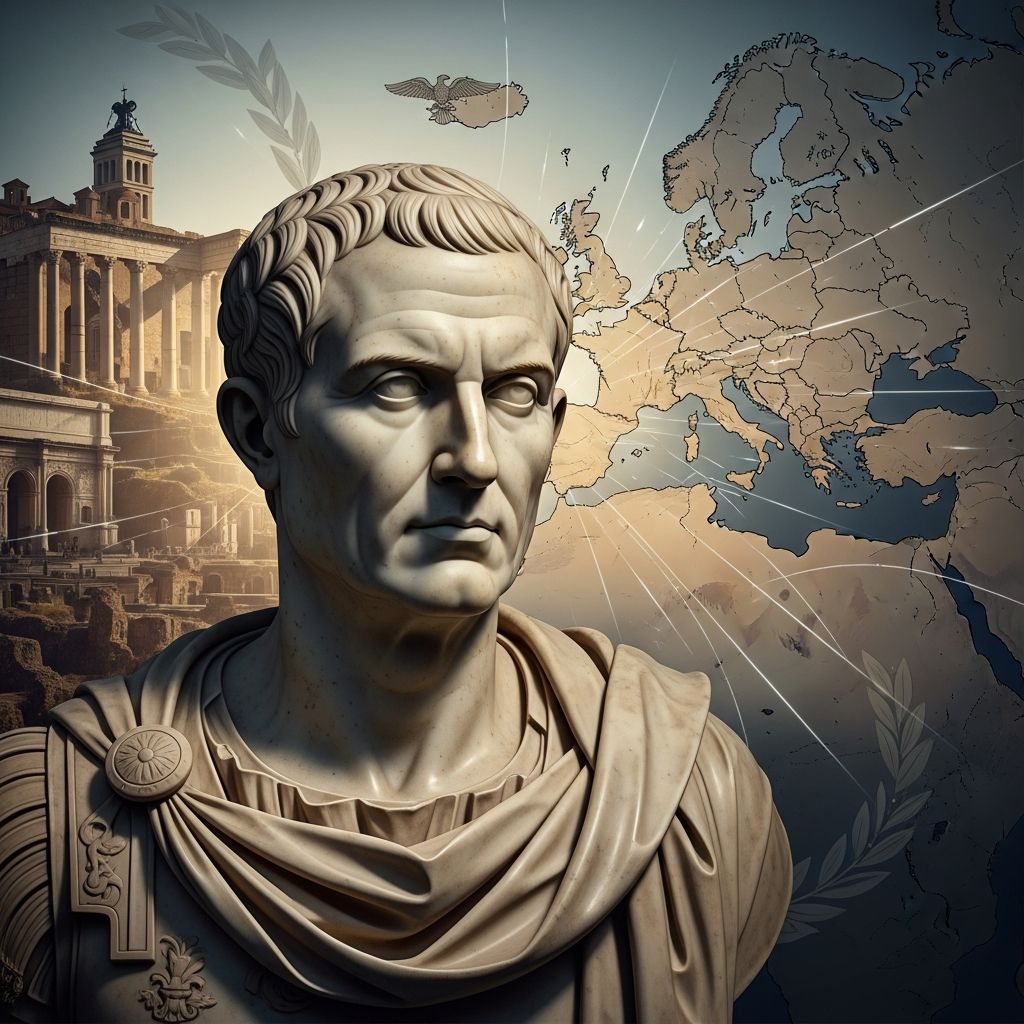
Gaius Julius Caesar stands as one of history’s most pivotal figures, whose military prowess, political acumen, and sweeping reforms fundamentally altered the trajectory of Rome from republic to empire. His actions expanded Rome’s borders, stabilized its economy, and centralized power, influencing governance for centuries.
Early Life and Rise Through the Ranks
Born into the patrician Julian family around 100 BCE, Caesar navigated a turbulent political landscape marked by civil strife following Sulla’s dictatorship. He began his career in military service under Marcus Minucius Thermus in Asia, earning the Civic Crown for bravery during the siege of Mytilene on Lesbos. This early valor set the stage for his ascent.
Returning to Rome after Sulla’s death in 78 BCE, Caesar honed his skills as an orator and pursued public office. His tenure as propraetor in Hispania Further demonstrated his leadership; he quelled local tribal conflicts, securing troop loyalty and honors upon his return. These experiences built the foundation for his political alliances.
Forming the First Triumvirate: A Power Alliance
By 60 BCE, Caesar forged the First Triumvirate with Pompey the Great and Marcus Licinius Crassus, an informal pact that dominated Roman politics. As consul in 59 BCE, Caesar pushed populares measures like land redistribution for the poor, backed financially by Crassus and militarily by Pompey. He married his daughter Julia to Pompey and wed Calpurnia, daughter of a key senator, solidifying ties.
This alliance shielded Caesar from optimates prosecution and allowed him to secure the governorship of Cisalpine Gaul, Transalpine Gaul, and Illyricum. It marked his shift from politician to conqueror, providing the resources needed for grand campaigns.
Conquest of Gaul: Forging an Empire’s Frontier
Caesar’s governorship ignited the Gallic Wars (58-50 BCE), a series of campaigns that annexed vast territories encompassing modern France, Belgium, parts of Switzerland, and beyond. Prompted by the Helvetii migration and pleas from the Aedui tribe, Caesar decisively defeated the Helvetii at the Battle of Bibracte in 58 BCE.
Subsequent victories included crushing the Belgae in 57 BCE and Aquitani in 56 BCE. In 55 BCE, he bridged the Rhine River—the first Roman to do so—demonstrating engineering supremacy and intimidating Germanic tribes. He also launched initial incursions into Britain, probing its shores.
The climax came at the Battle of Alesia in 52 BCE, where Caesar besieged Vercingetorix’s massive Gallic coalition. Building double fortifications, he repelled reinforcements while starving the defenders, capturing Vercingetorix and ending organized resistance. These wars not only enriched Rome with slaves and booty but elevated Caesar’s prestige and loyal legions.
Caesar chronicled these exploits in Commentarii de Bello Gallico, a propaganda masterpiece that justified his actions and burnished his image.
The Rubicon and the Civil War: Defying the Senate
With Gaul secured, tensions escalated. The Senate, aligned with Pompey, demanded Caesar disband his army and return as a private citizen. On January 10, 49 BCE, Caesar crossed the Rubicon River with his Thirteenth Legion, uttering “Alea iacta est” (the die is cast), sparking civil war.
- Battle of Pharsalus (48 BCE): Outnumbered 2:1, Caesar’s tactical genius routed Pompey’s larger force in Greece, forcing his flight to Egypt.
- Battle of Zela (47 BCE): Caesar swiftly defeated Pharnaces II of Pontus, famously declaring “Veni, vidi, vici”.
- Battle of Thapsus (46 BCE): In North Africa, he crushed Pompeian remnants led by Cato.
- Battle of Munda (45 BCE): The final clash against Pompey’s sons in Spain secured his dominance.
These victories dismantled republican opposition, positioning Caesar as Rome’s unchallenged leader.
Dictatorial Reforms: Reshaping Roman Society
Appointed dictator in 49 BCE and dictator perpetuo in 44 BCE, Caesar enacted transformative policies. He introduced the Julian calendar, aligning 365.25 days with the solar year, replacing the erratic lunisolar system—a framework enduring until 1582.
| Reform Area | Key Changes | Impact |
|---|---|---|
| Economy | Debt relief, currency stabilization, reduced grain dole | Prevented bankruptcy, curbed inflation |
| Administration | Enlarged Senate to 900 members, standardized taxes, reorganized provinces | Reduced corruption, integrated territories |
| Social | Extended citizenship to Cisalpine Gaul, land for veterans/poor, new colonies | Promoted unity, rewarded loyalty |
| Infrastructure | Public works, drained marshes, improved forums | Boosted employment, urban renewal |
These measures favored the populares, curbed senatorial luxury, and fostered stability, though they alienated traditionalists.
Foreign Alliances and Cleopatra: Expanding Influence
Pursuing Pompey to Egypt in 48 BCE, Caesar allied with Cleopatra VII, installing her as ruler after defeating her brother Ptolemy XIII. This liaison produced Caesarion, strengthening Roman ties to Egypt’s grain wealth. Later campaigns in Pontus and Africa further secured eastern frontiers.
The Ides of March: Betrayal and Assassination
Caesar’s consolidation of power bred fear among senators. On March 15, 44 BCE (Ides of March), a conspiracy led by Marcus Junius Brutus and Gaius Cassius Longinus stabbed him 23 times in the Senate, crying “Sic semper tyrannis”. His will named Octavian (Augustus) heir, sparking further chaos.
Lasting Legacy: From Republic to Empire
Caesar’s death paradoxically fulfilled his vision. Octavian avenged him, defeated the assassins at Philippi (42 BCE), and established the Principate. The Empire endured 400+ years, adopting Caesar’s calendar, administrative models, and imperial precedents.
His name became synonymous with emperor (Kaiser, Tsar), and his writings influenced military strategy. Yet, his ambition ended the Republic, symbolizing the perils of unchecked power.
Frequently Asked Questions (FAQs)
What were Julius Caesar’s major military achievements?
Caesar’s triumphs include conquering Gaul (58-50 BCE), victories at Alesia, Pharsalus, and Thapsus, and incursions into Britain and across the Rhine.
How did Caesar reform the Roman calendar?
He replaced the 355-day lunisolar calendar with the 365.25-day Julian calendar, adding leap years for solar accuracy.
Why was Caesar assassinated?
Senators viewed his dictatorship and reforms as threats to republican liberty, fearing monarchy.
What was the First Triumvirate?
An alliance of Caesar, Pompey, and Crassus that controlled Rome from 60-53 BCE through mutual support.
How did Caesar’s actions lead to the Roman Empire?
His centralization and heir Octavian enabled the transition from Republic to imperial rule under Augustus.
References
- Julius Caesar Achievements, Failures & Quotes — Apollo Scholars. 2025-10-19. https://apolloscholars.co.uk/2025/10/19/julius-caesar-achievements-failures-quotes/
- Julius Caesar: The Life and Legacy of Rome’s Greatest Leader — History is Now Magazine. 2025-01-15. http://www.historyisnowmagazine.com/blog/2025/1/15/julius-caesar-the-life-and-legacy-of-romes-greatest-leader
- Julius Caesar’s Greatest Achievements — The Collector. N/A. https://www.thecollector.com/julius-caesar-achievements/
- Julius Caesar Biography — Encyclopædia Britannica. 2026 (updated). https://www.britannica.com/biography/Julius-Caesar-Roman-ruler
- Julius Caesar — Wikipedia (references primary sources). N/A. https://en.wikipedia.org/wiki/Julius_Caesar
- The Life and Achievements of Gaius Julius Caesar — UNRV Roman History. N/A. https://www.unrv.com/julius-caesar/index.php

- Integrated M.A. in Applied Linguistics, University of Hyderabad
- 5+ years in editorial, instructional, SEO, and research-based writing
Sneha is a relationships and lifestyle writer with a strong foundation in applied linguistics and certified training in relationship coaching. She brings over five years of writing experience to theskillvault, crafting thoughtful, research-driven content that empowers readers to build healthier relationships, boost emotional well-being, and embrace holistic living. Her writing and insights reflect the belief that beauty, happiness, and wellness…