
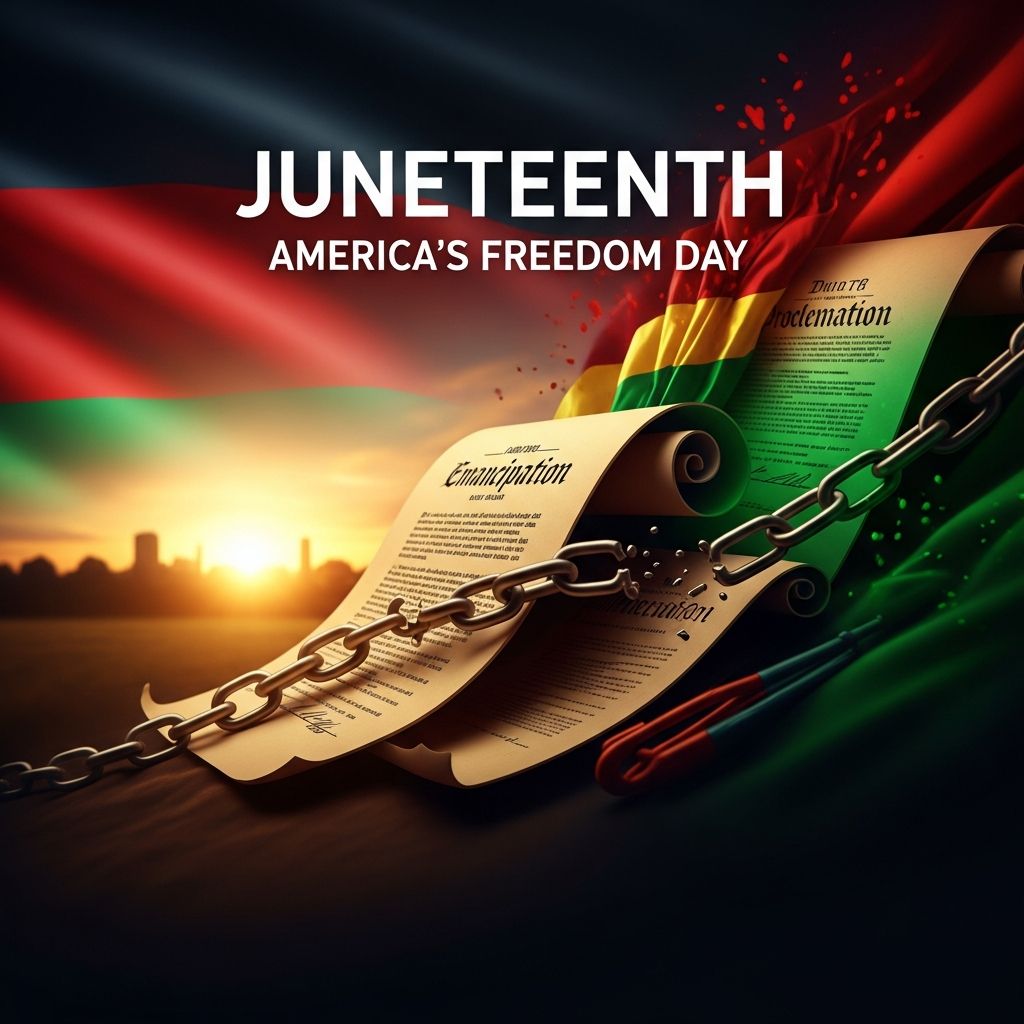
Juneteenth, observed every June 19, commemorates the effective end of slavery in the United States, specifically the moment when Union forces enforced emancipation in Texas.This federal holiday honors the resilience of African Americans and reflects on the nation’s journey toward true liberty.
Historical Background: Slavery’s End in a Divided Nation
The American Civil War (1861-1865) was fundamentally about preserving the Union and abolishing slavery. President Abraham Lincoln’s Emancipation Proclamation, issued on January 1, 1863, declared freedom for enslaved people in Confederate states, but enforcement depended on Union military advances.
Texas, the most remote Confederate state, remained a refuge for slavery longest. Enslaved people there continued laboring under brutal conditions even as the war ended with Confederate surrender at Appomattox in April 1865. Freedom’s arrival was delayed by geography, resistance from enslavers, and slow communication.
- Texas had over 250,000 enslaved individuals by 1865, the highest number in the Confederacy at war’s end.
- News of emancipation traveled unevenly; some areas heard it sooner, but Galveston lagged behind.
- The Emancipation Proclamation did not immediately free all; it applied only to rebel-held territories, excluding border states.
The Pivotal Day: June 19, 1865
On June 19, 1865, Major General Gordon Granger and about 2,000 Union troops landed in Galveston Bay, Texas. Granger issued General Order No. 3, proclaiming: “The people of Texas are informed that, in accordance with a proclamation from the Executive of the United States, all slaves are free. This involves an absolute equality of personal rights and rights of property between former masters and slaves, and the connection heretofore existing between them becomes that between employer and hired labor.”
This announcement freed approximately 250,000 people, sparking immediate celebrations. Newly freed individuals gathered for prayers, feasts, and dances, embracing self-determination. The term “Juneteenth,” a blend of “June” and “nineteenth,” emerged soon after, first documented in the 1890s.
| Key Event | Date | Details |
|---|---|---|
| Emancipation Proclamation | January 1, 1863 | Freed enslaved in Confederate states; not enforced everywhere immediately. |
| Lee’s Surrender at Appomattox | April 9, 1865 | Effectively ended Civil War. |
| Union Arrival in Galveston | June 19, 1865 | General Order No. 3 announced freedom in Texas. |
Early Celebrations and Community Traditions
Juneteenth festivities began in 1866 in Texas, with church-centered events including sermons, spirituals, and communal meals featuring barbecued meats, red foods symbolizing resilience (like red velvet cake or hibiscus tea), and games. Freed people traveled to Galveston annually, often wearing new clothes to signify rebirth.
These gatherings fostered racial pride and education. Families shared stories of bondage and liberation, teaching younger generations about perseverance. As African Americans migrated during the Great Migration (1910s-1970s), Juneteenth spread to cities like Milwaukee, Minneapolis, and Atlanta, evolving with local flavors.
- Symbolic Foods: Red drinks and dishes represent the blood shed for freedom and ancestral homelands.
- Music and Dance: Spirituals, blues, and ring shouts honored African roots.
- Educational Focus: Speakers emphasized voting rights and economic independence.
Challenges in the Post-Emancipation Era
Freedom was bittersweet. Many freed people faced sharecropping, debt peonage, and violence via Black Codes and later Jim Crow laws. The 13th Amendment (1865) abolished slavery nationwide, but enforcement was spotty. Lynching, segregation, and disenfranchisement persisted into the 20th century.
Juneteenth endured as resistance. During the Civil Rights Movement (1950s-1960s), activists wore “Juneteenth Freedom” buttons. The 1968 Poor People’s Campaign linked it to economic justice. Despite suppression—some states banned celebrations—the holiday symbolized ongoing struggle.
Path to National Recognition
Efforts to federalize Juneteenth gained momentum post-1960s. Texas made it a state holiday in 1980, the first of 49 states by 2021. Advocacy intensified after 2020’s racial justice protests following George Floyd’s murder.
On June 17, 2021, President Joe Biden signed the Juneteenth National Independence Day Act, making June 19 the 12th federal holiday. Opal Lee, known as the “Grandmother of Juneteenth,” championed this for decades.
Modern Observances and Cultural Impact
Today, Juneteenth features parades, festivals, readings of General Order No. 3, and reflections on systemic racism. Corporations, schools, and governments close, promoting education on Black history. It’s called America’s “second Independence Day,” contrasting July 4, when enslaved ancestors were excluded from “all men created equal.”
In 2026, celebrations emphasize voting rights, amid ongoing debates on equity. Events blend joy with activism, from block parties to panels on reparations.
Global Resonance and the Black Diaspora
Juneteenth transcends U.S. borders, resonating with the African Diaspora. It highlights the transatlantic slave trade’s legacy and liberation quests worldwide. International observances occur in Canada, the UK, and Caribbean nations.
Frequently Asked Questions (FAQs)
Why is Juneteenth celebrated on June 19?
June 19, 1865, marks when Union General Gordon Granger announced freedom to enslaved people in Texas, the last major holdout.
Is Juneteenth the official end of slavery?
No; the 13th Amendment (December 1865) did that. Juneteenth symbolizes practical enforcement in Texas.
How did Juneteenth become a federal holiday?
President Biden signed it into law on June 17, 2021, after decades of activism.
What do red foods mean in Juneteenth traditions?
They symbolize the African ancestral homeland, resilience, and blood sacrificed for freedom.
Does Juneteenth replace July 4th?
No; many view it as a complementary “Independence Day” for Black Americans.
Educational Resources and Ways to Participate
To honor Juneteenth:
- Read primary sources like General Order No. 3.
- Attend local festivals or virtual events.
- Support Black-owned businesses.
- Advocate for policies addressing racial inequities.
Schools incorporate it into curricula, fostering dialogue on history’s incomplete narratives.
References
- Juneteenth — National Museum of African American History and Culture (nmaahc.si.edu). Accessed 2026. https://nmaahc.si.edu/explore/moments/juneteenth
- Juneteenth: The complicated history, significance and celebration — University of South Florida St. Petersburg. 2023-06. https://www.stpetersburg.usf.edu/news/2023/juneteenth-complicated-history-significance-celebration-around-struggle-for-freedom.aspx
- Juneteenth — Wikipedia (for reference; primary sources cited). Ongoing. https://en.wikipedia.org/wiki/Juneteenth
- Juneteenth — Texas State Historical Association. Ongoing. https://www.tshaonline.org/handbook/entries/juneteenth
- A Brief History: The Significance of Juneteenth — Stanford Law School. 2022-06-15. https://law.stanford.edu/2022/06/15/a-brief-history-the-significance-of-juneteenth/
- The Historical Legacy of Juneteenth — National Museum of African American History and Culture. Ongoing. https://nmaahc.si.edu/explore/stories/historical-legacy-juneteenth
- Juneteenth: Its History, Celebration, and Significance — Emerson College. 2025-06-18. https://today.emerson.edu/2025/06/18/juneteenth-its-history-celebration-and-significance/

Medha Deb is an editor with a master's degree in Applied Linguistics from the University of Hyderabad. She believes that her qualification has helped her develop a deep understanding of language and its application in various contexts. Medha specializes in the areas of beauty, health, sports, and wellness and is committed to ensuring that the content on the website is…