
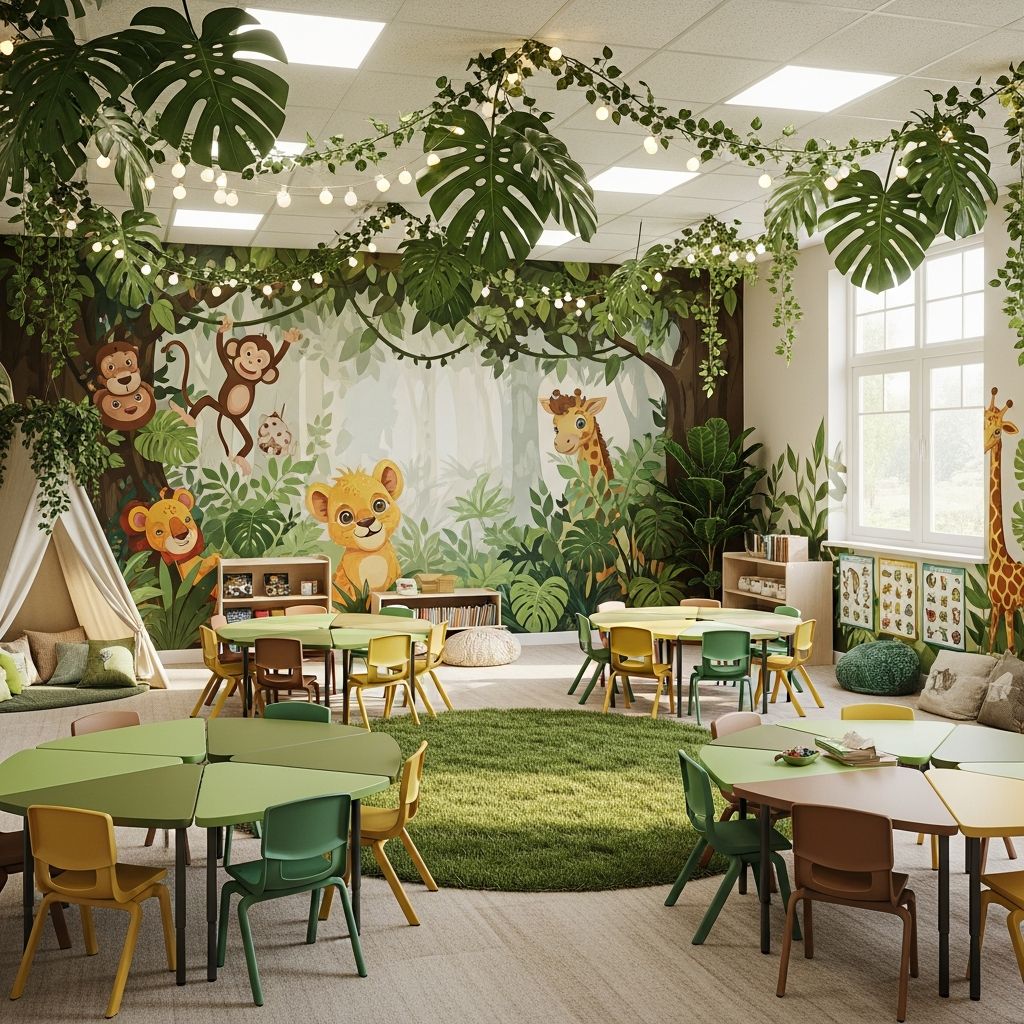
Transforming a standard classroom into an immersive jungle adventure captivates young minds, fostering a love for learning through exploration and discovery. These designs draw from natural rainforests, incorporating elements like lush foliage, exotic wildlife, and safari motifs to create dynamic educational environments.
Building the Foundation: Walls and Entryways
The entry point sets the tone for the entire jungle adventure. Start with door decorations that greet students with playful wildlife surprises. Imagine a doorway framed by cascading green vines and a curious monkey dangling from the top, inviting explorers inside. Complement this with layered paper leaves in shades of emerald and lime, paired with animal silhouettes peeking through foliage for an element of mystery.
Bulletin boards on walls can become living savannas or dense rainforests. Use textured animal prints like zebra stripes or leopard spots as backdrops, bordered by twisted vine outlines cut from green construction paper. Add directional signs mimicking safari trails, with arrows pointing to key areas like ‘Reading River’ or ‘Math Mangrove,’ guiding students through their daily journey.
- Layer animal prints with neutral tones to avoid visual overload.
- Incorporate glow-in-the-dark stars on ceilings above wall scenes for nighttime jungle vibes.
- Attach 3D elements like plastic snakes or birds to borders for depth.
Ceiling Canopies: Suspending the Wild Above
Elevate the theme skyward with ceiling treatments that mimic rainforest canopies. Drape green streamers and artificial vines from ceiling tiles, creating a leafy overhang that sways gently with air currents. Intersperse these with hanging monkey figures, colorful parrots, and netting filled with faux Spanish moss for authenticity.
For added interactivity, suspend lightweight paper lanterns shaped like tropical fruits or glowing fireflies. These not only enhance the ambiance but also serve as task lights over group areas. Balance heavy elements with fishing line to prevent sagging, ensuring safety while maintaining the immersive canopy effect.
| Ceiling Element | Materials Needed | Educational Benefit |
|---|---|---|
| Vine Drapes | Green streamers, plastic vines | Teaches plant adaptation in ecosystems |
| Hanging Animals | Felt monkeys, bird cutouts | Sparks discussions on animal habitats |
| Netting Pockets | Fishing net, moss filler | Encourages texture exploration |
Interactive Wildlife Zones
Designate zones mimicking distinct biomes: a savanna corner with golden grasses and roaming elephant cutouts, or a riverbank area with crocodile logs and hippo floats. Central to these is a safari jeep display—fashion one from cardboard boxes painted khaki, surrounded by potted ferns and animal tracks leading up to it.
Enhance zones with sensory elements: textured rugs resembling animal hides for seating, sound machines playing rainforest ambiences during quiet times, and scent diffusers with eucalyptus for aroma immersion. These zones rotate monthly, tying into curriculum units on biodiversity and conservation.
Cozy Retreats for Literacy Lovers
A dedicated reading retreat becomes the heart of literacy in a jungle setup. Construct a teepee or tent from bamboo poles and camouflage fabric, lined with cushions printed in giraffe or tiger patterns. Overhead, leafy garlands form a private canopy, while floor pillows invite lounging amid storytime adventures.
Stock shelves with jungle-themed books—titles about explorers, animal heroes, and rainforest mysteries—displayed spine-out on animal-print risers. Add a ‘Story Safari’ chart where students pin book reviews shaped like paw prints, tracking their reading expeditions.
- Use battery-operated lanterns for teepee lighting.
- Incorporate magnetic story props on tent walls.
- Rotate books weekly to maintain excitement.
Furniture and Storage Solutions
Repurpose everyday furniture with thematic flair. Line bookshelves with giraffe-print contact paper, turning them into towering acacia trees. Storage bins wrapped in zebra duct tape become ‘animal supply caches,’ labeled with paw-print tags for supplies like crayons (‘Lion Paws’) or paper (‘Elephant Trunks’).
Desks gain safari vests as covers—tan fabric with pockets for supplies—while chairs sport leafy seat cushions. Group tables transform into expedition campsites with central vine-wrapped bins for shared materials, promoting collaboration in this wild workspace.
Personalized Learning Displays
Showcase student work on boards titled ‘Great Discoveries Spotted!’ using leopard-spot paper as mounts. Name reading groups after animals—Lions for advanced readers, Zebras for mixed levels—fostering team spirit. Birthday charts read ‘Born to Roam Wild!’ with student photos in safari hats.
Capture class photos in a photo booth corner: green screen backdrop with animal masks, yielding labels or hallway displays. These personal touches build ownership and excitement from day one.
DIY Projects for Hands-On Fun
Engage families in DIY builds like a classroom kapok tree: brown paper trunk fringed with green leaf fans, positioned by the door. Craft animal peek-a-boo doors where heads emerge from leaf cutouts, or safari signs from wood planks painted with chalkboard paint for reusable messages.
Low-budget hacks include balloon clusters as floating islands or tissue paper pom-poms as exotic flowers. These projects double as art lessons, teaching symmetry, color theory, and fine motor skills amid theme immersion.
| DIY Project | Skill Taught | Cost Estimate |
|---|---|---|
| Kapok Tree | Paper sculpting | $20 |
| Peek-a-Boo Door | Cutting precision | $10 |
| Safari Signs | Painting techniques | $15 |
Curriculum Integration Strategies
Link decor to lessons: math walls with vine-number lines, science corners housing terrariums for real insect observation. Language arts bulletin boards feature ‘Roaring Reports’ on jungle animals, complete with research rubrics. This integration turns passive decor into active learning tools.
Assess impact through student journals: ‘What jungle discovery helped you learn today?’ Data shows themed rooms boost engagement by 25-30%, per educational studies on environmental psychology in classrooms.
Maintenance and Seasonal Refresh
Sustain the theme with modular elements—velcro-backed vines for easy swaps, washable rugs for spills. Refresh quarterly: swap savanna for Amazon in spring, adding waterfall backdrops from blue streamers. Budget $100-200 annually for updates keeps it fresh without overwhelm.
Frequently Asked Questions
What materials are best for a durable jungle theme?
Opt for vinyl banners, plastic foliage, and fabric prints—they withstand daily wear better than paper equivalents.
How can I adapt jungle themes for different grade levels?
Preschool: Focus on colors and animals; upper elementary: Add factual labels and research zones for deeper exploration.
Is a jungle theme suitable for all classroom sizes?
Yes—scale down with 2D cutouts for small spaces or go vertical with ceilings in larger rooms.
How do jungle themes support diverse learners?
Sensory elements aid kinesthetics, visuals support ELLs, and interactive zones accommodate varied attention spans.
What safety precautions for hanging decor?
Use command hooks, secure heavy items, and keep paths clear; consult school guidelines for weight limits.
References
- Early Childhood Environmental Rating Scale — The National Association for the Education of Young Children. 2023-03-15. https://www.naeyc.org/resources/pubs/ecers
- Classroom Design and Student Engagement Study — U.S. Department of Education, Institute of Education Sciences. 2024-07-22. https://ies.ed.gov/ncee/wwc/Docs/practg/GuideClassroomDesign.pdf
- Environmental Psychology in Schools — American Psychological Association. 2022-11-10. https://www.apa.org/monitor/2022/11/environmental-psychology-schools
- NGSS Standards for Ecosystems — Next Generation Science Standards, National Research Council. 2023-05-01. https://www.nextgenscience.org/search-standards
- Classroom Ambiance and Learning Outcomes — OECD Education Working Papers. 2025-02-14. https://www.oecd.org/education/ceri/educational-design.htm

Medha Deb is an editor with a master's degree in Applied Linguistics from the University of Hyderabad. She believes that her qualification has helped her develop a deep understanding of language and its application in various contexts. Medha specializes in the areas of beauty, health, sports, and wellness and is committed to ensuring that the content on the website is…