
Throughout literary history, poets have sought innovative methods to breathe life into their verses, transcending the limitations of ordinary language to create vivid imagery and emotional resonance. Among these techniques stands the kenning, a distinctive rhetorical device that has captivated audiences for centuries. A kenning represents a figuratively-phrased compound term that substitutes for a simple, single-word noun, enabling poets to communicate meaning through imaginative association rather than direct reference. This ancient linguistic tool originated in the poetry of Germanic and Norse cultures, where it became a hallmark of epic compositions and continues to influence contemporary creative writing.
The Foundational Mechanics of Kenning Construction
At its core, a kenning operates through a specific structural framework that distinguishes it from ordinary compound words. The device consists of two primary components working in tandem to create meaning through indirection. Understanding these elements proves essential for recognizing kennings in classical texts and for crafting them in modern poetry.
The base word, also referred to as the head-word, serves as the primary element that ultimately stands in for the referent—the original noun being replaced. This component carries metaphorical significance and shares a conceptual connection with the thing being described, though this relationship may not always be immediately apparent to the reader. The second element, called the determinant, functions similarly to an adjective by modifying and qualifying the base word. The determinant clarifies the relationship between the base word and the referent, helping readers grasp the intended meaning by specifying which attribute or characteristic links them together.
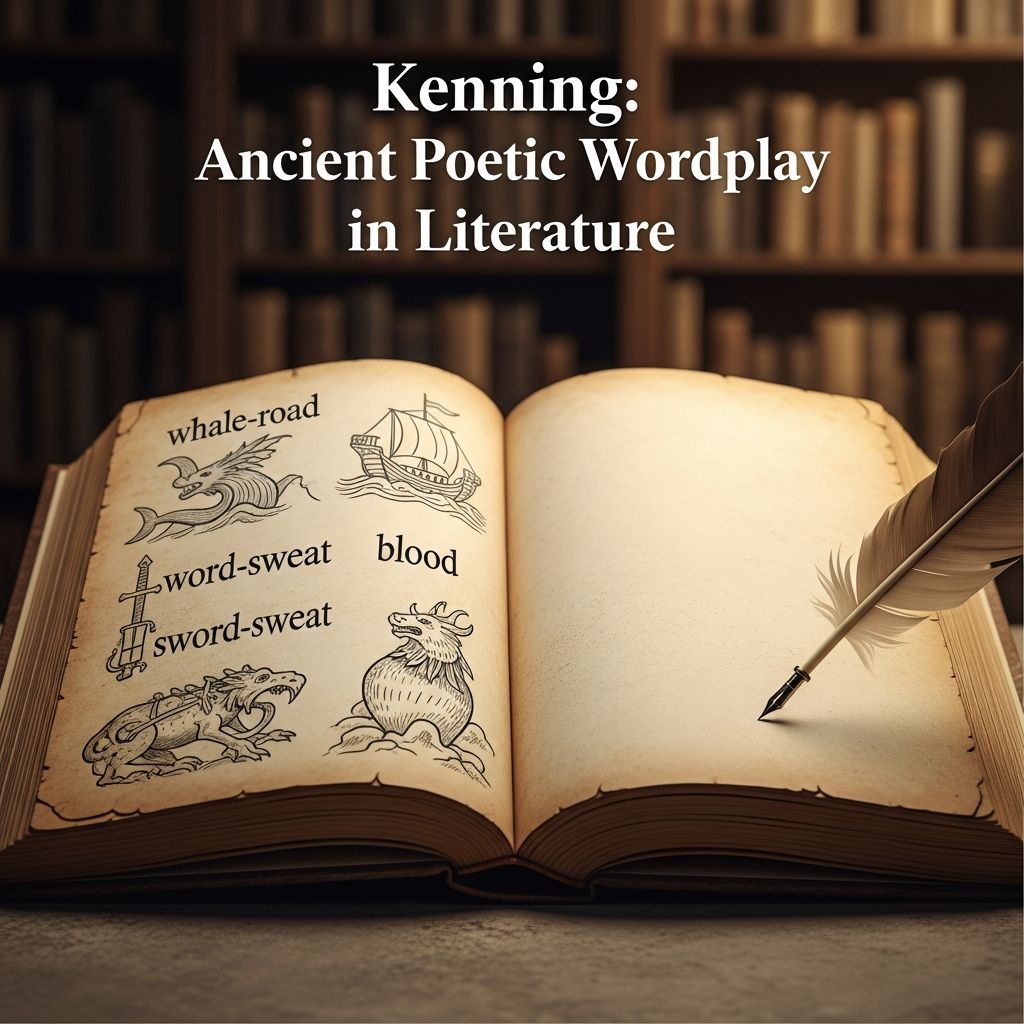
For instance, in the Old English kenning “whale’s road,” the word “road” functions as the base word, while “whale’s” operates as the determinant. Together, these elements evoke the image of the sea as a pathway through which whales travel, creating a poetic visualization that transcends the simple utterance of the noun “sea.” This structural economy—replacing one word with two—paradoxically enriches meaning through imaginative association.
Historical Origins and Cultural Development
The kenning emerged as a characteristic feature of Old Norse and Old English poetic traditions, where it became so prevalent that entire poems were constructed almost exclusively through these compound expressions. The device flourished particularly within alliterative verse, a poetic form that emphasizes the repetition of initial consonant sounds rather than end rhymes. This formal structure complemented kennings perfectly, as the alliterative patterns worked alongside the imaginative compound phrases to create a distinctive aesthetic that distinguished Germanic and Norse epic poetry from other literary traditions.
Kennings were not arbitrary creations but rather became conventional phrases recognized and understood within specific cultural contexts. Audiences of Old English and Norse poetry possessed shared knowledge of traditional metaphors and associations that enabled them to decode the meaning of kennings instantly. This cultural literacy transformed kennings from mere ornamental devices into essential communicative tools that conveyed information efficiently while maintaining poetic beauty.
The prevalence of kennings reached its zenith during the medieval period, with manuscripts such as Beowulf showcasing numerous examples of this rhetorical device. Two prominent Old English poets, Caedmon and Cynewulf, both employed kennings extensively in their compositions, establishing the technique as fundamental to the literary canon of their era.
The Figurative Language Framework
Kennings function as a specific category of figurative language, operating through multiple literary mechanisms simultaneously. Unlike simple metaphors, which typically involve a single comparison, kennings integrate metaphor, synecdoche, and metonymy into a unified compound expression. This multifaceted approach allows a single kenning to communicate complex ideas and associations through economical language.
Metaphorical thinking underlies the kenning’s essential operation. When a poet describes a sword as “battle-light,” they invoke a metaphorical comparison between the gleaming steel blade and illuminating radiance. The polished metal, when struck or moved through air, catches light much as a flame or torch would, creating a visual analogy that enriches our understanding of the weapon’s appearance and function.
Kennings also employ metonymy, a device in which one thing is named or referred to by the name of something else associated with it. The “battle-light” example again demonstrates this principle: a sword is defined not merely by its visual appearance but by its association with warfare and conflict. By linking the object to its characteristic context of use, the kenning conveys both literal and functional meaning.
Additionally, kennings sometimes incorporate synecdoche, wherein a part represents the whole or vice versa. This technique enables poets to reference broader concepts through specific, concrete imagery that resonates more powerfully with audiences than abstract terminology would.
Thematic Categories in Classical Kenning Usage
Analysis of classical kennings reveals distinct thematic groupings, reflecting the priorities and values of the societies that produced them. Different categories of kennings emerged based on their referents, creating a taxonomy of poetic expressions that served specific communicative purposes.
Natural Elements and Geography
Among the most frequently documented kennings are those referring to bodies of water and maritime phenomena. The sea, in particular, inspired numerous creative kenning variations: “whale-path,” “swan-road,” and “wave-traveler” all served as poetic substitutes for the noun “sea.” These expressions reflected the maritime culture of Norse and Anglo-Saxon peoples, for whom the ocean represented both opportunity and danger. By describing the sea through the activities of creatures that inhabited it or traversed it, poets created vivid imagery that evoked the vastness and movement of ocean waters.
Celestial References
The heavens also captured poetic imagination, generating kennings such as “God’s beacon” for the sun. This particular expression demonstrates how kennings often carried philosophical or theological significance, embedding cultural and spiritual values within poetic language. The sun, described through its function as divine illumination, simultaneously communicates astronomical fact and religious meaning.
Martial Imagery and Warrior Culture
Perhaps most significantly, kennings frequently referenced warfare, weapons, and warrior society, reflecting the martial values that dominated medieval Germanic and Norse cultures. The sword, a central symbol of warfare and nobility, inspired numerous kenning formulations beyond “battle-light.” Warriors themselves became subjects of kenning creation, with expressions like “ring-giver” serving as a poetic designation for a king. This particular kenning reveals the social structures of medieval societies: a king’s authority was established and maintained through the distribution of treasures and rewards to loyal followers, making the giving of rings a defining royal function.
Structural Variations and Linguistic Flexibility
While the basic kenning structure involves a determinant and base word joined by hyphens, linguistic flexibility within different Old Norse and Old English contexts permitted various configurational arrangements. In some instances, determinants appeared as nouns in the genitive case, placed before or after the base word, occasionally separated by intervening material. This flexibility allowed poets to adapt kennings to fit metrical requirements while maintaining semantic clarity.
Furthermore, in certain linguistic traditions, kennings could demonstrate recursive properties, with one element of the kenning itself being replaced by another kenning. This nested structure created layers of poetic meaning, rewarding audiences who possessed deeper familiarity with the tradition and cultural references embedded within the composition.
The Transition from Ancient to Modern Usage
Though kennings originated in ancient and medieval literary traditions, the device did not disappear with the decline of alliterative verse. Modern English continues to generate kenning-like compounds, though contemporary versions typically function without the conscious awareness that they represent a classical rhetorical tradition. Expressions such as “pencil pusher” for a writer or administrator, “tree hugger” for an environmentalist, and “bookworm” for an avid reader all employ the fundamental kenning principle: combining two words to create a metaphorical reference to a person or thing.
Contemporary poetry, particularly in experimental and avant-garde movements, has experienced renewed interest in classical kenning techniques. Poets seeking to revitalize their craft and honor literary heritage have deliberately incorporated kennings into modern compositions, recognizing in this ancient device tools for innovative expression within a postmodern context.
The Pedagogical Value of Kenning Study
Educational institutions increasingly recognize the value of teaching kennings as part of comprehensive literary instruction. Understanding kennings develops crucial skills in poetic analysis, creative thinking, and linguistic awareness. Students who study kennings learn to recognize figurative language patterns, to appreciate the interconnections between form and meaning, and to understand how historical poetic traditions inform contemporary language use.
The kenning also serves as an accessible entry point for creative writing instruction. Because kennings follow a relatively straightforward structural formula, students can experiment with their creation relatively quickly, building confidence in poetic composition while simultaneously engaging with classical literary traditions. Writing kenning poems encourages students to think metaphorically, to consider unexpected associations between objects and concepts, and to appreciate economy of language.
Characteristics of Effective Kennings
Not all two-word compounds function as effective kennings. Genuine kennings possess several distinguishing characteristics that separate them from ordinary compound words:
- Metaphorical resonance: The kenning should evoke a meaningful connection between its component parts and the referent, creating insight through association rather than literal description.
- Cultural intelligibility: Within its original or intended context, the kenning should be comprehensible to audiences familiar with relevant cultural knowledge and literary traditions.
- Poetic elevation: The kenning should enhance aesthetic value, transforming mundane references into vivid imagery through imaginative language.
- Structural economy: The compound should accomplish in two words what would require multiple words in ordinary speech, demonstrating linguistic efficiency.
- Circumlocution quality: The kenning necessarily employs more words than the simple noun it replaces, functioning as a specific variety of circumlocution that enriches rather than merely complicates meaning.
Comparing Kennings Across Literary Traditions
| Literary Tradition | Primary Culture | Typical Referents | Notable Characteristics |
|---|---|---|---|
| Old Norse Poetry | Scandinavian | Warriors, gods, sea, wealth | Highly developed recursive structures; mythological references |
| Old English Poetry | Anglo-Saxon | Warfare, nature, religious concepts | Integration with alliterative verse; Christian theological elements |
| Old Germanic Poetry | Continental Germanic peoples | Natural phenomena, warfare, heroism | Emphasis on warrior culture; less documented than Norse/English |
Frequently Asked Questions About Kennings
Q: What distinguishes a kenning from a simple metaphor?
A: While metaphors compare two different things using “is” or “like,” kennings replace a noun with a compound phrase that suggests the comparison indirectly. A kenning is also conventionally formatted as a hyphenated compound, whereas metaphors function as complete sentences or phrases. Kennings integrate multiple figurative devices (metaphor, metonymy, synecdoche) simultaneously, whereas simple metaphors typically employ a single comparison strategy.
Q: Are kennings still used in contemporary literature?
A: While kennings are no longer a dominant feature of mainstream poetry, contemporary poets deliberately employ the technique, particularly in experimental and heritage-conscious compositions. More significantly, modern English continues to generate kenning-like expressions unconsciously, as in “pencil pusher” or “tree hugger,” demonstrating the enduring vitality of the underlying linguistic principle.
Q: How do students effectively create their own kennings?
A: Students should select a noun they wish to replace, then identify striking visual, functional, or conceptual associations with that object. They should consider what creatures interact with it, how it functions, what it resembles, or what context typically surrounds it. By combining these observations into a two-word phrase joined by hyphens, students can craft kennings. The most effective student-created kennings demonstrate unexpected associations that prompt readers to think freshly about familiar objects.
Q: Which famous works contain notable kennings?
A: The epic poem Beowulf stands as the preeminent example of kenning-rich literature, containing numerous traditional expressions. Other significant works in Old English and Old Norse literature similarly showcase extensive kenning usage, particularly those composed in alliterative verse.
Q: Can kennings be created in languages other than English?
A: Yes, kennings originated in Old Norse and Old English but existed across Germanic and Norse language traditions. Modern adaptations of kenning techniques appear in various contemporary languages, though the tradition remains most strongly associated with Germanic linguistic and literary heritage.
References
- What is a Kenning? — Twinkl Wiki. Accessed April 2026. https://www.twinkl.com/teaching-wiki/kenning
- Kenning – Definition and Examples — LitCharts. Accessed April 2026. https://www.litcharts.com/literary-devices-and-terms/kenning
- Kennings — Harvard University, The English Language Today, Yesterday, Tomorrow. Accessed April 2026. https://cb45.hsites.harvard.edu/kennings
- Kenning — Poetry Foundation Education Glossary. Accessed April 2026. https://www.poetryfoundation.org/education/glossary/kenning
- How to Write Kennings Poems Explained by PlanBee — PlanBee. Accessed April 2026. https://planbee.com/pages/kennings
- Kenning — Britannica. Accessed April 2026. https://www.britannica.com/art/kenning
- What Is a Kenning? Examples & Definition — QuillBot. Accessed April 2026. https://quillbot.com/blog/rhetoric/kenning/
- Kenning — Wikipedia. Accessed April 2026. https://en.wikipedia.org/wiki/Kenning

Medha Deb is an editor with a master's degree in Applied Linguistics from the University of Hyderabad. She believes that her qualification has helped her develop a deep understanding of language and its application in various contexts. Medha specializes in the areas of beauty, health, sports, and wellness and is committed to ensuring that the content on the website is…