
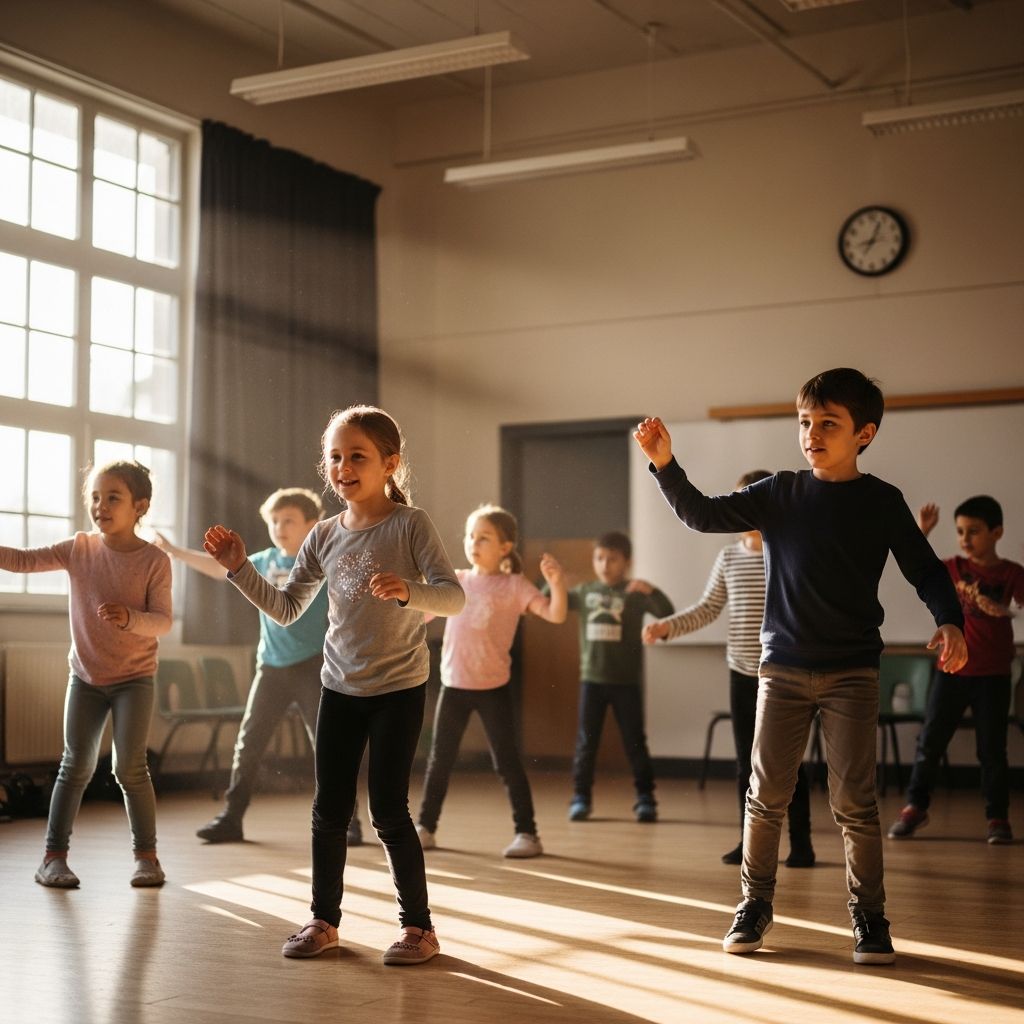
Traditional classroom instruction often relies heavily on lectures, textbooks, and passive observation—approaches that leave many students struggling to retain information and maintain engagement. A growing body of educational research demonstrates that when students physically interact with academic material, their learning outcomes improve significantly. Movement-based learning, also known as kinesthetic or experiential learning, represents a transformative approach that places students’ bodies and minds at the center of the educational experience.
The Science Behind Physical Movement and Learning
The connection between physical activity and cognitive development extends far beyond simple exercise benefits. When students engage in movement while learning, they activate multiple neural pathways simultaneously. Physical activity increases blood flow throughout the body, delivering more oxygen and nutrients to brain cells, which is crucial for optimal brain function. This enhanced circulation stimulates the release of neurochemicals such as endorphins and dopamine, which directly support memory formation and cognitive processing.
Research on neuroplasticity—the brain’s ability to form new neural connections—reveals that movement is fundamental to this process. When educators integrate physical engagement into lessons, they create opportunities for students to build stronger neural networks around academic concepts. This biological reality explains why students who learn through movement often demonstrate superior retention compared to those who only listen or watch.
The brain’s remarkable capacity to link thinking and movement means that cognitive development is not separate from physical development; they are deeply interconnected. By recognizing this connection, educators can design lessons that leverage the body’s natural role in learning.
Transforming Student Engagement and Focus
One of the most immediate benefits educators notice when implementing movement-based strategies is increased student engagement. When learners can stand, manipulate objects, role-play scenarios, or participate in experiments, they become active participants rather than passive observers. This shift in role fundamentally changes classroom dynamics.
Students who remain stationary during extended lectures struggle to maintain executive functioning in terms of attention and concentration. Schools that follow traditional bell-to-bell instruction models often assume students can sustain high cognitive demand throughout an entire class period—an assumption that contradicts how many learners actually function. Movement breaks and kinesthetic activities provide the cognitive reset necessary for sustained focus.
When kinesthetic learners receive instruction tailored to their learning method, the comprehension process becomes significantly more effective, leading to better academic performance and greater engagement. This is not merely anecdotal; studies have documented that using physical activities to improve fine motor skills can lead to a 99.5% success rate in related tasks.
Enhanced Memory and Knowledge Retention
Information absorbed through movement creates more durable memories than information acquired through passive reception alone. The multi-sensory nature of kinesthetic learning—engaging touch, proprioception, spatial awareness, and visual and auditory senses simultaneously—creates multiple memory pathways for retrieval.
For students with special educational needs and disabilities (SEND), this benefit becomes even more pronounced. Kinesthetic learning increases lesson engagement, motivation, information retention and recall, independence, and motor skill development while enhancing sensory processing and reducing stress and anxiety. These students often require active participation and sensory stimulation to remain focused, making movement-based approaches particularly effective.
Students working with materials—manipulating objects, building structures, or creating physical representations of abstract concepts—translate short-term visual information into long-term memory. This process works because the brain encodes experiences that involve the whole body more robustly than experiences limited to visual or auditory input alone.
Developing Critical Thinking and Problem-Solving Abilities
Movement-based learning naturally encourages students to approach challenges from multiple angles. When students engage in hands-on experiments or physical projects, they must think critically about their approach, test hypotheses, and adapt their strategies based on results.
Kinesthetic learning promotes divergent thinking—the ability to think creatively and generate multiple solutions to a problem. Rather than passively receiving a single correct answer, students actively explore various approaches and discover solutions through experimentation. This process builds confidence in their problem-solving abilities and demonstrates that multiple pathways can lead to success.
Consider how algebra can be taught through choreography: students create a simple dance of three twirls followed by a jump, then write it as “3x+y where x = twirl, y = jump.” Through this kinesthetic experience, students realize that 3(x+y) = 3x + y + 2y before they have a chance to declare, “I can’t do algebra.” This physical engagement removes mental barriers and builds genuine understanding.
Building Social Skills and Collaborative Abilities
Movement-based learning frequently involves group work, team projects, and collaborative problem-solving. Through working together to complete physical tasks, learners practice listening to others, providing feedback, and problem-solving as a group. These interactions develop communication skills that extend far beyond the academic content being taught.
Group role-playing, teamwork, and cooperative physical activities create natural opportunities for students to articulate their thoughts, negotiate solutions, and support peers. Students learn not just the subject matter but how to work effectively with others—a skill increasingly valued across all professional fields.
Kinesthetic learning encourages collaboration between students and improves social skills as students interact and work together. These social benefits occur organically when lessons are structured around movement and hands-on engagement.
Practical Strategies for Incorporating Movement Into Daily Instruction
Educators interested in adopting movement-based approaches need not completely overhaul their curriculum. Rather, they can systematically integrate physical engagement into existing lessons. Here are evidence-based strategies:
Allow Flexible Movement During Learning
Teachers sometimes restrict student movement during lessons, but allowing kinesthetic learners to move in class helps them learn more efficiently through standing, doodling, tapping, and other movements that help them focus and learn quickly. Creating an environment where some movement is normalized during instruction accommodates kinesthetic learners without disrupting others.
Use Hands-On Experiments and Demonstrations
Rather than only observing teacher-led demonstrations, students should handle materials, conduct experiments, and manipulate objects themselves. This direct interaction with content creates vastly superior comprehension compared to passive observation.
Incorporate Role-Playing and Simulations
Role-playing historical events, scientific processes, or literary scenarios allows students to embody concepts and understand them from multiple perspectives. These immersive experiences create memorable learning moments.
Design Building and Construction Projects
Kinesthetic learners can participate in building projects, such as constructing models or structures, to develop creativity and imagination. These projects simultaneously teach content knowledge and develop practical skills.
Create Real-World Connections
Kinesthetic learners benefit from making real-world connections to topics they are learning, and taking the class outside allows them to see it in context. Field experiences and outdoor learning connect abstract classroom concepts to tangible applications.
Addressing Diverse Learning Needs
Not all students naturally prefer kinesthetic learning, yet all students benefit from physical engagement with content. Even students who do not prefer kinesthetic learning will benefit from the active participation in lessons and should be encouraged to join in with hands-on, physical activities and tasks.
This inclusive approach recognizes that designing instruction that supports kinesthetic intelligence creates opportunities for students to engage with material in ways that align with their strengths and preferences, providing comfort and accessibility at different stages of the learning experience.
For students with significant developmental or physical differences, movement-based learning can be adapted to meet their capabilities while maintaining the core principle of physical engagement with content.
Managing Behavior Through Purposeful Movement
Kinesthetic learning can make it easier to manage the challenging behavior of restless students. Rather than viewing student movement as a disciplinary problem, educators can channel that natural energy into productive learning activities. Students who struggle with sitting still for extended periods often thrive when their movement needs are acknowledged and incorporated into instruction.
When students feel constrained by rigid classroom structures, behavior problems often emerge. Strategic movement breaks and kinesthetic activities prevent this frustration by allowing natural energy to be expressed in academically productive ways.
Overcoming Implementation Barriers
Despite strong evidence supporting movement-based learning, many educators hesitate to implement these approaches, citing concerns about classroom management, time constraints, or curriculum coverage. However, the research demonstrates that kinesthetic learning does not sacrifice academic rigor; rather, it enhances comprehension and retention. Students who learn through movement actually cover material more efficiently because their understanding is deeper and more durable.
Starting small with one or two kinesthetic activities per week allows teachers to build confidence and refine classroom management strategies without overwhelming themselves. Gradually expanding the approach creates a classroom culture where movement-based learning becomes the norm rather than the exception.
Supporting Students with Special Needs Through Movement
For students with Special Educational Needs and Disabilities (SEND), incorporating kinesthetic learning into lessons can be particularly effective. These students often need active participation and sensory stimulation to remain engaged and focused, making movement-based learning an ideal instructional approach.
Creative activities and hands-on experiences provide the sensory input and physical engagement that support learning for students with SEND. The benefits extend beyond academics to include improved motor skills, enhanced sensory processing, and reduced anxiety.
The Long-Term Impact on Student Development
Integrating movement-based learning throughout a student’s educational journey creates cumulative benefits. Students become more confident by practicing new things in a supportive environment where physical engagement is normalized. This confidence extends beyond academic performance to students’ overall self-concept and willingness to tackle challenging material.
Kinesthetic learning supports inclusive practice in teaching, ensuring that diverse learners find pathways to success. When classrooms incorporate multiple approaches to engagement, fewer students fall through the cracks of traditional instruction.
Frequently Asked Questions
What is kinesthetic learning exactly?
Kinesthetic learning is a style in which students physically interact with academic material through hands-on activities, movement, role-playing, and real-world experiences. Rather than passively listening or watching, kinesthetic learners engage their bodies to understand and retain information.
Will movement-based learning work for all subjects?
Yes, movement-based learning can be adapted for virtually every subject area, from mathematics and science to history and language arts. The key is creatively designing activities that have students physically engage with core concepts rather than observing demonstrations or reading about them.
How much time does kinesthetic learning require?
Kinesthetic activities can range from brief two-minute movement breaks to extended project-based units. Even small amounts of physical engagement improve focus and retention. Teachers can start with one or two kinesthetic activities per week and expand from there.
Will movement-based learning disrupt classroom management?
When implemented with clear expectations and purposeful structure, kinesthetic activities typically improve behavior by channeling student energy productively. Students who struggle with sitting still often exhibit fewer behavior problems when movement is incorporated meaningfully into instruction.
How does kinesthetic learning benefit students with SEND?
Students with special needs often benefit tremendously from kinesthetic approaches because they provide necessary sensory stimulation, reduce anxiety, improve motor skill development, and enhance engagement through active participation rather than passive observation.
Conclusion: Movement as a Core Educational Tool
The evidence is clear: when educators strategically incorporate movement and hands-on engagement into instruction, student outcomes improve across multiple dimensions—from academic achievement to social skills to behavioral management. Movement-based learning is not a supplementary strategy reserved for special occasions; it represents a fundamental shift toward more effective pedagogy that honors how human brains actually develop and retain information.
By embracing kinesthetic approaches, educators create classrooms where students are active, engaged participants in their own learning journey. The result is not just better test scores, though those often improve, but students who develop genuine confidence in their abilities, collaborative skills for working with others, and a love of learning that extends far beyond any single classroom.
References
- Kinaesthetic Learning | Benefits, Examples & Strategies — High Speed Training. 2024. https://www.highspeedtraining.co.uk/hub/what-is-kinaesthetic-learning/
- 4 Benefits of Kinesthetic Learning — Heinemann Blog. 2024. https://blog.heinemann.com/4-benefits-of-kinesthetic-learning
- The Power of Kinesthetic Learning: How Movement Boosts Child Development — Council of School Supervisors and Administrators. 2024. https://cmssny.org/kinesthetic-learning-boosts-child-development/
- What Is A Kinesthetic Learner? — Bay Atlantic University. 2024. https://bau.edu/blog/what-is-a-kinesthetic-learner/
- Kinesthetic Learning: Moving Toward a New Model for Education — Edutopia. 2024. https://www.edutopia.org/blog/kinesthetic-learning-new-model-education-kirin-sinha
- Kinesthetic Learning Style: Definition, Characteristics and Benefits in Education — Simple K12. 2024. https://www.simplek12.com/blog/kinesthetic-learning-style
- Learning Styles/Preferences Among Medical Students: Kinesthetic Learning — National Center for Biotechnology Information. 2021. https://pmc.ncbi.nlm.nih.gov/articles/PMC8368716/

- Integrated M.A. in Applied Linguistics, University of Hyderabad
- 5+ years in editorial, instructional, SEO, and research-based writing
Sneha is a relationships and lifestyle writer with a strong foundation in applied linguistics and certified training in relationship coaching. She brings over five years of writing experience to theskillvault, crafting thoughtful, research-driven content that empowers readers to build healthier relationships, boost emotional well-being, and embrace holistic living. Her writing and insights reflect the belief that beauty, happiness, and wellness…