
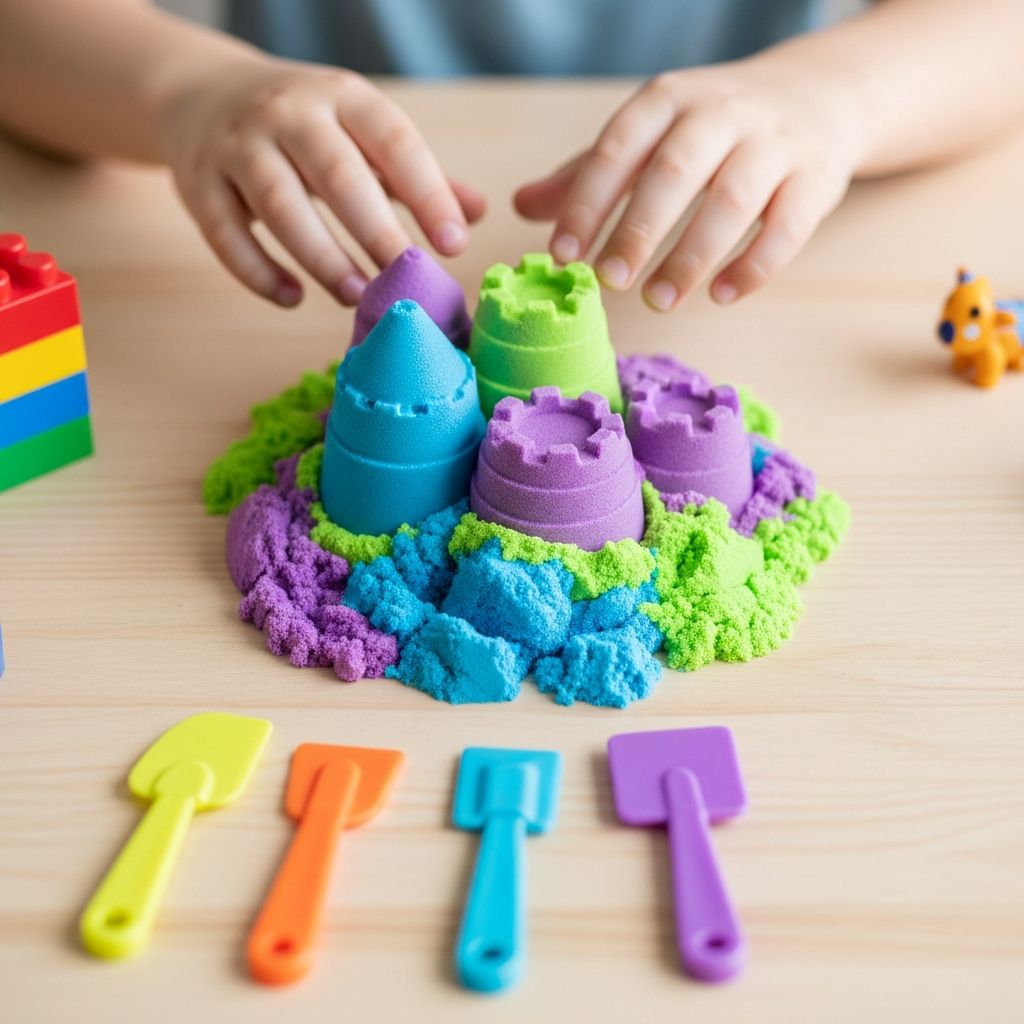
Understanding Kinetic Sand and Its Appeal to Children
Kinetic sand represents a modern twist on traditional sand play, offering a unique tactile experience that captivates children while supporting their developmental needs. Unlike ordinary beach sand, kinetic sand possesses a distinctive buttery texture that holds its form when pressed or molded, yet remains soft and pliable for manipulation. This paradoxical quality—being both structured and malleable—makes it an exceptionally versatile medium for play and learning.
The appeal of kinetic sand extends beyond mere entertainment. Parents and educators recognize its value as a sensory tool that engages multiple developmental domains simultaneously. When children interact with kinetic sand, they engage their tactile senses in ways that promote neurological development, emotional regulation, and cognitive processing. The sensory feedback from manipulating the sand creates neural pathways associated with motor planning and coordination, making play sessions productive from both recreational and developmental perspectives.
The Science Behind Creating Kinetic Sand at Home
One of the most appealing aspects of kinetic sand is its accessibility through simple DIY preparation. The basic formula requires only three fundamental ingredients combined in specific proportions to achieve the desired consistency and texture. Understanding the role of each component helps parents and educators appreciate why this particular combination produces such effective results.
The foundation of homemade kinetic sand relies on fine play sand as its primary ingredient. This sand serves as the base material and can be sourced from most craft supply stores or home improvement retailers at reasonable cost. The sand particles provide the bulk and structure necessary for molding and shaping activities.
Cornstarch acts as the binding agent in this mixture, though flour serves as an equally effective substitute for those with ingredient availability concerns. This powder creates the conditions necessary for the sand to hold its shape when compressed while maintaining its soft, non-wet texture. The starch particles coat the sand grains, allowing them to adhere temporarily without moisture.
Cooking oil completes the trinity of ingredients, providing the crucial element that gives kinetic sand its distinctive feel. The oil creates a hydrophobic barrier around the sand particles, preventing them from clumping permanently while offering that signature smooth, buttery sensation that children find so satisfying.
The Proper Ratio for Success
Achieving the perfect consistency requires adherence to the 5-3-1 ratio: five parts play sand, three parts cornstarch, and one part cooking oil. This proportion has been tested and refined through countless home experiments, and deviating from it may result in either overly crumbly or excessively oily sand that doesn’t perform optimally. Mixing these ingredients thoroughly until no dry patches or oily spots remain ensures uniform texture throughout the batch.
Essential Tools and Accessories for Enhanced Play
While kinetic sand alone provides engaging sensory experiences, incorporating various tools and accessories amplifies the play value and introduces new dimensions to creative expression. The beauty of this medium is that many household items and inexpensive toys transform into specialized tools that expand possibilities.
Kitchen-Based Implements
Common kitchen utensils create surprisingly effective kinetic sand accessories. Butter knives allow children to cut through and slice the sand, introducing fine motor challenges and opportunities for precise manipulation. Small spoons and scoops enable measuring and pouring activities that develop hand strength and coordination. Rolling pins flatten the sand into sheets suitable for various projects, while cookie cutters produce defined shapes that support creative construction and imaginative scenario-building.
Specialized Play Equipment
Items from toy kitchen sets, such as miniature forks, knives, and serving utensils, provide appropriately-scaled tools for small hands. Play-Doh tool sets offer scissors, rollers, and shapers designed for tactile manipulation. Ice cream scoops enable ball-making activities, while measuring cups from water tables facilitate pouring and filling exercises that build mathematical understanding through hands-on experience.
Construction and Decorative Elements
Plastic blocks, small toy animals, and figurines integrate storytelling into sand play, transforming simple manipulation into narrative-driven scenarios. Plastic jewels, buttons, and craft embellishments add aesthetic dimensions and encourage decorative thinking. Building blocks can be packed with sand to create structures, while small cups and containers enable mold-making activities that teach cause-and-effect relationships.
Learning Activities That Develop Essential Skills
Beyond recreational enjoyment, kinetic sand facilitates structured learning activities that address multiple developmental domains. Educators and parents can scaffold experiences to target specific competencies while maintaining the playful engagement that makes this medium so effective.
Literacy and Letter Formation
Using kinetic sand as a surface for letter tracing introduces multisensory learning to literacy development. Children can form letters with their fingers, create letter shapes with tools, or use the sand as a canvas for practicing letter formation. This tactile approach reinforces motor memory and provides immediate sensory feedback that supports alphabet acquisition and pre-writing skill development.
Numerical Exploration and Measurement
Kinetic sand naturally invites mathematical thinking through measuring, scooping, and pouring activities. Children can practice counting while decorating sand creations, explore fractional concepts by dividing sand into portions, and develop measurement skills through filling containers to specific levels. These concrete, hands-on experiences build foundational numeracy understanding that supports later abstract mathematical learning.
Color Recognition and Sorting
While traditional kinetic sand is typically tan or neutral-colored, colored sand can be incorporated to support color recognition and sorting activities. Children can categorize jewels, toys, or other objects by color within the sand, create color-coded zones in their play space, or organize materials by hue. These activities strengthen visual discrimination and classification skills essential for academic success.
Shape Identification and Spatial Reasoning
Cookie cutters and shape-making tools transform kinetic sand into an instrument for geometric learning. Children can explore how different shapes fit together, create patterns, and develop spatial understanding through hands-on manipulation. The temporary nature of sand creations allows for repeated practice without frustration, supporting skill refinement through play.
Imaginative Play Scenarios and Storytelling
Perhaps the most valuable aspect of kinetic sand lies in its capacity to inspire imaginative play that develops social-emotional competencies and creative thinking. The medium’s flexibility supports diverse narrative scenarios limited only by children’s imagination.
Archaeological and Paleontological Adventures
Burying toy dinosaurs and figurines in the sand creates treasure-hunt scenarios where children excavate buried items and construct narratives around their discoveries. These archaeological simulations develop problem-solving skills and introduce concepts related to history and natural science through experiential learning.
Culinary and Food-Based Play
Children create pretend cakes, cookies, and other baked goods using cookie cutters, sculpting tools, and decorative elements. These cooking simulations develop understanding of food preparation, practice planning and sequencing, and provide opportunities for practicing social interactions through shared meal preparation scenarios.
Construction and Infrastructure Building
Creating castles, roads, and structural elements develops spatial reasoning and planning capabilities. Children can design entire landscapes, create road systems for toy vehicles, and construct defensive structures for imaginative scenarios. These building activities strengthen problem-solving skills and encourage persistence through the iterative design process.
Ice Cream Shop Scenarios
Establishing pretend ice cream stands where children scoop sand into cups develops role-playing skills and social understanding. These scenarios incorporate mathematical thinking through transactions and menu creation while practicing language skills through customer interactions.
Fine Motor Development Through Kinetic Sand Play
The manipulation required in kinetic sand activities provides extensive opportunities for developing the precise hand movements and finger control essential for academic tasks and daily functioning. Children strengthen the small muscles of their hands through pressing, squeezing, pinching, cutting, and sculpting actions required by various play scenarios.
The resistance offered by kinetic sand provides appropriate challenge for developing hand strength without requiring excessive force that might discourage young players. This graduated difficulty level makes kinetic sand particularly valuable for children developing or refining fine motor capabilities. Regular engagement builds the muscular endurance and controlled precision necessary for writing, cutting with scissors, fastening clothing, and other self-care skills.
Sensory Processing and Emotional Regulation
Beyond skill development, kinetic sand serves important functions in sensory processing and emotional well-being. The tactile stimulation provides organizing input that helps children regulate their nervous systems, particularly for those with sensory processing differences. The non-messy nature of kinetic sand—unlike water or loose sand that creates cleanup challenges—makes it accessible for indoor use, supporting year-round sensory engagement regardless of weather conditions.
The repetitive, rhythmic motions involved in kinetic sand manipulation produce calming effects similar to other tactile stimulation activities. For children experiencing anxiety, transitions, or emotional overwhelm, kinetic sand can serve as a grounding tool that supports regulation and creates a sense of control through creative expression.
Storage and Maintenance Strategies
Proper storage extends kinetic sand’s usability and maintains its texture over time. Keeping the material in lidded containers prevents drying while protecting the play space from scattered particles. Designating specific trays or containers for sand play creates clear boundaries that support cleanup and help younger children understand where sand belongs.
Kinetic sand’s longevity depends on minimizing exposure to air and maintaining appropriate moisture balance. Stored properly in sealed containers, homemade kinetic sand remains usable for extended periods, making the initial preparation investment worthwhile. Regular mixing or remixing during storage helps redistribute oils evenly and maintains consistent texture throughout the batch.
Cost-Effectiveness and Sustainability Considerations
Creating kinetic sand at home costs substantially less than purchasing commercial versions while yielding equivalent or superior results. The minimal ingredients required are typically already present in most households or readily available at minimal cost from grocery or craft stores. For educators managing classroom budgets or families seeking affordable activities, homemade kinetic sand represents an excellent investment in learning and development.
The reusable nature of kinetic sand supports sustainable play practices. Unlike single-use toys or activities, kinetic sand can be manipulated repeatedly, stored indefinitely when properly maintained, and adapted to endless variations through different tools and accessories. This durability makes it environmentally conscious while meeting children’s needs for extended engagement.
Adapting Activities for Different Ages and Abilities
Kinetic sand’s versatility supports adaptation across diverse age groups and developmental levels. Toddlers benefit from the sensory stimulation and basic manipulation opportunities, while older children engage in complex construction projects and structured learning activities. Children with developmental differences can access sand play at their own level, with adults scaffolding activities to provide appropriate challenge without frustration.
Teachers and parents can differentiate kinetic sand experiences by adjusting tool complexity, activity structure, and learning objectives to meet individual needs. This adaptability makes kinetic sand valuable across inclusive classroom settings and multi-age family contexts.
Frequently Asked Questions
Q: How long does homemade kinetic sand last?
A: When stored in sealed containers away from air exposure, homemade kinetic sand maintains its texture and usability for several months or longer. Proper storage prevents drying while maintaining the consistency that makes it effective for play and learning activities.
Q: Can kinetic sand be made with ingredients other than cornstarch?
A: Yes, flour serves as an effective substitute for cornstarch. Both ingredients function as binding agents that enable the sand to hold shape while maintaining its soft, non-wet texture. Experimentation with different ratios may be necessary to achieve desired consistency with alternative ingredients.
Q: Is kinetic sand safe for young children and those with sensory sensitivities?
A: Kinetic sand made from food-grade ingredients is generally safe for young children when used under supervision. The oil-based formula prevents particles from becoming airborne like loose sand, reducing respiratory irritation. However, children who mouth objects should be supervised, and adults should verify all ingredients are appropriate for their specific child’s needs and allergies.
Q: What specific fine motor skills does kinetic sand play develop?
A: Kinetic sand activities develop hand strength, finger isolation, bilateral coordination, and precision control through squeezing, pinching, cutting, and sculpting actions. These movements build the muscular foundation and motor planning necessary for writing, using scissors, fastening clothing, and other essential daily tasks.
Q: Can kinetic sand be used in educational settings with multiple children?
A: Absolutely. The recipe scales easily for large quantities, and multiple children can share sand using different tools or play trays simultaneously. The non-competitive, open-ended nature of kinetic sand play supports collaborative experiences and social skill development alongside individual creative expression.
References
- DIY Kinetic Sand — Minnesota Children’s Museum. Accessed April 4, 2026. https://mcm.org/diy-kinetic-sand/
- 10 Ways to Play with Kinetic Sand — Fun Learning for Kids. Accessed April 4, 2026. https://funlearningforkids.com/10-ways-to-play-with-kinetic-sand/
- Kinetic Sand Activities — Teachers Pay Teachers. Accessed April 4, 2026. https://www.teacherspayteachers.com/browse?search=kinetic+sand+activities
- Get Inspired — Kinetic Sand. Accessed April 4, 2026. https://www.kineticsand.com/getinspired
- Kinetic Sand 101 — Busy Toddler. Accessed April 4, 2026. https://busytoddler.com/kinetic-sand/

- Integrated M.A. in Applied Linguistics, University of Hyderabad
- 5+ years in editorial, instructional, SEO, and research-based writing
Sneha is a relationships and lifestyle writer with a strong foundation in applied linguistics and certified training in relationship coaching. She brings over five years of writing experience to theskillvault, crafting thoughtful, research-driven content that empowers readers to build healthier relationships, boost emotional well-being, and embrace holistic living. Her writing and insights reflect the belief that beauty, happiness, and wellness…