
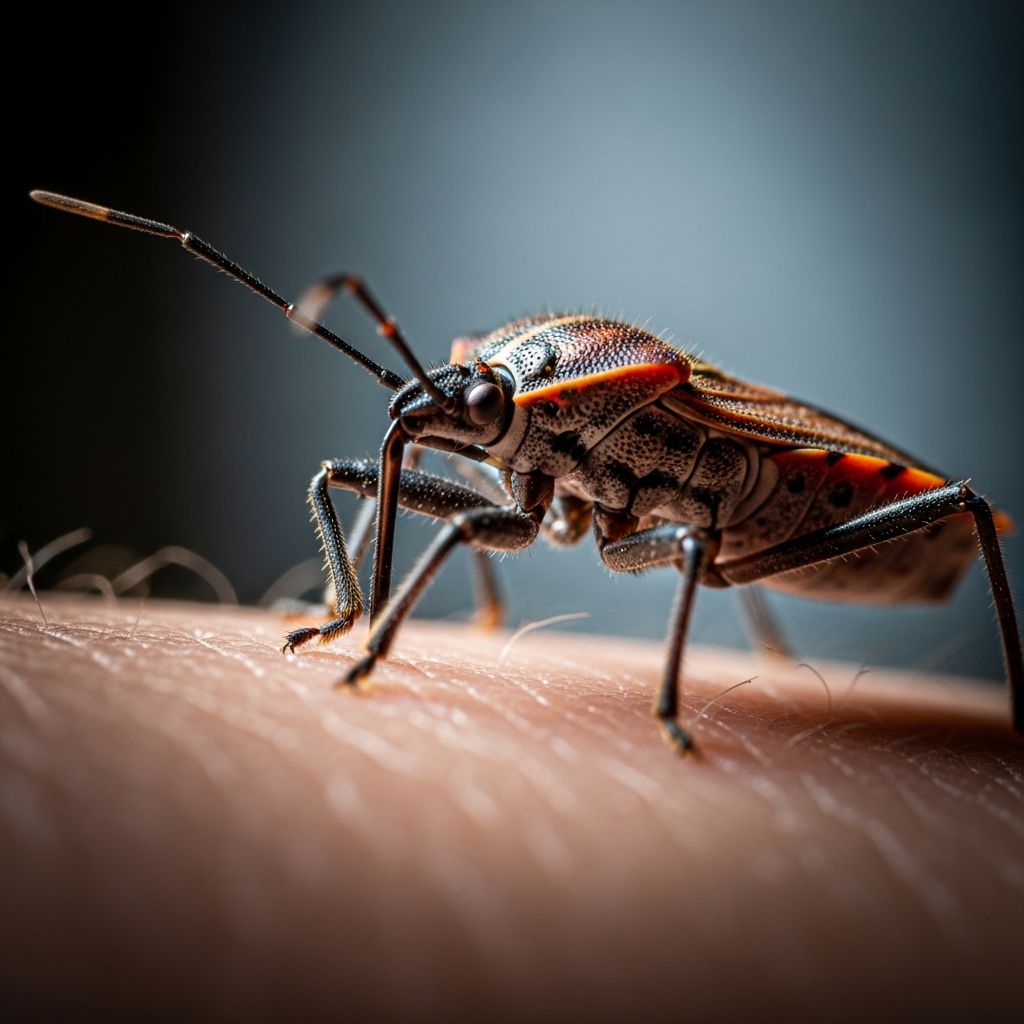
Kissing bugs, scientifically known as triatomines, are nocturnal insects notorious for their blood-feeding habits and potential to transmit a serious parasitic illness. These bugs earn their common name from preferring bites near the face, particularly around the mouth, during sleep. Understanding their biology, distribution, and health implications is crucial for prevention, especially in regions where they thrive.
Biology and Distinctive Features of Kissing Bugs
Triatomine bugs belong to the Reduviidae family and exhibit a unique cone-shaped head that sets them apart from other insects. Adults measure 0.5 to 1 inch in length, with dark brown or black bodies, sometimes featuring orange or yellow markings on their abdomens. Unlike ticks, they do not latch onto skin; instead, they insert a thin, needle-like proboscis to extract blood painlessly over several minutes.
These insects undergo incomplete metamorphosis, hatching from oval eggs as tiny nymphs that progress through five stages before adulthood. Nymphs lack wings and cannot fly, relying on crawling to locate hosts. Adult females possess an ovipositor for egg-laying, distinguishing them from males with rounded abdomens. Females can produce hundreds of eggs over their lifespan in favorable conditions.
- Cone-shaped head: Prominent feature for identification.
- Wingless nymphs: Five immature stages before flight capability.
- Blood meal duration: Up to several minutes per feeding.
- Abdomen patterns: Species-specific stripes or spots.
Geographic Spread and U.S. Presence
Over 130 triatomine species inhabit North, Central, and South America. In the United States, they occur in at least 29 states, with highest concentrations in Texas, Arizona, and New Mexico. Texas A&M research documents multiple species, including Triatoma gerstaeckeri, T. sanguisuga, and T. protracta, many found near homes and farms.
Arizona hosts seven species, notably T. rubida, T. protracta, and T. recurva, often invading dwellings. While human Chagas cases remain rare in the U.S., animal infections are common, signaling potential risks. Southern states see more activity due to warmer climates supporting wildlife hosts.
| State | Key Species | Notable Risks |
|---|---|---|
| Texas | T. gerstaeckeri, T. sanguisuga | High infection rates (~50-55%), human bites reported |
| Arizona | T. rubida, T. protracta | Dwelling invasions, allergy risks |
| New Mexico | Multiple Triatoma spp. | Proximity to Mexico increases transmission potential |
| California | Various | Rare human infections due to defecation habits |
Feeding Habits and Why They Target Faces
Nocturnal by nature, kissing bugs emerge at night to feed on vertebrate blood, preferring mammals like raccoons, opossums, rodents, birds, dogs, cats, and cattle. They detect hosts via heat, carbon dioxide, and odors, often entering homes through cracks or hiding in animal nests nearby.
Bites occur primarily during sleep because bugs are drawn to exhaled breath and facial warmth. The painless feeding allows engorgement, after which they defecate near the wound. Scratching transfers feces containing parasites into the skin, eyes, or mouth. Unlike bed bugs, they do not remain attached.
The Chagas Disease Threat: Trypanosoma cruzi Parasite
About 50-55% of U.S. kissing bugs carry Trypanosoma cruzi (T. cruzi), a protozoan parasite responsible for Chagas disease. The parasite resides in the bug’s hindgut, exiting via feces—not saliva—post-feeding. Infection occurs if rubbed into bites or mucous membranes.
Chagas manifests in acute (weeks post-exposure: fever, swelling) and chronic phases (years later: heart failure, digestive issues). Globally, millions suffer chronic effects; U.S. cases are underreported but rising in awareness. Animals like dogs frequently contract it, serving as sentinels.
- Transmission vector: Fecal matter, not bite itself.
- Infection rate: Half of tested bugs in Texas positive.
- Chronic impact: Heart and gut damage in 20-30% of untreated cases.
Signs of Kissing Bug Bites and Allergic Reactions
Bites cause delayed itching, red welts, or hives, often linear on exposed skin. Some experience severe allergies after repeated exposure, risking anaphylaxis—call emergency services if breathing difficulties arise. Droppings resemble black ink spots; live bugs hide in wall voids or furniture.
Distinguishing from other bites: Kissing bug welts are larger, bites clustered near faces. Nymphs, harder to spot, pose risks too, though less infected than adults.
Prevention Strategies for Homes and Yards
Seal cracks around doors, windows, and foundations. Use weatherstripping and screens. Remove woodpiles, bird feeders, and harborage near homes. Treat pets for fleas/ticks, as they attract bugs. Nightly inspections and sticky traps aid monitoring.
- Eliminate animal dens near structures.
- Install bright outdoor lights to deter nocturnal flight.
- Vacuum cracks; dispose bags outdoors.
- Professional pest control for infestations.
Treatment Options for Chagas and Bug Control
Acute Chagas responds to antiparasitics like benznidazole (CDC-recommended). Chronic cases manage symptoms via cardiology. Early diagnosis via blood tests improves outcomes. Insecticides (pyrethroids) target bugs; integrated pest management is best.
For bites, antihistamines and steroids alleviate symptoms. Consult physicians for travel-related exposures, common from Latin America.
Research and Community Efforts
Texas A&M’s citizen science has analyzed over 7,000 bugs since 2012, revealing 55% infection rates and aiding distribution maps. Such programs empower reporting, enhancing surveillance.
Frequently Asked Questions (FAQs)
Do kissing bugs fly into homes?
Yes, adults fly at dusk, entering through openings. Nymphs crawl from infested areas.
Are kissing bugs in every U.S. state?
No, primarily southern states; 29 documented with findings.
Can pets get Chagas from kissing bugs?
Yes, dogs and cats are common hosts; veterinary screening recommended.
How do I report a kissing bug?
Contact local health departments or programs like Texas A&M for submission.
Is Chagas fatal?
Chronic untreated cases can lead to death from heart complications in 10-30%.
References
- The Facts About Kissing Bugs — Turner Pest Control. Accessed 2026. https://www.turnerpest.com/the-facts-about-kissing-bugs/
- What you need to know about the kissing bug — Ohio State University Wexner Medical Center. Accessed 2026. https://health.osu.edu/health/virus-and-infection/what-you-need-to-know-about-the-kissing-bug
- Kissing Bugs and Chagas Disease — California Department of Public Health (CDPH). Accessed 2026. https://www.cdph.ca.gov/Programs/CID/DCDC/Pages/Conenose-Kissing-Bugs.aspx
- Kissing Bugs and Chagas Disease in the U.S. — Texas A&M University. Accessed 2026. https://kissingbug.tamu.edu
- Kissing Bug and Chagas Disease Guide — Texas Department of State Health Services (DSHS). 2018-06-19. https://www.dshs.texas.gov/sites/default/files/IDCU/disease/chagas/UT_Health_Kissing_Bug_Chagas_Guide-061918.pdf
- Kissing Bugs — Southeastern Center of Vector Borne Diseases (SECVBD). Accessed 2026. https://sercoevbd-flgateway.org/kissing-bugs/
- What You Should Know About Kissing Bugs — University of Arizona Cooperative Extension. Accessed 2026. https://extension.arizona.edu/publication/what-you-should-know-about-kissing-bugs
- Chagas disease – Symptoms & causes — Mayo Clinic. Accessed 2026. https://www.mayoclinic.org/diseases-conditions/chagas-disease/symptoms-causes/syc-20356212

- Integrated M.A. in Applied Linguistics, University of Hyderabad
- 5+ years in editorial, instructional, SEO, and research-based writing
Sneha is a relationships and lifestyle writer with a strong foundation in applied linguistics and certified training in relationship coaching. She brings over five years of writing experience to theskillvault, crafting thoughtful, research-driven content that empowers readers to build healthier relationships, boost emotional well-being, and embrace holistic living. Her writing and insights reflect the belief that beauty, happiness, and wellness…