
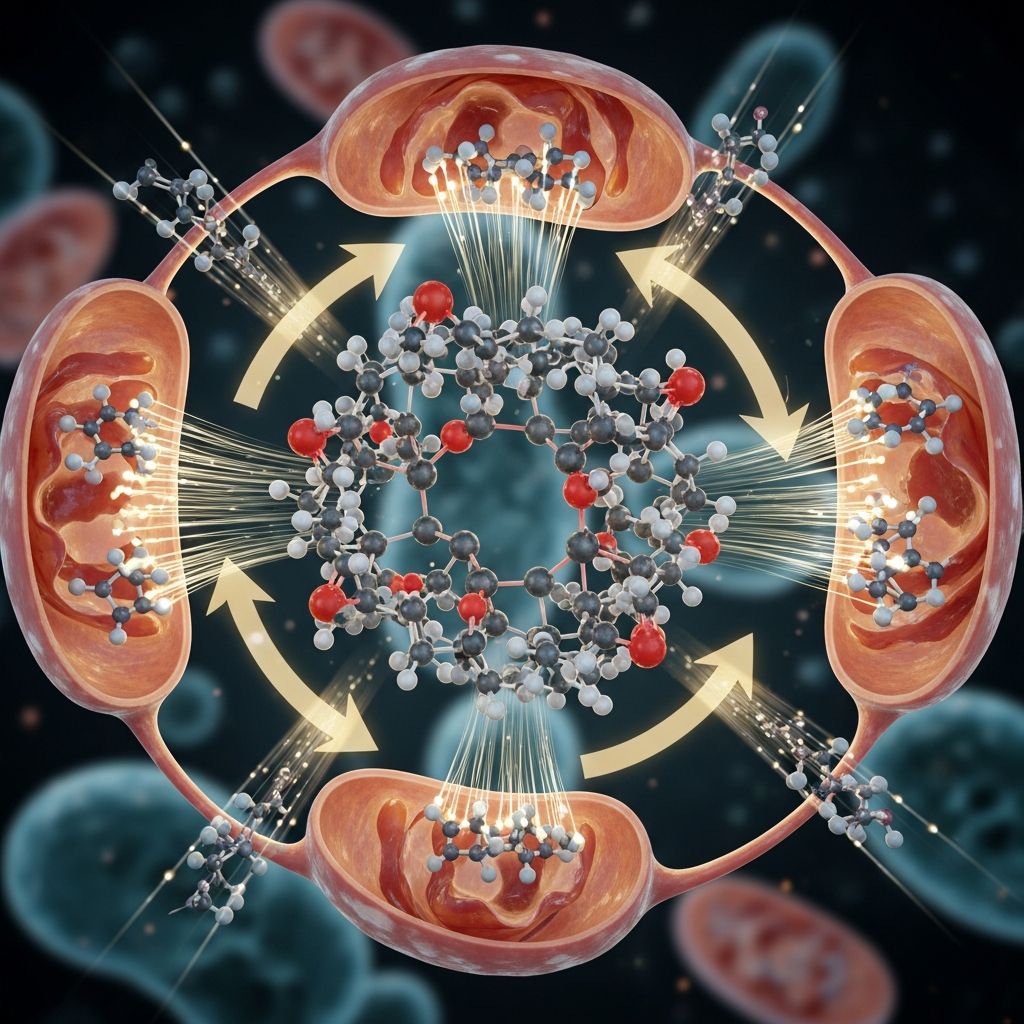
The Krebs cycle, also known as the citric acid cycle or tricarboxylic acid (TCA) cycle, stands as a cornerstone of aerobic metabolism in eukaryotic cells. Occurring within the mitochondrial matrix, this cyclical series of enzymatic reactions fully oxidizes acetyl-CoA derived from carbohydrates, fats, and proteins, yielding high-energy electron carriers and a small amount of ATP. Its discovery by Hans Krebs in 1937 revolutionized our understanding of energy production, earning him the Nobel Prize.
Positioning the Krebs Cycle in Cellular Respiration
Cellular respiration unfolds in three main phases: glycolysis, the Krebs cycle, and the electron transport chain (ETC). Glycolysis in the cytosol converts glucose into two pyruvate molecules, generating a net of 2 ATP and 2 NADH. Each pyruvate then enters the mitochondria, where it undergoes oxidative decarboxylation by the pyruvate dehydrogenase complex to form acetyl-CoA, releasing CO2 and producing another NADH.
Acetyl-CoA, a two-carbon unit, fuels the Krebs cycle. For one glucose molecule, two acetyl-CoA molecules enter, doubling the cycle’s output. This pathway bridges nutrient breakdown to oxidative phosphorylation, where NADH and FADH2 donate electrons to the ETC, driving ATP synthesis via chemiosmosis.
Detailed Breakdown of the Eight Enzymatic Steps
The Krebs cycle comprises eight tightly regulated steps, each catalyzed by a specific enzyme. It begins with the fusion of acetyl-CoA and oxaloacetate, regenerating the four-carbon oxaloacetate at the end to sustain the cycle.
- Step 1: Citrate Formation – Acetyl-CoA (2C) condenses with oxaloacetate (4C) to form citrate (6C), catalyzed by citrate synthase. This irreversible step commits the substrate to the cycle.
- Step 2: Isomerization to Isocitrate – Citrate is rearranged into isocitrate via aconitase, involving dehydration and rehydration for stereochemical adjustment.
- Step 3: Oxidative Decarboxylation to α-Ketoglutarate – Isocitrate dehydrogenase oxidizes isocitrate to oxalosuccinate, then decarboxylates it to the five-carbon α-ketoglutarate, producing NADH and CO2. This rate-limiting, NAD+-dependent step is a key regulatory point.
- Step 4: Further Oxidation to Succinyl-CoA – α-Ketoglutarate dehydrogenase complex converts α-ketoglutarate to succinyl-CoA (4C), releasing CO2 and generating NADH. Similar to pyruvate dehydrogenase, it requires five cofactors.
- Step 5: Succinate Formation and GTP Synthesis – Succinyl-CoA synthetase cleaves succinyl-CoA to succinate, coupling the reaction to substrate-level phosphorylation, forming GTP (convertible to ATP).
- Step 6: Oxidation to Fumarate – Succinate dehydrogenase oxidizes succinate to fumarate, producing FADH2. This enzyme is embedded in the inner mitochondrial membrane, linking to the ETC.
- Step 7: Hydration to Malate – Fumarase adds water across the double bond of fumarate to yield malate.
- Step 8: Regeneration of Oxaloacetate – Malate dehydrogenase oxidizes malate back to oxaloacetate, producing NADH and closing the cycle.
Per acetyl-CoA (two per glucose), the cycle nets 3 NADH, 1 FADH2, 1 GTP (or ATP), and 2 CO2, totaling 6 NADH, 2 FADH2, and 2 GTP from glucose.
Energy Yield and Integration with Oxidative Phosphorylation
While the Krebs cycle directly produces only 2 ATP equivalents per glucose via GTP, its true power lies in NADH and FADH2. These carriers feed electrons into the ETC, where each NADH yields ~2.5 ATP and FADH2 ~1.5 ATP through proton pumping and ATP synthase. Thus, the cycle contributes ~20 ATP per glucose, comprising over 80% of respiration’s total yield.
| Input (per Glucose) | Krebs Cycle Outputs | ETC ATP Yield |
|---|---|---|
| 2 Acetyl-CoA | 6 NADH, 2 FADH2, 2 GTP | ~20 ATP |
| – | 4 CO2 | – |
Regulation Mechanisms to Balance Energy Demand
The cycle’s flux is finely tuned to cellular energy status. Key control points include pyruvate dehydrogenase, isocitrate dehydrogenase, and α-ketoglutarate dehydrogenase. High NADH/NAD+, ATP/ADP, and acetyl-CoA ratios inhibit these enzymes via allosteric feedback, while ADP, Ca2+, and NAD+ activate them. Citrate synthase is feedback-inhibited by ATP, NADH, succinyl-CoA, and citrate. This ensures the cycle ramps up during energy need and slows when ATP is abundant.
Beyond Energy: Biosynthetic Roles and Anaplerosis
Intermediates like α-ketoglutarate and oxaloacetate serve as precursors for amino acids, nucleotides, and porphyrins. Anaplerotic reactions replenish these, such as pyruvate carboxylase converting pyruvate to oxaloacetate. This amphibolic nature allows the cycle to support both catabolism and anabolism.
Aerobic Requirement and Location
Exclusively aerobic, the cycle demands O2 as the final electron acceptor in the ETC to regenerate NAD+ and FAD. Without O2, NADH accumulates, halting the cycle. All steps occur in the mitochondrial matrix, except succinate dehydrogenase on the inner membrane.
Clinical Relevance: Disruptions and Diseases
Dysfunctions link to metabolic disorders. Pyruvate dehydrogenase deficiency causes lactic acidosis; α-ketoglutarate dehydrogenase defects mimic Parkinson’s. Fluoroacetate poisoning inhibits aconitase, blocking the cycle. Cancer cells often rewire metabolism, relying less on the cycle via the Warburg effect.
Comparative Insights Across Organisms
Universal in aerobes from bacteria to humans, variations exist. Plants use it for gluconeogenesis; some parasites have modified versions. Evolutionary conservation underscores its fundamental role.
Frequently Asked Questions (FAQs)
What is the primary function of the Krebs cycle?
The Krebs cycle oxidizes acetyl-CoA to produce NADH, FADH2, and GTP for ATP generation via the ETC.
How many ATP does one turn of the Krebs cycle produce directly?
One GTP (equivalent to ATP) per turn, or 2 per glucose.
Why is the Krebs cycle called a cycle?
Oxaloacetate is regenerated, allowing continuous operation.
Where does the Krebs cycle occur in the cell?
In the mitochondrial matrix (most steps).
Can the Krebs cycle function without oxygen?
No, it requires O2 to regenerate NAD+ and FAD via the ETC.
What regulates the Krebs cycle?
Allosteric effectors like ATP, NADH (inhibitors) and ADP, Ca2+ (activators) at key dehydrogenases.
The Krebs cycle exemplifies metabolic elegance, integrating catabolism, energy production, and biosynthesis. Its study illuminates cellular physiology and pathology, with ongoing research probing therapeutic targets.
References
- Krebs Cycle or Citric Acid Cycle: Steps, Products, Significance — BYJU’S. 2023. https://byjus.com/neet/krebs-cycle/
- The Krebs Cycle A Step-by-Step Explanation — PraxiLabs. 2023-01-02. https://praxilabs.com/en/blog/2023/01/02/krebs-cycle/
- 2.28: Krebs Cycle — Biology LibreTexts. 2023. https://bio.libretexts.org/Bookshelves/Introductory_and_General_Biology/Introductory_Biology_(CK-12)/02:_Cell_Biology/2.28:_Krebs_Cycle
- Physiology, Krebs Cycle — StatPearls, NCBI Bookshelf. 2023-10-24. https://www.ncbi.nlm.nih.gov/books/NBK556032/
- The citric acid cycle — Khan Academy. 2023. https://www.khanacademy.org/science/biology/cellular-respiration-and-fermentation/pyruvate-oxidation-and-the-citric-acid-cycle/a/the-citric-acid-cycle

- Integrated M.A. in Applied Linguistics, University of Hyderabad
- 5+ years in editorial, instructional, SEO, and research-based writing
Sneha is a relationships and lifestyle writer with a strong foundation in applied linguistics and certified training in relationship coaching. She brings over five years of writing experience to theskillvault, crafting thoughtful, research-driven content that empowers readers to build healthier relationships, boost emotional well-being, and embrace holistic living. Her writing and insights reflect the belief that beauty, happiness, and wellness…