
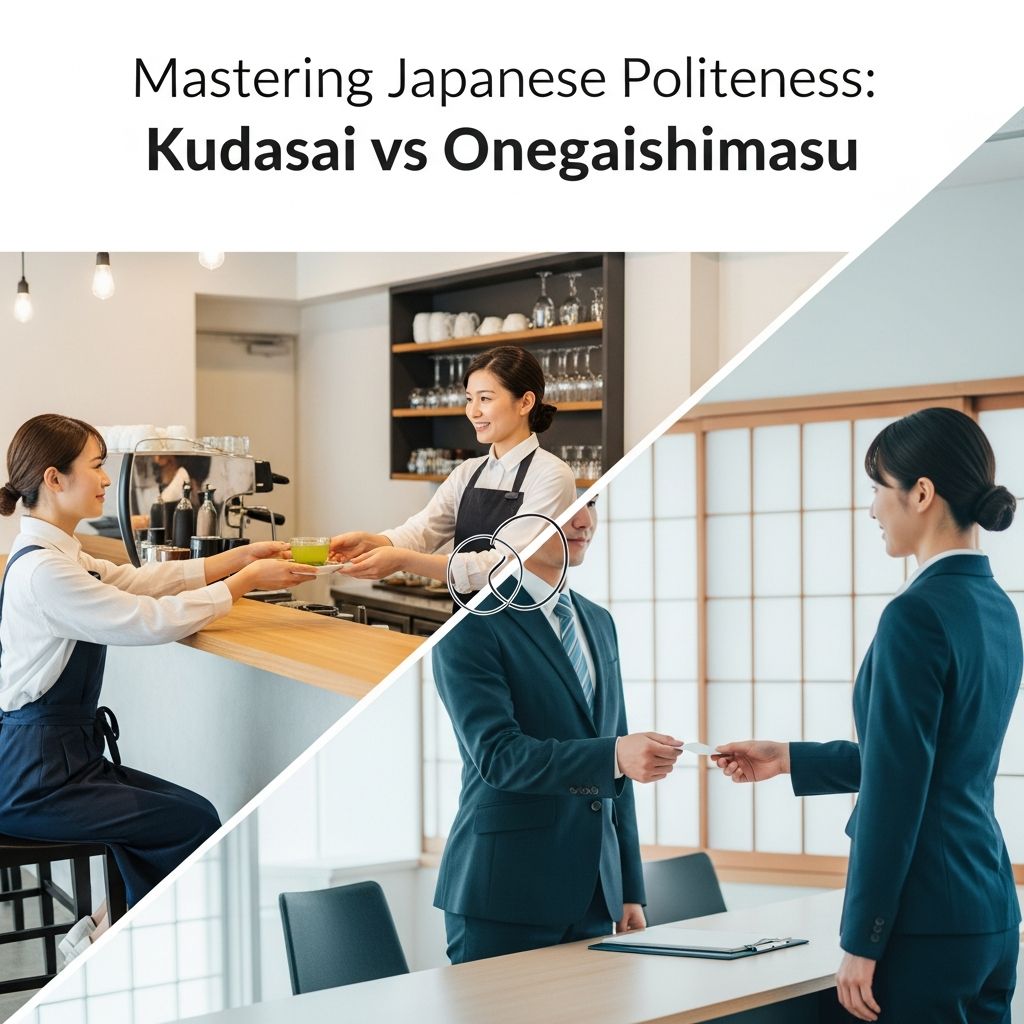
Understanding Japanese Request Expressions
The Japanese language offers multiple ways to express politeness and make requests, reflecting the culture’s deep emphasis on respect and social harmony. Two fundamental expressions that learners encounter early in their studies are ください (kudasai) and おねがいします (onegaishimasu). While both translate roughly to “please” in English, their applications, formality levels, and underlying meanings differ significantly. Navigating these distinctions is crucial for anyone seeking to communicate authentically and respectfully in Japanese.
The Foundation: Etymology and Linguistic Origins
Each request expression carries its own linguistic heritage that informs how and when it should be used. Understanding these origins provides insight into why Japanese speakers choose one over the other in specific contexts.
The Roots of Kudasai
ください originates from the verb くださる (kudasaru), an honorific form meaning “to give.” This etymological connection is fundamental to understanding its usage. The word essentially instructs someone to perform the action of giving, making it inherently direct and transactional. When you use kudasai, you are literally requesting that another person transfer something to you—whether that be a physical object, information, or action. The verb form emphasizes the recipient’s entitlement to what is being requested, which is why kudasai carries an implicit assumption that the request is reasonable and justified.
The Roots of Onegaishimasu
In contrast, おねがいします derives from 願い (negai), meaning “wish” or “hope,” combined with します (shimasu), the polite form of “to do.” This combination creates an expression that literally translates to “I humbly request” or “I make a request.” The inclusion of the concept of “wishing” adds an emotional and humble dimension absent from kudasai. When using onegaishimasu, the speaker positions themselves in a more subordinate role, expressing their request not as an entitlement but as a sincere plea for assistance or favor.
Directness and Social Positioning
The practical differences between these two expressions manifest most clearly in how they position the speaker relative to the listener and reflect different social contexts.
Kudasai: The Direct Approach
Kudasai functions as a more straightforward, transactional request. When you use this expression, you are asking for something tangible—an object, a service, or an action—with the assumption that your request is justified. This directness does not necessarily mean kudasai is rude; rather, it suggests a certain level of entitlement or confidence in the request. For example, when ordering at a restaurant, saying “コーヒーをください” (koohii wo kudasai—literally “coffee please give me”) is entirely appropriate and commonly heard. The customer is making a straightforward request for a service they expect to receive in exchange for payment.
Onegaishimasu: The Humble Request
Onegaishimasu, by contrast, approaches requests with greater humility and deference. This expression acknowledges that you are asking someone to do something for you and that you appreciate their willingness to help. It carries implications of gratitude and recognition of the listener’s agency. Using onegaishimasu when handing your credit card to a cashier, asking a colleague for assistance, or making a formal inquiry demonstrates respect and politeness. The emotional undertone suggests that you are not taking the other person’s help for granted.
Grammatical Structures and Usage Patterns
Beyond their emotional and social dimensions, kudasai and onegaishimasu follow different grammatical patterns that determine when and how each can be employed.
Kudasai with Objects and Verbs
Kudasai attaches directly to nouns using the direct object particle を (wo). The structure is straightforward: object + を + ください. Examples include 水をください (mizu wo kudasai—water please) or このをください (kono wo kudasai—this one please). Additionally, kudasai can attach to verb stems in their て-form to request actions. This grammatical flexibility makes kudasai versatile for requesting both tangible items and specific actions.
Onegaishimasu with Objects and Broader Applications
Onegaishimasu similarly follows the structure object + を + おねがいします, though the を particle can be omitted in spoken conversation, particularly in informal settings. While kudasai is primarily used for requesting physical objects or specific actions, onegaishimasu has broader applications. It can introduce requests without specifying an object, such as when asking for general assistance or favors. This flexibility makes onegaishimasu suitable for situations where the nature of the request is less concrete or where the relationship between speaker and listener suggests a need for greater formality.
Comparative Usage Scenarios
| Scenario | Kudasai Appropriateness | Onegaishimasu Appropriateness | Notes |
|---|---|---|---|
| Ordering food at a restaurant | Highly appropriate | Equally appropriate | Both convey politeness; context determines choice |
| Asking a colleague for help with a project | Less formal | More appropriate | Reflects workplace relationship and respect dynamics |
| Requesting a specific product in a store | Very appropriate | Also appropriate | Clarity and transaction-focused nature favor kudasai |
| Making a formal business request | Less suitable | Most appropriate | Formality and humility take precedence |
| Asking a friend for a favor | Acceptable | More respectful option | Relationship closeness determines actual usage |
Formality Levels and Social Context
Japanese communication is heavily influenced by context, relationship, and formality requirements. These expressions reflect those considerations differently.
When Kudasai Suffices
In transactional, service-oriented contexts, kudasai is entirely acceptable and commonly used. At cafes, restaurants, shops, and other commercial establishments, customers use kudasai to request items without appearing rude. The context of the transaction makes the directness appropriate. Additionally, in informal settings with friends or family members with whom you share a close relationship, kudasai may be preferred for its simplicity and straightforwardness.
When Onegaishimasu Elevates the Exchange
Onegaishimasu becomes essential in formal, professional, or delicate social situations. When dealing with authority figures, unfamiliar individuals, or matters of significant importance, onegaishimasu demonstrates appropriate respect. In professional emails, formal meetings, or situations where maintaining harmony and showing deference is important, this expression is the better choice. It signals that you recognize the effort involved in fulfilling your request and that you value the relationship beyond the immediate transaction.
Common Misconceptions About Japanese Requests
Language learners often develop incorrect assumptions about these expressions based on incomplete understanding or limited exposure to authentic usage.
- **Misconception:** Kudasai is impolite or rude.Reality: Kudasai is entirely polite in appropriate contexts, particularly in commercial or transactional settings. Its directness reflects the nature of the transaction, not disrespect.
- **Misconception:** Onegaishimasu is always the “safer” choice.Reality: While onegaishimasu is more universally polite, using it in every situation can seem overly formal or even awkward to native speakers.
- **Misconception:** You can never mix these expressions.Reality: Skilled speakers often choose based on nuance and context rather than rigid rules.
- **Misconception:** These are the only ways to make requests in Japanese.Reality: Additional expressions and grammatical patterns exist for making requests in various contexts.
Developing Practical Communication Skills
Rather than memorizing rigid rules, learners benefit from understanding the principles underlying these expressions and practicing their use in realistic contexts.
Exposure and Observation
The most effective way to internalize when to use each expression is through exposure to authentic Japanese language. Watching Japanese films, television programs, podcasts, and YouTube content allows learners to observe native speakers using these expressions in various contexts. Paying attention to the relationship between speakers, the formality of the setting, and the nature of the request reveals patterns that textbooks may not capture as effectively.
Contextual Practice
Once learners understand the basic distinctions, practicing in contextually appropriate situations accelerates mastery. Role-playing scenarios such as ordering at a restaurant, asking for directions, making business requests, and seeking favors from people in various relationships helps develop intuition about which expression to use.
Seeking Native Speaker Feedback
Language exchange partners, tutors, or native speaker friends can provide immediate feedback on expression choices. This real-time correction and explanation helps learners refine their understanding more quickly than independent study alone.
The Broader Context of Japanese Politeness
These two expressions exist within a larger ecosystem of Japanese politeness markers and levels of formality. Understanding their place within this system enhances overall communication competence.
Japanese culture places significant emphasis on avoiding offense, maintaining social harmony, and showing appropriate respect for others. The existence of multiple ways to say “please” reflects this cultural value. The choice between kudasai and onegaishimasu is one of many decisions Japanese speakers make throughout conversations to maintain appropriate social positioning and demonstrate cultural competence. Developing sensitivity to these nuances marks the transition from basic language competence to cultural fluency.
Frequently Asked Questions
Q: Can I use kudasai and onegaishimasu interchangeably?
A: While both express requests and politeness, they carry different nuances. In some contexts they are interchangeable, while in others one is clearly more appropriate than the other. Context, relationship, and formality level determine which is better.
Q: Is kudasai appropriate for formal business situations?
A: Kudasai is less suitable for formal business requests. Onegaishimasu is the better choice for professional communication, as it demonstrates greater respect and formality.
Q: Can I attach both expressions to verbs?
A: Kudasai can attach to verb stems in て-form to request actions. Onegaishimasu typically does not function this way for verb requests, though it can appear in broader request contexts.
Q: How do I know which expression native speakers prefer in my situation?
A: Observe how native speakers communicate in your specific context through media, conversations, or language exchange partners. Real-world exposure is the best teacher for developing appropriate judgment.
Q: Are there penalties for using the “wrong” expression?
A: Native speakers generally understand that non-native speakers are learning and will not take offense at minor expression choices. Using either appropriately demonstrates respect and effort to communicate politely.
References
- Difference Between Kudasai and Onegaishimasu: ください vs おねがいします — COTO Japanese Academy. 2024. https://cotoacademy.com/kudasai-and-onegaishimasu/
- How to Say Please in Japanese: Kudasai vs Onegaishimasu — Migaku. 2024. https://migaku.com/blog/japanese/please-in-japanese
- What is the difference between KUDASAI and ONEGAI SHIMASU — FromZero. 2024. https://www.fromzero.com/ask/what-is-the-difference-between-kudasai-and-onegai-shimasu-also-how-does-the-direct-object-marker-work-with-them
- ONEGAI SHIMASU or KUDASAI? — JapanesePod101. 2024. https://www.japanesepod101.com/lesson/absolute-beginner-questions-answered-by-hiroko-15-onegai-shimasu-or-kudasai

Medha Deb is an editor with a master's degree in Applied Linguistics from the University of Hyderabad. She believes that her qualification has helped her develop a deep understanding of language and its application in various contexts. Medha specializes in the areas of beauty, health, sports, and wellness and is committed to ensuring that the content on the website is…