
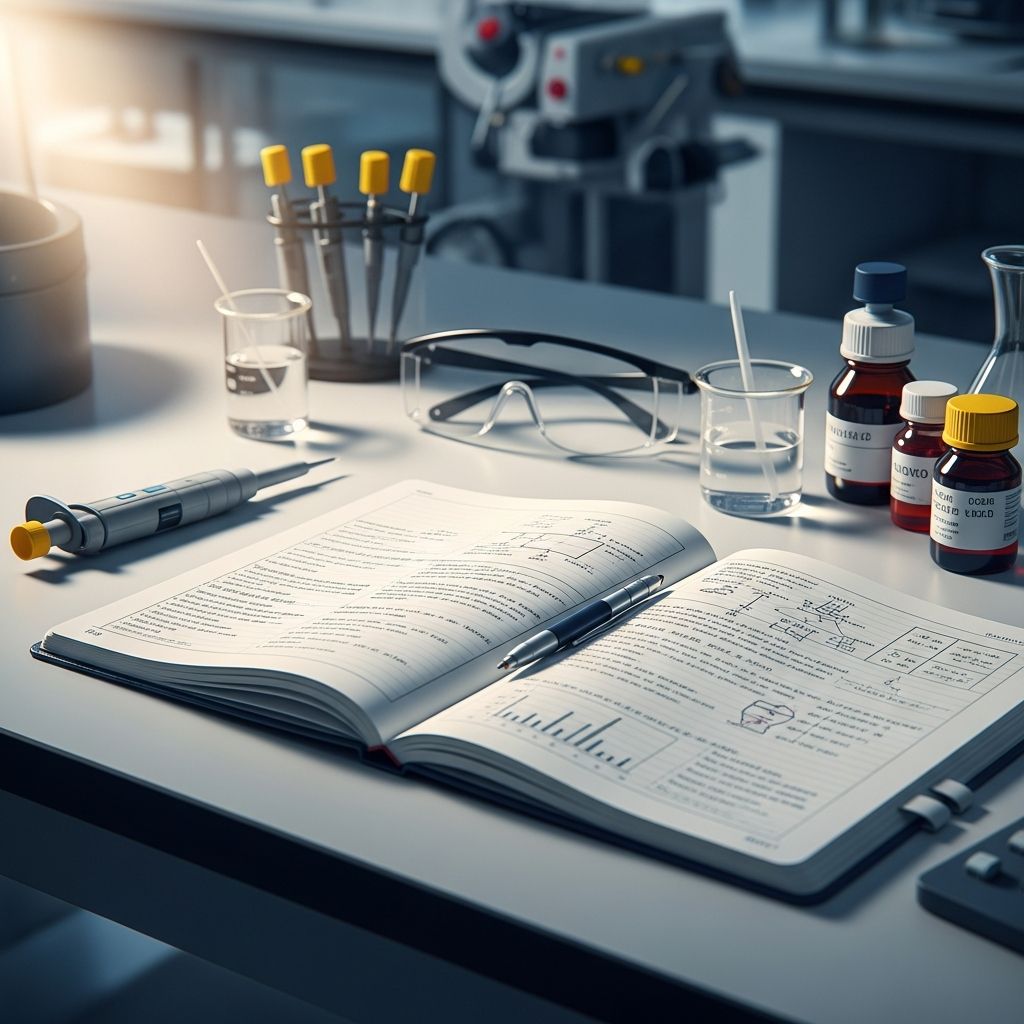
Lab notebooks serve as the foundational record of scientific inquiry, capturing every detail of experiments to support reproducibility, intellectual property protection, and collaborative efforts. Proper maintenance transforms them from mere logs into powerful tools for advancing knowledge.
Selecting the Ideal Lab Notebook
Choosing the right notebook is the first step toward effective documentation. Opt for hard-bound volumes with stitched pages and pre-numbered sections to prevent tampering and ensure durability. These features make it evident if pages have been removed, upholding data integrity.
Paper options remain popular for their tactile reliability, but electronic lab notebooks (ELNs) offer searchable databases and automated backups. Hybrid approaches combine both, using paper for quick sketches and digital for structured data.
- Paper notebooks: Durable covers, acid-free paper, waterproof if possible.
- ELNs: Cloud-synced, version-controlled platforms compliant with institutional policies.
- Hybrid: Scan paper pages into apps like Genius Scan for digital archiving.
Initial Setup and Organization
Begin by dedicating the first two pages to a dynamic table of contents, listing experiment titles and starting page numbers. Update it religiously to facilitate quick navigation, even years later.
Label the cover with your name, project title, lab address, and principal investigator’s details. This ownership information clarifies accountability and aids in retrieval.
| Element | Purpose | Example |
|---|---|---|
| Cover Label | Ownership ID | “John Doe, Protein Folding Project, PI: Dr. Smith, Lab Address” |
| Table of Contents | Navigation | “Exp 1: pH Test – p.5; Exp 2: PCR Run – p.12” |
| Page Headers | Chronology | “2026/04/05 – Location: Bench A” |
Daily Entry Protocols
Record entries in indelible ink—black or blue ballpoint pens are ideal—to withstand scrutiny. Always include the full date in YYYY/MM/DD format, time, location, and collaborators’ names for complete context.
Write in present tense for procedural clarity: “Add 5mL reagent X to solution Y.” Describe objectives, materials, step-by-step methods, observations, data, and preliminary analysis. Note anomalies like equipment failures or interruptions immediately.
- Date and timestamp every session.
- Detail rationale: Why this protocol?
- Quantify precisely: “37°C for 30 min” not “hot for a bit.”
- Sketch diagrams legibly, labeling axes and scales.
Handling Errors and Corrections
Mistakes are inevitable; handle them transparently to maintain credibility. Draw a single thin line through errors, initial beside it, and add the correction nearby with date and justification. Never obliterate, erase, or use correction fluid.
For taped additions like printouts or photos, sign and date across the tape seam. Cross out unused page space to prevent insertions.
In ELNs, leverage audit trails for tracked changes, eliminating manual strikethroughs while preserving history.
Preserving Data Integrity and Security
Treat the notebook as a legal document. Never remove pages, as gaps raise suspicions of data manipulation. Store “in progress” books at the bench in fireproof cabinets; archive completed ones centrally for 5+ years post-project, or patent life +6 years.
Ownership resides with the institution or PI upon departure—hand over promptly. Witness key findings with a colleague’s signature and date, establishing invention priority.
Integrating Digital Tools and Backups
Supplement paper with digital protocols stored in shared folders, raw data on servers, and analyses on GitHub for code. Filename with dates and descriptors: “2026-04-05_pH-assay_rawdata.xlsx.”
Daily backups via smartphone photos to cloud storage or auto-WiFi cameras prevent loss. Apps like Evernote organize tagged entries with snapshots and reflections.
- Cross-reference: Notebook p.10 links to “file://2026-04-05_exp1.”
- To-do lists track progress weekly.
- Maintain separate binders for gels, spectra, or contracts.
Advanced Organizational Strategies
Devote sections for sample inventories: tables listing locations, labels, and notebook references. “Seed Vial A1: Stored Freezer -20°C, see p.45 for protocol.”
For multi-day experiments, continue on new pages but reference prior entries. Use color-coding sparingly for categories like “data” (blue) vs. “analysis” (red), ensuring legibility.
PI oversight: Review entries periodically, especially in ELNs where access is controlled.
Common Pitfalls and How to Avoid Them
Avoid vague shorthand only you understand; prioritize clarity for peers or future self. Don’t backlog entries—record in real-time to capture nuances.
| Pitfall | Consequence | Solution |
|---|---|---|
| Skipping dates | Timeline confusion | Header every page |
| Illegible script | Reproducibility fail | Practice neat penmanship |
| No backups | Data loss | Daily cloud photos |
| Personal scraps | Incomplete record | All in notebook |
Legal and Ethical Dimensions
Notebooks substantiate patents, with witness dates proving priority. Federal labs like NIH deem them records owned by the institution, mandating ELN compliance.
Ethical record-keeping fosters trust; fabricated or hidden data undermines science. Always ask: Can another replicate from this alone?
Frequently Asked Questions (FAQs)
Q: Must I use a bound notebook?
A: Yes, for legal defensibility; loose pages invite tampering accusations. ELNs with similar safeguards are alternatives.
Q: How long to keep notebooks?
A: At least 5 years post-study; longer for patents (life +6 years). Consult PI or policy.
Q: Can I use pencil?
A: No—erasable and unreliable. Ink only.
Q: Who owns my notebook?
A: Typically the lab/PI/institution, especially post-employment.
Q: Best backup method?
A: Daily photos to cloud, plus server storage for digital files.
Building Habits for Lifelong Excellence
Consistent practices yield notebooks that propel careers. Review weekly, seek feedback, and evolve with technology. Ultimately, a stellar notebook mirrors rigorous science: transparent, thorough, and timeless.
References
- Maintaining a laboratory notebook — Colin Purrington. 2019-01-11. https://colinpurrington.com/tips/lab-notebooks/
- How to keep a lab notebook — Science | AAAS. 2016-12-15. https://www.science.org/content/article/how-keep-lab-notebook
- MAINTAINING A LAB NOTEBOOK — Stanford University. Undated PDF. https://web.stanford.edu/class/chem184/manual/LabNotebook.pdf
- RCR – Lab Management | Laboratory Notebooks — HHS Office of Research Integrity. Undated. https://ori.hhs.gov/education/products/wsu/data_lab.html
- Mini Series Part 1 – Keeping a Laboratory Notebook — YouTube (Educational). Undated. https://www.youtube.com/watch?v=-MAIuaOL64I
- Good Laboratory Notebook Practices — Columbia University ReaDI Program. Undated PDF. https://research.columbia.edu/sites/default/files/content/RCT%20content/ReaDI%20Program/tutorial_LabNotebook_V9.pdf
- Keeping a Lab Notebook — Rutgers Biotechnology Training Program. Undated PDF. https://biotechnology.rutgers.edu/sites/default/files/uploads/RESOURCES%20PAGE-Lab%20Notebook%20Presentation.pdf
- Best Practices Keeping ELN-PI — NIH Office of Intramural Research. 2024-07-01. https://oir.nih.gov/system/files/media/file/2024-07/best_practices-keeping_eln-pi_0.pdf

Medha Deb is an editor with a master's degree in Applied Linguistics from the University of Hyderabad. She believes that her qualification has helped her develop a deep understanding of language and its application in various contexts. Medha specializes in the areas of beauty, health, sports, and wellness and is committed to ensuring that the content on the website is…