
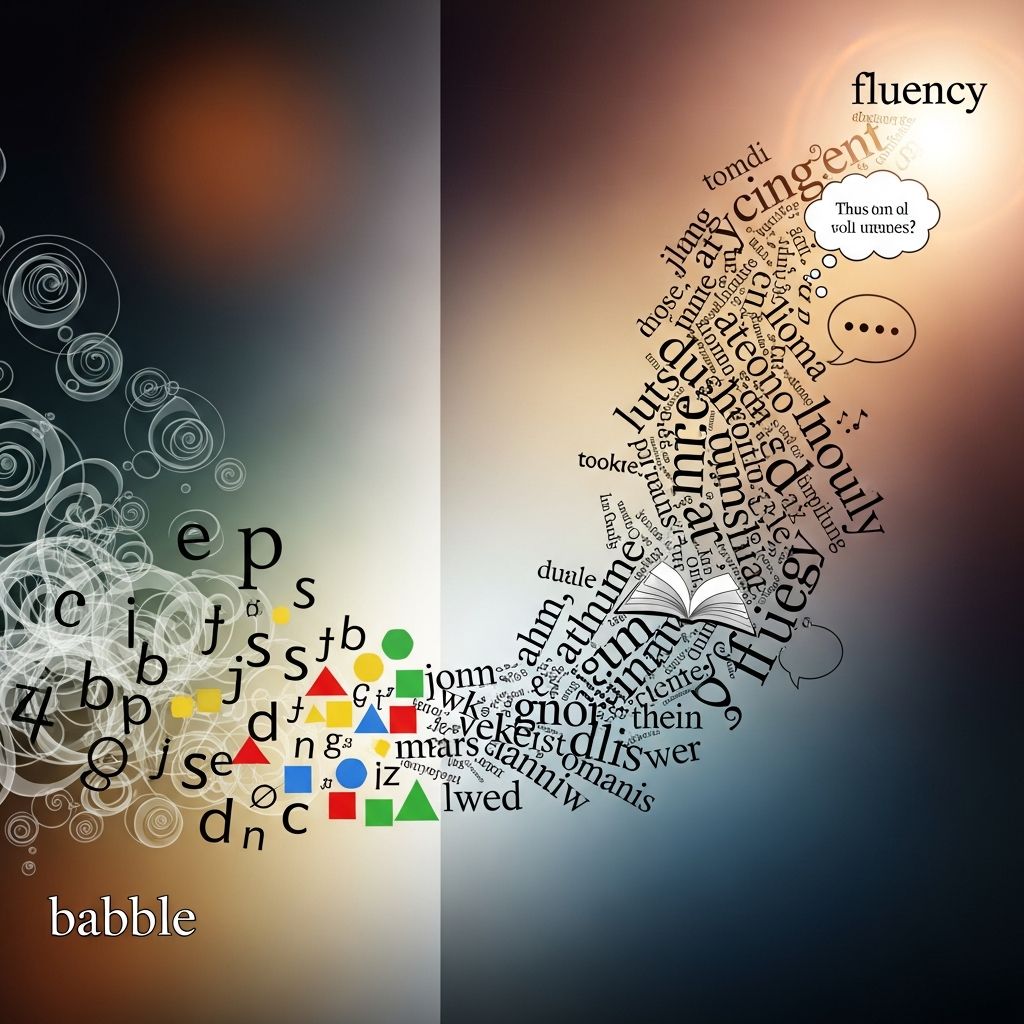
Language acquisition represents one of the most remarkable feats of human development, enabling individuals to comprehend and produce complex communication systems from infancy. This process unfolds through predictable stages influenced by biology, environment, and experience, differing slightly between first-language learners and those acquiring additional tongues.
The Foundations of Human Language Development
At its core, language acquisition involves perceiving sounds, grasping meanings, and generating speech. Infants enter the world equipped with an innate capacity to distinguish phonemes across all languages, a universal trait observed regardless of cultural background. This biological predisposition, often termed the language acquisition device, allows babies to filter and adapt to their native tongue’s specific sounds within the first year.
Early vocalizations mark the beginning: newborns cry to signal needs, already demonstrating sensitivity to their mother’s voice prenatally. By two months, cooing emerges, expanding into babbling around six months where rhythmic syllable repetitions like ‘ba-ba’ appear. This prelinguistic phase builds auditory processing skills essential for later speech.
Key Milestones in First Language Acquisition
First language acquisition, or L1, follows a consistent trajectory worldwide. Children progress from reflexive sounds to meaningful utterances in a stepwise manner.
- Prelinguistic Stage (0-12 months): Dominated by crying, cooing, and babbling. Infants narrow their phonemic repertoire to match ambient language, achieving echolalia—speech-like repetitions—near the first birthday.
- Holophrastic Stage (12-18 months): Single words convey whole ideas, such as ‘milk’ meaning ‘I want milk.’ Vocabulary explodes from 50 words by 18 months.
- Two-Word Stage (18-24 months): Combinations like ‘more juice’ emerge, signaling grammatical awareness.
- Telegraphic Speech (24-30 months): Short phrases omit function words, e.g., ‘doggie run fast.’
- Multiword Stage (30+ months): Full sentences form with improving grammar, reaching basic fluency by age 4-5.
These stages underscore speech perception preceding production, with children building abstract rules from input. Environmental factors like caregiver interaction accelerate progress, as responsive dialogue provides rich, comprehensible input.
Navigating Second Language Acquisition
Second language acquisition (L2) builds on L1 foundations, assuming prior linguistic competence. Learners traverse six distinct phases, each demanding tailored support.
| Stage | Duration | Characteristics | Strategies |
|---|---|---|---|
| Pre-production (Silent Period) | 0-6 months | Listening focus; minimal output; relies on gestures/visuals | Total Physical Response (TPR); visuals; patience |
| Early Production | 3-6 months | Short phrases; high error rate; 1000+ receptive words | Simple questions; repetition; bilingual pairing |
| Speech Emergent | 6-12 months | Longer sentences; context-dependent; growing vocabulary | Interactive dialogues; embrace errors |
| Beginning Fluency | 1-3 years | Social fluency; academic struggles; fewer errors | Expand vocabulary; scaffold new contexts |
| Intermediate Fluency | 3-5 years | Near-fluent; handles opinions/analysis; minor gaps | Complex tasks; peer discussions |
| Advanced Fluency | 5-7+ years | Full proficiency; accent may persist; navigates novelty | Authentic immersion; refinement |
Timeline varies: strong L1 literacy shortens to 5-7 years; weaker foundations extend to 10 years. Researchers like Cummins emphasize L1 proficiency as a predictor of L2 success.
Influential Theories Shaping Our Understanding
Several frameworks explain acquisition mechanisms. Noam Chomsky’s nativist theory posits an innate universal grammar, enabling rule extraction from limited data. In contrast, behaviorist views stress imitation and reinforcement, though critiqued for ignoring creativity.
Connectionist models highlight neural network pattern recognition through exposure, aligning with input-based approaches. Krashen’s Input Hypothesis advocates comprehensible input slightly beyond current level (i+1), prioritizing acquisition over learning. Usage-based theories, meanwhile, view language as emerging from frequency effects in usage.
Empirical evidence supports a hybrid: biology provides the blueprint, environment supplies the data.
Factors Influencing Acquisition Speed and Success
Multiple variables modulate pace. Age matters: critical periods (birth-12 for phonology, puberty for syntax) favor early exposure, though adults leverage cognition for faster initial gains.
Motivation, aptitude, and first language similarity accelerate progress. Immersion environments outperform classrooms, as constant input fosters natural uptake. Strong L1 skills transfer metalinguistic awareness, aiding L2 grammar.
Socioeconomic factors, like access to quality input, impact outcomes; deprived children lag in vocabulary by school entry.
Practical Strategies for Learners and Educators
Effective support aligns with stages. For pre-production, employ TPR: commands like ‘stand up’ paired with actions build confidence without pressure. Visual aids, gestures, and repetition aid comprehension.
Early production benefits from yes/no questions and labeled images, celebrating approximations. Emergent speakers thrive on dialogues embracing code-switching, leveraging L1 for clarification.
Fluency stages demand expanded input: stories, songs, and discussions. Digital tools like LingQ’s mini-stories provide repetitive, comprehensible content for passive absorption.
Parents foster L1 via read-alouds and responsive talk; educators differentiate for English learners (ELLs) using scaffolds like sentence frames.
Challenges and Common Misconceptions
Silent periods alarm teachers mistaking absorption for disengagement—patience is key. Fossilization, where errors persist, arises from insufficient input or negative feedback.
Myth: Adults can’t achieve native-like fluency. Reality: accents may linger, but proficiency is attainable. Another: Translation aids hinder—bilingual strategies actually enhance transfer.
Frequently Asked Questions (FAQs)
What is the difference between first and second language acquisition?
First language acquisition occurs naturally in infancy without instruction, while second builds on existing knowledge, often requiring conscious effort and taking 5-10 years for fluency.
How long does it take to become fluent in a second language?
Typically 5-7 years with strong L1 support; up to 10 years otherwise. Individual factors like exposure and motivation vary timelines.
Can adults learn languages as effectively as children?
Adults excel in grammar and vocabulary via analytical skills but struggle with accents due to critical periods. Immersion bridges gaps.
What role does the first language play in second language learning?
Proficiency in L1 facilitates L2 metalinguistic skills and literacy transfer, accelerating overall progress.
Is the silent period normal for language learners?
Yes, it’s a vital absorption phase lasting weeks to months, building receptive skills before production.
Future Directions in Language Acquisition Research
Neuroscience advances, via fMRI, reveal brain plasticity during acquisition, informing interventions. AI-driven apps simulate immersion, personalizing input. Bilingualism studies highlight cognitive benefits like enhanced executive function, promoting dual-language programs.
Global migration underscores L2 needs; evidence-based policies emphasize maintenance of heritage languages for optimal outcomes.
References
- Language Acquisition: An Overview — Colorín Colorado. Accessed 2026. https://www.colorincolorado.org/article/language-acquisition-overview
- The 6 Second Language Acquisition Stages — Ensemble Learning. Accessed 2026. https://ensemblelearning.org/second-language-acquisition-stages/
- Language Acquisition Theory In Psychology — Simply Psychology. Accessed 2026. https://www.simplypsychology.org/language.html
- 3 Stages of Language Acquisition: How Long It Takes + Tips — The Linguist Blog. Accessed 2026. https://blog.thelinguist.com/language-acquisition-time-frame/
- Language Acquisition — Wikipedia (informed primary sources). Accessed 2026. https://en.wikipedia.org/wiki/Language_acquisition
- Language Acquisition — University of Georgia Linguistics. Accessed 2026. https://www.linguistics.uga.edu/research/content/language-acquisition

- Integrated M.A. in Applied Linguistics, University of Hyderabad
- 5+ years in editorial, instructional, SEO, and research-based writing
Sneha is a relationships and lifestyle writer with a strong foundation in applied linguistics and certified training in relationship coaching. She brings over five years of writing experience to theskillvault, crafting thoughtful, research-driven content that empowers readers to build healthier relationships, boost emotional well-being, and embrace holistic living. Her writing and insights reflect the belief that beauty, happiness, and wellness…